Tuesday, April 7th 2026
Limited Capacity and Order Shifts Drive March Consumer DRAM Price Surge, Led by Sub-4Gb Products
Major suppliers are continuing to phase out production of mature products below DDR4, according to TrendForce's latest research on the memory industry. As supply tightens structurally, DRAM prices have already posted significant cumulative increases in recent months.
TrendForce forecasts that consumer DRAM contract prices will continue to rise by 45-50% QoQ in 2Q26 after taking into account ongoing supply reductions, order transfers, and the slower pace of capacity expansion among Taiwanese suppliers.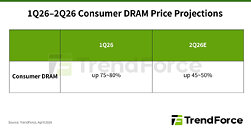 TrendForce reports that in March 2026, the pricing trends in the consumer DRAM sector were mainly driven by products with densities under 4 Gb. For instance, the average prices for DDR4 4 Gb increased by over 20% MoM, far outpacing price increases seen in higher-density products. This followed an earlier price jump in DDR4 and a 2025 announcement from major suppliers that some legacy-node products would be reaching end-of-life (EOL).
Taiwanese manufacturers shifted capacity toward DDR4 to capture the first wave of spillover demand. However, demand is now also shifting into DDR3 and DDR2 markets. With capacity constraints limiting supply, average prices across DDR3 and DDR2 products increased by 20-40% in March, marking an even sharper rise.
Looking ahead to the second quarter, Taiwanese suppliers raised quotations in March, with some prices already reflecting expected second-quarter increases. Furthermore, they've adopted a more assertive pricing stance amid constrained capacity and intensifying order migration.
Consequently, transaction price gaps across different customers are expected to narrow significantly in the coming quarter. In contrast, South Korean suppliers already command relatively higher ASPs in the consumer DRAM segment, and are therefore expected to implement more moderate price adjustments in the near term.
Source:
TrendForce
TrendForce forecasts that consumer DRAM contract prices will continue to rise by 45-50% QoQ in 2Q26 after taking into account ongoing supply reductions, order transfers, and the slower pace of capacity expansion among Taiwanese suppliers.

Taiwanese manufacturers shifted capacity toward DDR4 to capture the first wave of spillover demand. However, demand is now also shifting into DDR3 and DDR2 markets. With capacity constraints limiting supply, average prices across DDR3 and DDR2 products increased by 20-40% in March, marking an even sharper rise.
Looking ahead to the second quarter, Taiwanese suppliers raised quotations in March, with some prices already reflecting expected second-quarter increases. Furthermore, they've adopted a more assertive pricing stance amid constrained capacity and intensifying order migration.
Consequently, transaction price gaps across different customers are expected to narrow significantly in the coming quarter. In contrast, South Korean suppliers already command relatively higher ASPs in the consumer DRAM segment, and are therefore expected to implement more moderate price adjustments in the near term.
14 Comments on Limited Capacity and Order Shifts Drive March Consumer DRAM Price Surge, Led by Sub-4Gb Products
OpenAI wasn't buying the RAM themselves. The RAM would have gone into Oracle, Microsoft, Amazon, etc datacenters for OpenAI to use. Those companies are still building those datacenters, believing that they'll be used by someone.
Company 2024 (Pre-Stargate) 2025 (Projected/Actual) 2026 (Committed Guidance)
Amazon $83.0B $131.8B $200.0B
Alphabet (Google) $52.5B $91.4B $175.0B – $185.0B
Microsoft $44.5B $80.0B $120.0B – $148.0B
Meta $37.3B $72.0B $115.0B – $135.0B
Oracle ~$28B $35B+ $50.0B
Company 2024 to 2025 Growth (%) 2025 to 2026 Growth (%) Trend
Amazon ~58% ~51% Slowing
Alphabet ~74% ~95% Accelerating
Microsoft ~80% ~65% Slowing
Meta ~93% ~73% Slowing
The overall amount being spent is greater but the rate of increase is lower.
Moreover, a historical 400-500% increase that happens over a very short period of time would have to be the result of sudden unexpected demand. How exactly do you justify that when spend growth is actually slowing? There was no sudden demand, in fact demand grew slower than in prior years. Of which memory manufacturers had a whole 3 years to plan for.
This is the issue I have with this argument, if it were the increasing total spend (irregardless of actual spend growth %), the price increase would have happened slowly over time as these companies ink agreements. Not all at once.
The rapid price increase was specifically triggered by OpenAI's 40% global ram "purchase". If it had been triggered by other companies, the increase would have been more gradual and each increase would coincide with a deal being inked.
And here's another question, why did OpenAI and memory manufacturers hide the fact that the RAM wasn't in fact purchased. Not disclosing something like this shouldn't be legal.
The price rise was triggered by OpenAI's announcement that they would buy all the ram now and in the future, and by several market actors who amplified his message. The other trigger was the act of usa.gov.com buying an outsized share of INTC. The message was immediately understood by the entire semiconductor industry: you have free rein, don't let laws distract you, just bring in money, money, and more money, however you can!
X-ai is dumping 30 billion in the fire up from 8 or something
Nebius (yandex refugees) 20 billion
Byte dance 15 billion
tencent 5 billion
Core weave 9 billion
Lambda 2 billion
G42 a UAE financial construction billions (might change given recent "events", like a lot of things will probably change if that keeps going)
A heck of a lot of billions are still flowing in to datacentre hardware, even if it isn't Swinder Altman's imaginary hundreds of billion
The price increases also come from these datacenter companies increasingly opting for long-term contracts instead of short-term contracts (and I'm talking about real contracts, not Letters of Intent like OpenAI did). Prices are lower if future production is not yet sold, because then consumers (in the broad sense, not individual consumers) always have the option to wait if there's a short-term supply crunch that raises prices.
DRAM manufacturer's are also hesitant to start building even more capacity right now, because they're uncertain whether this AI bubble will last another 5 years (which is a perfectly reasonable concern). If they start building more plants, that's potentially $100s of billions in wasteful capex. This has happened many times before (most recently post-COVID), and a company can go bankrupt if they misjudge the market.What are you talking about? It was never hidden. You can read the first article to report on it here: www.reuters.com/business/media-telecom/samsung-sk-hynix-supply-memory-chips-openais-stargate-project-2025-10-01/
It explicitly says it's a letter of intent. Then retarded social media users and other journalists took some clickbait soundbite as gospel and repeated the lies over and over again.
If you never bothered to do a modicum of research yourself, that's entirely your fault for being uninformed.
They should immediately refund the money they got plus interest and a penalty for violating their agreement.
And what "agreement" did they violate, exactly? Please specify the exact language of any agreement with the government and/or provision of the CHIPS act, and how "they" (whoever "they" are) have violated it?