Wednesday, April 8th 2026

SK hynix Begins Shipping 321-Layer QLC NAND cSSDs, Dell First Customer
SK hynix has started shipping its PQC21 cSSD, the first product built on its 321-layer QLC NAND flash technology. The product is available in 1 TB and 2 TB capacities, with Dell as the first customer starting this month. QLC (Quad-Level Cell) stores four bits per cell, which maximizes storage density per unit area but has historically come with a write performance penalty compared to TLC (Triple-Level Cell). SK hynix addresses that with SLC caching, frequently accessed data is written to faster SLC-mode regions first before being transferred to the QLC cells, smoothing out the performance gap for typical workloads.
According to market research from IDC (International Data Corporation), the QLC NAND is expected to go from 22% of the global cSSD market in 2025 to 61% by 2027, so the timing of this launch makes sense. SK hynix says it will expand beyond Dell to other major customers as production scales up.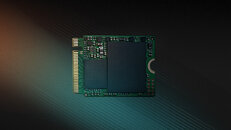
 On the broader NAND market, Samsung is still on top with $6.6 billion in revenue, up 10% QoQ, though its share slipped to 28% as bit shipments dropped during a process transition. SK Group (SK hynix and Solidigm combined) had the strongest quarter of the top five, with revenue up 47.8% QoQ to around $5.21 billion and market share climbing to 22.1%, driven by mobile NAND and enterprise SSD demand.
Source:
SK hynix
According to market research from IDC (International Data Corporation), the QLC NAND is expected to go from 22% of the global cSSD market in 2025 to 61% by 2027, so the timing of this launch makes sense. SK hynix says it will expand beyond Dell to other major customers as production scales up.


22 Comments on SK hynix Begins Shipping 321-Layer QLC NAND cSSDs, Dell First Customer
Still, 321 layers is impressive. Now let's see a TLC version.
What's the raw QLC write rate and how many TBW for a 1TB drive, for example?
I'm sure it's enough to last the warranty period for a thin-and-light that primarily runs webapps on Windows, but nobody wants to buy the absolute bare minumum of quality or performance.
WD4Me4Eva, hahaha :D
Please.
Chop chop, get that order in before we run out of allocation from TSMC for our SSD controllers!
then I wonder how much work the controller is doing for error correcting, it gets way more complex with the higher and higher density they are hitting
"Density is as density does" - Forest, Forest Gump (well, sorta :))
At some point in the near future, surely they will reach a point of diminishing/no returns on the layers & their densities, yes ?
My SA510's have been like this, they fast when freshly written but can get very slow even after only a month.
Problem is benchmark tools just read back freshly written data, so its not a problem easily exposed.
long time endurance does not matter for certain companies like hp or dell. the device shall be defective or slow or malfunctioning in year 3 or 4 or 5.
Dell should solder those storage and dram to the motherboard to improve short and long term profit
I bought Super TalentUltradrive ME 64GB SSD back in 2009 for 160 EUR, and for a decade I could double the capacity every two years for the same amount. Until 2020, when M.2 format arrived, and then we hit a brick wall, and half a decade later we're actually going backwards. QLC RAMless drives that top at 2 TB?
The following paper should be enough to give an idea of one of a myriad of solutions in the enterprise space. :toast:
ieeexplore.ieee.org/document/6378623yeah keep a QLC dramless SSD far away from me. :laugh:
Outside of the consumer market, the QLC enterprise drives I've seen actually have decent sustained write performance. Not as good as TLC drives, but nowhere near the sheer garbage of consumer QLC SSDs. I personally would be more than willing to go with QLC enterprise drives for a cost and/or capacity advantage.Jokes aside, $4000 would be pretty good for a 32 TB M.2 SSD, I'd probably pick up 4 or so, allowing me to relegate all hard drives to cold storage / backup duty. If I remember correctly, there were even 30.72 TB QLC U.3 enterprise SSDs available for around $3000 before the storage apocalypse.
heck, SK Hynix seems to be heading toward PLC NAND
then after that, perhaps HLC (hexa-level cell), or maybe a new storage type will be made
With pretty much nearing analog 16 charge/voltage levels for cell QLC isn't going to be good in that.
Pretty sure manufacturers know retention behaviour, but it's even more sure those numbers are under lock and key.Gotta get back to floppy drive's writing speeds and DRAM's data retention...
the argument ssds do not die because of flash based is therefore most likely gone.
If you're talking about a 200TB all-flash storage server then maybe it's coming soon but the problem with those $100K+ appliances is that they need to five-nines, enterprise-grade, mission-critical reliability with automatic drive replacement under warranty within a 4-hour window. Even QLC is risky for that (I currently have one all-flash Pure Storage array based on QLC drives and so far it's been good, but it's also only a couple of years old Time will tell and all those Intel 660p QLC drives have not fared well as storage array members. They spawned a 5 year period of me avoiding QLC like the bubonic plague!)
I am pretty sure the 4TB SA510 is QLC. :laugh: Opened one of them up and posted pics on here, there is a mysterious big Q engraved on the nand chips. :laugh: Could have got a red or 870 EVO for less than 20% more, obviously not now though, really annoyed with myself.