Thursday, April 9th 2026

ASUS Introduces ROG Equalizer 12V-2x6 Cable for GPU Power Stability
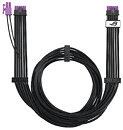
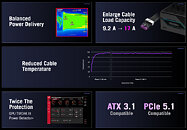
ASUS has introduced the ROG Equalizer, a new 12V-2×6 PCIe power cable designed to improve power delivery stability for modern GPUs. The cable is compliant with ATX 3.1 and PCIe 5.1 standards and will be bundled with the company's upcoming ROG Thor III and ROG Strix Platinum power supplies. The ROG Equalizer targets ongoing reliability issues around 16-pin GPU power connectors by focusing on load balancing across all pins. According to ASUS, the cable is designed to distribute power more evenly across all the wires, this reducing the risk of hotspots caused by uneven load. The cable supports up to 17 A per wire, compared to standard 12V-2x6 cables, which are rated at 9.2 A per wire (per pin).
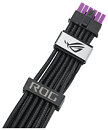
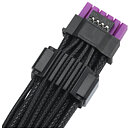
ASUS also claims the design keeps operating temperatures around 73°C even when some wires aren't under full load, a situation where standard cables can run noticeably hotter due to uneven current distribution across the conductors. The exact internal engineering hasn't been provided by ASUS, but the likely approach is equalizing the impedance across all conductors (wires) to spread the load more evenly. The cable itself is 750 mm long, braided in a dual-tone finish, and ships with cable combs for tidier routing. It follows a GPU-first wiring layout and is built with high-power delivery in mind. No information regarding pricing yet.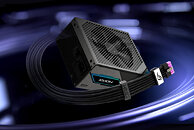
Source:
ASUS
ASUS also claims the design keeps operating temperatures around 73°C even when some wires aren't under full load, a situation where standard cables can run noticeably hotter due to uneven current distribution across the conductors. The exact internal engineering hasn't been provided by ASUS, but the likely approach is equalizing the impedance across all conductors (wires) to spread the load more evenly. The cable itself is 750 mm long, braided in a dual-tone finish, and ships with cable combs for tidier routing. It follows a GPU-first wiring layout and is built with high-power delivery in mind. No information regarding pricing yet.


84 Comments on ASUS Introduces ROG Equalizer 12V-2x6 Cable for GPU Power Stability
Neither the safety-oriented cable (Corsair ThermalProtect) or the overengineered ones (ROG Equalizer, Segotep Titanload) are curatives for the problem. They're not solutions, merely paliative care, and should be used with the same concerns in mind. ThermalProtect actually seems to be the wisest choice at this point in time, owed to its low cost (it's $25), good availability and simple design, it's a standard-grade (9.2 A spec), 3-dimple cable with an inline thermistor that will shut down when it reaches 65 ºC, this places the actual wire temperature somewhere in the 90's, a little before it hits melting range anywhere.
I plan on placing an order for a ROG Equalizer in a couple of weeks, if they're still available by then. It'll cost me $85 due to taxes, but I'll buy one. I would also be willing to try Segotep's Titanload cable, which makes slightly less lofty claims than the ROG Equalizer (15 A per wire, no busbar) but it is not available for purchase anywhere, be it Amazon or AliExpress.
All in all, the closest we'd have to an ideal solution would be a cable that unites the Titanload's robust cables, Equalizer's busbar and 4-spring gauges plus the ThermalProtect's inline thermistor. Maybe even a deluxe model with a built-in WireView/Ampinel-type power meter. I'd happily spend $150 on one.
At the end of the day, Igor Wallossek made the final verdict and I agree with him... if this cable requires the precision of a watchmaker in a clean room to simply plug it in, it's just garbage. It was nice being oblivious during the year I used my card before it finally happened to me.
Those psu i tested, not atx3 as of now, briding one pin on teh 20 or 24 pin atx connector wakes the psu up and put it in working mode. that is usually done by the motherboard.
with in "spec" cables it does not matter if you pull only 600 watts via the gpu connector and have only 150Watts + a bit overload value left for the remaining hardware. are 150 Watts enough for usb and motherboard, hmm. I would say no.
_roman_ has a usb keyboard, usb mouse, usb audio interface, several fans which generate passive load always without even considering the motherboard with cpu, dram and storage
I am well aware of, some really argue, 550Watts or 650Watts were enough for certain hardware configurations. They always argued against spending 20 € more for the next bigger power supply unit in the 80 watt gold plus class.
-- we all know igor measured in his word an intel cpu, in my words reading his article, a intel motherboard with DRAM and intel cpu with 450 Watts. That is the root cause why 1050W psu should be used for a 600 Watt 12V high power gpu which is rated or intended to use for 600 Watts. + usb hid (human input devices) + storage + fans + rgb (forgot about that fps booster) // usb 4?? than you will need even more power
-- anyway you also came to the same conclusion what kirchoff law states. jay just has shown the wires are better of that cable. If these connectors are really better, who knows?
-- the common connector everyone wants, I do not, USB-C. They could already start using USB-C inside the computer also, there is no reason for anything else for some older connectors
Apparently ASUS should have placed the bridge close to the PSU, by equalizing close to the source and leaving the cable portion up to the GPU longer the current imbalance (because of resistances) would have been decreased.
For all we know the connector might achieve a better pin mating but it's completely masked/cancelled by the added resistances because of the short segment up to the bridge.
So in the end it's a failed design, perhaps ASUS should try a version with the bridge at the PSU side maybe that one will work better.
Actually it would be better in another regard that is not adding extra weight close to the GPU connection which amplifies sag and therefore potential current imbalance by acting as a lever on the GPU connector.
ASUS taking advantage of consumers -> nothing new under the sun.No need to invent something else.
www.igorslab.de/en/nvidias-connector-story-eps-vs-12vhpwr-connector-unfortunately-good-doesnt-always-win-but-evil-does-more-and-more-often-background-information/
2x 8 pin EPS is the solution. 6+2 pin PCIe is obsolete, same format but lower power capability.
Igor wins, all the other fellas are trying so sell some shit. Case closed. Lobby for 8 pin EPS people, vote politicians that push for that. Oh yeah and Huang sent back to Taiwan.That PCB is great for other reasons than 3x 8 pin.
It's long meaning no huge flow through cutout at the back so that RAM gets cooked. Also being long and with connectors at the end they are as far from the back of the case as possible which aids with cable management.
The PCB isn't tall meaning there is enough room up to the sidepanel to adequately bend the cable.
It also has fuses which is rarity nowadays. Load balancing isn't even necessary.Current balancing apparently isn't that easy to implement according to Aris.
hwbusters.com/news/the-solution-to-the-melting-cable-connectors-issue/
The whole load balancing is another wild goose chase, it's meant to solve a previously created problem by overcomplicating things and making the product more expensive.No man you're going down the rabbithole like they want you to. You're even willing to spend more money, as long as the Kool-Aid tastes great. Meanwhile the fix is right there and they won't use it. Because they can't charge you extra for it.
2x 8 pin EPS, it's that simple.
Proven design, no load balancing needed, large safety margins, no bullshit 105°C insulation that doesn't actually do anything, low thermal density, sturdy connection on both ends, large contacts that simply work, and cheaper to manufacture.
Well yeah but we're not stuck with them for life.
The problem is that people aren't united. I mean they cheered for that mofo when he showed up at Computex. These enablers are just as big of an enemy as he is.
Any cable that can't actively handle (control) current distribution among wires is money thrown out of window.
But the real issue is the connector design is pure essence of shitness in it's finest (for users).
For companies that like to sell snake oil, this connector is a golden-eggs-laying-duck lol.
The 12V-2x6 Connector is a prime example of what "Enshittification" really is.
You take a solid (but of course not perfect) 8 Pin Connector, and create a much worse Version of it that cant handle what you says it can handle. You then reject the Warranty of your Cards that you put the Connector on, knowing that the Connector will most likely melt, burn or destroy the card.
DONE!
Now we have an entire industry that is based on an "Enshittified" Connector, trying unsuccessfully to fix it somehow.
BTW the only device that can do what you're suggesting is the Ampinel, with limited success