Monday, April 27th 2026

Intel "Wildcat Lake" Outruns Apple's MacBook Neo and Its Successor in First Benchmarks

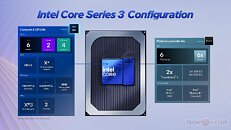
Intel recently unveiled its "Wildcat Lake" Core 300 series of laptop processors, designed for the entry-level market with excellent CPU and GPU capabilities to meet basic needs. By combining two "Cougar Cove" P-cores with four LPE "Darkmont" cores, these processors should provide sufficient CPU power for basic tasks in the entry-level segment. Especially when paired with the NPU 5, Xe display and media engine, and a GPU featuring up to two Xe3 cores, this SoC should handle tasks with ease, including some very light entry-level gaming. Today, the first benchmarks appeared, showcasing what this CPU is capable of and how it compares to industry-leading solutions in this price range, such as Apple's newest MacBook Neo, thanks to the initial PassMark benchmark results.

In the latest benchmark, PassMark recorded the Intel Core 5 320 "Wildcat Lake" with two P-cores running at up to 4.6 GHz and LPE cores with a maximum turbo frequency of 3.4 GHz. This SoC scored about 4,047 points in the single-threaded rating and approximately 15,222 in the multithreaded rating in the PassMark evaluation benchmark. This places its rating just above Apple's first-generation M1 SoC in both single and multithreaded results. Additionally, the design surpasses Apple's A18 Pro SoC in the current MacBook Neo and the A19 Pro SoC that is expected to be included in the second-generation MacBook Neo design scheduled for 2027. Technically, both are based on different architectures, but they serve the same purpose: providing customers with an affordable SoC/laptop design that delivers solid computing power for all basic tasks.

Interestingly, Apple's MacBook Neo is a hit in the $599 category, projected to sell 10 million units and make Apple the third-biggest notebook vendor by unit sales. Intel and AMD solutions at similar price points have been less competitive, but Intel seems to have found a way to compete with Apple in this market segment with "Wildcat Lake," targeting a similar price point and performance to match. However, initial benchmarks show that the new Intel WCL platform is more than capable of outperforming Apple in terms of performance, so we are looking forward to seeing the price and more performance tests of the upcoming laptops based on the WCL platform. We noticed that Intel's reference design laptop also boasts a similar aluminium body and vibrant colors as the MacBook Neo, so this segment should become much more competitive.
Sources: PassMark, via X86 is dead&back on X
Add your own comment

15 Comments on Intel "Wildcat Lake" Outruns Apple's MacBook Neo and Its Successor in First Benchmarks

#1
Six_Times
Impressive. That means next Nova based cpu's will crush even more.
Posted on Reply
#2
atomek
* Plugged into the wall with the fans set to full speed.
Posted on Reply
#3
dir_d
Chips are so fast now these days, only thing that matters is if the price is right and if i can run the operating system i want on said chip. The Neo is so cheap i was looking at one for my kids even though i have 0 apple footprint. I'd rather stay on a windows/linux platform but as they say money talks.
Posted on Reply
#4
capdauntless
Maybe out-perform, sure. But do we expect the notebooks with that chip in it, if priced similarly to the Neo, to be packaged as nicely? I highly doubt that.
Posted on Reply
#5
Darmok N Jalad
atomek* Plugged into the wall with the fans set to full speed.
Yeah, I suspect there won’t even be passively-cooled Wildcat Lake options, but hopefully OEMs can do a decent job cooling it quietly. Still, just edging the aged M1 that debuted almost 6 years ago isn’t exactly a huge flex. The M1 could also run passively cooled.

Edit: Intel claims that WL can run in passively cooled systems, but TDP is limited to 11W. The PL1/PL2 on active systems is 17/35W, so I’d be really surprised if these initial numbers are for the passively cooled setup.
Posted on Reply
#6
aktpu
Darmok N JaladYeah, I suspect there won’t even be passively-cooled Wildcat Lake options, but hopefully OEMs can do a decent job cooling it quietly. Still, just edging the aged M1 that debuted almost 6 years ago isn’t exactly a huge flex. The M1 could also run passively cooled.
AleksandarKAdditionally, the design surpasses Apple's A18 Pro SoC in the current MacBook Neo and the A19 Pro SoC that is expected to be included in the second-generation MacBook Neo design scheduled for 2027
So it's faster than soc released less than a year ago. Both Air current and Neo throttle themselves if you actually do heavy workloads on them
Posted on Reply
#7
Darmok N Jalad
aktpuSo it's faster than soc released less than a year ago. Both Air current and Neo throttle themselves if you actually do heavy workloads on them
Yes, a SOC from a year ago that you could get in an iPhone. And will WL throttle in passive setups too? You bet. It likely does in active setups.
Posted on Reply
#8
kondamin
OK that is nice, but without power, clock and price point it's pretty useless information.
Posted on Reply
#9
jesdals
Well I do hope that the Intel Laptop had more than 8GB of memory - and if so - no so impressive to compare a computer with a foldeable phone
Posted on Reply
#10
AntiX3DGlazer
Certianly faster than ADL-N lol.
Darmok N JaladYeah, I suspect there won’t even be passively-cooled Wildcat Lake options, but hopefully OEMs can do a decent job cooling it quietly. Still, just edging the aged M1 that debuted almost 6 years ago isn’t exactly a huge flex. The M1 could also run passively cooled.

Edit: Intel claims that WL can run in passively cooled systems, but TDP is limited to 11W. The PL1/PL2 on active systems is 17/35W, so I’d be really surprised if these initial numbers are for the passively cooled setup.
If we assume similar (or the same) positioning as ADL-N, it'll be avalible in all kinds of configs (including thsoe that don't use fans.)
Posted on Reply
#11
cfenton
capdauntlessMaybe out-perform, sure. But do we expect the notebooks with that chip in it, if priced similarly to the Neo, to be packaged as nicely? I highly doubt that.
That is the problem for Intel. The Neo isn't a hit because it's a powerhouse. It's a hit because it's powerful enough, built well, and cheap. Intel doesn't make laptops and the OEMs will cut every corner to save a buck. I expect we'll mostly see these chips in plastic bodies with tiny batteries and bad screens. Hopefully at least one OEM will figure it out.
Posted on Reply
#12
SRB151
Isn't this a bit of a "tallest of the midgets" contest? A phone SOC against Intel's smallest?
Posted on Reply
#13
DavidC1
cfentonThat is the problem for Intel. The Neo isn't a hit because it's a powerhouse. It's a hit because it's powerful enough, built well, and cheap. Intel doesn't make laptops and the OEMs will cut every corner to save a buck. I expect we'll mostly see these chips in plastic bodies with tiny batteries and bad screens. Hopefully at least one OEM will figure it out.
You need to cut "every corner" to get to the price points some laptops are at brand-new and not lose money or heck make money as a business. You know, the #1 purpose of making a business? Laptops, especially budget laptops have thin margins. You don't sound like those that believe only way companies should operate is to be is non-profit.

Sure if you pay enough you'll get all the quality you want. But you can't expect all you want in a $300 one.
Posted on Reply
#14
Atomofvoid
I believe you got it a bit confused. The chip here is the A18 Pro, which is weaker than the A19 Pro and faster and more energy efficient than the M1. I hate saying "you're wrong" like this, but I think that you should come back to me with calculations with the A18 Pro.
Posted on Reply
#15
cfenton
DavidC1You need to cut "every corner" to get to the price points some laptops are at brand-new and not lose money or heck make money as a business. You know, the #1 purpose of making a business? Laptops, especially budget laptops have thin margins. You don't sound like those that believe only way companies should operate is to be is non-profit.

Sure if you pay enough you'll get all the quality you want. But you can't expect all you want in a $300 one.
No, not $300, but now I can get that quality for $500 or $600 with the Neo. My point is that having a CPU that beats the Neo doesn't matter much if everything else in the laptop is worse.
Posted on Reply
Add your own comment
Nov 17th, 2026 13:14 CST change timezone

New Forum Posts

Popular Reviews

TPU on YouTube

Controversial News Posts