Wednesday, April 29th 2026

Intel Stock Surges to All-Time High on Foundry Revival and Strong CPU Demand
Intel's stock is one of the best-performing semiconductor-related names in 2026, with the company's share price reaching a new all-time high of $94.10 per share at the time of writing. This is remarkable news, considering that about a year ago, Intel's stock hit a decade-low of $17.67 per share. This marks a growth of more than 400% in a single year for a company that is one of the most strategically important in the United States' sovereign semiconductor manufacturing. Intel's rise began with investment from the United States government, aimed at supporting the only company left in the U.S. conducting R&D and advanced silicon manufacturing. Since then, Intel has been on an upward trajectory, and the share price shows no signs of slowing down.
Contributing to this success is the revival of Intel's Foundry business, which is on track to attract many external customers. Intel Foundry recently achieved a significant milestone by improving yields across all major foundry nodes currently in high-volume manufacturing. This includes the Intel 4, Intel 3, and 18A nodes, which power the majority of Intel's product portfolio. In the latest Q1 2026 earnings call, Intel CFO David Zinsner noted that the company continues to improve yields on its older nodes, such as Intel 4 and Intel 3, while refining the yield of the current top-performing 18A node to reduce waste and increase the number of functional chips, even in larger dies. Additionally, Tesla signed on as Intel's first major 14A customer for Elon Musk's Terafab AI chip complex in Austin, indicating that the foundry's success in attracting external clients is just beginning.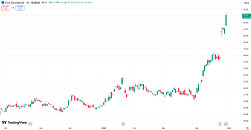 Finally, Intel's product execution is impressive, as the company is experiencing such high demand for its CPUs that it is selling silicon that would otherwise be discarded. For example, Intel is repurposing some of the dies found on the very edge of the silicon wafer, which would have otherwise become scrap, into products that customers are eager to buy. This strategy allows even some SKUs, which may have been flawed due to factors like silicon node yield, to find new life through repurposing.
Contributing to this success is the revival of Intel's Foundry business, which is on track to attract many external customers. Intel Foundry recently achieved a significant milestone by improving yields across all major foundry nodes currently in high-volume manufacturing. This includes the Intel 4, Intel 3, and 18A nodes, which power the majority of Intel's product portfolio. In the latest Q1 2026 earnings call, Intel CFO David Zinsner noted that the company continues to improve yields on its older nodes, such as Intel 4 and Intel 3, while refining the yield of the current top-performing 18A node to reduce waste and increase the number of functional chips, even in larger dies. Additionally, Tesla signed on as Intel's first major 14A customer for Elon Musk's Terafab AI chip complex in Austin, indicating that the foundry's success in attracting external clients is just beginning.

13 Comments on Intel Stock Surges to All-Time High on Foundry Revival and Strong CPU Demand
Look where stock price of WD and Seagate has gone the last year.
Hardware is like gold bars today.
I think a part of this is might be stockholders panicking over other stockholders' ideas. I briefly considered buying Intel stock (but didn't because that would've been speculative), but many people were calling for Intel to split up and then Gelsinger was ousted. I was worried Intel's board would break up the company before 18A reached market. Consider that AMD broke into AMD and Global Foundries, and much later Global Foundries abandoned 7nm just before a silicon boom.
'In 10 years of tracking retail CPU sales, I have never seen such a steep decline,' says one tech channel after staring at the grim figures
Musk is risky, as he can change his mind really quickly. I would not call this surge in stocks a success.
It will be a success when there will be no steep decline like there was many times in Intel's stocks before.
He sound like a guy with strong conviction and knows The potential of Intel everyone can be good AMD can innovate Intel can too, whether Intel does or not, well we're seeing it!
Whether he sell or not 🤣 I'm sure he got positive results from his belief as you say hold firm!
Intel Lunar Lake truly good hahahahah
I think environmental concerns are gonna affect the share prices significantly just saying guys!
Long term shirt term whatever respectfully precisefully in a become better way capitalism continue if they develop sustainable technology epic sub 65 watt gaming PC epic their share price to $200 t least hahahah?!
Benedict Chen Luashfui Li Edgey 10 melbeojrbsetuos the only Roberts lts gooo!!
👊🦾🤖🤣🙏🌹😊😹💔❤️🩹❤️💖😔💕😍😐😂🤖🦾👊X2!+
[MEDIA=applemusic]au/song/1586987271[/MEDIA]
Now, when consumers stop buying, it means they are sticking with their current systems. If an upgrade becomes essential, they are forced to buy. If something breaks and is out of warranty, they are forced to buy. Those who don't buy and wait for prices to drop remain with their existing setups, but more importantly, they remain with the need to upgrade. This means that when prices eventually drop—not necessarily to previous levels, but to levels largely acceptable to the public—consumers will rush to buy. At that point, we will see the opposite headlines: reports of a vertical surge in sales.
The downside is that we probably won't see the prices of the past ever again. Companies aren't stupid. This won't change unless we see a complete collapse of the AI bubble, which I personally don't believe will ever happen. There might be a significant crisis stemming from a company's failure to meet its targets, or a specific stock might face pressure because investors fear it no longer holds a monopoly, but AI itself will not collapse. One can already imagine AI moving beyond home computers and mobile devices into other markets, such as vehicles, machinery, household appliances, and robotics. Consequently, companies like Nvidia, AMD, Intel, TSMC, Broadcom, and Qualcomm will have more and more markets to serve. However, they will also face more competitors. Among the first three, Nvidia has the capital and expertise to pioneer in new markets; AMD has the CPUs and GPUs to capitalize on these new market openings—not necessarily as a pioneer, but as a reliable alternative; and Intel, in a move that should be credited to Pat Gelsinger, has the foundries to turn everyone into a customer as an alternative to TSMC and Samsung. Furthermore, if future U.S. presidents continue the approach of the current administration, which relies heavily on patriotism, the existing pressure on American companies to choose Intel as their manufacturing partner—if not for all their products, then at least for some—will likely persist.
Consequently, hardware prices will not return to the levels we knew until a year ago. Technology must first advance enough to double the capacity of memory and storage media before we see similar price-per-GB ratios again. But it will take much longer than what many say. Probably 3-5 years in my opinion.I am regretting selling 10% of my shares at $83. Then again, I am not a person who will buy an RTX 5090 and a Threaddripper for bragging rights, so I wouldn't miss the extra profits I failed to make by not keeping that 10%. Not to mention that I wasn't keeping an eye on WD and Seagate all this time. We are talking about AMD, Intel and Nvidia, but have a look at what those two companies did the last year. They don't sell shovels, but they do sell equipment needed to run the gold mine and store the gold.