Thursday, May 21st 2026

NVIDIA Now Reports GeForce Gaming GPU Revenue Under "Edge Computing"
NVIDIA reported its Q1 2026 earnings with revenue reaching $81.6 billion, setting a new record. Amid these record-breaking results, the company announced a change in how it reports revenue from its GeForce RTX gaming GPUs. According to NVIDIA CFO Colette Kress, the standalone GeForce RTX GPU gaming revenue is no longer separately listed and is now integrated under the "Edge Computing" segment. This segment "highlights devices for agentic and physical AI, including PCs, game consoles, workstations, AI-RAN base stations, robotics, and automotive." The last standalone report for gaming revenue was in Q4 2025, where NVIDIA posted $3.7 billion. Now, under the "Edge Computing" category, NVIDIA reported $6.4 billion, an increase of 10% from the previous quarter and 29% from the same period last year, when this segment had a different name.
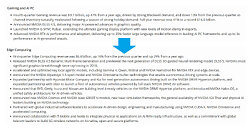
With the new reporting structure, NVIDIA includes revenue from GeForce RTX GPU sales, as well as contributions from AI models, automotive, software libraries, and accelerated networking infrastructure like AI-RAN. These segments now form a smaller portion of NVIDIA's total revenue, collectively referred to as "Edge Computing." This new segment accounted for only 7.84% of the total Q1 revenue, indicating that NVIDIA's reporting structure now aligns with its revenue sources. This might be one of the last ways to track quarterly gaming revenue, as the company is integrating other verticals here. We may not know exactly how the GeForce GPU segment is performing unless NVIDIA provides separate information. Below you can see highlights form the Gaming and AI PC segment in the Q4 2025, versus the "Edge Computing" transition in Q1 2026.
 These quarterly results have also highlighted that NVIDIA's entry into the independent CPU market with its "Vera" CPU generation could position the company as a major player, just behind AMD and Intel. According to NVIDIA's estimates, they expect to sell around $20 billion worth of "Vera" CPUs, tapping into a $200 billion Total Addressable Market (TAM) with their standalone products. By partnering with major hyperscalers to supply "Vera" CPU racks, NVIDIA is accelerating widespread deployment across infrastructure providers for both internal use and third-party offerings. This strategy opens up a vast market, potentially elevating NVIDIA to one of the top positions among CPU manufacturers.
Source:
NVIDIA CFO
With the new reporting structure, NVIDIA includes revenue from GeForce RTX GPU sales, as well as contributions from AI models, automotive, software libraries, and accelerated networking infrastructure like AI-RAN. These segments now form a smaller portion of NVIDIA's total revenue, collectively referred to as "Edge Computing." This new segment accounted for only 7.84% of the total Q1 revenue, indicating that NVIDIA's reporting structure now aligns with its revenue sources. This might be one of the last ways to track quarterly gaming revenue, as the company is integrating other verticals here. We may not know exactly how the GeForce GPU segment is performing unless NVIDIA provides separate information. Below you can see highlights form the Gaming and AI PC segment in the Q4 2025, versus the "Edge Computing" transition in Q1 2026.


85 Comments on NVIDIA Now Reports GeForce Gaming GPU Revenue Under "Edge Computing"
I have patience and honestly, I'm not worried about gaming's future at all. Nvidia or no Nvidia, it'll survive. I've been doing just fine on AMD's GPUs lately, and I hear Intel has some IP too, and that's not even including ARM.
But even if they weren't, PC gaming would soldier on without them. PC Gaming was strong before NVidia and it'll continue strong if they leave the market.
That $153 they paid me for Bulldozer fraud was making it legal for a price. Not much of a price, as they claimed it wasn’t financially significant to them.
AMD made their intellectual property theft legal for a price on March 6, 2026. (Surprise! I’m betting you know nothing about that one. Go google it quick)
The court ruling AMD lost for fraud, breach of warranties, and systemic violations of consumer protection laws for defective Ryzen CPUs in October 2025 is a step to make things legal for a price.
How many times has AMD been sued by their own shareholders? I’ve lost count.
Why is an AMD venture still under govt. sanctions for doing business with CCP military? Will they make that legal for a price also? Not even Intel is that evil.
My point stands, your foaming hatred of anything “not AMD” leaves you blinded to actual truth.
Would like to see how much of that revenue was generated by shuffling money around the cycle. It almost seems like infinite money loop.
The more money is being put in cycle transactions, or the more iterations of cycle are present per year, the higher is revenue.
Trick about fooling people into buying shares, putting their own money to the cycle, so representatives and board directors can sell shares at all time high.
Is it illegal? Unfortunately, not. Is it unethical and misleading, shenanigans-like? Definitely.
www.bloomberg.com/news/features/2025-10-07/openai-s-nvidia-amd-deals-boost-1-trillion-ai-boom-with-circular-deals
And here comes the cherry on top:
www.cnbc.com/2026/05/15/trump-stock-trade-tech-oge.html
Let me explain, in the gts-gtx era gaming allowed Nvidia to grow and put money into RnD to make todays 4k 240fps gaming even possible. Heck, 10-8 years ago running any game at 4k 60fps would require one or even two TITANs at $1200+ each, current pricing aside the tech has become more accessible.
Mining boom has allowed Nvidia to pipe money into tensor cores (matrix multiplication pipelines) development and made it possible to have ray tracing and ML hardware acceleration.
Raytracing has evolved into path tracing and it does add minor, but noticeable details that make the image more natural looking.
Neural texture compression, at least on paper, allows for much higher texture quality at 5-6x lower vram usage.
research.nvidia.com/labs/rtr/neural_texture_compression/assets/Results/results.html
There are mesh compressors, I think they are also ML based nowadays.
There are so many great developments that has happened in tech in the last 10 years :)
"A 12-inch wafer is a lot more expensive today than it was yesterday, and it's not a little bit more expensive, it is a ton more expensive," "Moore's Law is dead … It's completely over, and so the idea that a chip is going to go down in cost over time, unfortunately, is a story of the past."
That was said well before AI explosion, in 2022.
I was still able to get an rtx 5070ti at $1200 USD, and I live in Russia, where no direct import is allowed and the VAT is 22% + cross border tax + tax on anything above $300 + tax on tech goods.
Upd: Ooops, the formula should've been the other way around
OK, I was wrong, it's not into tens of thousands of dollars, it's actually millions, if you go by a widely inaccurate 50% increase every generation - I know not all generations had that much uplift - some had more, many had less, some are actually rebrands so very little increase... But the picture is still very striking.
RIVA 128 - $250
RIVA TNT - $375
RIVA TNT2 - $562
GeForce 256 - $844
GeForce 2 - $1265
GeForce 3 - $1898
GeForce 4 - $2848
GeForce FX - $4271
GeForce 6 - $6407
GeForce 7 - $9610
GeForce 8 - $14.416
GeForce 9 - $21.624
GeForce 100 - $32.436
GeForce 200 - $48.654
GeForce 300 - $72.982
GeForce 400 - $109.473
GeForce 500 - $164.210
GeForce 500 - $246.315
GeForce 600 - $369.472
GeForce 700 - $554.209
GeForce 900 - $831.314
GeForce 10 - $1.246.971
GeForce RTX 20 - $1.870.456
GeForce RTX 30 - $2.805.685
GeForce RTX 40 - $4.208.528
GeForce RTX 50 - $6.312.792
Clutch those fecal pearls.
Like, the salaries for all the people developing software, hardware, the cost of building a factory and material research, the UV machinery, the scale of production etc.
AFAIK DX12 Ultimate is an API anyone can use; just like Vulkan or older iterations of DX serve a multitude of games and devs. Nothing in this space is owned by Nvidia. Zero. Engines to make games on... similarly, Nvidia has no stake in that at all. They don't own jack shit of the gaming space. They just made money off it (and pushed it forward). Their proprietary shit can be gone yesterday and nobody would bat an eye, really; well maybe the real fans would cry on the web for a while before they implement a dll themselves and run their precious DLSS on another GPU.
Technology is invented, it won't go away because Nvidia stops marketing it. Worst case is we get a few generations of lesser implementations of same tech, and then things recover to work just fine without Nvidia altogether.
Also I don't really think the current advancements are that monumental. We're well in the realm of diminishing returns and the games themselves certainly haven't gotten better.
What we will see in the near future is an efficiency bump for gaming; its already happened really with the handheld push. We'll also see simpler chips and we'll see limitations put on what games are going to produce graphics wise. I don't see even a sliver of an issue here. Games were fine ten years ago, and you can run them on a toaster. We don't need cloud for that either. There's just simply no real demand other than what will be propped up artificially by companies to part fools and money; like RTX in its entirety; or selling 4K dreams only to present you an upscaler.
Progress has always been measured by the increase in performance per dollar. Why should it be any different now?
Twice the performance for twice the money is not progress. It's stagnation.
The only thing truly unrealistic was the idea that Moore's Law would keep on giving. Nothing in the history of this planet keeps on giving. You gain an understanding of it, and then it plateaus because 'you figured it out'. Graphics, chip development... they're all looking at the same trajectory.
Then you sell a load of bull to people who won't look any deeper and borrow billions to keep it all going, for as long as you can...
In the old days people would probably go to jail, but we're evolved past that seemingly.