Thursday, May 21st 2026

NVIDIA Now Reports GeForce Gaming GPU Revenue Under "Edge Computing"
NVIDIA reported its Q1 2026 earnings with revenue reaching $81.6 billion, setting a new record. Amid these record-breaking results, the company announced a change in how it reports revenue from its GeForce RTX gaming GPUs. According to NVIDIA CFO Colette Kress, the standalone GeForce RTX GPU gaming revenue is no longer separately listed and is now integrated under the "Edge Computing" segment. This segment "highlights devices for agentic and physical AI, including PCs, game consoles, workstations, AI-RAN base stations, robotics, and automotive." The last standalone report for gaming revenue was in Q4 2025, where NVIDIA posted $3.7 billion. Now, under the "Edge Computing" category, NVIDIA reported $6.4 billion, an increase of 10% from the previous quarter and 29% from the same period last year, when this segment had a different name.
With the new reporting structure, NVIDIA includes revenue from GeForce RTX GPU sales, as well as contributions from AI models, automotive, software libraries, and accelerated networking infrastructure like AI-RAN. These segments now form a smaller portion of NVIDIA's total revenue, collectively referred to as "Edge Computing." This new segment accounted for only 7.84% of the total Q1 revenue, indicating that NVIDIA's reporting structure now aligns with its revenue sources. This might be one of the last ways to track quarterly gaming revenue, as the company is integrating other verticals here. We may not know exactly how the GeForce GPU segment is performing unless NVIDIA provides separate information. Below you can see highlights form the Gaming and AI PC segment in the Q4 2025, versus the "Edge Computing" transition in Q1 2026.
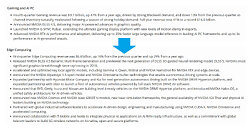 These quarterly results have also highlighted that NVIDIA's entry into the independent CPU market with its "Vera" CPU generation could position the company as a major player, just behind AMD and Intel. According to NVIDIA's estimates, they expect to sell around $20 billion worth of "Vera" CPUs, tapping into a $200 billion Total Addressable Market (TAM) with their standalone products. By partnering with major hyperscalers to supply "Vera" CPU racks, NVIDIA is accelerating widespread deployment across infrastructure providers for both internal use and third-party offerings. This strategy opens up a vast market, potentially elevating NVIDIA to one of the top positions among CPU manufacturers.
Source:
NVIDIA CFO
With the new reporting structure, NVIDIA includes revenue from GeForce RTX GPU sales, as well as contributions from AI models, automotive, software libraries, and accelerated networking infrastructure like AI-RAN. These segments now form a smaller portion of NVIDIA's total revenue, collectively referred to as "Edge Computing." This new segment accounted for only 7.84% of the total Q1 revenue, indicating that NVIDIA's reporting structure now aligns with its revenue sources. This might be one of the last ways to track quarterly gaming revenue, as the company is integrating other verticals here. We may not know exactly how the GeForce GPU segment is performing unless NVIDIA provides separate information. Below you can see highlights form the Gaming and AI PC segment in the Q4 2025, versus the "Edge Computing" transition in Q1 2026.


85 Comments on NVIDIA Now Reports GeForce Gaming GPU Revenue Under "Edge Computing"
Why has the amount of Pay 2 Win titles dwindled so hard? It wasn't due to marketing, but because people figured it out. You could say this an evolutionary process. We do collectively get smarter, but that doesn't mean everyone's gotten smart, it might even include a big number of people that have turned stupid along the way.
Why didn’t you just come out and say our god given GPUs are being taken from us. I’ll start locking mine up in a vault when I’m not home.
Do you know if the FBI or NCA has a task force working into finding the perpetrators that are taking away our GPUs? I’ll sure sleep better knowing those dastardly criminals are behind bars.
I took you off ignore, please keep everyone informed about these GPU thieves.
Given the alternative, I'm happy with a broader category in the financial report.
Jensen Huang Tells the Media That Moore's Law is Dead
To answer the question, AMD is following in Nvidia's footsteps in AI, so yes, Nvidia is the source of the problem.
As a personal take, I call 7900 XT level performance with better RT for just a bit more than half the price a win, but this is highly off topic, so let's leave it at that. Progress isn't measured in absolute performance, but in improvements in price to performance and price to power ratios.
Back to Nvidia, please.
And no, 7900xt level of performance at half the price isn't a win (nor was it half the price btw, lol) - obviously. Why is it not? Cause anyone with a 7900xt or higher cannot upgrade. It's completely pointless to have cheaper GPUs if they aren't faster as well, I don't care if 10 years down the line I can get 7900xt levels of performance for 25$ if that's all I can get. I already have that level of performance, I need something faster. So I wish AMD gives you more wins in the future, their new gen fastest GPU should be at 9070xt levels of performance but cheaper. What a huge W, have fun upgrading.
It doesn't matter "how many people" whatever, it's not progress. At some point everyone will have that level of performance, so im asking you how is it a win to stagnate performance while only getting cheaper gpus? That doesn't make any freaking sense. Nvidia is bringing the 3060 back but they have OPTIONS for people that want higher performance. They don't just offer you 3060 levels of performance, do they?
EDIT1: Nvrmnd, just looked it up. I'm in the neighborhood, but not quite there.
EDIT2: Nvrmnd again, just read the review and it depends(as always). My 3080 is on par in most areas, despite having half the VRAM.
I'm not policing, just stating the fact that what you're talking about has nothing to do with the topic at hand.People won't have that level of performance if it costs north of 2 grand. Sure, people have options, but what good are those options if the vast majority of users are locked out of it?You're a PC enthusiast, not a regular Joe.
Edit: typo
All I'm saying is that our expectations are vastly different than that of the general public. Heck, even I can't justify a GPU that costs as much as a used car. And I certainly can't call such prices progress.
Congratulations, i hope we can afford a gpu from them in the future.
When the GeForce 256 launched in 1999, it was $199. Later DDR versions were $249-$279. This was the fastest GPU money could buy at the time.
And no we have not had 1300% inflation since then, at least not in the USA.