Thursday, May 21st 2026

NVIDIA Now Reports GeForce Gaming GPU Revenue Under "Edge Computing"
NVIDIA reported its Q1 2026 earnings with revenue reaching $81.6 billion, setting a new record. Amid these record-breaking results, the company announced a change in how it reports revenue from its GeForce RTX gaming GPUs. According to NVIDIA CFO Colette Kress, the standalone GeForce RTX GPU gaming revenue is no longer separately listed and is now integrated under the "Edge Computing" segment. This segment "highlights devices for agentic and physical AI, including PCs, game consoles, workstations, AI-RAN base stations, robotics, and automotive." The last standalone report for gaming revenue was in Q4 2025, where NVIDIA posted $3.7 billion. Now, under the "Edge Computing" category, NVIDIA reported $6.4 billion, an increase of 10% from the previous quarter and 29% from the same period last year, when this segment had a different name.
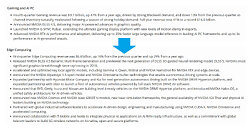
With the new reporting structure, NVIDIA includes revenue from GeForce RTX GPU sales, as well as contributions from AI models, automotive, software libraries, and accelerated networking infrastructure like AI-RAN. These segments now form a smaller portion of NVIDIA's total revenue, collectively referred to as "Edge Computing." This new segment accounted for only 7.84% of the total Q1 revenue, indicating that NVIDIA's reporting structure now aligns with its revenue sources. This might be one of the last ways to track quarterly gaming revenue, as the company is integrating other verticals here. We may not know exactly how the GeForce GPU segment is performing unless NVIDIA provides separate information. Below you can see highlights form the Gaming and AI PC segment in the Q4 2025, versus the "Edge Computing" transition in Q1 2026.
 These quarterly results have also highlighted that NVIDIA's entry into the independent CPU market with its "Vera" CPU generation could position the company as a major player, just behind AMD and Intel. According to NVIDIA's estimates, they expect to sell around $20 billion worth of "Vera" CPUs, tapping into a $200 billion Total Addressable Market (TAM) with their standalone products. By partnering with major hyperscalers to supply "Vera" CPU racks, NVIDIA is accelerating widespread deployment across infrastructure providers for both internal use and third-party offerings. This strategy opens up a vast market, potentially elevating NVIDIA to one of the top positions among CPU manufacturers.
Source:
NVIDIA CFO
With the new reporting structure, NVIDIA includes revenue from GeForce RTX GPU sales, as well as contributions from AI models, automotive, software libraries, and accelerated networking infrastructure like AI-RAN. These segments now form a smaller portion of NVIDIA's total revenue, collectively referred to as "Edge Computing." This new segment accounted for only 7.84% of the total Q1 revenue, indicating that NVIDIA's reporting structure now aligns with its revenue sources. This might be one of the last ways to track quarterly gaming revenue, as the company is integrating other verticals here. We may not know exactly how the GeForce GPU segment is performing unless NVIDIA provides separate information. Below you can see highlights form the Gaming and AI PC segment in the Q4 2025, versus the "Edge Computing" transition in Q1 2026.


85 Comments on NVIDIA Now Reports GeForce Gaming GPU Revenue Under "Edge Computing"
They could have been expensive in 1999. Pentium III's were $500-$700 in 1999, dropping to $300-$450 by late 1999, all more expensive than a top line Geforce 256 DDR with the lowest number ($350) being equivalent to $700 today according to the CPI calculator. Imagine, a low end CPU being $700.
Making GPUs more expensive and powerful was just a function of adding more cores, more pipelines, always has been.
That was the late 70s and early 80s.
It took 27 years for gold to recover its value vs the dollar.
And no I don't buy you remembering 29c/gal gas. If you were that old, you'd know that things are way way way better today than they were in the 70s, or 80s for that matter. You sound very Gen-Z to me, maybe millennial. Typical self-assured low info person.
You own the thing that owns the thing. Basic investment strategy for the last 30 years. Too bad you listened to granny without verification.
Thanks for thinking this old boomer is Gen-Z. Age is a state of mind in my opinion. Keep exercising your mind and you won’t grow mentally old.
You never did clarify what the point you’re trying to make is. Just more whining about the price of leading edge semiconductors? How boorish.