Wednesday, June 24th 2026

Proton Experimental Adds FSR 4 Support for RDNA 3 GPUs on Linux
Following the recent release of FSR 4 support on RDNA 3 GPUs, Valve engineer, Pierre-Loup Griffais, has announced in a post on Bluesky that the same support has officially been added to Linux via Steam's Proton compatibility layer. Support for FSR 4 on RDNA 3 comes by way of the latest version of Proton Experimental, so it's by no means a stable implementation just yet, but the engineer specifically calls out SteamOS and the Steam Machine as the target system for the new upscaler support, suggesting that Valve will invest development resources into getting the support into a more complete state ahead of the full roll-out of the Steam Machine.
Curiously, the post also specifically calls out devices with RDNA 3 discrete GPUs and the Steam Machine, suggesting that support for Radeon iGPUs, like the 780M and 890M that largely dominate the gaming handheld space has not yet been implemented. It's possible that Valve developers, who often contribute to Linux graphics drivers and gaming optimizations, may implement support for the gaming handhelds. There are also reports that manually adding support for FSR 4 on RDNA 3-based iGPU systems—via tools like OptiScaler, for example—results in a working implementation of the upscaler.
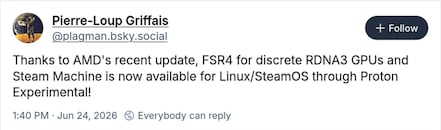
Source:
Pierre-Loup Griffais on Bluesky
Curiously, the post also specifically calls out devices with RDNA 3 discrete GPUs and the Steam Machine, suggesting that support for Radeon iGPUs, like the 780M and 890M that largely dominate the gaming handheld space has not yet been implemented. It's possible that Valve developers, who often contribute to Linux graphics drivers and gaming optimizations, may implement support for the gaming handhelds. There are also reports that manually adding support for FSR 4 on RDNA 3-based iGPU systems—via tools like OptiScaler, for example—results in a working implementation of the upscaler.


9 Comments on Proton Experimental Adds FSR 4 Support for RDNA 3 GPUs on Linux
Maybe get us some relevant figures?
Radeon 7000 cards get that improvement.
As you can see on HUB video , RDNA2 is more impacted than RDNA3 and whithin the same family lower tier is more impacted than higher tier SKU ... there is a limit to what AMD can optimise on a RX6600 tier GPU.
Maybe you should stop coping !
Edit : Official release for RDNA3 just dropped. ComputerBase reports 12-16% perf drop compared to FSR3.1 on the 7900XTX .... pretty much in line with the ''unstable leaked version'' ...
Are the figures relevant enough for your coping taste ? :roll::roll::roll:RDNA2 is also getting it but much later ( 2027 ) for no good reason since per AMD omission RDNA2 optimisation is ultra challenging ( no hardware support for INT8 ) , so there is not much AMD can do to optimise things, thus absolutely not worth waiting 2027 for it. They should had released it along with RDNA3. Radeon doing Radeon things in other words .
they just delayed it as much as possible / feasible to urge people to get a radeon 9000 one. The laste release of the radeon 9070 gre is basically the same tacitcs, sell the more expensive cards first. Maybe product segmentation, whatever you want to call it.
I'm not sure if those diagrams are valid as the picture quality may differ a lot between fsr 3 and fsr 4. 94% to 183% or 207% is still a nice improvement.
And if AMD isn't willing to post drivers how do you decide they are stable?