Tuesday, June 30th 2026

AMD Backs Up PS6 Portable Rumors With "Zen 6 LP" Core Support in Linux
When rumors and leaks about the internals of the upcoming PlayStation 6 Portable handheld started to emerge, we caught wind that the upcoming gaming handheld would feature a Zen 6c CPU with four Zen 6c cores and two Zen 6 LP cores. The rumors that the PS6 Portable would feature Zen 6 LP cores has been corroborated by a new Linux kernel patch from AMD engineer, Vishal Badole, that includes support for Zen 6 LP cores, piling evidence on top of Sony's recent hints that it is developing a standalone gaming handheld for the PS6 generation. The kernel update adds support for a new CPU classification and reads:
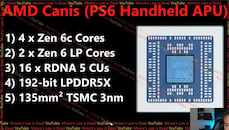 The mention of "minimal power consumption" indicates that this is Zen 6 LP, and it would be the first time we've seen AMD branch off from its current heterogenous design, which features two CPU core types—Zen 5c and Zen 5—while we've already seen Zen 6 and Zen 6c cores appear in rumors about Medusa Point APUs. The Canis APU in the upcoming PlayStation 6 Portable was, until this kernel update, the only time we've seen mention of the Zen 6 LP core type, so the addition of support to the Linux kernel seems to add credence to the leaks and rumors concerning the PS6 handheld, but it's not a guarantee of anything, given how volatile the gaming hardware space has been of late.
Source:
Linux Kernel mailing list on Archive.today
"This series extends the x86 topology cpu_type classification to support a Low Power core type, in addition to the existing Performance and Efficiency types. AMD heterogeneous parts report the core type via CPUID Fn0x80000026 EBX [31:28](Extended CPU Topology, Core Type). Value 2 identifies a low-power core designed for minimal power consumption during background or idle workloads."


47 Comments on AMD Backs Up PS6 Portable Rumors With "Zen 6 LP" Core Support in Linux
And at the right price even low volume makes financial sense
Also, I hope this e/p/ep/lp/xp, whatever mixed core crap doesn't seep through desktop parts like it did on Intel's side.
AMD is just late, as usual.
Sony locks the firmware of the PAYstation (note no l). there is no other operating system allowed or supported, they do everything to lock it down.
Where does the connection come with the linux kernel? Or linux operating system, embeeded linux? I do not see it.
Zen4C cores do already exists, low lache variants. They may already exists in mobile laptops etc these days. With all the rebrands or not rebrands.
Cache wise I distingusih, zen 4c vs zen 4, vs ryzen 8000 low cache vs ryzen 7000 cache. AMD does several segmentation only by cpu cache for l1, l2, l3. Feel free to check the specs and get a clear picture.I installed this gnu gentoo linux installatin in 2006, 20 years ago. I do build my kernel, check the new kernel options and read the changes.
Fact is, in my personal opinion and bias, there is no proper linux kernel support yet for those mixed cores.
I think 12th generation intel core introduced those mixed cores, we are now at 16, 17, 18th intel core (who cares)
When I personally see, changes in teh scheduler and other stuff which are only for those mixed cores for years, it implies it is a bad fix.
The only reason those low power cores etc exists are intel high power consumptions. For arm it is not that worse as arm v8(whatever), v9 do not even have many cpu instructions. android was always a laggy google platform and on a smartphone or tablet power consumption is the most important over response times or cpu instructions. Intel just took over the same strategy from smartphone and implemented it without proper software support.
Lower cache cores wiht the same architectures have less impact as those intel cores which can not execute most of the code.
Intel had also a reason why it has no avx512 inside. they can not do it. And the power consumption will go up.
--
That news topic does not make any sense. Feel free to provide facts which sony Paystation uses which linux kernel officially.
--
Consoles have it much easier, a few cores are just used for system tasks and not for gaming tasks. that was stated multiple times in the past years. so having a few low power cores which just do cpu scheduling tasks or operating system tasks can be a bonus.
WIN 10 21H2 LTSC
WIN 10 22H2
WIN 11 21H2, 22H2, 23H2, 24H2 LTSC, 25H2, and even God-damn 26H1.
Something is wrong with me? No. Just CLEAN INSTALL always, latest BIOSes (the CPU swapped through 3!! motherboards, 1 B660 DDR4, then B760 DDR5 now Z790 DDR5 lol), and strictly locked power limits to "reasonable" like 250W. No degradation issues even with P-cores OC, no gaming issues with stuttering, good enough bench scores (but below the tops because of restricted power limit lol).
For the price of "just" X
3D 8 core "dumb" CPU I could have extra(/spare lol) GOOD mobo for my Intel, LMFAO. And if I'm into spending SUCH money on a CPU only as X3D costs, I'd be getting any day Ryzen 9 or i9 thing.:rolleyes::oops::kookoo::DOn that note, Intel don't make such a mess with their server parts. There they sell them as either all P-cores or all E-cores.
I think the problem is Intel have designed a laptop part then overclocked the shit of of them to get desktop performance. Whereas AMD have sensibly used their server chiplets for desktop.
At the high end, the 270K Plus is within 2% of a CPU that's twice it's price. The 250K Plus beats everything except the 16 core xx50 parts, at $220.
Literally middle of the pack.
I take your point.
I don't buy Intel anymore because of their stupid socket policy and I don't buy them because they don't have monolithic core design anymore either. I just want something reliable that just works and doesn't ever have to rely on software to pick the right core. I followed that rule with 5800X3D and I followed that rule with 9800X3D. For the future, I honestly don't know at this point, but I prefer the safest reliable way.