Tuesday, June 30th 2026
Omdia: US PC Shipments Fell 7.0% in 1Q26, Marking Steepest Decline Since 2023
The latest research from Omdia shows that US PC shipments (excluding tablets) fell 7.0% year-over-year in Q1 2026 to 15.8 million units, the largest annual decline since Q3 2023. The downturn reflects component supply constraints and cost pressures from surging PC memory and storage prices, compounded by a demand hangover following the Windows 11 refresh cycle, which had exhaust much of the near-term commercial pipeline. The comparison was also affected by a strong Q1 2025, when tariff-related inventory pull-forward inflated shipments, as well as modest channel stocking in Q1 2026 ahead of anticipated memory price increases.
US PC shipments impacted by component supply constraints
With DRAM and NAND supply increasingly diverted to AI server applications, rising component costs are eroding vendor margins on entry-level devices, making low-priced PCs increasingly unviable. Shipments of PCs priced under $500 declined 18.7% year-on-year in the quarter. Omdia expects industry-wide declines to continue throughout the remainder of 2026 as supply tightness persists, with full-year US PC shipments forecast to decline 14.4% compared to 2025.
 Business PC upgrades outpace consumer demand
"The impact of component supply constraints on PC shipments materialized in the US market in the first quarter of 2026," said Scott Braverman, Senior Analyst at Omdia. "The consumer segment declined 9.5% year-over-year, worse than the overall market, as many consumers delayed purchase decisions amid higher price tags and challenging economic conditions. Business shipments declined by just 5.0% year-over-year, supported by remaining Windows 11 refresh activity and inventory purchases ahead of further price increases."
According to Omdia's May forecast, the first half of 2026 is likely to be the stronger period for business PC demand. The component cost environment is expected to keep entry-level prices elevated through 2027, suppressing consumer demand.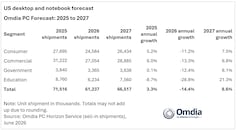 "Budget-constrained segments also faced pressure, although the education segment declined just 6.2% in Q1 2026," said Braverman. "This was a significant improvement from the double-digit declines recorded in each of the previous three quarters. However, this stabilization is unlikely to hold, as rising prices disproportionately affect the entry-level devices that dominate education procurement. Government procurement also declined as price increases strained already tight public sector budgets. Both segments are expected to remain under pressure through 2026, with meaningful recovery unlikely until 2027," added Braverman.
AI PC adoption and supply pressures drive up average selling prices
"While average selling prices rose just 4% year-on-year in Q1 2026, Omdia expects growth to reach 12% in Q2 and exceed 12% in the second half of 2026 as supply-side headwinds continue to materialize," said Kieren Jessop, Research Manager at Omdia. "In addition, demand dynamics are also driving average selling prices higher as the share of AI-capable PCs grew to 44% of all shipments. Large enterprises in particular are increasingly procuring higher-cost AI-capable PCs."
Business PC ASPs are expected to grow 11% in 2026, with 10% ASP increases in the consumer and government segments. Education ASPs are expected to remain flat as this cost-conscious segment delays PC refreshes due to rapid pricing increases.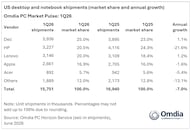 Vendor performance varied significantly in Q1 2026, reflecting difference in segment exposure and pricing dynamics. HP's 21.6% decline in shipments was the steepest drop among major providers and resulted in HP losing its top spot in the US in Q1 2026. Dell captured the lead with a 25.0% share, posting 1.1% growth despite overall market contraction, while Lenovo also achieved growth of 1.2% to reach 20.0% of the market. Both vendors' growth was driven by significant consumer segment share gains (4 percentage points each year-over-year), narrowing the gap with Apple and HP. Apple's shipment decline of 1.6% outperformed the overall market, maintaining a 16.9% share as MacBook adoption continued in business segments where Apple's presence has grown to 15.3%. Smaller vendors also faced severe pressure, with shipments declining 13.1% as these brands lack the same component procurement leverage as larger competitors.
Source:
Omdia
US PC shipments impacted by component supply constraints
With DRAM and NAND supply increasingly diverted to AI server applications, rising component costs are eroding vendor margins on entry-level devices, making low-priced PCs increasingly unviable. Shipments of PCs priced under $500 declined 18.7% year-on-year in the quarter. Omdia expects industry-wide declines to continue throughout the remainder of 2026 as supply tightness persists, with full-year US PC shipments forecast to decline 14.4% compared to 2025.


"The impact of component supply constraints on PC shipments materialized in the US market in the first quarter of 2026," said Scott Braverman, Senior Analyst at Omdia. "The consumer segment declined 9.5% year-over-year, worse than the overall market, as many consumers delayed purchase decisions amid higher price tags and challenging economic conditions. Business shipments declined by just 5.0% year-over-year, supported by remaining Windows 11 refresh activity and inventory purchases ahead of further price increases."
According to Omdia's May forecast, the first half of 2026 is likely to be the stronger period for business PC demand. The component cost environment is expected to keep entry-level prices elevated through 2027, suppressing consumer demand.

AI PC adoption and supply pressures drive up average selling prices
"While average selling prices rose just 4% year-on-year in Q1 2026, Omdia expects growth to reach 12% in Q2 and exceed 12% in the second half of 2026 as supply-side headwinds continue to materialize," said Kieren Jessop, Research Manager at Omdia. "In addition, demand dynamics are also driving average selling prices higher as the share of AI-capable PCs grew to 44% of all shipments. Large enterprises in particular are increasingly procuring higher-cost AI-capable PCs."
Business PC ASPs are expected to grow 11% in 2026, with 10% ASP increases in the consumer and government segments. Education ASPs are expected to remain flat as this cost-conscious segment delays PC refreshes due to rapid pricing increases.

18 Comments on Omdia: US PC Shipments Fell 7.0% in 1Q26, Marking Steepest Decline Since 2023
Their estimates are mostly based on revenue reports from major companies. And we all know those reports are often used as marketing, not as some faithful reporting - which should of course be illegal, but breaching these rules is laughably cheap for companies, and they can even ignore the rulings altogether and choose not to pay (as Nvidia chose when they lost for hiding the sales of the cards for cryptomining under all the sectors). So I would expect companies aren't really faithfully reporting that their explosive growths are all just from AI orders, because that would show this growth as vulnerable to AI bubble popping, so they are dispersing their reported revenue. It's natural growth in all sectors, there is no bubble!
That's why you have a 20+% of fall at Dell and a rise at HP.
The outcome is of course a completely distorted picture of what market is really doing. A complete breakdown of consumer order gets estimated as "a 7% fall of shipments, nothing to worry about".
Look at twitch. It has barely 1 to 2 million users and it caps it's users to between 4 and 8mbps. On a stream that can be buffered. Gaming cannot.
And that takes into consideration current 4k monitors. If in 5-10 years 8k is the meta now suddenly quadruple those calculations.
The man himself also said 5070 = 4090. So what. Geforce now is offered as an option for those that don't want to buy a pc. Why the hell would nvidia not want to sell you 500 to 3k gpus every generation. They have no financial benefit to move you to the cloud.
The jacket man would rather sell the same GPU's for $10k each to pro users and datacenters than at $500-3K to consumers, and they have every incentive to sell you a GPU in the cloud instead of you buying it because like all subscriptions they're getting a constant revenue stream from consumers instead of buying hardware every few years.
The whole internet currently is estimated to be averaged out at 2.2 Pb/s...so basically we need 7 times the bandwidth to make it work. That doesn't take into account the kind of servers we'd need to do that. If you spread 10 servers across the planet each single server will absolutely DWARF the biggest AI datacenters by 40x. Heck the hardware required just to handle that kind of network traffic alone (so im not even taking about the GPUs required to run the games) would be enormous.
And then suddenly in 5-10 years we move to 8k. Yeah, now 4x that.
So it's not "You'll own nothing and be happy" - it's just the first part, you're not considered a customer any more, you can't afford their products.
"AI won't take over for people. But people who use AI will take the place of those who don't."
And kitchen sinks.
Because everyone that could enter the PC gaming market could at the same time enter the AI market. With incomparably larger revenue.
So you're telling me that someone will plan to be the man of focus, commitment, sheer will, and plan to enter a market that brings 1/10th of a revenue they could rake by selling basically the same product to different people?
Not until the AI bubble pops. And I fear we might be waiting for a long time for that, even if the sector might encounter difficulties.
In order to compete in the AI market against nvidia youd need an astronomical amount of investment. You can't just make a GB200 out of thin air. Also you'd competing for the same node space.
So yeah, 1/10th the revenue but also 1/1000th the investment required. On the other hand to make a gpu of the caliber of a 3060 or a 5060 is astronomically easier. Intel hit it on their first try. Right now AMD and nvidia have a chokehold on the gaming GPU market due to years of driver optimizations etc. If they suddenly excuse themselves from the market an ARC gpu suddenly becomes a great choice and a business opportunity for Intel to invest into their drivers. A lot more companies could join the fray.
And none of this makes sense, why would nvidia want to move you to the cloud then? Why wouldn't they just sell all their GPUs to AIAIAI where they can make 10 times the revenue as you are claiming?
And about how easy it is to enter gaming GPU vs. AI accelerators - yeah, Intel did enter gaming with their first try. Kind of, they were always in with their iGPUs. So not really their first try, and it wasn't even their first discrete card. And soon after they basically abandoned gaming sector. AMD just kind of hangs in there, but every time they make a product that's even a bit competing they show they don't really mean it, and scarcity drives the price up, leaving Nvidia with majority of share. But both companies invest and market their AI solutions, even though they can't make a GB200 out of thin air, or air of any density. Also, right now everything kind of competes with AI, there is no node safe from impact of scarcity that Jensen Huang so loves. We see that in rising prices of legacy products like DDR4 memory made on old processes.
Anyways, the point is, cloud gaming cannot work unless we invent some extraordinary method of delivering data globally. If everyone went to cloud tomorrow the whole internet would totally collapse.
Anyway i stated my opinion , this research article or whatever write up is basically a hint at what’s to come but more of an extension of what we have been hearing from the major players
And about infrastructure not being there for the future plans in cloud gaming - I think situation is no worse than trying to convince people to drive electric cars while you tell them to remember to turn off the lights and turn off their AC to conserve energy. Even before the power hungry datacenters this didn't add up, now it's becoming a crisis - that of course won't be paid off by automotive industry, data centres or electric providers, it's all of a sudden a national problem.