Wednesday, July 8th 2026

Samsung Begins Mass Production of PM1763 PCIe Gen 6 SSD
Samsung Electronics Co., Ltd., a global leader in advanced memory technology, today announced mass production of PM1763, the company's PCIe 6.0-based enterprise solid state drive (SSD) optimized for next-generation AI and HPC server environments. As the volume of data required for AI training and inference continues to grow rapidly, enterprise SSDs (eSSDs) capable of delivering data quickly and reliably are becoming increasingly essential to AI infrastructure.
Featuring high-speed data transfer and an optimized controller architecture, PM1763 is expected to serve as a key storage solution for high-performance AI platforms. "Built on industry-leading performance, PM1763 has successfully completed validation for next-generation AI platforms and is well positioned to support evolving AI infrastructure requirements," said Jangseok Choi, Vice President and Head of Memory Product Planning at Samsung Electronics. "As AI models continue to grow in size and complexity, PM1763 will serve as a key solution that enables customers to efficiently scale memory capacity and optimize AI operations."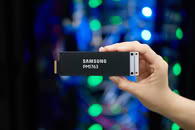 Incorporating Samsung's 9th-generation V-NAND and a newly developed 4-nanometer (nm) controller, PM1763 significantly improves both performance and power efficiency.
PM1763 is available in 4-terabyte (TB), 8 TB and 16 TB capacities, with the 16 TB configuration delivering industry-leading performance with sequential read and write speeds of up to 28,400 megabytes-per-second (MB/s) and 21,900 MB/s, respectively—more than 2 times the performance of its predecessor, PM1753.
This level of performance allows the transfer of a 40-gigabyte (GB) large language model (LLM) in approximately 1.4 seconds, helping minimize data latency between processors and accelerators while improving overall AI processing efficiency.
PM1763 is optimized for liquid-cooled server environments through direct-to-chip (D2C) cooling technology. This enables sustained peak performance even under intensive workloads and extended operating conditions.
Power efficiency is also improved by more than 1.8 times compared to its predecessor, helping reduce overall datacenter operating costs.
To address growing security requirements in AI, Samsung has also strengthened PM1763's security capabilities. The drive supports post-quantum cryptography (PQC) algorithms designed to protect against future quantum computing threats, as well as TEE Device Interface Security Protocol (TDISP)1, which helps secure data pathways in virtualized environments.
Featuring high-speed data transfer and an optimized controller architecture, PM1763 is expected to serve as a key storage solution for high-performance AI platforms. "Built on industry-leading performance, PM1763 has successfully completed validation for next-generation AI platforms and is well positioned to support evolving AI infrastructure requirements," said Jangseok Choi, Vice President and Head of Memory Product Planning at Samsung Electronics. "As AI models continue to grow in size and complexity, PM1763 will serve as a key solution that enables customers to efficiently scale memory capacity and optimize AI operations."

PM1763 is available in 4-terabyte (TB), 8 TB and 16 TB capacities, with the 16 TB configuration delivering industry-leading performance with sequential read and write speeds of up to 28,400 megabytes-per-second (MB/s) and 21,900 MB/s, respectively—more than 2 times the performance of its predecessor, PM1753.
This level of performance allows the transfer of a 40-gigabyte (GB) large language model (LLM) in approximately 1.4 seconds, helping minimize data latency between processors and accelerators while improving overall AI processing efficiency.
PM1763 is optimized for liquid-cooled server environments through direct-to-chip (D2C) cooling technology. This enables sustained peak performance even under intensive workloads and extended operating conditions.
Power efficiency is also improved by more than 1.8 times compared to its predecessor, helping reduce overall datacenter operating costs.
To address growing security requirements in AI, Samsung has also strengthened PM1763's security capabilities. The drive supports post-quantum cryptography (PQC) algorithms designed to protect against future quantum computing threats, as well as TEE Device Interface Security Protocol (TDISP)1, which helps secure data pathways in virtualized environments.
12 Comments on Samsung Begins Mass Production of PM1763 PCIe Gen 6 SSD
Oh, it's not meant for people?
PCIe 6.0 is not yet available even on datacenter CPUs. It is expected with upcoming Intel Xeon Diamond Rapids and AMD EPYC Zen 6 server platforms.
The only available implementation is from NVIDIA in their ConnectX-9 network adapters which have 48 lanes of PCIe 6.0 and can be used as PCIe hosts to connect directly to SSDs, so the host CPU doesn't have to do the heavy lifting.
Edit: Amend the above: ConnectX-9 is not the only one. NVIDIA Vera CPU also supports 6.0. An estimation of the Vera Rubin unit connection diagram from SemiAnalysis.
Neither capacity or speed has been an issue, but how many of you are running RAID 100 arrays?
You might need a good U.2 controller as well, because I doubt most on-board ones can take the punch these can deliver.
But I agree, as a single person it's not the easiest investment.
WD4Me4Eva.....
Back in late '24, when the prices had bottomed out, I bought about $6k worth of 2 & 4TB SN850X's, and some DDR-4 & 5 ram too, for 3 reasons (other than price):
A) Most etailers did not have qtys of any other brands that I wanted, and
B) I've used WD drives (and other brands to) for many, many years nottaproblemo, all the way back to the 7200rpm VelicoRaptors....so I stick with what I know works, and
C) I've had more failures of Sammy drives than all the other brands combined, and have ZERO faith in their stuff nowadays...
And you are correct, they haven't cared about us little people and our puny little home-based peecee's for several years now, so I say f**k 'em & forget 'em.....
Regards,
Fred.