Thursday, July 16th 2026

Steam Machine Running Windows With Performance On-Par With SteamOS
Valve recently released Windows drivers for the new Steam Machine living room console, and it turns out the drivers are pretty good, given recent benchmark results from ETA Prime. The notorious YouTuber and gaming hardware reviewer installed Windows 11 on the Steam Machine, noting that the process was fairly painless, and that all the hardware worked flawlessly. It's both notable and somewhat comical that the GPU shows up in both Windows Task Manager and AMD's Radeon Adrenaline driver as an AMD Radeon RX 7600.
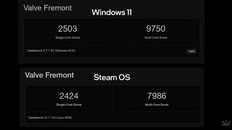
The Steam Machine in question has been upgraded to have 64 GB of memory, so there may be slight differences in performance, especially once the Windows installation starts to accrue more and more programs. In terms of actual gaming and productivity performance, SteamOS and Windows mostly trade blows, but Windows does have a few notable performance wins over SteamOS. For starters, Windows edges out SteamOS by a sizeable 22% margin in the Geekbench 6 multi-thread benchmark, with the single-core benchmark being just about on par. In Cinebench 2024, the Steam Machine scores a middling 99 points in the single-core benchmark and 554 points in the multicore test, falling significantly behind Apple's M1 Max and the AMD Ryzen 5800X in the multi-thread tests.
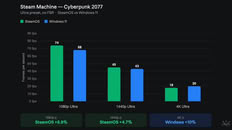
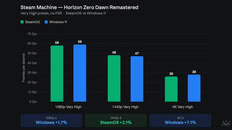
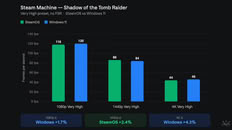 In gaming, things are a lot more even, although there's a trend that shows the Steam Machine running Windows gaining a small advantage at 4K and 1080p resolutions. In Shadow of the Tomb Raider, Windows outperforms SteamOS ever so slightly, at both 1080p (a 1.7% uplift) and 4K (a more substantial 4.3% win for Windows), but at 1440p, SteamOS is 2.4% faster. When it comes to Cyberpunk 2077 on Ultra settings, SteamOS has a handy 8.8% advantage over Windows and a smaller 4.7% win at 1440p. At 4K, however, both were unplayable, with SteamOS delivering 18 FPS average and Windows delivering 20 FPS. The two are neck-and-neck in Horizon Zero Dawn Remastered with High graphics and no FSR, too, with the only notable outlier being a 7.1% win for Windows in Horizon Zero Dawn Remastered. At 1440p, SteamOS was 2.1% faster, and at 1080p, Windows was, again 1.7% faster.
 In conclusion, it seems as though running Windows on the Steam Machine is perfectly feasible, and it's one of the things Valve has been vocal about in its Steam Machine marketing—that the Steam Machine is just a PC, and you can basically do with it whatever you'd be able to do with any other PC. However, there are other reasons to run SteamOS, aside from just gaming performance, as we discussed in another article covering a comparison between Fedora Linux and Windows 11 in gaming tests.
Source:
ETA Prime on YouTube
The Steam Machine in question has been upgraded to have 64 GB of memory, so there may be slight differences in performance, especially once the Windows installation starts to accrue more and more programs. In terms of actual gaming and productivity performance, SteamOS and Windows mostly trade blows, but Windows does have a few notable performance wins over SteamOS.


28 Comments on Steam Machine Running Windows With Performance On-Par With SteamOS
Going forward, this will be a bigger issue. I don't know why were defending AMD restricting driver updates, but here we are.Rdna3 is still on the current, developer, driver branch. No, it is not in "maintenance".Again, you're wrong. Linux is not dependent on AMDs custom driver shenanigans like Windows is.Oh moose muffins! You have no way of knowing if running an outdated driver, an end user will have no issues in future years. We have evidence of the opposite (which you immediately try to dismiss) and we of course know that newer drivers are released to fix game breaking bugs all the time.
What evidence do you have that there will be no game breaking bugs in the 2024 driver branch for the next 3 years?That's called being developed, not maintained. New features don't come to maintenance branches.
Do you understand what maintenance branches are, or are you just intentionally trolling the forum today?
The problem is how AMD licenses the creation/maintenance of the Windows drivers for their custom silicon. Do we blame them for this? I can't say, because while we can blame them for not including Van Gogh and the Z-series APUs in their mainline drivers, we don't know how their licensing with the OEMs work.
Maybe we should blame the OEMs for not paying the licensing fee for these drivers? (Especially now that these handhelds have exorbitant pricing.) It's confusing but at the end, the annoyance ends up on the customers who buy these devices who want to use Windows on them.
Boutique handheld OEMs (e.g. GPD, OneXPlayer, etc.) use off-the-shelf mobile APUs (i.e. 6800U, 7840U, 8840U, HX 370 etc.) that other OEMs can buy in bulk, so they can use the standard Windows drivers.
I'm also done with this conversation as it's going in circles.