Friday, September 11th 2026
Chinese Chipmaker SMIC Expands Market Share with $3 Billion Quarterly Revenue
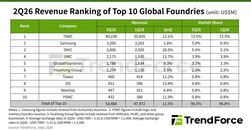
Chinese semiconductor maker SMIC has increased its market share as the world's third-largest chipmaker. According to the latest report from TrendForce, SMIC now holds 5.4% of the semiconductor manufacturing market share in Q2 this year, a slight increase from 5.1% in Q1. In the three-month period ending in June, SMIC generated about $3 billion in revenue from domestic companies producing homegrown silicon. This marks a significant improvement compared to $2.2 billion in Q2 2025, with a slight increase in market share from that period's 5.1%. This indicates that overall capacity has increased across the supply chain.
SMIC's most advanced manufacturing nodes include the SMIC N+2, a 7 nm-class node used by Huawei to manufacture its Ascend series of AI accelerators and other infrastructure parts, and the SMIC N+3, a 5 nm-class node for its customers. The company uses DUV to print silicon designs but faces significant challenges in achieving its silicon ambitions as it currently has no access to EUV tools, since ASML has restricted exports of its EUV scanners, and it is the only company manufacturing EUV machinery at scale.
 For printing smaller nodes, EUV scanners offer more possibilities due to their much smaller wavelength of 13.5 nm, compared to the smallest DUV immersion scanner wavelength of 193 nm. In a single-patterning round, the best DUV immersion scanners can achieve resolutions for nodes with sub-38 nm prints. SMIC has likely optimized these machines to reach closer to 35 nm in a single print, using multiple rounds of printing to fully etch the design. Techniques like self-aligned quadruple patterning (SAQP) have been used in semiconductor nodes for years, so it is logical that SMIC has employed a similar technique with its new N+3 node, which seems to be generating revenue steadily for the chipmaker.
Source:
TrendForce
SMIC's most advanced manufacturing nodes include the SMIC N+2, a 7 nm-class node used by Huawei to manufacture its Ascend series of AI accelerators and other infrastructure parts, and the SMIC N+3, a 5 nm-class node for its customers. The company uses DUV to print silicon designs but faces significant challenges in achieving its silicon ambitions as it currently has no access to EUV tools, since ASML has restricted exports of its EUV scanners, and it is the only company manufacturing EUV machinery at scale.


Comments on Chinese Chipmaker SMIC Expands Market Share with $3 Billion Quarterly Revenue
There are no comments yet.