Tuesday, September 22nd 2026

AMD Adds GDDR7 Support in GPU Driver, Preparing for RDNA 5 Launch
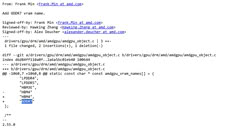
AMD has submitted patches to its open-source graphics card drivers for Linux, adding support for GDDR7 memory, as anticipation builds for the company's next-generation RDNA 5 GPUs. In the AMDGPU open-source driver, GDDR7 is now listed among the supported VRAM types. Currently, AMD's graphics cards use GDDR6 for the consumer RDNA 4-based Radeon RX 9000 series, while Instinct MI data center and workstation GPUs use HBM3E and HBM4 memory. Since AMD is developing data center GPUs with HBM and consumer cards are the only models using GDDR, the GDDR7 placeholder indicates future support for RDNA 5.
Switching to GDDR7 will allow AMD to significantly boost the memory speeds of its graphics cards and potentially increase capacity, all while improving energy efficiency. The latest GDDR6 memory modules top out at 20 Gb/s, while GDDR7 can achieve 36 Gb/s today and even 48 Gb/s in future versions, according to JEDEC specifications. This could enable AMD's gaming and workstation GPUs with RDNA 5 technology to achieve significantly higher memory bandwidth, enhancing performance in memory-bound workloads.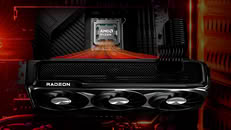
 While AMD's RDNA 5 is still months away from any potential launch, Linux kernel patches and AMDGPU driver work have revealed some additional information. For example, the Display Core Next (DCN) display engine, used for display output, image scaling, monitor ratio output, pixel manipulation, and more, will arrive in version 6 for RDNA 5. With DCN 6, AMD has introduced new scaling integrity and costing surfaces, a UPSP pre-scaler to sample 4:2:0 and 4:2:2 content before scaling, and new pixel formats within the display logic. This means that the final GPU will support modern high-refresh and high-resolution gaming across a range of aspect ratios and configurations, delivering content smoothly.
Sources:
Freedesktop, via VideoCardz
Switching to GDDR7 will allow AMD to significantly boost the memory speeds of its graphics cards and potentially increase capacity, all while improving energy efficiency. The latest GDDR6 memory modules top out at 20 Gb/s, while GDDR7 can achieve 36 Gb/s today and even 48 Gb/s in future versions, according to JEDEC specifications. This could enable AMD's gaming and workstation GPUs with RDNA 5 technology to achieve significantly higher memory bandwidth, enhancing performance in memory-bound workloads.


10 Comments on AMD Adds GDDR7 Support in GPU Driver, Preparing for RDNA 5 Launch
It’s also important to understand what it tells us. This isn’t “patch for gta6” it’s “don’t kernel panic when you strap gddr7 by family ID on bring up.”
We are waaaays away from usable driver
AMD still focusing on gaming is good though, they can't just sit on cards for 3 years like Nvidia can.
Or you could say, "Soon™"