Wednesday, September 23rd 2026
Discord Updates Age Verification Process With "Privacy-Preserving" Methods
Discord was met with substantial backlash when it first announced that it would be adding age verification requirements globally, with the platform almost immediately rolling back the ID requirements after the backlash. It has since announced that it will be introducing new age verification methods, including credit card verification, Apple Store and Google Play Store verification, Google Wallet, and AgeKey—a third-party reusable age credential that can be used for multiple platforms. It will use these services to place its users in an age group—13-17 years and 18+ years—which will allow them access only to content appropriate for their age. While these new methods will apply to international users, users in the UK, Brazil, Australia, and the US state of Texas will have to follow different guidelines.
However, these new systems will not be the first resort for age determination. Discord says that, following the controversy with the ID requirement for age verification, it will prefer other ways to verify the age of its users, including account signals—account age and which servers users are part of, specifically. It says that these signals match biometrics on accuracy. Only in cases where there aren't sufficient signals to confirm user age, will Discord require users to verify their age using one of the aforementioned age assurance options. Users in the teen group will not have access to sensitive media, while messages to teens from non-friends will be filtered through message requests, and other users will not be able to see teens' full profiles or activity. They will also not be able to join age-restricted servers without confirming their age.
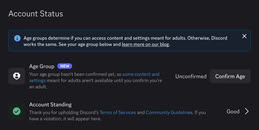
 Discord has also released updated transparency reports, which now detail how many users on the platform were required to verify their age. You can read the full announcement blog post by Discord, but below are excerpts directly from the post highlighting the important information.
Source:
Discord
However, these new systems will not be the first resort for age determination. Discord says that, following the controversy with the ID requirement for age verification, it will prefer other ways to verify the age of its users, including account signals—account age and which servers users are part of, specifically. It says that these signals match biometrics on accuracy. Only in cases where there aren't sufficient signals to confirm user age, will Discord require users to verify their age using one of the aforementioned age assurance options. Users in the teen group will not have access to sensitive media, while messages to teens from non-friends will be filtered through message requests, and other users will not be able to see teens' full profiles or activity. They will also not be able to join age-restricted servers without confirming their age.


That's why, starting tomorrow, we'll automatically place you in an age group using account signals, like how long your account has existed and the kinds of servers you're part of. We use multiple account signals to determine age groups at an accuracy level matching what's possible with biometrics. No single server determines your age group, and we don't look at your messages, calls, or other content to decide which age group you're in.
If you just want to know your age group: Go to User Settings > Account Status. We're launching this over the course of this week, so it may take a few days to reach your account. If you don't see anything yet, check back later. Your age group isn't shown on your profile or visible to other members in a server. Here's what each age group status means:Our age group estimation model looks at patterns of account behavior on Discord. It does not look at your messages, calls, or other content. For example, the way a typical teen uses Discord will look different in aggregate from how a typical 30-year-old uses Discord. Our model has learned these patterns and uses them to estimate whether a given account most likely belongs to an adult (18+) or a teen (13-17).
- Adult Age Group: You're in the adult age group (18+), so nothing changes for you.
- Teen Age Group: You're in the teen age group (13-17), so you have additional protections. Content and settings meant for adults aren't available. Otherwise, Discord works the same. Learn more here.
- Unconfirmed: This is for cases where we don't have enough signal yet to place you in an age group, so some content and settings meant for adults aren't available until you confirm you're an adult. New accounts remain unconfirmed until we have enough information to determine an age group for them. You can continue to use Discord without taking any action, but if you want access to age-restricted content, spaces, and settings, you can confirm your age group in User Settings > Account Status.
Specifically, the age group estimation model looks at factors such as:No single server, community, or friend decides your age group. Our age group estimation model learns from patterns across accounts, working the same way as the safety systems we've run for years to catch coordinated abuse.
- The communities, servers, and games you're connected to
- General activity levels, such as how many channels or servers you're active in
- Account history, such as how old your account is
21 Comments on Discord Updates Age Verification Process With "Privacy-Preserving" Methods
It's just wild how insanely restrictive online is becoming, all with excuse to "protect" the children, all while exposing personal information of literally billions of users. Literally EVERYTHING we were taught through decades not to do online we're now required to do online. Either everyone is stupid or someone has an agenda with all of this. Suspecting the later...
ID verification is a joke, it just helps with fraud when those databases get breached even though they were never supposed to hold on to the data, but they did anyway
Genuinely abysmal dogshit. Time to move on, just as I did from AIM, MSN, Skype, Teamspeak, Mumble, and XFire.
If enough people don't put up with this it'll kill off the service and something that respects user privacy will replace it.
As for Discord itself, it has not been compromised ever, *at least as far as I know.*
And as for the old support route that provided Age verification, it seems that in light of that incident they just removed it completely. Either you verify using the methods provided inside the app or you don't and instead get assigned Adult or Teen according to whatever internal metrics Discord uses to determine that.It will never happen unless Discord fucks it up really bad. Age verification is almost a non-issue in the larger scheme of things for the userbase.
As for the Discord alternatives, what I've heard pretty much says they're either shit or they're just gonna sell your data/rush towards full monetization soon. So... not an improvement at all if you want to go all "I care about what things companies do with my data" about it.
I have accounts on the internet that are old enough to drink. It'll be hilarious when they get hit with an age restriction. It's just a matter of time.
I'm of the opinion that age verification which respects the individual's privacy can only ever be universally provided as a public service. A government office whose entire purpose is to run CA servers and issue valid tokens to be individually printed onto IDs by issuing agencies, so that the only person who can link any given token to a specific person is someone who has seen the ID itself. How you make these tokens both easy to input and safe from brute-force, I'm less qualified to answer in specifics, but I doubt it's too grand of a challenge.
Steam's messaging/voice calls are surprisingly good, but the way group chats or whatever are structured has many things to be desired.
Last time I looked there's no parity Discord in March, where the platform hosts the servers. And the high data bandwidth usage of streaming your games/screens and cams.
The best that can be said is, "additionally". :)