Monday, October 19th 2026

Intel Readies XMX-Accelerated XeSS Support for Valve's Proton Compatibility Layer
Intel is preparing to add support for XeSS, accelerated by XMX cores in its graphics cards, to Valve's Proton compatibility layer. This is great news because the Valve Proton layer currently uses a slower version of the upscaler that is not very efficient. The XMX cores would significantly accelerate upscaling and bring substantial performance improvements. Intel is promoting XeSS and its latest version 3.0, which features multi-frame generation (MFG). This version integrates up to three generated frames between two rendered frames, resulting in up to a fourfold increase in frame rate using MFG, similar to NVIDIA's DLSS MFG technology. Intel is joining the trend of AI-generated frame insertion, which seems to be gradually expanding.
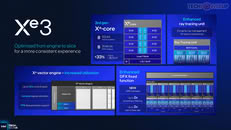
Looking at the latest "Panther Lake" SoC with Xe3 cores, each Xe3 core includes eight vector engines, eight matrix engines (XMX), and a dedicated ray tracing unit. These execution units now operate with higher utilization thanks to refined thread dispatch and load balancing. The vector and matrix engines double peak FP16 and INT8 throughput compared to Xe2, benefiting both traditional rendering and AI-assisted tasks such as denoising, upscaling, and frame generation. Hence, supporting XMX-accelerated XeSS will finally give Intel Xe gamers on Linux a much-needed performance bump.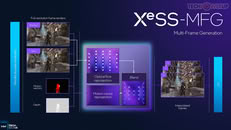
Sources:
Intel on GitHub, via Phoronix
Looking at the latest "Panther Lake" SoC with Xe3 cores, each Xe3 core includes eight vector engines, eight matrix engines (XMX), and a dedicated ray tracing unit. These execution units now operate with higher utilization thanks to refined thread dispatch and load balancing. The vector and matrix engines double peak FP16 and INT8 throughput compared to Xe2, benefiting both traditional rendering and AI-assisted tasks such as denoising, upscaling, and frame generation. Hence, supporting XMX-accelerated XeSS will finally give Intel Xe gamers on Linux a much-needed performance bump.


8 Comments on Intel Readies XMX-Accelerated XeSS Support for Valve's Proton Compatibility Layer
This has pretty much been the only thing I miss since upgrading my Arc machine to Linux.
Atleast their driver team is quite good and actively fixing issues.
A software feature is useless if there's no hardware to use it.