News Posts matching #upscaling

Return to Keyword Browsing

New DLSS 5 Mod Borrows a VR Trick for Better Ultrawide Performance

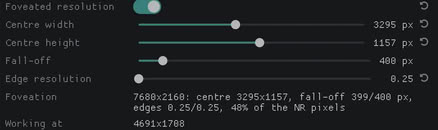
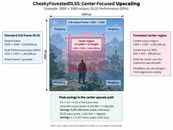
A new DLSS 5 mod borrows a trick from VR headsets to make Neural Rendering less punishing on ultrawide monitors. FoveatedDLSS5, a ReShade add-on built by maximedgoulet, keeps neural rendering at full resolution in the middle of the screen and steps it down toward the edges, where peripheral vision picks up less detail. In a Reddit post, the modder says The Witcher 3 went from 49 FPS to about 80 FPS on an RTX 4090 at 7680x2160 with 2x multipass, a gain of over 60%.

With default settings on a 7680x2160 panel, Neural Rendering ends up processing about 71% of the original pixels. Smaller screens gain less, however. At 4K, the defaults leave 93% of the pixels, and at 3440x1440 the mod turns itself off, so 16:9 and 21:9 users should shrink the center zone. It's also a pre-release tested in one game, and it only works when neural rendering runs after upscaling, which rules out pairing it with the Neural Upstream trick. Videocardz points out a similar project, CheekyFoveatedDLSS, that has been out since early September and adds eye-tracked foveation for VR headsets.

AMD FSR 4.1.2 Modded to Run on Intel Arc GPUs Leveraging XMX Cores

OptiScaler is a community-driven project that seeks to bring the benefits of upscaling and frame-generation across brands of GPUs, so gamers don't miss out on playability if the game doesn't feature the upscaler/frame-gen tech provided by their GPU vendor. The community successfully modded AMD FSR 4.1.2 to work on Intel Arc GPUs, leveraging the Intel XMX cores (Xe Math Extensions). Current implementations of FSR on Arc relies on a fallback DP4a path that offers significantly lower performance benefit.

DarkerThanLpDark on Reddit put FSR 4.1.2 Lite on Arc B580 to the test in "Clair Obscur: Expedition 33," comparing its performance with the game's native XeSS implementation, and FSR's standard DP4a implementation on Arc GPUs. The latest OptiScaler mod was found offering almost the same levels of performance as XeSS (SR). FSR 4.1.2 Lite logged an upscaling time of 0.59 ms compared to 0.58 ms of XeSS (SR).

ASUS Rolls Out FSR 4.1 Preview for ROG Xbox Ally Handhelds

ASUS has started rolling out a preview GPU driver that brings AMD FSR 4.1 upscaling to the ROG Xbox Ally X and ROG Xbox Ally X20. Owners can grab it through Armoury Crate SE under Update Center, then Preview Updates. This follows AMD's announcement earlier this week that FSR 4.1 is expanding to Radeon RX 6000 series GPUs, APUs, and Xbox. According to ASUS, the handheld version runs on a lighter model that is less than half the size of the original INT8 model, built with the Ryzen AI Z2 Extreme in mind. FSR 4.1 works in over 400 games that support FSR 3.1 or newer. Handheld owners have waited a while for this, as AMD previously had no definitive decision on RDNA 3.5 APUs before confirming FSR 4 for APUs by the end of 2026.

Once FSR is enabled in a game's settings, users also have to add the FSR tile in Command Center and switch it on. ASUS warns that RSR, the system-level upscaler, should not be combined with it. Neither AMD nor ASUS has shared any performance numbers yet, and ASUS notes that preview updates may still have bugs. As for the regular ROG Xbox Ally, ASUS says it will also get support through a GPU driver update coming soon, though there's no date yet. The Xbox Series X|S consoles are next in line and will reportedly get FSR 4.1 in the coming weeks, while FSR Diamond has already been teased for Project Helix.

AMD Software Adrenalin 26.10.1 WHQL Drivers Released

AMD has released its Adrenalin 26.10.1 WHQL graphics drivers, adding FSR Upscaling 4.1 support for Radeon RX 6000 series graphics cards and several Ryzen AI processor families. The release follows yesterday's announcement that AMD plans to bring FSR 4.1 to older Radeon GPUs, APUs, and Xbox. The new upscaling version supports Radeon RX 6000 series graphics products released back in 2020 and powered by the RDNA 2 graphics architecture. AMD FSR Upscaling 4.1 also arrives to Ryzen AI Max "Strix Halo" and "Gorgon Halo" APUs, and Ryzen AI 9 "Strix Point" and "Gorgon Point" mobile processors. The drivers also add support for Call of Duty: Modern Warfare 4, STAR WARS: Galactic Racer, and FINAL FANTASY RESONANCE.

In these new graphics drivers, AMD has fixed a stuttering issue that could occur in Call of Duty: Modern Warfare 4 on Radeon RX 6000 series graphics products and newer models. Several known issues remain, as detailed in the release notes that follow, as usual.

DOWNLOAD: AMD Software Adrenalin 26.10.1 WHQL

AMD and Microsoft Bring FSR 4.1 to Xbox Series X|S, FSR Diamond Teased for Project Helix

AMD and Microsoft have confirmed that FSR Upscaling 4.1 is coming to the Xbox Series X and Series S. The news came in an AMD video presentation led by Jack Huynh, joined by Xbox CTO Scott Van Vliet and ASUS. The ROG Xbox Ally handhelds are getting it too, and it looks like they will be first in line, while the consoles are only listed as "coming soon." Neither company has shared a release date or a list of supported games. Both consoles use RDNA 2 graphics, the same architecture as the Radeon RX 6000 series, which AMD also announced FSR 4.1 for today, well ahead of the early 2027 target it set in May. Here's what Van Vliet said:
With FSR 4.1 coming to Xbox. Now, we've worked very closely with AMD to optimize this technology, giving developers another powerful tool for great performance and visual quality for players. Now, whether you're playing on an Xbox Ally handheld, as well as coming soon to Xbox Series X and Series S consoles. And this is just the beginning. Our teams are continuing to work together across hardware and software, and there's even more ahead with Project Helix, leveraging FSR Diamond to power what comes next.

Pool of Radiance: Ruins of Myth Drannor Comes to Steam and GOG.com on November 6th

Boutique publisher SNEG, in collaboration with Wizards of the Coast, a subsidiary of Hasbro, Inc., are proud to announce the restoration of heritage Dungeons & Dragons title Pool of Radiance: Ruins of Myth Drannor will be available for the first time digitally on November 6th. You won't have to wait that long to play it, however, as a demo is available today through October 26th for Steam Next Fest - and your progress will transfer over into the full game!

Originally released in 2001 by Ubisoft and developed by Stormfront Studios, Pool of Radiance: Ruins of Myth Drannor is a turn-based party RPG set in the Forgotten Realms. It returns to the legendary Pool of Radiance, one of the most storied legacies in CRPG history - now updated to run smoothly on modern systems!

Intel Readies XMX-Accelerated XeSS Support for Valve's Proton Compatibility Layer

Intel is preparing to add support for XeSS, accelerated by XMX cores in its graphics cards, to Valve's Proton compatibility layer. This is great news because the Valve Proton layer currently uses a slower version of the upscaler that is not very efficient. The XMX cores would significantly accelerate upscaling and bring substantial performance improvements. Intel is promoting XeSS and its latest version 3.0, which features multi-frame generation (MFG). This version integrates up to three generated frames between two rendered frames, resulting in up to a fourfold increase in frame rate using MFG, similar to NVIDIA's DLSS MFG technology. Intel is joining the trend of AI-generated frame insertion, which seems to be gradually expanding.

Looking at the latest "Panther Lake" SoC with Xe3 cores, each Xe3 core includes eight vector engines, eight matrix engines (XMX), and a dedicated ray tracing unit. These execution units now operate with higher utilization thanks to refined thread dispatch and load balancing. The vector and matrix engines double peak FP16 and INT8 throughput compared to Xe2, benefiting both traditional rendering and AI-assisted tasks such as denoising, upscaling, and frame generation. Hence, supporting XMX-accelerated XeSS will finally give Intel Xe gamers on Linux a much-needed performance bump.

Steam and Windows Games Now Run Locally on Android, Cyberpunk 2077 Hits 60 FPS

An open-source app called DroidDeck is letting Snapdragon-powered Android devices run Valve's Steam client and Windows PC games on the device itself, with no streaming from a PC or the cloud involved. As VideoCardz reports, YouTuber ETA Prime tested it on a RedMagic 11 Pro with the Snapdragon 8 Elite Gen 5 and 16 GB of memory, where Cyberpunk 2077 ran at around 60 FPS on medium settings. Skyrim Special Edition hit a similar figure at 720p, while Hogwarts Legacy was tougher on the phone and sat around 40 FPS even with lower settings and FSR.

Other solutions like Steam Link stream games from another PC, whereas DroidDeck runs them on the device itself. It loads Valve's ARM64 Linux Steam client in Big Picture mode as a regular Android app, and Windows games go through Valve's ARM64 Proton with x86 translation. Projects like Armada instead replace Android with SteamOS entirely, and DroidDeck needs neither that nor root access. It also handles GPU driver switching, AMD FSR and Snapdragon GSR upscaling, and frame generation through Lossless Scaling.

AMD Confirms FSR 4 Is Coming to APUs by the End of 2026

AMD has confirmed that its FSR 4 machine learning upscaling technology will be available for APUs with integrated graphics by the end of this year. Jack Huynh, senior vice president and general manager of the computing and graphics group, shared this news with the South Korean media in Seoul. He mentioned that FSR 4 will be coming to more devices as AMD optimizes the software stack for APUs. Initially, FSR 4 was only available on RDNA 4-based Radeon RX 9000 series graphics cards. This summer, AMD added support for FSR 4 on RDNA 3 hardware with Radeon RX 7000 series discrete graphics cards. However, APUs like "Strix Halo," which feature RDNA 3.5 integrated graphics, were not supported. Now, it appears these models will receive official support by the end of the year. Below is the machine-translated official quote:
AMD's Jack HuynhWe will expand FSR 4 across our product lineup, including APUs, gaming laptops and handheld devices, by the end of this year.

PlayStation 5 Gets AI Upscaling With Quick Spectral Super Resolution Technology

Sony today announced that it is extending its AI upscaling efforts to the base PlayStation 5 model, expanding beyond the flagship PlayStation 5 Pro. This new technology, called Quick Spectral Super Resolution (QSSR), was developed from Project Amethyst in collaboration with AMD. QSSR is a simplified version of the Spectral Super Resolution (PSSR) used in the PS5 Pro. The neural network architecture has been streamlined in a way to get maximum visual fidelity, and its performance has been fine-tuned to maximize the computing capabilities of the base PS5 model.

Sony currently considers PSSR the "gold standard" for the PS5 Pro, while QSSR serves as a lower-tier option, but the only viable AI technology that can run on PS5. Both technologies will continue to coexist, catering to different console generations, and we may see an enhanced version of PSSR in future PS6 consoles. The first few titles to support QSSR include Wolverine and Ghost of Yōtei, and game developers are working on updates to bring more titles in line with QSSR. You can check out visual comparisons below.

CD Projekt Red Unveils Detailed PC Requirements for The Witcher 3: Wild Hunt Remastered

CD Projekt RED has published the full and updated PC requirements for The Witcher 3: Wild Hunt Remastered, which launches tomorrow, September 29, as a free upgrade for existing owners. Only the minimum and recommended specs were public until now, but the new detailed requirements are broken down by categories and even include separate Ray Tracing and Path Tracing requirements. The updated table covers six tiers: Minimum, Recommended, Ultra, RT Minimum, RT Recommended, and Path Tracing.

The Minimum tier targets 1080p at 30 FPS with the Low preset, and requires a Core i5-8400 or Ryzen 5 2600 CPU, 12 GB of RAM, and a GTX 1660, RX 5500 XT, or Arc A580 graphics card. CDPR says the GTX 1660 can reach 60 FPS or higher there. Recommended (1080p, 60 FPS, High) asks for a Core i7-8700K or Ryzen 5 3600X CPU, 16 GB of RAM, and an RTX 2060 Super, RX 6600 XT, or Arc B580 GPU. If you want to play at Ultra (1440p, 60 FPS), it calls for a Core i7-13700K or Ryzen 7 7700X CPU, 24 GB of RAM, and an RTX 3070 Ti, RX 6800 XT, or Arc B580 graphics card with XeSS.

Rayman Legends Retold PC System Requirements: 1080p at 60 FPS on GTX 1660

Optimization and low system requirements have been something of a trend in PC gaming of late, with even games like the upcoming Fable slated to be playable on entry-level gaming hardware from 2020. Despite its updated graphics and gameplay, Ubisoft's Rayman Legends Retold seems to be going down the same path. According to the recently announced system requirements for the game, Rayman Legends Retold will be playable at 1080p and 60 FPS on an NVIDIA GeForce GTX 1660, AMD Radeon RX 5500 XT, or Intel Arc A580 and Intel Core i3-8100 or AMD Ryzen 3100, as long as graphics are set to the low preset and the upscaler is set to Quality. On GPUs capable of using it, the game will rely on NVIDIA DLSS, but it will also feature FSR and XeSS, although exact upscaler versions were not specified. The original Rayman Legends is still available on Steam, and it is significantly less demanding on hardware, with recommended specs calling for only an Intel Core 2 Duo E4400 or AMD Athlon64 X2 3800+, 2 GB of RAM, an NVIDIA GeForce 9600 GT or AMD Radeon HD3850, and a mere 2 GB of RAM.

General system requirements also include at least 8 GB of RAM, with recommended, 2K, and 4K configurations all asking for 16 GB, 33 GB of storage, and Windows 10. Windows 11 is required when using DLSS, though, and ReBar must be enabled in order to use Intel GPUs. The recommended spec is aimed at running the game at 1080p, 60 FPS, with high graphics settings enabled on an Intel Core i5-8400 or AMD Ryzen 5 3600 and an NVIDIA GeForce RTX 3070, AMD Radeon RX 5700, or Intel Arc A750. There's no mention of native quality rendering, but tools like FSR 3 and XeSS generally use a 1.5× scale factor in Quality mode. The blanket use of Quality mode also means that gaming handhelds still stand a chance at decent frame rates when using Performance or Ultra Performance upscaling modes.

Microsoft's Automatic Super Resolution Comes to Intel "Panther Lake"

Microsoft announced that it has expanded device support for its Automatic Super Resolution (Auto SR) feature, which provides resolution upscaling to nearly every NPU-powered device, to Intel's flagship "Panther Lake" mobile platform. Introduced in 2024, Auto SR was designed to bring resolution upscaling to more devices, being hardware-agnostic and useful when native technologies are not available. For instance, Microsoft has added Intel Core Ultra Series 3 "Panther Lake" designs to its Auto SR support list. When a game supports Intel's native XeSS Super Resolution upscaling technology, it is recommended to use that. However, if the game doesn't support XeSS-SR, Auto SR can take over, as it is built into Windows and can apply super resolution across existing games without requiring game-integrated super resolution.

Regarding performance, Microsoft conducted preliminary testing with Assassin's Creed Valhalla Benchmark Averages on the Intel Arc B390 GPU found in "Panther Lake" SoCs. At a native 1600p resolution with in-game settings on "High," the average frame rate is around 45 FPS. However, when Auto SR is applied to upscale a 1050p resolution to 1600p with in-game settings on "Ultra," the performance increases to 52 FPS. This represents a 15% improvement with higher in-game graphics settings, without any noticeable difference in resolution due to the model's upscaling capabilities. The current goal of Auto SR is to achieve a playable 60 FPS on devices that can't reach that, but Microsoft aims for a 90-120 FPS target in future iterations.
Auto SR on Panther Lake Auto SR on Panther Lake

Modders Rework DLSS 5's Rendering Pipeline For a Big Performance Boost

Modders have found a way to cut the huge performance cost of NVIDIA's DLSS 5 Neural Rendering. The fix involves reworking the DLSS 5 rendering order so that neural rendering runs before upscaling. The mod, called Neural Upstream and built by matiasLombo, now works through DLSS5-Autopilot, a community tool similar to DLSS 5 Swapper, that runs Neural Rendering in games NVIDIA never officially supported. A Redditor tested this fix on an RTX 4080 in Assassin's Creed Shadows at 4K with DLSS Performance. Switching from NVIDIA's standard pipeline to Neural Upstream reportedly pushed frame rates from 31 FPS up to around 50 FPS, compared to 63 FPS with the effect off entirely.

The trick comes down to where NVIDIA placed Neural Rendering in the pipeline. It normally runs last, on the fully upscaled 4K frame, which is why the cost balloons at higher resolutions. This is an issue the modders already ran into when they first got Neural Rendering working on RTX 40-series cards. Neural Upstream instead applies it to the lower-resolution frame before DLSS Super Resolution scales it up, similar to how Performance and Quality presets already work for regular upscaling. It looks like NVIDIA leaned toward image fidelity in the standard application, so the trade-off is a further hit to visual quality on top of DLSS 5's existing "uncanny valley" issues.

RPCS3 Team Won't Touch Leaked DLSS 5, Calls the Output "Slop"

The RPCS3 developers have made their stance on DLSS 5 pretty clear after fans started poking around with a leaked version of the tool on the PS3 emulator. Responding to questions about whether official support was coming, the team posted on X that some users are already testing a leaked DLSS 5 DLL on the renderer, but that they've seen what it produces and want no part of it. Modders are already testing DLSS 5 on emulators such as PCSX2, but the RPCS3 team apparently wants its emulator to avoid it completely. Here's what they posted:
"Whilst the gaming industry pushes more upscalers and frame generation to hallucinate games and hide their lack of optimization, we do not ship any of that slop."

Warhorse Developer Defends DLSS 5, Says It's Not an AI Slop Filter

Kingdom Come: Deliverance 2 director Daniel Vávra has praised DLSS 5 again, saying the tech now looks closer to how his team originally envisioned the game's lighting and character faces. Speaking on X, he said character models that once looked flat in-engine finally read the way artists intended, closing the gap between how faces looked on artists' workstations and what actually shipped in the game.

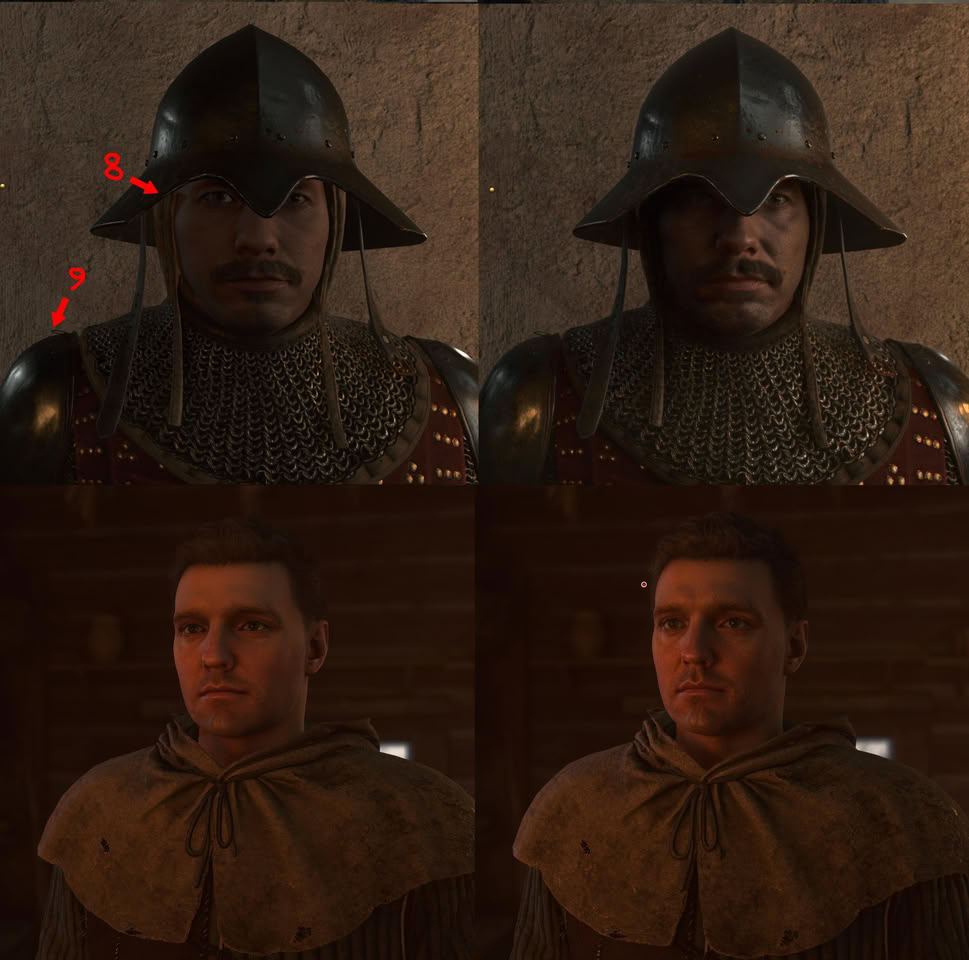
Vávra singled out shadow rendering as a big win. He said Warhorse struggled for years to get shadows from hats, hoods, helmets, and small props like buckles and pouches to render on characters, calling it a persistent frustration during development. DLSS 5 apparently solves this, and Vávra called it an excellent upgrade to the character lighting model, though he noted it roughly halves frame rate in its current form. He also sees potential in DLSS 5 when applied to older games:
"It's not the infamous AI slop we saw couple months ago. I see huge potential here for the future, and it's absolutely great that even older games lighting could be improved this way."
Return to Keyword Browsing
Nov 11th, 2026 06:15 CST change timezone

New Forum Posts

Popular Reviews

TPU on YouTube

Controversial News Posts