Monday, November 16th 2026

AMD-Powered Lux Supercomputer Opens to Scientific Users at Oak Ridge
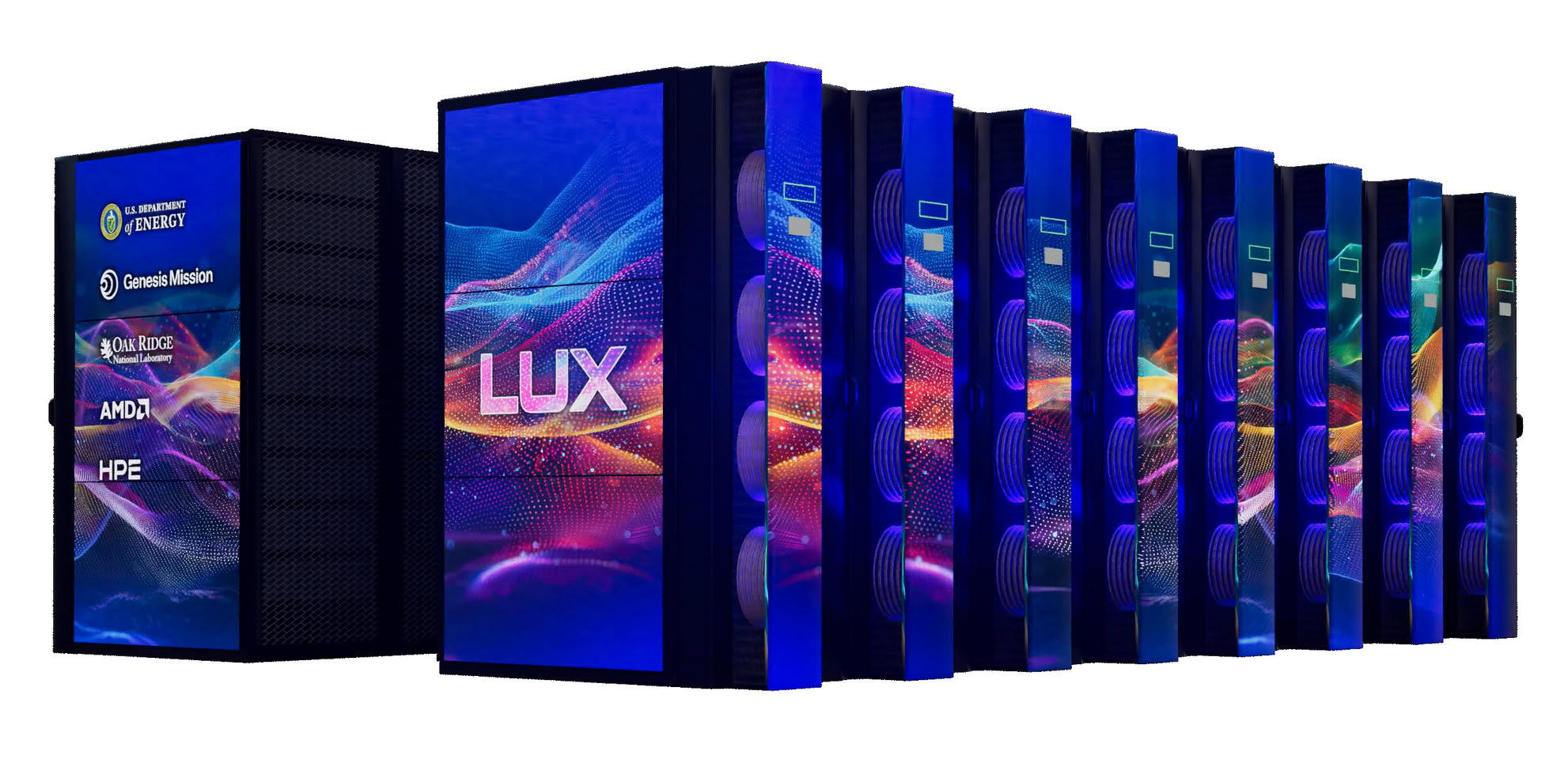
AMD (NASDAQ: AMD) today announced that the Lux SI + HPC supercomputer is open to scientific users at the U.S. Department of Energy's (DOE) Oak Ridge National Laboratory (ORNL). Ranked No. 14 on today's TOP500 list of the world's most powerful supercomputers, Lux was developed through a public-private partnership between AMD and the DOE. The supercomputer provides the first dedicated U.S. AI Factory for the Genesis Mission, the DOE-led initiative to advance AI-driven science.
Lux brings together AMD EPYC processors, AMD Instinct MI355X GPUs, AMD Pensando networking and AMD ROCm software in a system built by HPE. The system combines AI with high-performance modeling and simulation to expand U.S. capabilities in science, energy and national security.
The Genesis Mission projects allocated to run on Lux include AI-assisted fusion power plant design, an AI-based foundation model factory for materials development and advanced manufacturing, and Earth system prediction to forecast water availability, streamflow and river temperature in the Tennessee Valley Authority region.
Lux marks the next chapter in the longstanding relationship among AMD, HPE, DOE and Oak Ridge to advance American science. Building on the computing foundation established at ORNL by the Frontier supercomputer, the first supercomputer to break the exascale barrier, Lux expands that foundation with dedicated capacity for AI-driven research. The upcoming Discovery supercomputer will extend this commitment with deeper integration of AI and high-performance computing. Together, these systems support the Genesis Mission by helping researchers connect simulation, AI and scientific data to accelerate discovery.
AMD is also working with ORNL to support DOE's American Science Cloud, a national platform designed to extend advanced AI and high-performance computing capabilities across DOE laboratories, universities and mission partners in support of the Genesis Mission.
For researchers, Lux provides an opportunity to train and refine models using scientific data, to combine AI with established simulation methods, and to investigate problems that require computing beyond their home institutions. Its delivery extends the AMD and ORNL collaboration behind Frontier into dedicated capacity for AI-driven science.
Researchers and organizations interested in using Lux to advance Genesis Mission research are encouraged to contact ORNL's Oak Ridge Leadership Computing Facility (OLCF) to discuss their computing needs and applicable access pathways. Visit the ORNL Lux resource page to learn more about the system and connect with the OLCF team.
Source:
AMD
Lux brings together AMD EPYC processors, AMD Instinct MI355X GPUs, AMD Pensando networking and AMD ROCm software in a system built by HPE. The system combines AI with high-performance modeling and simulation to expand U.S. capabilities in science, energy and national security.

Thomas Zacharia, senior vice president, Global Public Sector and Strategic Partnerships, AMD"Lux shows what is possible when national laboratories, government and industry work together to advance scientific discovery. By bringing high-performance computing and AI closer to researchers, we are helping them explore new approaches to complex problems and make better use of simulation and experimental data. This partnership builds on a strong foundation at Oak Ridge and supports an open, sovereign AI stack with tools that can benefit researchers across the country".
Georgia Tourassi, associate laboratory director for Computing and Computational Sciences at Oak Ridge National Laboratory"Lux represents the first major addition to DOE's computing infrastructure in support of the Genesis Mission, translating an ambitious national vision for SI-driven science into tangible capabilities for researchers. By expanding the computational resources available to the scientific community, Lux will help accelerate the integration of SI, modeling and simulation, and experimental data to advance discovery in areas critical to our nation's energy, economic competitiveness and security."
Trish Damkroger, senior vice president and general manager, HPC & AI Infrastructure Solutions at HPE"Together with Oak Ridge National Laboratory and AMD, we have delivered breakthrough engineering innovation to advance the nation's scientific computing resources, and now with the debut of Lux, we are furthering what we can accomplish as a proven public-private partnership. We're proud of our continued collaboration and investment in the Genesis Mission to stand up one of its first AI systems that will scale scientific research and make transformative breakthroughs to advance national initiatives."Expanding Computing Access for the Genesis Mission
The Genesis Mission projects allocated to run on Lux include AI-assisted fusion power plant design, an AI-based foundation model factory for materials development and advanced manufacturing, and Earth system prediction to forecast water availability, streamflow and river temperature in the Tennessee Valley Authority region.
Lux marks the next chapter in the longstanding relationship among AMD, HPE, DOE and Oak Ridge to advance American science. Building on the computing foundation established at ORNL by the Frontier supercomputer, the first supercomputer to break the exascale barrier, Lux expands that foundation with dedicated capacity for AI-driven research. The upcoming Discovery supercomputer will extend this commitment with deeper integration of AI and high-performance computing. Together, these systems support the Genesis Mission by helping researchers connect simulation, AI and scientific data to accelerate discovery.
AMD is also working with ORNL to support DOE's American Science Cloud, a national platform designed to extend advanced AI and high-performance computing capabilities across DOE laboratories, universities and mission partners in support of the Genesis Mission.
For researchers, Lux provides an opportunity to train and refine models using scientific data, to combine AI with established simulation methods, and to investigate problems that require computing beyond their home institutions. Its delivery extends the AMD and ORNL collaboration behind Frontier into dedicated capacity for AI-driven science.
Researchers and organizations interested in using Lux to advance Genesis Mission research are encouraged to contact ORNL's Oak Ridge Leadership Computing Facility (OLCF) to discuss their computing needs and applicable access pathways. Visit the ORNL Lux resource page to learn more about the system and connect with the OLCF team.
1 Comment on AMD-Powered Lux Supercomputer Opens to Scientific Users at Oak Ridge
But still the press release talks all about AI. Sad.