Wednesday, November 25th 2026
Seoul Semiconductor Enables Beyond-OLED Picture Quality with LCD
Seoul Semiconductor Co., Ltd., a global opto-semiconductor company, today announced that its 'WICOP Pixel'—the world's first package-free technology, developed by its subsidiary Seoul Viosys—arranges RGB chips at an ultra-fine pitch of several tens of micrometers (µm) to render tens of thousands of colors. Replacing conventional white-light LCD backlights, the technology achieves 100% of DCI-P3 color gamut, the international film industry standard for reproducing natural colors, while delivering more than three times the brightness of OLED displays. The company has entered full-scale mass production and begun expanding supply to global TV manufacturers.
Seoul Semiconductor's display-related revenue in the third quarter rose nearly 20% year-over-year. To meet capacity needs across the global market, the company plans to convert its existing white backlight light-source capacity to WICOP Pixel production rather than make large new investments, while expanding both revenue and profit through a global patent licensing program. In this way, it will support stable production for its customers while generating royalty income, which it plans to invest in expanded research and development in future fields such as biotechnology, 3D printing, AR and AI data communications.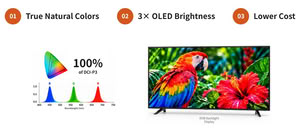
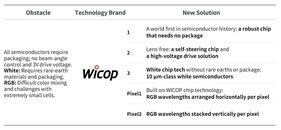 The core of the 'WICOP Pixel' RGB backlight technology is that, while using a standard LCD panel, it reproduces natural colors and scenes more faithfully than OLED and heightens immersion even in bright settings such as living rooms and public spaces. This strengthens its appeal for home-theater TVs and raises product value and profitability for TV manufacturers. In addition, it reduces dependence on expensive LCD panels, and to cut costs further, the company is also researching technology to eliminate the color filter, which accounts for about 20% of LCD panel material costs.
The technology also covers 100% of the DCI-P3 color gamut, the international standard for digital cinema, enabling richer, more vivid color than OLED. Its peak brightness of up to 3,000 nits is more than three times that of OLED, delivering sharp images and strong immersion even in bright indoor and outdoor environments. Experts expect this to further strengthen TV's role as home theaters and to deliver clear images even in bright public spaces. It also offers more than twice the lifespan of OLED.
According to a market research firm Omdia, the shift to RGB backlights—the category that WICOP Pixel technology addresses—is accelerating. Global RGB TV shipments, led by the large-screen premium segment, are expected to reach about 7 million units by 2030, representing more than 10% of global TV market revenue. As the current white-backlight market of about USD 3 billion shifts to RGB, the market is expected to more than double in size with the adoption of Advanced Packaging technology.
Source:
Seoul Semiconductor
Seoul Semiconductor's display-related revenue in the third quarter rose nearly 20% year-over-year. To meet capacity needs across the global market, the company plans to convert its existing white backlight light-source capacity to WICOP Pixel production rather than make large new investments, while expanding both revenue and profit through a global patent licensing program. In this way, it will support stable production for its customers while generating royalty income, which it plans to invest in expanded research and development in future fields such as biotechnology, 3D printing, AR and AI data communications.
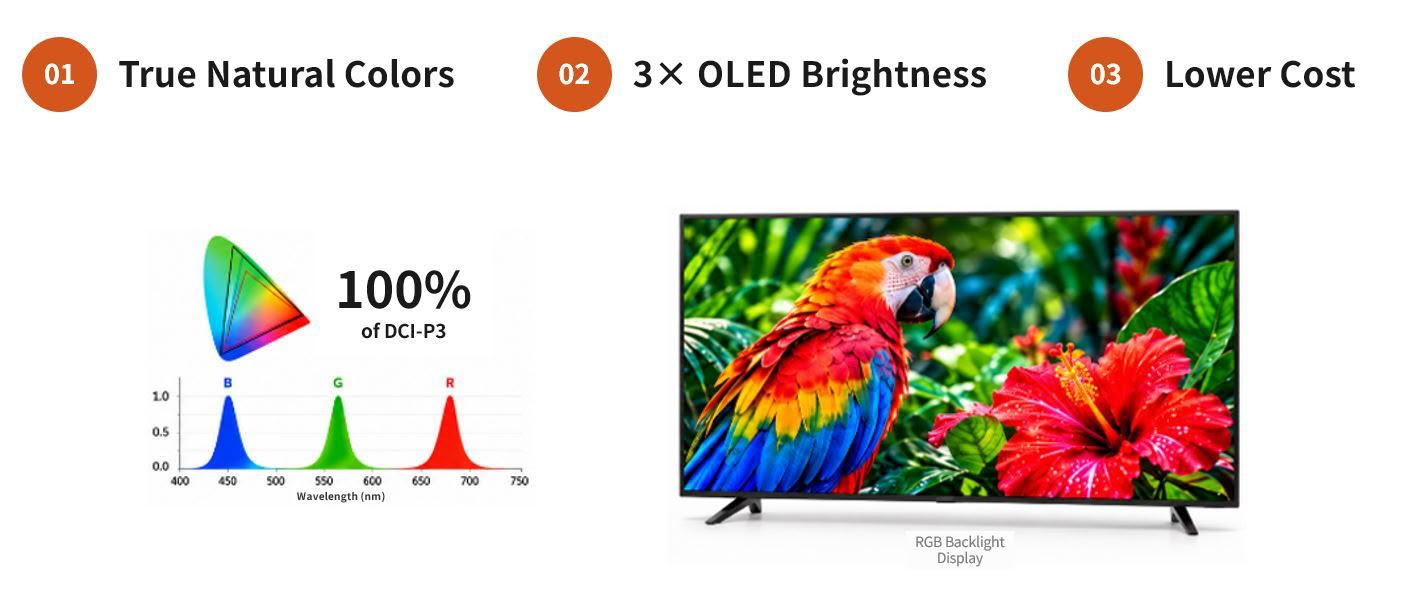
The technology also covers 100% of the DCI-P3 color gamut, the international standard for digital cinema, enabling richer, more vivid color than OLED. Its peak brightness of up to 3,000 nits is more than three times that of OLED, delivering sharp images and strong immersion even in bright indoor and outdoor environments. Experts expect this to further strengthen TV's role as home theaters and to deliver clear images even in bright public spaces. It also offers more than twice the lifespan of OLED.
According to a market research firm Omdia, the shift to RGB backlights—the category that WICOP Pixel technology addresses—is accelerating. Global RGB TV shipments, led by the large-screen premium segment, are expected to reach about 7 million units by 2030, representing more than 10% of global TV market revenue. As the current white-backlight market of about USD 3 billion shifts to RGB, the market is expected to more than double in size with the adoption of Advanced Packaging technology.
- DCI-P3 (Digital Cinema Initiatives - P3): An international color gamut standard used in the digital cinema industry that defines the range of colors a display can reproduce. 100% DCI-P3 coverage means a display can reproduce the standard's entire color gamut.
- BT.2020: An international standard for ultra-high-definition video established by the International Telecommunication Union (ITU).
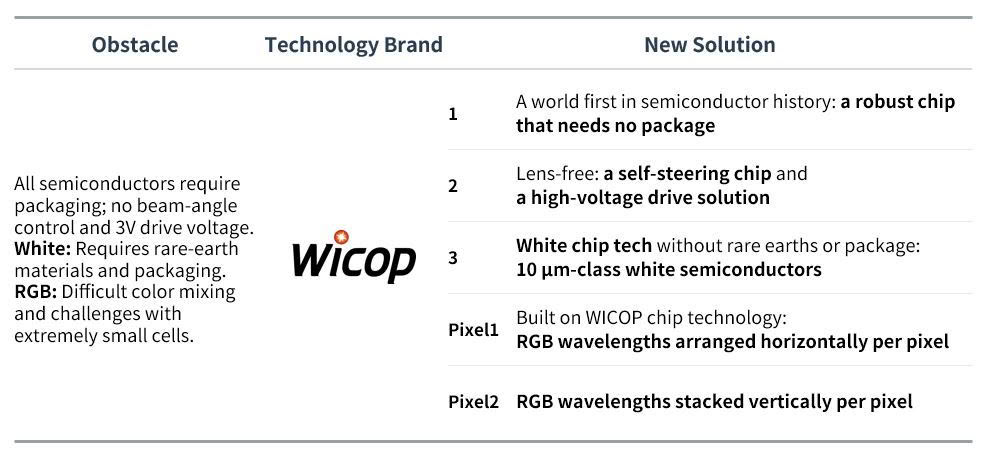
- WICOP Pixel: Seoul Viosys' WICOP is the world's first opto-semiconductor technology that achieves a robust chip structure without a separate package, allowing it to be used like an ordinary electronic component. The WICOP technology previously applied to blue opto-semiconductors has been extended to all wavelengths, including green, red and UV. WICOP Pixel integrates multiple wavelengths, such as red, green and blue, into a single pixel unit. Each color is controlled independently and combined precisely, reproducing tens of thousands of natural colors efficiently and vividly.
2 Comments on Seoul Semiconductor Enables Beyond-OLED Picture Quality with LCD
Probably limited to bigger screen sizes.