Tuesday, July 14th 2026

MSI Unveils the PRO MAX OLED 271UPJW12: The World's First 27-Inch 4K IJP OLED Monitor
MSI, a global leader in high-performance computing, has officially announced the PRO MAX OLED 271UPJW12, marking a new era in visual technology as the world's first 27-inch Inkjet-printed (IJP) OLED display. Designed as the ultimate display, it seamlessly bridges high-efficiency productivity and premium entertainment.
Unmatched Clarity and Infinite Contrast
The PRO MAX OLED 271UPJW12 features a breathtaking 27-inch 4K display with a fluid 120 Hz refresh rate. With a 164 PPI density and an optimized RGB Stripe sub-pixel layout that closely resembles the uniform RGB structure of traditional LCDs, this advanced design effectively eliminates color fringing, optimizing text and image clarity. Delivering pure color precision, the PRO MAX OLED 271UPJW12 covers 99% of the DCI-P3 wide color gamut with an exceptional Delta E ≤ 2 accuracy. Furthermore, it carries the prestigious VESA DisplayHDR True Black 500 certification and achieves a striking HDR peak brightness of up to 1,000 nits, ensuring deep, inky blacks and infinite contrast for a truly lifelike viewing experience.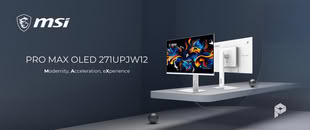 MSI OLED Auto Care: The World's First Uninterrupted OLED Protection
To maintain sustained peak performance, the PRO MAX OLED 271UPJW12 is equipped with cutting-edge MSI OLED Auto Care Technology. Unlike conventional OLED protection that forces disruptive pauses for OLED refreshes, this advanced technology calculates and applies Data Counting Compensation (DCC) dynamically in real-time. This fully automated, background-operating technology eliminates intrusive prompts, providing a truly uninterrupted workflow and gaming experience.
Durability and Comprehensive Wellness
Engineered for rigorous daily use, the PRO MAX OLED 271UPJW12 features an advanced anti-glare (AG) coating that upgrades surface hardness from 2H to 3H, delivering 2.5x greater scratch resistance.
Beyond physical durability, the PRO MAX OLED 271UPJW12 prioritizes your health with MSI EyesErgo technology. It features TÜV-certified hardware low blue light and flicker-free technologies to ensure optimal eye comfort. Furthermore, the IJP OLED is certified with the Eyesafe 3.0 certification by natively restricting harmful blue light emissions to 20% or less, and it also meets the Circadian Protection Factor (CPF) standard. This CPF compliance targets the specific light waves affecting sleep hormones, preventing nighttime screen exposure from disrupting your sleep quality.
The Ultimate Command Center for Productivity
The 27-inch monitor with a flat stand is the definitive choice for desktop efficiency, optimizing your workspace with its space-saving footprint. Engineered as the ultimate command center, the PRO MAX OLED 271UPJW12 integrates built-in KVM, PIP/PBP support, and USB-C with 15 W Power Delivery, empowering you to manage multiple systems seamlessly with just a single set of peripherals. To ensure personalized comfort, a fully adjustable ergonomic stand offers effortless flexibility to suit any viewing angle. Furthermore, robust multi-format support across SDR and HDR modes enables highly customizable display settings, tailored for every scenario.
Sources:
Reddit, MSI
Unmatched Clarity and Infinite Contrast
The PRO MAX OLED 271UPJW12 features a breathtaking 27-inch 4K display with a fluid 120 Hz refresh rate. With a 164 PPI density and an optimized RGB Stripe sub-pixel layout that closely resembles the uniform RGB structure of traditional LCDs, this advanced design effectively eliminates color fringing, optimizing text and image clarity. Delivering pure color precision, the PRO MAX OLED 271UPJW12 covers 99% of the DCI-P3 wide color gamut with an exceptional Delta E ≤ 2 accuracy. Furthermore, it carries the prestigious VESA DisplayHDR True Black 500 certification and achieves a striking HDR peak brightness of up to 1,000 nits, ensuring deep, inky blacks and infinite contrast for a truly lifelike viewing experience.

To maintain sustained peak performance, the PRO MAX OLED 271UPJW12 is equipped with cutting-edge MSI OLED Auto Care Technology. Unlike conventional OLED protection that forces disruptive pauses for OLED refreshes, this advanced technology calculates and applies Data Counting Compensation (DCC) dynamically in real-time. This fully automated, background-operating technology eliminates intrusive prompts, providing a truly uninterrupted workflow and gaming experience.
Durability and Comprehensive Wellness
Engineered for rigorous daily use, the PRO MAX OLED 271UPJW12 features an advanced anti-glare (AG) coating that upgrades surface hardness from 2H to 3H, delivering 2.5x greater scratch resistance.
Beyond physical durability, the PRO MAX OLED 271UPJW12 prioritizes your health with MSI EyesErgo technology. It features TÜV-certified hardware low blue light and flicker-free technologies to ensure optimal eye comfort. Furthermore, the IJP OLED is certified with the Eyesafe 3.0 certification by natively restricting harmful blue light emissions to 20% or less, and it also meets the Circadian Protection Factor (CPF) standard. This CPF compliance targets the specific light waves affecting sleep hormones, preventing nighttime screen exposure from disrupting your sleep quality.
The Ultimate Command Center for Productivity
The 27-inch monitor with a flat stand is the definitive choice for desktop efficiency, optimizing your workspace with its space-saving footprint. Engineered as the ultimate command center, the PRO MAX OLED 271UPJW12 integrates built-in KVM, PIP/PBP support, and USB-C with 15 W Power Delivery, empowering you to manage multiple systems seamlessly with just a single set of peripherals. To ensure personalized comfort, a fully adjustable ergonomic stand offers effortless flexibility to suit any viewing angle. Furthermore, robust multi-format support across SDR and HDR modes enables highly customizable display settings, tailored for every scenario.
18 Comments on MSI Unveils the PRO MAX OLED 271UPJW12: The World's First 27-Inch 4K IJP OLED Monitor
Oh wait, it saves money FOR THE MANUFACTURER while they continue to scalp everyone as hard as runaway late-stage capitalism will let them? They should have made that more clear on all the previous press releases for this technology....
I'm not cynical or surprised, I'm just disappointed.
Grok: Estimated Pricing Context
Based on comparable 27" 4K OLED monitors (mostly QD-OLED or WOLED models from ASUS, MSI, etc.):
- Current similar models (e.g., MSI PRO MAX 271UPXW12G / 271UPX12G QD-OLED variants) are priced around $600–$650 (often listed at ~$599–$650).
- Premium 27" 4K OLED gaming/creator monitors typically range from $600 to $1,000+, depending on refresh rate (120Hz here is moderate), features, and brand positioning.
Likely estimated MSRP: $650–$850 range. It positions as a productivity-focused "PRO MAX" model with unique IJP OLED tech (from TCL panel) for sharper text/uniformity, so it may land toward the higher end of budget-to-midrange 4K OLEDs rather than ultra-premium gaming flagships. Expect official pricing, availability, and retailers to be revealed in the coming weeks/months."MSI, a global leader in high-performance computing, has officially announced the PRO MAX OLED 271UPJW12, marking a new era in visual technology as the world's first 27-inch Inkjet-printed (IJP) OLED display."
2. Is the phrase above not self-explanatory? It's an OLED display where the pixel structure are produced by inkjet (as opposed to the conventional method (which IIRC is some form of vacuum deposition). I fail to see how it could be made easier to understand...
Plain English please?
I can forgive not knowing about inkjet printed OLED, but cmon it’s been the next big thing for over 5 years now. I thought this was an enthusiast site, why complain about it?
More or less, inkjet printing the organic emissives right on the glass should be hardier and have much higher yields than vapor disposition and masking of current oleds. It should also eventually be brighter and cheaper, but obviously it’s been hard to get going. I think TCL is in the lead for TV sized inkjet OLEDs, I wonder who supplies this panel.
You even cut out the part of your own quote that explains some of it, Jesus Christ
OLEDs aren't first hitting the market, they're an established commodity and this tech is purely a benefit to the manufacturer to enable faster and cheaper production. There's nothing in the technology that makes it an inherently better OLED than existing models.