News Posts matching #Asus

Return to Keyword Browsing

ASUS Unveils ROG Rapture GT-BN98, First Wi-Fi 8 Gaming Router

ASUS unveiled the ROG Rapture GT-BN98 at Gamescom 2026, presenting it as the world's first Wi-Fi 8 gaming router. The ROG Rapture GT-BN98 is a quad-band Wi-Fi 8 (802.11bn Draft) router featuring eight distinctive external antennas, giving it a menacing look. It uses a quad-core processor running at 2.6 GHz, 256 MB of flash, and 2 GB of RAM. The router's total throughput goes up to 25,000 Mbps. The 2.4 GHz band reaches up to 1,376 Mbps, both 5 GHz bands hit 5,764 Mbps each, while the 6 GHz band features up to 11,529 Mbps with 320 MHz channel support. Wired connectivity includes one 10G WAN/LAN port, one 10G LAN port, one 2.5G WAN/LAN port, three 2.5G LAN ports, and one standard gigabit LAN. The routers also have USB 3.2 Gen 1 and USB 2.0 ports, and support Router, AiMesh node, Access Point, Repeater, and Media Bridge operating modes.

On the software side, Adaptive QoE handles dynamic bandwidth allocation based on live network conditions while Wi-Fi Insight monitors all bands in real time with continuous interference detection running in the background. Moreover, ASUS bundled GTNet, a third-party service that routes game traffic through the most reliable path to game servers. For security, we have AiProtection that also includes ad and tracker blocking. Guest Network Pro supports up to five SSIDs for IoT management, VPN, and parental controls. No pricing has been announced.



ASUS Intros ROG Gladius IV Ace Wireless Gaming Mouse at Gamescom 2026

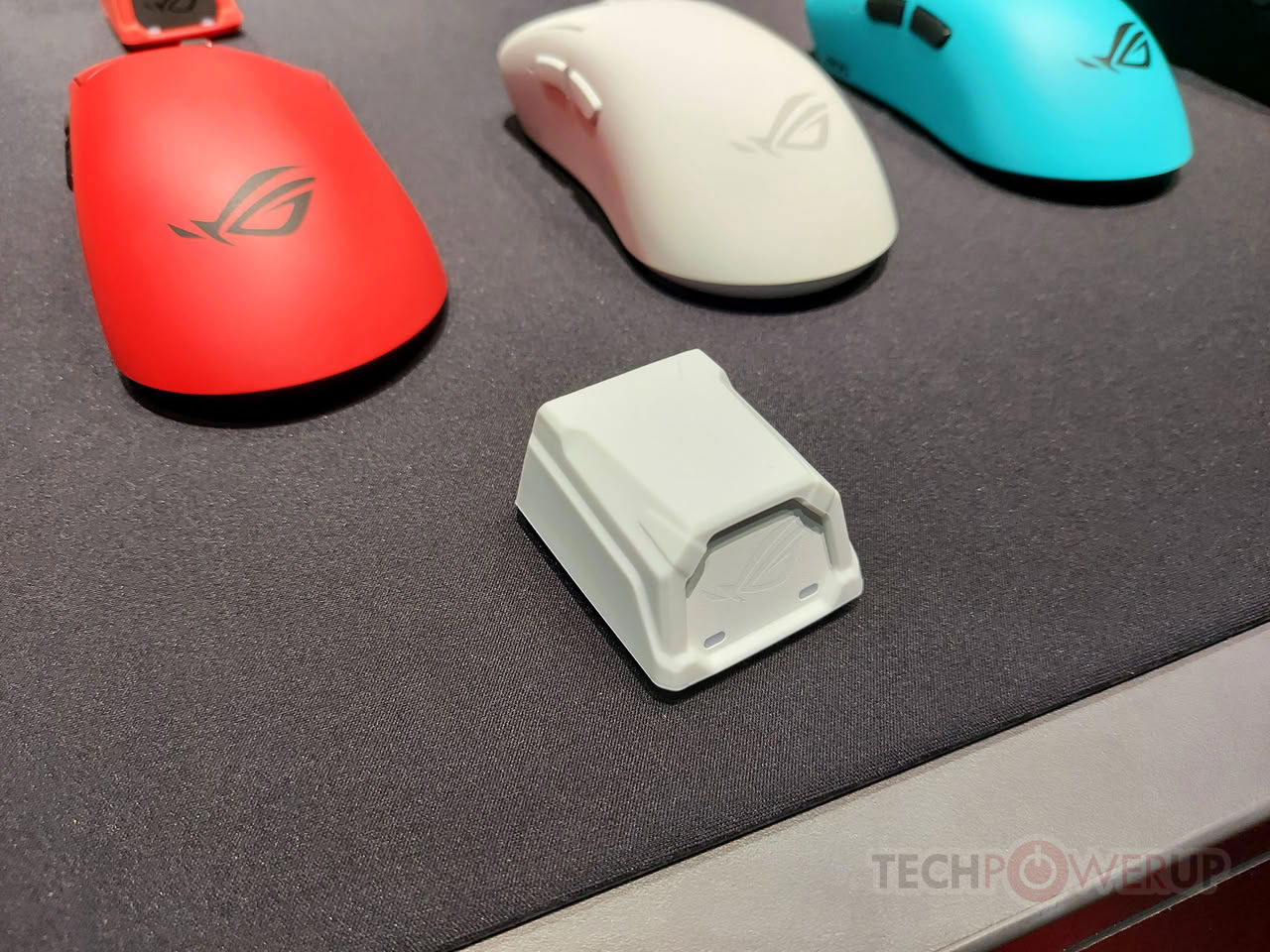
ASUS held an extensive press event today at Gamescom, where, among many new products, the fourth generation of the ROG Gladius gaming mouse was introduced, following the ROG Gladius III that was launched in 2021. The ROG Gladius IV Ace uses an ergonomic design and weighs just 56 g. The weight balance can be adjusted using the three included weights (3 g, 5 g, and 7 g) giving users a total of eight configurations. The mouse itself measures 127.5 x 67.7 x 44.15 mm and uses the ROG AimPoint Pro 65K sensor with up to 65,000 DPI and 11 selectable lift-off distances (LODs). It also features ROG 100M optical micro switches and large 100% PTFE feet. The ROG SpeedNova 8K Gen II receiver provides 8,000 Hz polling and, according to ASUS, improved power efficiency over the previous generation. Connectivity also includes 2.4 GHz RF, Bluetooth 6.0, and USB Type-C wired with the 2-meter ROG Paracord cable included.

The Gladius IV Ace adds a Zone Mode with competition-oriented profiles that adjust polling, sensor responsiveness, frame-rate tuning, and transmit power. Configuration is available through the browser-based ROG Gear Link software. The mouse will be available in Q3 2026 in Black, Moonlight White, Lava Red, and Aqua Blue variants, with a dedicated carrying case. ASUS has not announced pricing yet.
More pictures follow.

ASUS Republic of Gamers Announces New Monitors at Gamescom 2026

As the world's No. 1 OLED gaming monitor brand, ROG further sharpens its competitive edge with the launch of the ROG Swift OLED PG259QWS Ace, the ROG Strix OLED XG259QDPG Ace, and the XG259QDNS Ace. These three 24.5-inch Ace esports monitors are developed with direct input from professional players and expand the ROG OLED Esports monitor lineup, joining the ROG Strix OLED XG259QWPG Ace, which recently made its debut at Computex 2026.

Every Ace monitor shares the tools pros rely on to perform at their best, including integrated measurement scales on the tilt (-5°-+33°), swivel (±45°), and height (0-155 mm) adjustments to help players consistently reproduce their preferred setup; a Quick OSD menu that lets players easily tweak core settings before every game; and three Esports Color modes that provide tailored presets optimized for three different FPS gaming scenarios. Every Ace monitor also incorporates Gallium Nitride Field-Effect Transistor (GaNFET) technology in its power-supply design to optimize heat dissipation to protect the panel and help extend the OLED lifespan.

NVIDIA GeForce RTX 5060 with GB205 Appears in Third-Party AIB Design

NVIDIA's GeForce RTX 5060 mid-range graphics card is officially based on the GB206 GPU die SKU, equipped with 3,840 CUDA cores, 120 TMUs, 48 ROPs, and a total of 8 GB of GDDR7 memory running on a 128-bit bus. This is the standard configuration, which is supposed to be the same across every RTX 5060 GPU you buy from any of NVIDIA's add-in board partners. However, a review of the ASUS DUAL GeForce RTX 5060 OC D7 8 GB by Intek & Company, Quasar Zone revealed that the GPU die inside this graphics card is actually a GB205-200-KB-A1 GPU die SKU. This die is usually found in NVIDIA's GeForce RTX 5070, RTX 5070 Ti Mobile, and RTX PRO 3000 "Blackwell" mobile graphics cards.

When NVIDIA does these GPU SKU crossovers, it usually comes down to binning. Sometimes, GPUs of a lower bin do not meet all the parametric yields, meaning not all CUDA cores are functional. In such cases, the company can repurpose these GPUs as a lower-tier design, as is the case with the RTX 5060. Instead of this SKU going into an RTX 5070 and lacking CUDA cores, ROPs, or TMUs, it is cut down to RTX 5060 specs and used as an RTX 5060 base. No performance difference should be present.

NVIDIA Power Limit Bypass: RTX 5090 OC Hits 700 W, RTX 5080 Up To 680 W. No Shunt Mod Needed

The latest mVolt+ v0.36 update added a number of video card power and voltage management features that appear to make it possible to bypass the stock power limits of some NVIDIA RTX 50-series GPUs without the typical shunt mod or flashing a new vBIOS. Using the new capabilities, one user on r/Overclocking on Reddit claims to have reached 700 W total power draw on their NVIDIA GeForce RTX 5090, scoring 16,523 points in 3DMark Steel Nomad in the process. That's a 125 W up from a stock 5090 TDP of 575 W.

Based on the screenshots of the aforementioned 3DMark benchmark, the GPU topped out at 3,127 MHz, which is a substantial 720 MHz higher than the reference design's 2,407 MHz clock speed. Another user, reporting their results to VideoCardz, managed to overclock an ASUS ROG Astral NVIDIA GeForce RTX 5080 OC to draw a total of 680 W, up from a stock TDP of 400 W—although this can be increased to 450 W with an official tool. In this case, the user notes that there is no shunt mod in use.

ASUS Republic of Gamers Announces ROG Flux Charger Dock

ASUS Republic of Gamers (ROG) today announced the ROG Flux Charger Dock, a premium all-in-one charging and connectivity hub for gamers and creators. With 260 watts of total power output, it easily turns a laptop into a full gaming setup with an external monitor, mouse, and keyboard. A built-in 1.9-inch LCD screen and control knob let users view critical information and adjust settings on the fly. The dock features extensive connectivity options, including USB-C with 140 W charging and 10 Gbps transfer speeds, as well as HDMI 2.1 to support up to 4K @ 144 Hz visuals. Aura Sync compatibility and bold ROG design elements help set it apart from other devices in its class.

Unmatched power
Engineered to deliver 260 W of continuous power, the ROG Flux Charger Dock can easily run any accessory in a gamer's arsenal. The dock can charge a laptop at up to 140 W, with capacity to spare for a gaming handheld, phone, headset, keyboard, and more. The single-cable design allows for neater setups and greater convenience.

Bazzite 44 Gets Official Handheld Launch With Slew of Updates

The development team of Bazzite, the immutable, gaming-focussed Linux distribution based on Fedora Silverblue, has just announced the official stable launch of the handheld version of Bazzite 44, which brings with it a host of new updates for gaming handhelds from the likes of Lenovo, ASUS, MSI, and Ayaneo, among others. This release comes after the Bazzite-deck image release was delayed in late-April due to further development work being needed.

For starters, Bazzite 44 switches away from Handheld Daemon (HHD) for input remapping and controller handling. Instead, the distro now uses InputPlumber for controller support, emulation, and remapping. Other HHD features, like TDP control, will be managed in Bazzite 44 by SteamOS-Manager or PowerStation for devices that don't support SteamOS-Manager.

ASUS Announces Intel-Powered ExpertBook P3 G2

ASUS today announced ExpertBook P3 G2, a laptop designed for modern professionals who demand both performance and day-long comfort. Powered by up to an Intel Core 7 Series 3 processor, ExpertBook P3 G2 delivers fast, responsive performance to help users stay productive throughout the workday, whether tackling everyday business tasks in the office or on the move.

Built for all-day productivity, ExpertBook P3 G2 combines long battery life, fast charging, and durable design to support seamless workflows wherever work takes users. Protected by ASUS ExpertGuardian NIST SP 800-155 compliant BIOS and Windows 11 Secured-core technologies, it safeguards privacy and business data while delivering dependable protection for today's modern workstyles.

ASUS Announces the New ExpertBook B3 G2

ASUS today announced the new ASUS ExpertBook B3 G2, a configurable laptop designed for business, available in 14-inch (B3406CMA) and 16-inch (B3606CMA) models and featuring a durable, lightweight design starting from just 1.45 kg that offers a 180° lay-flat hinge, AI capabilities. enterprise-grade security, and seamless collaboration.

Powered by up to the latest Intel Core 7 Series 3 processors with integrated GPU and NPU acceleration, ASUS ExpertBook B3 G2's advanced AI features—including Microsoft Copilot, and AI noise-canceling technology—enhance business productivity. The lightweight, easy-maintenance design offers extensive I/O options and support for high-speed WiFi 6E connectivity. Security is strengthened by ASUS ExpertGuardian, delivering NIST SP 800-193 compliance, dual ROM recovery, and TPM 2.0 protection for robust data resilience.

ASUS GPU Tweak III Adds Auto-Shutdown to Prevent 12V-2×6 Meltdowns

The NVIDIA 12v-2×6 GPU power cable meltdown debacle seems to be something of a cat-and-mouse game, in which GPU board partners and PSU manufacturers keep trying to find workarounds and new safeguards against the GPU cables that have now claimed many a gaming GPU. ASUS's latest GPU Tweak III V2.1.8.0 update adds yet another feature to help save GPUs from potential temperature-induced premature failure.

The GPU Tweak III update adds support for auto-shutdown on GPU models with Power Detector+, which will shut down a system when "persistently high current is detected." ASUS has not shared what the exact parameters are for high current or how long the high current must be sustained before it triggers. Being limited to Power Detector+ GPUs means that auto-shutdown is limited to the ASUS ROG Astral GeForce RTX 5090, ROG Astral LC GeForce RTX 5090, ROG Astral GeForce RTX 5080, and ROG Matrix GeForce RTX 4090 GPUs.

ASUS Republic of Gamers Announces Raikiri II Pro PC Controller

ASUS Republic of Gamers today announced the ROG Raikiri II Pro PC - the ultimate gaming controller with competition-grade 8K polling rate, extensive customization options including hot-swappable joysticks for a tailored feel, and industry-leading battery life. The ROG Raikiri II Pro PC provides gamers with unparalleled precision control to dominate gaming arenas.

Ultimate precision and ultra-low latency
The ROG Raikiri II Pro PC controller boasts an 8000 Hz polling rate and 2.4 GHz wireless performance enhanced by ROG SpeedNova technology for incredibly responsive control and ultra-low latency. All buttons - i.e., D-Pad, ABXY, and rear buttons - and bumpers feature micro switches for instant actuation and crisp, tactile feedback. In addition, the Dual Mode Triggers feature lets gamers seamlessly switch between short-travel, micro-switch and TMR sensor triggers with full travel, allowing for a tailored feel based on game genre.

CXMT Breaks 9,000 MT/s Barrier with DDR5

Chinese memory giant CXMT has finally surpassed 9,000 MT/s on the AMD platform, rivaling DRAM kits from Micron, SK hynix, and Samsung. On the Colorful iGame X870E VULCAN W OC motherboard, an iGame Shadow II 24G×2 kit with 48 GB of memory achieved speeds of 9,000 MT/s. In the provided screenshot, the kit runs at 4,507 MHz, which translates to over 9,014 MT/s, thanks to double data rate technology. Late last year, CXMT announced that its DDR5 could reach 8,000 MT/s, but now we see that overclocked memory can exceed these speeds on the AMD platform.

Additionally, CXMT is working on improving latency. Some Colorful iGame Shadow II 24Gx2 48 GB kits are being tested on ASUS motherboards to achieve ultra-low latency, matching the performance of the top three memory manufacturers. On the latest AMD and Intel platforms, Colorful has tested DDR5 kits running at 6,000 MT with CL30 latency and even some preliminary tests with CL28 latency. This is a promising sign that CXMT memory is finally meeting the standards of competing DRAM from the leading memory makers in both transfer rate and latency.

Global OLED Monitor Shipments Grew 26.1% QoQ in 2Q26; ASUS Extended Its Lead Over Samsung While MSI Closed the Gap

TrendForce's latest market research shows that the global OLED monitor market maintained strong growth momentum in 2Q26. Shipment growth was driven by the launch of new models, strong demand generated by China's 618 shopping festival, and the continued adoption and promotion of 27-inch QHD monitors, the market's dominant product segment.

Supported by these factors, global OLED monitor shipments increased 26.1% QoQ in 2Q26 and surged 98% YoY, nearly doubling from the same period last year. The results underscore the rapid penetration of OLED technology in the gaming and premium display markets.

CXMT Surpasses 90% DDR5 Yield, Challenges Industry Giants

Chinese memory giant CXMT has reportedly achieved a significant milestone in DDR5 production, with manufacturing yields now comfortably above 90%. This is comparable to what major manufacturers like Samsung, SK hynix, and Micron are achieving. According to reports, CXMT uses a 17 nm node for DDR5 chip production and has reached a 90% yield for these chips. This is only 2-3% lower than Samsung's yield on its 10 nm class node for DDR5 production, indicating that CXMT's production quality is matching that of the world's largest memory maker. This is a remarkable achievement for a company that excels in cleanroom construction time, taking only 12 months to build its fab's cleanroom compared to the two years others require. As the company plans to end the year with 350,000 DRAM wafers per month, high yields mean there is little waste or leftover.

Chinese MyDrivers also notes that PC OEMs have mixed reactions to adopting CXMT DRAM in their products. For instance, Dell has completely banned the use of CXMT in its machines, while HP only allows CXMT DRAM in its Chinese PCs. Major Taiwanese brands such as ASUS and Acer have increased adoption in some models, as they have more flexibility in supply chain procurement. However, both companies use CXMT memory for PCs sold in mainland China and some emerging markets, meaning the West is still far from receiving PCs with CXMT memory modules. PC OEMs are also cautious about procuring CXMT memory due to concerns about disrupting their relationships with the big three memory makers.

ASUS Bundles 3 Months of Google AI Pro 5TB or Google AI Plus 400GB with Eligible Notebooks

ASUS announced a new offer with Google that gives customers who purchase selected eligible ASUS and ROG laptops access to three months of Google AI Pro or Google AI Plus at no extra cost. The offer is designed to help users do more than use AI on a single device. It opens the door to a broader Google AI ecosystem for creating, studying, working, researching, and building, together with expanded cloud storage.

With this offer, eligible ASUS customers can start exploring more Google AI experiences as soon as they set up a new laptop. As the top-level offering, Google AI Pro unlocks expanded access to Google's most capable Gemini models and higher usage limits to Google's AI tools that power advanced creative and professional workflows. This plan comes with a massive 5 TB of cloud storage. Google AI Plus delivers an accessible entry point to Google's AI tools, offering elevated model performance, creative generation and productivity features, and 400 GB of cloud storage.

ASUS DisplayWidget Center Update Introduces AI Agent-Ready Controls

ASUS today announced a major update to the ASUS DisplayWidget Center monitor management software, providing users with a more intuitive way to control compatible ASUS and ROG displays. This latest release adds AI-based automation, deeper personalization with App Tweaker and OLED Care, and broader device integration—all while keeping monitor management simple with a mouse or keyboard instead of physical monitor buttons. Available as a free download from the ASUS website, DisplayWidget Center supports Windows 11 or later and macOS on compatible devices. Additional improvements include a firmware update notification feature and one-key product registration that automatically fills in the device serial number.

AI agent-ready display control
This latest update to DisplayWidget Center moves it into the AI agent era. With ASUS Display Control Command Line Interface (CLI) and Agent Skill installed, compatible AI agents can adjust monitor settings through natural-language requests. Users can manage brightness, color mode, color temperature, and OLED Anti-Flicker without having to manually navigate through menus.

ASUS ROG Quietly Launches 10 Gbps Ethernet USB Dongle

If you've been looking at adding faster networking at home, but either don't have a spare PCIe slot in your PC or need it on a laptop, then ASUS ROG might just have launched what you've been waiting for. Its new ROG USB-C10G USB dongle brings 10 Gbps Ethernet in a fairly compact form factor of 85 x 32 x 19 mm and 38 grams, without the cable. ASUS went down what we'd call the correct route here by not having a captive cable, instead the dongle has a USB Type-C port and is supplied with a short USB-C to USB-C cable that also comes with a USB-C to USB-A adapter.

As this is most likely a Realtek RTL8159 based Ethernet dongle, it has one quirk that means it won't work with some computers, as this is a USB 3.2 Gen 2x2 device. Yes, that's 20 Gbps, but as the USB protocol has quite a bit of overhead, USB 3.2 Gen 2 won't be enough for 10 Gbps Ethernet, instead you end up somewhere between 6 and 8 Gbps based on tests we've seen of other RTL8159 dongles. This means that it's not compatible with Macs, as Apple only supports USB 3.2 Gen 2 and USB4/Thunderbolt. This also means that you will limit the throughput if you use the USB-C to USB-A dongle. ASUS hasn't provided any official pricing, but we found a listing online from a Norwegian retailer that stocks it for around US$139, including 25 percent VAT, suggesting it might retail for US$100-120 once it becomes more broadly available.

Lexar Lists 32 GB DDR5-7200 Memory With Chinese DRAM at $592

Lexar has introduced a new THOR RGB DDR5 Gen 2 32 GB memory kit, consisting of two 16 GB DDR5 modules, specifically for the Chinese market. The kit features DDR5 memory running at 7,200 MT/s, with the actual DDR5 modules produced by an unidentified Chinese DRAM manufacturer, likely CXMT. The latest THOR RGB 32 GB kit offers memory with 38-48-48-86 CAS latency timings at 1.40 V and supports Intel's XMP 3.0 and AMD EXPO profiles to achieve maximum frequency and overclocking potential. While the exact overclocking range of these modules is unknown,

Lexar has not explicitly disclosed which Chinese DRAM maker is used for this DDR5 kit, but it is assumed that CXMT DRAM is housed under the sandblasted aluminium heat spreaders. The company tested a variety of ASUS and MSI motherboards on both AMD and Intel platforms, even mentioning a 32 GB kit with 7,600 MT/s speeds, as opposed to this newly listed 7,200 MT/s kit. It is likely that more motherboards and vendors will be compatible without issues, but only those mentioned in the list below were tested. Lexar's official JD store lists the price for the THOR RGB DDR5-7200 32 GB kit at 3,999 RMB, which is approximately $592 at the time of writing, based on the current exchange rate. This kit is meant for the mainland China, with no mention of global availability.

ASUS Announces Prime AP304 PC Case

ASUS today announced the ASUS Prime AP304, a versatile panoramic ATX case designed to showcase system components with style. It features a patented slot vent with a three-sided ventilation structure to provide optimal cooling for the graphics card, reinforced clamp and bracket, and an integrated ARGB light band that works seamlessly with ASUS Aura Sync. To give users additional cooling options, the ASUS Prime AP304 ARGB variant comes with four pre-installed ARGB fans.

A curved-glass panel wraps around the front to the side of Prime AP304, providing a panoramic view of the inside of the case. This glass panel undergoes a five-stage manufacturing process that approaches aerospace standards, including a tempering process that gives it superior strength and durability. This technique helps ensure reliable protection while elevating the DIY experience, offering users an immersive and refined foundation for their build. In addition, the curved glass panel features an easy-detach rail, making removal and reattachment safe and simple.

ASUS Announces ProArt Display OLED PA279CDV and PA329CDV Monitors

ASUS today announced two new additions to the ProArt OLED monitor lineup: ProArt Display OLED PA279CDV and PA329CDV. The 26.5-inch ProArt Display OLED PA279CDV and 31.5-inch PA329CDV boast 4K QD-OLED panels with up to 1000 nits peak brightness (3% area) for exceptional contrast. Both monitors offer 99% DCI-P3 and true 10-bit color depth for exceptional color reproduction. Designed to surpass industry standards, these monitors are factory calibrated to Delta E<1.5 color accuracy, making them ideal for video editing, color grading, and other professional post-production workflows. The panel of both monitors are protected by an anti-scratch film that increases panel hardness for up to 2.5X better scratch resistance compared to previous-generation QD-OLED panels.

PA279CDV and PA329CDV are Mac-friendly and feature the M Model-P3 color setting to ensure consistent colors on macOS devices. Plus, ASUS DisplayWidget Center is available for macOS, enabling convenient control over any ProArt display.

ASUS Accelerates Enterprise AI at Scale with 6th-Gen AMD EPYC Server CPUs

ASUS today announced its groundbreaking new server lineup powered by the AMD EPYC 9006 processors, engineered to deliver unmatched performance for the most demanding intensive enterprise workloads. This advanced portfolio introduces two highly optimized series with efficiency-optimized AMD EPYC SP8 server CPU, the flagship dual-socket ASUS RS700A/720A for extreme compute density and the single-socket ASUS RS500A/520A for superior space efficiency and deployment flexibility.

Both series integrate full PCIe 6.0, leading memory support, and high-density E3.S storage, all underpinned by proprietary ASUS innovations for superior thermal management and operational efficiency to meet and exceed the rigorous demands of enterprise AI, virtualization, storage and cloud environments.

ASUS Releases Beta Version of Zenni Claw for Supported ASUS Devices

ASUS today announced the beta release of ASUS Zenni Claw, an agentic AI software designed to help users of supported ASUS devices turn everyday prompts into guided, task-oriented workflows. First introduced at Computex 2026, ASUS Zenni Claw makes agentic AI more approachable for everyday users. Instead of starting from a blank prompt or having to go through a complex setup process, users can leverage ready-to-use AI assistant skills across work, travel, and daily planning.

Unlike traditional AI chatbots that primarily respond to questions, ASUS Zenni Claw is designed to help users move through tasks. By combining guided workflows and ready-to-use skills, it gives users a simpler way to understand what agentic AI can do in real-world scenarios. The beta release of ASUS Zenni Claw marks the next step in ASUS's broader effort to make AI PC experiences more practical, personal, and accessible. It gives users a more approachable way to explore agentic AI on supported ASUS devices.

Steam Deck Sales Crash After Price Hike in May

Despite a notable sales blip immediately following the recent RAMpocalypse-driven price hikes, which saw Steam Deck prices skyrocket by $240-300 overnight, it appears as though sales for the Steam Deck have plummeted since the price increases.

According to a recent report by Boiling Steam, which tracks Steam hardware sales by extrapolating Valve's Top Sellers chart data, there has been a massive decline in Steam Deck sales since the beginning of June. The analysts report that the Steam Deck's slide from fifth to 14th in the Top Sellers chart could represent an up to 82% decline in weekly sales figures.

Samsung Display Supplies Tandem OLED Laptop Panels With VESA DisplayHDR True Black 1400

Samsung Display announced today that it has begun the full-scale supply of tandem OLED panels for laptops that meet VESA DisplayHDR True Black 1400, VESA's new certification tier for high-brightness OLED displays. Samsung Display is working with global PC manufacturers to expand the premium laptop OLED market with significantly enhanced brightness performance.

Announced by VESA this month, VESA DisplayHDR True Black 1400 requires a display to reproduce black levels of 0.0005 nits or lower while achieving peak brightness of 1,400 nits at a 10% On Pixel Ratio, or OPR, which refers to the percentage of active pixels among all pixels that make up the screen. The new tier raises the peak brightness requirement by 40% compared with True Black 1000, previously VESA's highest certification level. Products certified to True Black 1400 combine OLED's signature true black performance with enhanced brightness to deliver exceptional viewing quality.

iFixit Slams ASUS ROG Flow Z13's 10/10 Repairability Score

When ASUS launched the ROG Flow Z13 gaming 2-in-1 in 2025, it proudly boasted about the convertible's 10/10 repairability score—a self-reported score that evaluates the repairability of a product based on the availability of parts, documentation, repair cost, and how easy it is to access the internals for parts replacement.

Just recently, iFixit, the popular repair and right-to-repair activism company, got its hands on the Flow Z13 for one of its teardown repairability analyses, and after taking the device apart, iFixit gave the Flow Z13 a much more reserved 7/10 repairability score. Of course, this is still a reasonably high score, especially considering how compact the Flow Z13 is, but it's nowhere close to the 10/10 that ASUS gave itself based on the French index.
Return to Keyword Browsing
Nov 25th, 2026 22:55 CST change timezone

New Forum Posts

Popular Reviews

TPU on YouTube

Controversial News Posts