Monday, August 17th 2026

CXMT Breaks 9,000 MT/s Barrier with DDR5
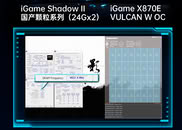
Chinese memory giant CXMT has finally surpassed 9,000 MT/s on the AMD platform, rivaling DRAM kits from Micron, SK hynix, and Samsung. On the Colorful iGame X870E VULCAN W OC motherboard, an iGame Shadow II 24G×2 kit with 48 GB of memory achieved speeds of 9,000 MT/s. In the provided screenshot, the kit runs at 4,507 MHz, which translates to over 9,014 MT/s, thanks to double data rate technology. Late last year, CXMT announced that its DDR5 could reach 8,000 MT/s, but now we see that overclocked memory can exceed these speeds on the AMD platform.
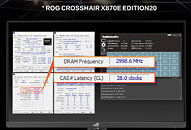
Additionally, CXMT is working on improving latency. Some Colorful iGame Shadow II 24Gx2 48 GB kits are being tested on ASUS motherboards to achieve ultra-low latency, matching the performance of the top three memory manufacturers. On the latest AMD and Intel platforms, Colorful has tested DDR5 kits running at 6,000 MT with CL30 latency and even some preliminary tests with CL28 latency. This is a promising sign that CXMT memory is finally meeting the standards of competing DRAM from the leading memory makers in both transfer rate and latency.
 Earlier reports indicate that CXMT uses a 17 nm node for DDR5 chip production and has achieved a 90% yield for these chips. This is only 2-3% lower than Samsung's yield on its 10 nm class node for DDR5 production, suggesting that CXMT's production quality is approaching that of the world's largest memory maker.
Sources:
Colorful on Weibo, ASUS on Bilibili
Additionally, CXMT is working on improving latency. Some Colorful iGame Shadow II 24Gx2 48 GB kits are being tested on ASUS motherboards to achieve ultra-low latency, matching the performance of the top three memory manufacturers. On the latest AMD and Intel platforms, Colorful has tested DDR5 kits running at 6,000 MT with CL30 latency and even some preliminary tests with CL28 latency. This is a promising sign that CXMT memory is finally meeting the standards of competing DRAM from the leading memory makers in both transfer rate and latency.


60 Comments on CXMT Breaks 9,000 MT/s Barrier with DDR5
if USA tries to bully other countries to ban it, they will laugh in USA face, just as they did with the other tariffs. USA is losing trading partners and other countries are creating new trade deals, world is changing fast. USA is losing leverage at an incredible rate.
More to the point, China is the largest market for consumer electronics on earth. China just supplying China will do a number to the big 3's demand. The other members of BRICS (brazil, India, Russia, South Africa) will happily buy Chinese memory. Lenovo already uses YTMC flash in German builds and likely much of the EU already, and CXMT can't be far behind. South America will also happily buy it.
You could probably get the five eyes countries and western Europe to enforce a ban, but that sphere of influence has its limits. The cat is long out of the bag, and this was the predicted result when export controls were placed on the Chinese in the first place.
so not sure what your point is
Wait until you find out about undersea cables.
www.reuters.com/technology/european-countries-who-put-curbs-huawei-5g-equipment-2023-09-28/
The US gets what they want eventually.
www.microgridknowledge.com/data-center-microgrids/article/55398420/nvidia-leads-500-billion-private-equity-investment-in-ai-infrastructure-and-power-solutions
www.cnbc.com/2026/08/17/nvidia-financing-open-ai-data-center-ohio.html (a few weeks ago they said $250 billion dollars)
Yet, independent countries will not comply... Kinda like already happened with oil tariffs.
And then, US can just play along, or lose.
The EU, on the other hand, was much slower to follow. In 2023, a significant portion of their equipment was still made by the likes of Huawei. It was only in 2025 when a ban on ZTE and Huawei was considered based on the results of the 5g toolbox, and they have 3 years to implement those changes, so that will be almost a decade after the US demanded those changes. As of may 5th 2026, that ban has STILL not been implemented, merely existing as a non binding pressure point. And Huawei consumer products are still available in all the affected countries, including the UK. Only the US bans the consumer devices. And as I said, YTMC is used in laptops sold in the EU, despite it being banned in the US.
securitypointbreak.com/2026/05/05/eu-huawei-zte-telecom-security-supply-chain-risk/
cepa.org/article/ban-huawei-not-europe/
And this ignores the rest of the globe. As stated, BRICS isnt going to listen to the US. South America is no longer in America's sphere of influence. The middle east obviously wont be listening. SE asia isnt going to listen.
Any sort of ban the US puts on CXMT will only be of limited effectiveness. As I said, it will be effective in Five eyes countries, and possibly in western Europe, but not globally. The US has lost far too much influence to pull that off today.
ram is different though, i don't see it being as big a threatyep, this is the key point I was trying to make. other countries are already making new trade deals with each other, ignoring USA entirely, first time it has happened to my knowledge.
Scam Altman said he was going to buy 40% of the world's dram wafers but didn't buy any of it, the dram cartel still used it as an excuse to massively increase the price of ram and ssds and you wonder why people are skeptical about that supply and demand?
Altman is one man. OpenAI is one company. They are a multitude of companies running in the AI race, and a multitude of companies making products. As far as the RAM cartel is concerned, they are sold out for 2026 and 2027 with reservations. Now regardless if those RAM sticks sit in warehouses, or go on GPUs, or ever reach a data center, they have been purchased. From their perspective, demand exceeds supply.
CXMT is the same way. They are selling every chip they produce. If one billionaire is stockpiling those chips in a warehouse or if its going into millions of gaming PCs is irrelevant to the discussion about supply and demand. For CXMT, they are selling out. Period. Now, wether that demand can be SUSTAINED is where your arguments come in, but those are immaterial to the fact that the memory makers have their entire production spoken for, and until that changes, they have no reason to lower prices. If they can pump western AI companies for tens of billions for overpriced RAM and use that to fund new facilities, they're going to do that so long as the market supports it.
What matters is that CXMT IS growing production, at a significant rate. When supply matches demand, and it will, either by expansion efforts or, more likely, a cooldown in demand, CXMT will bein an excellent position to undercut the competition. But that wont happen until supply catches up.We have heard the same "sky is falling" claims for years. Remember how hard drives would never come down after the 2011 floods? Remember how Crypto would make all GPUs unaffordable forever in 2015? How about how GPUs would never be in supply in 2020?
AI companies will eventually reach equilibrium where the growth slows down and supply catches up.
AI companies simply won't slow down their demand, because without constant growth investors will worry that AI is an unsustainable bubble, and supply cannot catch up because datacenter companies will always want the latest cutting edge memory. The modern corporate tactic is to want constant growth year over year forever, even though it's not sustainable or logically possible.
CXMT catching up is good news, but it doesn't matter since the US will likely ban it anyway, only making exemptions for massive companies like HP or Dell who "donate" a pile of cash to get around the ban.
Competition would be zero-sum, meaning what one wins, the others lose. But CXMT is just going to allow the market to grow.
*Yes it's easy to be gratuitously cynical and claim without proof that they are, especially since they have been found guilty of it in the past. But that was a quarter century ago, and nothing indicates that the current situation is not what the industry claims it is, i.e. simple market economics of supply/demand due to the AI boom.