News Posts matching #FSR 4.1

Return to Keyword Browsing

AMD FSR 4.1.2 Modded to Run on Intel Arc GPUs Leveraging XMX Cores

OptiScaler is a community-driven project that seeks to bring the benefits of upscaling and frame-generation across brands of GPUs, so gamers don't miss out on playability if the game doesn't feature the upscaler/frame-gen tech provided by their GPU vendor. The community successfully modded AMD FSR 4.1.2 to work on Intel Arc GPUs, leveraging the Intel XMX cores (Xe Math Extensions). Current implementations of FSR on Arc relies on a fallback DP4a path that offers significantly lower performance benefit.

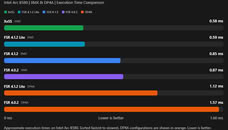
DarkerThanLpDark on Reddit put FSR 4.1.2 Lite on Arc B580 to the test in "Clair Obscur: Expedition 33," comparing its performance with the game's native XeSS implementation, and FSR's standard DP4a implementation on Arc GPUs. The latest OptiScaler mod was found offering almost the same levels of performance as XeSS (SR). FSR 4.1.2 Lite logged an upscaling time of 0.59 ms compared to 0.58 ms of XeSS (SR).

ASUS Rolls Out FSR 4.1 Preview for ROG Xbox Ally Handhelds

ASUS has started rolling out a preview GPU driver that brings AMD FSR 4.1 upscaling to the ROG Xbox Ally X and ROG Xbox Ally X20. Owners can grab it through Armoury Crate SE under Update Center, then Preview Updates. This follows AMD's announcement earlier this week that FSR 4.1 is expanding to Radeon RX 6000 series GPUs, APUs, and Xbox. According to ASUS, the handheld version runs on a lighter model that is less than half the size of the original INT8 model, built with the Ryzen AI Z2 Extreme in mind. FSR 4.1 works in over 400 games that support FSR 3.1 or newer. Handheld owners have waited a while for this, as AMD previously had no definitive decision on RDNA 3.5 APUs before confirming FSR 4 for APUs by the end of 2026.

Once FSR is enabled in a game's settings, users also have to add the FSR tile in Command Center and switch it on. ASUS warns that RSR, the system-level upscaler, should not be combined with it. Neither AMD nor ASUS has shared any performance numbers yet, and ASUS notes that preview updates may still have bugs. As for the regular ROG Xbox Ally, ASUS says it will also get support through a GPU driver update coming soon, though there's no date yet. The Xbox Series X|S consoles are next in line and will reportedly get FSR 4.1 in the coming weeks, while FSR Diamond has already been teased for Project Helix.

AMD Software Adrenalin 26.10.1 WHQL Drivers Released

AMD has released its Adrenalin 26.10.1 WHQL graphics drivers, adding FSR Upscaling 4.1 support for Radeon RX 6000 series graphics cards and several Ryzen AI processor families. The release follows yesterday's announcement that AMD plans to bring FSR 4.1 to older Radeon GPUs, APUs, and Xbox. The new upscaling version supports Radeon RX 6000 series graphics products released back in 2020 and powered by the RDNA 2 graphics architecture. AMD FSR Upscaling 4.1 also arrives to Ryzen AI Max "Strix Halo" and "Gorgon Halo" APUs, and Ryzen AI 9 "Strix Point" and "Gorgon Point" mobile processors. The drivers also add support for Call of Duty: Modern Warfare 4, STAR WARS: Galactic Racer, and FINAL FANTASY RESONANCE.

In these new graphics drivers, AMD has fixed a stuttering issue that could occur in Call of Duty: Modern Warfare 4 on Radeon RX 6000 series graphics products and newer models. Several known issues remain, as detailed in the release notes that follow, as usual.

DOWNLOAD: AMD Software Adrenalin 26.10.1 WHQL

AMD and Microsoft Bring FSR 4.1 to Xbox Series X|S, FSR Diamond Teased for Project Helix

AMD and Microsoft have confirmed that FSR Upscaling 4.1 is coming to the Xbox Series X and Series S. The news came in an AMD video presentation led by Jack Huynh, joined by Xbox CTO Scott Van Vliet and ASUS. The ROG Xbox Ally handhelds are getting it too, and it looks like they will be first in line, while the consoles are only listed as "coming soon." Neither company has shared a release date or a list of supported games. Both consoles use RDNA 2 graphics, the same architecture as the Radeon RX 6000 series, which AMD also announced FSR 4.1 for today, well ahead of the early 2027 target it set in May. Here's what Van Vliet said:
With FSR 4.1 coming to Xbox. Now, we've worked very closely with AMD to optimize this technology, giving developers another powerful tool for great performance and visual quality for players. Now, whether you're playing on an Xbox Ally handheld, as well as coming soon to Xbox Series X and Series S consoles. And this is just the beginning. Our teams are continuing to work together across hardware and software, and there's even more ahead with Project Helix, leveraging FSR Diamond to power what comes next.

AMD Announces FSR 4.1 for Radeon RX 6000 Series, APUs, and Xbox

AMD is bringing FSR 4.1 to even more graphics cards and gaming platforms; in a major announcement today by Jack Huynh, SVP & GM, Computing & Graphics, the company announced that it is bringing FSR 4.1 to Radeon RX 6000 series graphics cards powered by the RDNA 2 graphics architecture, which date back to 2020. AMD has developed and optimized FSR 4.1 for the entire range of RX 6000 series GPUs, from the top RX 6950 XT, down to the entry-level RX 6400.

Next up, the company announced that it is bringing FSR 4.1 to the integrated graphics solutions of its APUs, spanning all Ryzen AI Max "Strix Halo" and "Gorgon Halo" APUs, Ryzen AI 9 "Strix Point" and "Gorgon Point" mobile processors. FSR 4.1 is also coming to the Ryzen Z2 series processors for gaming handhelds. Lastly, the company announced that it has worked with Microsoft to bring FSR 4.1 to Xbox Series X and Xbox Series S consoles.

AMD Radeon Owners Can Now Run Nearly Every DLSS Feature Through Fan-Made Mod

Daniel Blanco's DLSS-NR on AMD project has grown well past its original scope. The mod first got NVIDIA's DLSS 5 Neural Rendering running on Radeon cards back in September, and later pulled off a 74% performance jump in a single day. The new Alpha 0.8.0 release, published on October 17, now brings almost the whole DLSS stack to AMD GPUs. That includes DLSS 4.5 Super Resolution (Models M and L), Ray Reconstruction (Model F), and Frame Generation with up to 4x multi-frame generation (MFG) in games that expose DLSS FG inputs. FSR 4.1.1 is also bundled, so it no longer depends on the driver, and a new NeuralHub mod manager handles game detection and installation.

According to the developer, this is a ground-up reimplementation of the DLSS runtimes using custom HIP kernels rather than a translation layer, and users have to supply their own NVIDIA DLLs. RDNA 4 and RDNA 3 cards get the full feature set, while RDNA 2 support is still experimental and limited to Neural Rendering. The developer says DLSS 5 Neural Rendering now runs at roughly 90 to 100 FPS at 1080p on an RX 9070 XT, and the goal is to match an RTX 5070 Ti. Early results with Ray Reconstruction are mixed, however. One Reddit user reported no performance loss in Cyberpunk 2077 with path tracing at 1440p on an RX 9070 XT, while others saw drops of up to 25%. The mod only works in DirectX 12 games on Windows 11, and anti-cheat software blocks it, so readers are advised to stick to single-player titles.

AMD Confirms FSR 4 Is Coming to APUs by the End of 2026

AMD has confirmed that its FSR 4 machine learning upscaling technology will be available for APUs with integrated graphics by the end of this year. Jack Huynh, senior vice president and general manager of the computing and graphics group, shared this news with the South Korean media in Seoul. He mentioned that FSR 4 will be coming to more devices as AMD optimizes the software stack for APUs. Initially, FSR 4 was only available on RDNA 4-based Radeon RX 9000 series graphics cards. This summer, AMD added support for FSR 4 on RDNA 3 hardware with Radeon RX 7000 series discrete graphics cards. However, APUs like "Strix Halo," which feature RDNA 3.5 integrated graphics, were not supported. Now, it appears these models will receive official support by the end of the year. Below is the machine-translated official quote:
AMD's Jack HuynhWe will expand FSR 4 across our product lineup, including APUs, gaming laptops and handheld devices, by the end of this year.

Steam Machine Updates: FSR 4.1 Lands Alongside CAD Files for Custom Faceplates

Since the long-awaited launch of the Steam Machine, Valve has provided periodic updates on the new hybrid game console. Despite Valve's recent confirmations that RAM remains in short supply and at a high cost, the company has said in its latest update that it should be able to offer everyone in the reservation queue the option to purchase a Steam Machine by the end of 2026. After that, Valve will move on to users in the waitlist who have not yet had the chance to place a reservation.

Valve has also confirmed that it has published the CAD files for the Steam Machine's exterior for those who want to create their own faceplates or other accessories. The CAD model is in STEP format, which is widely regarded as a fairly universally accessible and compatible CAD format, and it is published under the Creative Commons Attribution-NonCommercial-ShareAlike 4.0 (BY-NC-SA) license, which specifies that the files are free to use and modify, but that users must attribute the original creator—in this case Valve—and share any projects they make under the same license. The CAD models have external topology, including fan mounting points, feet, and even geometry for the power button and I/O.

AMD's FSR 4.1 Performance on RDNA 3 Notably Slower than FSR 3.1

AMD recently released FSR 4.1 for its RDNA 3 GPUs, which demonstrated a handy performance increase over native rendering on RDNA 3, but a recent comparison by German outlet, ComputerBase, has revealed that there are noticeable performance regressions when comparing FSR 4.1 to FSR 3.1 on RDNA 3 GPUs. The publication tested FSR 4.1 and FSR 3.1 on the AMD Radeon RX 7900 XTX, RX 7800 XT, and RX 7600, and FSR 4.1 on the Radeon RX 9070 XT. In geometric mean results of nine tested games, the 9070 XT scores an identical frame rate to the RX 7900 XTX in 4K native resolution, but the RDNA 3 flagship scores 52.6 FPS when using FSR 4.1 Quality settings, compared to 56.5 FPS on the 9070 XT—a 7% performance penalty. Looking at FSR 4.1 Performance, the gap grows, with the 7900 XTX serving 65.2 FPS in the test, while the 9070 XT scores 71.9 FPS, making the 7900 XTX 9% slower than the 9070 XT at FSR 4.1 compute.

The comparison between FSR 4.1 and FSR 3.1 on RDNA 3 is where it becomes even more interesting, with the geometric mean reflecting an 11% performance penalty for FSR 4.1 in Quality mode and a 14.5% regression in Performance mode. AMD previously explained in an interview with TechPowerUp that there were notable differences between the implementation of FSR 4.1 on RDNA 4 and RDNA 3, specifically that the older hardware uses 8-bit integer (INT8) data, while the RDNA 4 implementation uses the built-in FP8 support in the 2nd-generation AI accelerators in RDNA 4 GPUs. Despite this, AMD claims that it aimed for quality parity across different RDNA generations, which may partially explain the bigger performance penalty on RDNA 3 GPUs. FSR 4.1 support has yet to make it to RDNA 2 GPUs, with official support for the RX 6000-series graphics cards planned for early 2027, so we have yet to see what sort of performance penalty will be incurred there, however, AMD also commented that supporting that older hardware is even more complex, since there are no dedicated AI accelerators. This means RX 6000 GPUs will need to rely on Stream Processors to compute FSR 4.1 upscaling.

Valve Quietly Walks Back Steam Machine 4K 60 FPS Performance Claims

Valve's Steam Machine has earned more than its fair share of skeptics, thanks to performance claims and more recently its unfortunate pricing. More recently, though, Valve has seemingly taken some of this criticism to heart and silently changed some of those performance claims on the Steam Machine product page. Where the performance claims on the product page once read "4K gaming at 60 FPS with FSR," they now say "Up to 4K gaming with FSR 4.1," removing any mention of FPS and softening the claim with the classic "up to."

As shown in a number of performance reviews, the Steam Machine sometimes struggles to hit 60 FPS at 1080p in certain games when using maximum or ultra graphics quality, and 1080p would be upscaled to 4K when using FSR 4 in Performance mode. It makes sense that Valve wouldn't want to misrepresent the performance of the Steam Machine in order to avoid litigation, but many fans are drawing comparisons between the 4K/60 FPS claims and Sony's 8K marketing for the PS5. It's also worth noting that this change seems to have been made on June 25, which is the same day that Valve cut off reservations for Steam Machine pre-orders.

AMD FSR SDK v2.3 Arrives with Ray Regeneration 1.2 and FSR 4.1.1 for RDNA 3

AMD has released its latest Software Development Kit (SDK) version 2.3, bringing updates to several AMD FSR Redstone DLL-based machine learning technologies. According to AMD, the most significant change from the FSR SDK 2.2, released in March, is an update to Ray Regeneration, now at version 1.2. In Ray Regeneration v1.2, AMD has implemented quality improvements and optional add-on ambient and specular denoising. This means that with Ray Regeneration, games can deliver much better results compared to analytical denoising using traditional machine learning. Since FSR Ray Regeneration denoising is decoupled from FSR Upscaling, the visual fidelity should be significantly improved when running on AMD GPUs.

Additionally, in this SDK release, AMD has introduced FSR Upscaling 4.1.1 to the AMD Radeon RX 7000 series of GPUs, based on the RDNA 3 GPU architecture. Beyond this specific RDNA 3 feature, the FSR Frame Generation version has been updated to 4.0.1, which is a minor update for machine learning-based frame generation and the frame generation swapchain. This update provides an easy way to handle dispatching the workloads required for frame interpolation and frame pacing. Since AMD GPUs don't have hardware-based flip metering for frame pacing, AMD uses software pacing presentation to maintain consistent frame generation.

FSR 4.1 Shows Massive Performance Gains on RDNA 3

When TechPowerUp spoke to AMD's Chief Software Officer and Senior Director of Software earlier in June, the executives made bold claims about the quality of its new FSR 4.1 implementation coming to older RDNA 3 GPUs, stating that, despite underlying technical differences, the actual output would have the same quality as it does on RDNA 4 GPUs. There was, however, little discussion about a potential performance hit from the upscaling tech, although it seems as though that discussion may not have been necessary at all, according to testing that has shown up on r/radeon on Reddit.

Based on the testing by the redditor, who tested AMD's FSR 4.1 in Cyberpunk 2077 on an AMD Radeon RX 7900 XTX at 3840 × 2160p resolution, high settings, and with Ray Tracing on and Ray-Traced Lighting set to Ultra, the performance improvements can be as high as 100% compared to testing conducted without the tech enabled. In benchmark screenshots shared by the redditor, the RDNA 3 GPU managed to get a 49.82 FPS average (43.46 minimum and 60.51 maximum) with FSR 4 set to Balanced and 60.81 FPS average (52.94 minimum and 73.03 minimum) with FSR 4 set to Performance. While there are no results posted, the tester claims in a follow-up comment that performance went "from 24~FPS at native to 50~FPS with FSR 4 Balanced and 61~FPS with FSR 4 Performance." These tests were conducted on a Windows 11 Pro installation with an AMD Ryzen Threadripper 3970X CPU and 128 GB of RAM, which is an unconventional setup for gaming, and it may ultimately mean that gaming performance could be higher with a more gaming-focused PC build. As the updated FSR version rolls out to older hardware, we will likely see more tests on other hardware tease out the true performance and image quality benefits, but a ~100% performance uplift is promising, especially for gaming handhelds on Radeon 780M iGPUs, for example.

AMD Releases Adrenalin Edition 26.6.2 WHQL Drivers

AMD has released its latest Adrenalin Edition 26.6.2 WHQL Drivers today, bringing FSR Upscaling 4.1 to the RDNA 3 GPU family, commonly known as the Radeon RX 7000 series. This driver release is the second in June, specifically tailored for RDNA 3 gamers, with general improvements for everyone else as well. Starting with new game support, the Adrenalin Edition 26.6.2 WHQL drivers introduce support for Assassin's Creed Black Flag Resynced and DOOM: The Dark Ages | Revelations across all RDNA generations. This means Radeon GPUs will now power these titles without any issues. Interestingly, there have been a few fixes for issues such as playing RoadCraft on Radeon RX 7000 series, as well as screen corruption when using third-party VR headsets on the Radeon RX 6000 series of GPUs. Some known issues, like Battlefield 6 crashing on Ryzen AI 9 HX 370 APU, remain, and AMD is working on a fix that will likely be included in the next driver release.

DOWNLOAD: AMD Software Adrenalin 26.6.2 WHQL.
For a full list of details, check the release notes below.

AMD FSR Upscaling 4.1 Officially Released for Radeon RX 7000 GPUs

AMD has officially released the RDNA 3-focused FSR Upscaling 4.1 model for the Radeon RX 7000 series of graphics cards. This marks the first step towards deploying the FSR 4 technology across all RDNA gaming GPUs. According to a post on X by AMD's Jack Huynh, Senior Vice President and General Manager of the Computing and Graphics Group, FSR Upscaling 4.1 is now available for RDNA 3 GPUs. With the latest AMD Software: Adrenalin Edition 26.6.2 graphics driver download, Radeon RX 7000 series gamers can enjoy more than 300 games running FSR 4.1, providing a significant performance boost and finally offering features that RDNA 4 gamers have been enjoying for a while. You can find some AMD-provided performance comparisons in the slides below.

We have confirmed that AMD's FSR Upscaling 4.1 model for RDNA 3 GPUs is fundamentally different from the RDNA 4 version. RDNA 4 has native processing for 8-bit floating point data, allowing FSR 4.1 on RDNA 4 to run on FP8 data types. To get the FSR 4.1 Upscaling model to run on RDNA 3, AMD must convert this to 8-bit integer data, as RDNA 3 hardware uses INT8 data types without FP8 support. Generally, integer math is sufficient to optimize these models, but the conversion work is necessary, which explains the delay between RDNA 4 and RDNA 3 support. This difference required AMD to completely modify the FSR 4.1 model for the new data type and ensure there is no quality loss in the final visual output. AMD officially states that the visual fidelity is on par with the FSR 4.1 model that runs on RDNA 4.

Leaked FSR 4.1 INT8 Model Confirms Compatibility with RDNA 3.5

Valve has begun integrating AMD's FSR Upscaler 4.1 into its Proton compatibility layer to enable FSR 4.1 on the SteamOS Linux-based operating system. Recently, we reported that AMD has been developing a separate model for FSR Upscaling 4.1 to function on RDNA 3. This involves converting from the FP8 data type used on RDNA 4 GPUs to INT8 data types to ensure smooth operation on RDNA 3. One of the biggest questions surrounding FSR 4.1 compatibility was whether the solution would work with RDNA 3.5 integrated graphics, in addition to the already announced RDNA 3 IP support. Valve has now leaked the FSR 4.1 INT8 model, which has been observed running on RDNA 3.5 thought Radeon 890M GPU.

Valve has included preliminary FSR 4.1 support in its Proton Experimental build, which is used for testing features before they appear in the stable release that ships with SteamOS builds. A Redditor managed to download the leaked file before Valve removed it and ran a few tests using OptiScaler to force different FSR DLL versions in games. Since the file is officially signed, games checking for DLL signatures reportedly ran without issues. This is great news for those waiting for the official DLL release, especially RDNA 3.5 users who were left uncertain about whether FSR 4.1 would work with RDNA 3.5.

AMD Explains FSR 4.1 Upscaling for RDNA 3, Promises Quality Parity with RDNA 4

At Computex 2026, we had the opportunity to interview AMD's Chief Software Officer, Andrej Zdravkovic, and Terry Makedon, Senior Director of Software at AMD, to discuss various developments happening in AMD's labs. One of our questions focused on the FSR 4.1 Upscaling algorithm, which is currently exclusive to the RDNA 4 generation with the Radeon RX 9000 series of graphics cards. However, it is expected to be available this July for RDNA 3-based Radeon RX 7000 series GPUs. We were curious whether the FSR 4.1 Upscaling model that currently runs on RDNA 4 would be the same one used on RDNA 3. AMD explained that the underlying model is slightly different, but the end result will be of the same quality. This is reassuring news for millions of RDNA 3 and RDNA 2 gamers worldwide, especially during a time when upgrading PC hardware is more challenging than it has been in years.

For example, we know there are some fundamental differences in the RDNA generations regarding microarchitecture. For RDNA 3, this means there is no 8-bit floating point support in older generations, as only the latest RDNA 4 uses FP8. To run the FSR 4.1 Upscaling model on RDNA 3, AMD must convert this to 8-bit integer data, since RDNA 3 hardware uses INT8 data types without FP8 support. Generally, integer math is sufficient to optimize these models, but the conversion work is necessary, hence the delay between RDNA 4 and RDNA 3 support. This difference requires AMD to completely modify the FSR 4.1 model for the new data type and ensure there is no quality loss in the final visual output. AMD's software officials have confirmed that the company has been working hard on this issue, and more information will be released next month, in July, as the launch approaches.

AMD: No Definitive Decision on FSR 4.1 Support for RDNA 3.5 APUs

A report from Hardware Luxx suggested that AMD does not currently plan to bring its upcoming FSR 4.1 upscaling technology to RDNA 3.5-based integrated graphics. If accurate this would leave Ryzen AI 300 and Ryzen AI 400 series APUs without support for the latest iteration of FSR. Back in May AMD previously confirmed that FSR 4.1 which utilizes INT8 processing, will arrive for discrete RDNA 3 (Radeon RX 7000) GPUs in July, while RDNA 2 (Radeon RX 6000) desktop graphics are scheduled to receive support by early 2027. This exclusion affects silicon families that are using the RDNA 3.5 graphics architecture. More precisely Strix Point, Strix Halo, Krackan Point and upcoming refreshes like Gorgon Point and Gorgon Halo. These APU configurations integrate high-performance iGPUs such as the Radeon 890M and the top-tier Radeon 8060S, both capable of running the required INT8 operations.

However, AMD's Frank Azor has since pushed back on reports that RDNA 3.5 has been ruled out. Responding on X, Azor stated that "no such decision as being reported and implied here has been made," while adding that AMD is not ready to discuss future product plans at this time. While this does not confirm FSR 4.1 support for RDNA 3.5 graphics, it suggests that AMD has not made a final decision regarding the architecture's inclusion in the technology roadmap.

007 First Light Ships with Baked-in FSR 3.1, Lacks FSR 4 Support, DLL Mods Don't Work

007 First Light launched yesterday, but gamers on AMD Radeon RX 9000 series RDNA 4 GPUs noticed that the game doesn't support FSR 4.1 upscaling. This is a fairly demanding game on modern GPUs as our testing has shown, and it helps to have the latest upscaling technology for gamers on mid-range hardware to enjoy the game at 1440p or 4K Ultra HD resolutions. While the game supports the latest DLSS 4.5 for gamers on NVIDIA GeForce RTX 30-series or later; it is limited to AMD FSR 3.1.5 integrated with the game.

At launch, 007 First Light lacks AMD FSR 4 support, and as ComputerBase.de notes, it is not possible to swap its FSR library files to try and manually give it AMD FSR 4.1 support on Radeon RX 9000 series GPUs. This is because the game's FSR 3.1.5 implementation is baked directly into the game engine. There is a significant difference in image quality between FSR 3.1 and FSR 4.1, as AMD fundamentally changed the upscaling algorithm with a new one that uses machine learning, something that currently requires an RX 9000 series GPU, but which AMD plans to extend to RX 7000 series and RX 6000 series later this year. In related news, the game also lacks support for Intel XeSS, something that would have helped gamers on Intel Arc GPUs that fit into the mid-performance segments.

AMD FSR Upscaling 4.1 Officially Arrives to Radeon RX 7000/6000 GPUs

AMD has responded to what gamers have been most vocal about: bringing its FSR 4.1 upscaling technology to older RDNA 3 and RDNA 2 GPUs. Today, we learn that this dream is becoming a reality, as AMD is officially introducing its FSR Upscaling 4.1 technology to millions of Radeon RX 7000 Series graphics cards worldwide. Arriving this July, millions of RDNA 3 gamers will enjoy official support for FSR Upscaling 4.1 in over 300 supported games. This means that, just like the latest RDNA 4-based Radeon RX 9000 Series, RDNA 3 gamers will also benefit from the upscaling algorithms based on various machine learning techniques without needing to upgrade to the latest Radeon RX 9000 GPUs if their current GPU performs adequately.

Interestingly, the FSR Upscaling 4.1 will use the same underlying model on RDNA 3 as it does on RDNA 4. However, differences in hardware create some background variations, as RDNA 4 has FP8 processing units and INT8, whereas RDNA 3 only has INT8. AMD explains that the company has developed FSR Upscaling 4.1 with the FP8 format in mind, while the latest ML algorithm has been optimized and ported for the INT8 data format to work with RDNA 3. This difference in hardware support delayed AMD's port of FSR technologies to RDNA GPU IP below version four, but it is now finally making an appearance.

Blind Test Shows Gamers Prefer NVIDIA DLSS 4.5 Over AMD FSR 4.1

Back in February, ComputerBase conducted a large blind test comparing in-game screenshots generated using the latest upscaling technologies: AMD's FSR 4.0 and NVIDIA's Deep Learning Super Sampling 4.5. The testing has since been updated, and community votes have been processed, revealing that AMD's updated upscaling technology, FSR 4.1, shows significant improvement over FSR 4.0. However, it still trails behind NVIDIA's DLSS 4.5 in visual quality. In the latest ComputerBase testing, the following games were upscaled using FSR 4.0, FSR 4.1, and DLSS 4.5: Year 117 - Pax Romana, ARC Raiders, Assassin's Creed Shadows, Call of Duty: Black Ops 7, Kingdom Come 2: Deliverance, Resident Evil Requiem, and The Last of Us Part I. In all of these games, the ComputerBase review concluded that DLSS 4.5 was the top performer, a view confirmed by the community in a separate blind test vote.

Similar to the previous test, the ComputerBase team conducted the comparison using videos labeled with three options, without revealing which rendering method was used, to ensure a fully blind test. This resulted in a community verdict with two notable outcomes. First, NVIDIA's DLSS 4.5 remains the leader in image quality, with 6 out of 7 games showing the best results using DLSS 4.5. The only game where AMD's FSR upscaling came out on top was Resident Evil Requiem, where DLSS 4.5 placed second behind FSR 4.1. Overall, DLSS 4.5 is seen as providing sharper visual details and more consistent frame generation compared to AMD's FSR upscaling.

AMD Quietly Renames Anti-Lag 2 to "FSR Latency Reduction 2.0"

AMD has quietly renamed its Anti-Lag 2 technology as part of the FSR package, now calling it "FSR Latency Reduction 2.0." This move aligns with AMD's recent trend of rebranding FSR-related technologies. The AMD Radeon marketing team has successfully unified FidelityFX Super Resolution under the FSR branding, although Anti-Lag 2 was previously an exception, bundled with other AMD technologies. The advanced graphics technology, once known as FidelityFX Super Resolution, is now simply called "FSR." This change is reflected on AMD's official product page, which notes that FSR stands for "formerly AMD FidelityFX Super Resolution." However, AMD has not formally announced this rebranding. These changes occurred before the official launch of the FSR "Redstone" product in late December last year. Now, every new announcement features the standard FSR language, suggesting that this renaming might be part of a broader update to Anti-Lag 2.

Since FSR is aimed at gamers, it is now included in the FSR package as "FSR Latency Reduction 2.0." With FSR Redstone, AMD has already grouped four technologies under the FSR "Redstone" name: FSR Upscaling, FSR Frame Generation, FSR Ray Regeneration, and FSR Radiance Caching. If the renaming becomes more than just a label update, FSR Latency Reduction 2.0 could become the fifth component of the FSR "Redstone" suite. Technologies like AMD Anti-Lag 2 are specifically designed to reduce latency by improving CPU and GPU coordination. Even without frame generation, it can lower latency in a game, but it may be especially useful when synthetic frames are involved, helping to keep latency at a level where any added delay is far less noticeable.

AMD Releases FSR SDK v2.2 with FSR 4.1 and Ray Regeneration 1.1

AMD has released its official FSR Software Development Kit version 2.2, which includes the latest set of FSR technologies. This release features FSR Upscaling 4.1 and Ray Regeneration 1.1, showcased late last week as part of the Adrenalin Edition 26.3.1 WHQL driver. The updated FSR "Redstone" SDK v2.2 introduces a much improved FSR 4.1 upscaling technology for the RDNA 4 family of graphics cards. The transition from FSR 4.0 to FSR 4.1 demonstrates that the latest version provides much finer details of game scenery, especially when objects are in motion. In the Crimson Desert game demo, grass moved by the wind appears much more detailed with FSR 4.1 compared to FSR 4.0, which previously applied a somewhat blurry effect to the grass. This improvement brings the visuals closer to native rendering.

Additionally, AMD has included Ray Regeneration 1.1 in the FSR SDK 2.2. AMD's FSR Ray Regeneration processes the noisy output that ray tracing naturally produces and cleans it up in real time, resulting in noticeably sharper and more polished visuals without requiring developers to overhaul their existing pipelines. With the update to version 1.1, it delivers much better and deeper shadows, immersive lighting, and more. You can check out the images below for comparison. The latest SDK also includes AMD FSR Frame Generation 4.0.0 in its vanilla version, as well as AMD FSR Radiance Caching 0.9.0, which is now in technical preview.

Crimson Desert Lacks Intel Arc Support, Developer Tells Arc Gamers to Seek Refunds for the Game

Gamers with Intel Arc GPUs hoping to have a go at Crimson Desert are in for a rude surprise. Its developer, Pearl Abyss, stated that the game does not support Intel Arc graphics cards. What this means in practice, is that the developer will not fix any bugs or issues arising from trying to play the game on Arc GPUs. While apologizing for the inconvenience caused, Pearl Abyss, in an FAQ entry, said that gamers who bought the game expecting Intel Arc support should try to seek refunds for the game. To date, AMD and NVIDIA have released GPU drivers with optimization for Crimson Desert. AMD's Adrenalin 26.3.1 WHQL and NVIDIA's GeForce 595.79 WHQL include day-zero optimization for the game. The game also leverages several AMD-exclusive gaming technologies, including FSR 4.1 upscaling, and ray regeneration.

AMD FSR 4.1 Update Brings Sharper Details, Smoother Camera Motion, and Better Perfomance

With the latest Adrenalin Edition 26.3.1 WHQL, AMD introduced an updated version of its FSR 4.1 upscaling technology for the Radeon RX 9000 series graphics cards. The latest update focuses on several key quality improvements that AMD gamers have long wished for, and AMD is finally delivering. In a demonstration of the technology in the Crimson Desert game, AMD showed what Ray Regeneration 1.1 and FSR Upscaling 4.1 are capable of in real-world games. For example, comparing FSR 4.0 and FSR 4.1 clearly shows that upscaling in the latest version provides much finer details of the game scenery when there are objects in motion. In the Crimson Desert game, grass moved by the wind is much more detailed now with FSR 4.1 than it was previously with FSR 4.0, which applied a kind of blurry image effect on the grass. This has been improved to reflect scenarios similar to native rendering.

Additionally, AMD showcased what its Ray Regeneration 1.1 looks like. AMD's FSR Ray Regeneration processes the noisy output that ray tracing naturally produces and cleans it up in real time, resulting in noticeably sharper and more polished visuals without requiring developers to overhaul their existing pipelines. Now, with the update 1.1, we see it delivering much better and deeper shadows, immersive lighting, and more. You can check out the images below for comparison.
Return to Keyword Browsing
Nov 11th, 2026 06:15 CST change timezone

New Forum Posts

Popular Reviews

TPU on YouTube

Controversial News Posts