Monday, June 22nd 2026
Leaked FSR 4.1 INT8 Model Confirms Compatibility with RDNA 3.5
Valve has begun integrating AMD's FSR Upscaler 4.1 into its Proton compatibility layer to enable FSR 4.1 on the SteamOS Linux-based operating system. Recently, we reported that AMD has been developing a separate model for FSR Upscaling 4.1 to function on RDNA 3. This involves converting from the FP8 data type used on RDNA 4 GPUs to INT8 data types to ensure smooth operation on RDNA 3. One of the biggest questions surrounding FSR 4.1 compatibility was whether the solution would work with RDNA 3.5 integrated graphics, in addition to the already announced RDNA 3 IP support. Valve has now leaked the FSR 4.1 INT8 model, which has been observed running on RDNA 3.5 thought Radeon 890M GPU.
Valve has included preliminary FSR 4.1 support in its Proton Experimental build, which is used for testing features before they appear in the stable release that ships with SteamOS builds. A Redditor managed to download the leaked file before Valve removed it and ran a few tests using OptiScaler to force different FSR DLL versions in games. Since the file is officially signed, games checking for DLL signatures reportedly ran without issues. This is great news for those waiting for the official DLL release, especially RDNA 3.5 users who were left uncertain about whether FSR 4.1 would work with RDNA 3.5.
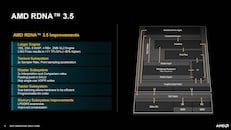 Finally, we understand that there are some fundamental differences in the RDNA generations regarding microarchitecture. For RDNA 3, there is no support for 8-bit floating point, as only the latest RDNA 4 uses FP8. To run the FSR 4.1 Upscaling model on RDNA 3, AMD must convert it to 8-bit integer data, as RDNA 3 hardware uses INT8 data types without FP8 support. Generally, integer math is sufficient to optimize these models, but the conversion work is necessary, which explains the delay between RDNA 4 and RDNA 3 support. However, since RDNA 3.5 appears to be closer to pure RDNA 3 with its data types support than RDNA 4, running the INT8 model of FSR 4.1 without any problems seems to be a good sign that the official support will be there.
Source:
Reddit
Valve has included preliminary FSR 4.1 support in its Proton Experimental build, which is used for testing features before they appear in the stable release that ships with SteamOS builds. A Redditor managed to download the leaked file before Valve removed it and ran a few tests using OptiScaler to force different FSR DLL versions in games. Since the file is officially signed, games checking for DLL signatures reportedly ran without issues. This is great news for those waiting for the official DLL release, especially RDNA 3.5 users who were left uncertain about whether FSR 4.1 would work with RDNA 3.5.


27 Comments on Leaked FSR 4.1 INT8 Model Confirms Compatibility with RDNA 3.5
I even tried FSR4.0 INT8 on an Intel Arc GPU back when the Optiscaler team made it really easy to use, and while the performance was garbage and it had graphical issues, it did technically work.
It's almost like AMD should've just released this already, or at the very least, said they were working on it.
It should therefore work on all RDNA GPUs.
I may be dreaming... but I do wish Valve would work some magic, and integrate Optiscaler styled functionality directly into SteamOS.
Being able to spoof the GPU/IGP, intercept all DLSS/XeSS/FSR2+3 calls, and convert it into working FSR4.1 would be a massive win for them, and Linux gaming in general.
bullshit / nonsense / fake claims by AMD as always. there are no technical limitations. it is just a limit from the compiler and the guy who is not willing to convert the code or find an algorithm
How can someone do floating maths? I really wonder. Do I really need float when i have 8bit integer? Stupid AMDMaybe time for a amd meme, "stupid, stupider, AMD".
edit: someone else was faster than I with that quote
Instead, AMD chose to claim they were not supporting older hardware after code leaked that showed they could, and they continue to plant their boots firmly in their mouth at every opportunity. So now they have a ton of scrutiny from the pissed off community that was created entirely of their own doing.
www.amd.com/en/resources/support-articles/release-notes/RN-RAD-WIN-26-6-2.html
In any case and of note it's that now AMD specifically says APUs (RDNA 3 specifically) will be getting FSR 4.1 later instead of vagueness. I wonder if it indeed is blocked for now on Windows with integrated graphics or if they let users of them to just run the "unoptimized model".
I have a 6700 XT. A card that despite physical capability to run FSR4 in ever so slightly hindered mode and despite urgency for it (let's be real, this GPU barely keeps up with modern games at native resolutions if we don't count obsolete ones like 900p and 720p), there's still no official support for it. None. Nada. Zilch. My GPU is just five-something years old and it's already treated like it was made when King Arthur was still a thing.
All that while RTX 2000 cards, two years older cards, still have full and complete support for any DLSS upscaling the first day these new libraries are released. Why would I pick AMD for my next purchase? AMD clearly don't give me any meritable "why".
Also not to mention anything before 50 series won't get the latest frame gen features or whatever Nvidia decides to sell their users on next.
Why an AMD card? I personally value having better price/performance, a melt free power connector, and drivers that aren't vibe coded. I don't care much for upscaling, it's better late than never.
Nothing stops you from running an LLM on a Radeon card, Nvidia has people locked in with CUDA though, and IMO they shouldn't be allowed that monopoly with how much control over the market Nvidia has at this point.AMD has their slip ups, but Nvidia has been having worse driver quality with the 50 series, bad mistakes that shouldn't happen like crashing or fans not working.Yeah, the connector is one reason why I refuse to give Nvidia any money.
If EVGA still made graphics cards at least there would've been a decent warranty policy in place, but I shouldn't have to rely on a warranty, or what board partners are doing with band aid fixes to the cable.You could've been using the "leaked" FSR4 a year ago with Optiscaler, for whatever reason it took AMD time to get the INT8 conversion right, and now official FSR4 for RDNA3 is better and faster than the leaked community version.
FSR4 INT8 works on older cards. FSR4 frame gen doesnt, and nobody expects FSR4 frame gen on rDNA 3 or 2. Please stop being disingenuous.Cool. Glad you're OK with worse support. Most consumers are not, which would inform AMD's abysmal market share compared to nVidias.
BTW, if you think AMD isnt using AI coding on their drivers, I have a bridge to sell you. They talk about AI more then nVidia do.
TBF, as others have pointed out before, we kinda knew it when we bought an amd gpu, so it's on us. At least that's the narrative around here, that amd is so bad at supporting it's own products that we should have known. They are not entirely wrong.
No idea, though I hope it comes (with the option to use the less demanding FSR 3.1).
Community mod driven?
Already there!