News Posts matching #Hynix

Return to Keyword Browsing

AMD CEO Lisa Su Says 2027 Will Bring a "Substantial" Supply Increase

AMD will "substantially" increase its chip supply in 2027, CEO Lisa Su told reporters in Taipei on Tuesday, while admitting that demand is still running ahead of what the company can ship. Su is on her third trip to Taiwan this year, meeting partners such as Foxconn, Quanta, Acer, and ASUS, with TSMC also on the schedule. She is reportedly heading to South Korea later this week to sit down with memory suppliers Samsung and SK Hynix. Here's what she said:

We've been able to increase our supply as we've gone through 2026, and we're going to substantially increase our supply in 2027, but we can definitely use more. There's very, very high demand for the next several years. We can see very high demand, and so we need more advanced wafer capacity.

Micron's 2 GB GDDR7 Memory Chips Reportedly Reach End of Life

Micron has reportedly discontinued its 2 GB GDDR7 memory chips, the same modules used on several GeForce RTX 50 series cards. Spotted by UNIKO's Hardware, Micron's 28 Gbps D8FHL chip (MT68A512M32DF-28:A) is now listed as end of life on the company's own website. Every 2 GB GDDR7 chip in Micron's catalog, both the 28 Gbps and 32 Gbps variants, now carries the same EOL status, leaving 3 GB modules as the only option going forward.

Micron only started supplying GDDR7 to NVIDIA in a meaningful way earlier this year, and its chips were never the primary source for RTX 50 cards. Samsung and SK Hynix still cover the bulk of the supply, so this shouldn't cause an immediate shortage. Still, losing even a partial supplier during an already tight memory market isn't reassuring, and it says something about where these companies would rather put their manufacturing capacity these days.

Intel and SK hynix Could Start DRAM Production in United States

According to anonymous sources close to Reuters, Intel and SK hynix are in talks to start DRAM production lines in the United States for the first time. This means that Intel might either collaborate with SK hynix to acquire memory IP technology in a joint venture or SK hynix could lease part of Intel's facility in Ohio. In the first scenario, a joint venture between Intel and SK hynix would significantly alleviate supply chain pressures, as hyperscalers, fabless chip designers, and others are in urgent need of more DRAM. Since these firms would likely consume all the DRAM produced in the coming years, both Intel and SK hynix would have a substantial financial interest in the joint venture.

On the other hand, if SK hynix decides to lease Intel's facilities in Ohio, the South Korean memory giant would pay premiums for leasing the facility while retaining all production for itself. Reuters couldn't determine which specific technology would be the focus of the facility, but the primary goal is to produce regular planar DRAM, HBM, and some storage solutions with NAND Flash. Intel declined to comment on the rumor but noted that the Ohio investments are continuing regardless. SK hynix stated that the company has not finalized its decision or any cooperation but did not explicitly rule out the possibility of future collaboration. Therefore, an official decision should be announced soon.

SK hynix CEO Says Memory Shortage Will Last Through 2030

SK hynix expects the current memory shortage to persist through the end of 2030, with no clear signs of a slowdown yet, according to CEO Kwak Noh-Jung. Speaking after the company's groundbreaking ceremony for its new Indiana packaging facility, Kwak said any eventual slowdown would likely be the result of a gradual easing rather than the sharp price crashes memory markets have previously seen, per Reuters. SK hynix had previously flagged tight supply lasting through 2028 for commodity DRAM, so this latest comment pushes that prediction out further.

Kwak's reasoning is that memory products have moved away from being purely commodity parts. AI-driven demand has pushed customers toward customized DRAM and HBM configurations, which makes future demand easier for manufacturers to forecast and less prone to the abrupt oversupply swings that caused previous crashes.

Lexar to Use CXMT Chips for Upcoming THOR RGB DDR5 Kits Rated Up to 7600 MT/s

Lexar is preparing new DDR5 memory kits built around CXMT (ChangXin Memory Technologies) chips, and the jump in speed over previous CXMT-based products is notable. Earlier kits using CXMT memory were limited to 6000 MT/s while the new modules push that to 7200 MT/s and 7600 MT/s, both running CL38 timings at 1.4 V. The new kits will launch under the THOR II name in the existing THOR RGB DDR5 lineup in 32 GB dual-channel configurations using two 16 GB modules. CPU-Z data backing the 7600 MT/s claim has already surfaced, with the faster kit identified by the module name LD5U16G76C38BV.

MSI recently demonstrated CXMT-based DDR5 hitting 8000 MT/s on AMD platforms, which signals that these chips have more overclocking headroom than their mainstream entry-level positioning suggested. However, the new Lexar kits don't seem to quite reach that speed, but 7600 MT/s at CL38 is competitive with what other memory vendors are offering in the same tier. No pricing or release date has been announced yet by Lexar for its upcoming THOR II RGB DDR5 memory kits. Looking back at CXMT, it does seem that the Chinese company has managed to close the gap with Samsung, SK Hynix, and Micron. Moreover, recent reports stated that even Apple is negotiating with the U.S. government to get clearance to use sanctioned CXMT memory chips in its products.

DRAM Triarchy Hit with Class-Action Lawsuit Alleging Memory Price-fixing and Cartel Behavior

A class-action lawsuit has been filed in the U.S. alleging that the three leading DRAM manufacturers, namely Micron Technology, Samsung Electronics, and SK Hynix, are engaged in price-fixing and causing artificial scarcities to keep prices of computer memory high. Consumer DDR5 PC memory saw a near 700% inflation in price in a span of just 1 year, caused mainly by DRAM manufacturers allocating their production capacity to HBM stacks used by AI compute GPUs; and booking orders years into the future, which would keep a large percentage of their manufacturing capacity occupied with HBM production going as far into the future as 2030.

The lawsuit calls for PC memory manufacturers to restore consumer DRAM production and availability. Among the plenty of examples the lawsuit can cite, it mentions Apple's recent decision to increase the prices of all its products, including Macs and iPhones, citing escalating memory prices. The lawsuit alleges collusion and cartel-like behavior by Samsung, Micron, and SK Hynix, to coordinate pricing. It also cites evidence of such activity in the past, specifically in the year 2000, where the U.S. Department of Justice fined these companies hundreds of millions of dollars, besides prison sentences for several company executives.

DRAM Manufacturer Stock Prices Dip Over Google TurboQuant Announcement

Stock prices of DRAM manufacturers dipped by as much as 19% over the past 5 days, over the March 24 announcement of Google TurboQuant, a new technology that Google claims will reduce the memory footprint of AI models by a factor of 6, and improve inference speeds by a factor of 8. As of this writing, Micron Technology (NASDAQ: MU) dipped 19.5% over the last 5 days. Over in Korea, SK Hynix saw its stock price drop by 6%, while Samsung Electronics saw a dip by 5%.

TurboQuant is an advanced quantization algorithm developed by Google that delivers massive data compression for LLMs and vector search engines. It effectively tackles memory bottlenecks in the key-value cache and accelerates similarity lookups without sacrificing model accuracy. TurboQuant achieves this efficiency by combining two novel techniques: PolarQuant, which simplifies data geometry using polar coordinates to eliminate traditional memory overhead, and Quantized Johnson-Lindenstrauss (QJL), a 1-bit mathematical error-checker. Capable of compressing the key-value cache to just 3 bits without requiring fine-tuning, TurboQuant enables up to 8x faster runtimes on GPUs, establishing a new standard for AI efficiency.

JEDEC Announces Updates to Universal Flash Storage (UFS) and Memory Interface Standards

JEDEC Solid State Technology Association, the global leader in the development of standards for the microelectronics industry, today announced the publication of its highly anticipated JESD220H and JESD223G: Universal Flash Storage 5.0 and UFS Host Controller Interface (UFSHCI) 5.0. Designed for mobile applications, automotive and computing systems that demand high performance with low power consumption, UFS 5.0 will deliver faster data access and improved performance compared to its predecessor while maintaining compatibility with UFS 4.x hardware.

UFS offers high-performance, embedded storage with low power consumption, making it ideal for use in applications where power efficiency is essential. This includes computing and mobile systems like smartphones and wearables, as well as an expanding role in generative AI, automotive applications, edge computing and gaming consoles. Its high-speed serial interface and optimized protocol enable significant throughput for power-efficient system performance.

ASML Boosts EUV Power to 1,000W for Better Yields and Lower Chip Costs

ASML says it has boosted the light source power in its EUV lithography systems to 1,000 watts, up from roughly 600 W today. According to a Reuters report, the company claims the increase could enable up to 50% more chip output by the end of the decade. More source power translates directly into higher throughput. ASML says customers could process around 330 wafers per hour by 2030, compared to about 220 wafers per hour today, lowering the cost per chip. EUV light at a 13.5 nm wavelength is generated by firing a CO₂ laser at microscopic droplets of molten tin, creating plasma that emits EUV radiation. The light is then collected and directed through precision optics supplied by Carl Zeiss AG. To reach 1,000 W, ASML doubled the droplet rate to roughly 100,000 per second and shifted to a two-pulse laser shaping approach instead of a single pulse. The company says there is a path toward 1,500 W and potentially even 2,000 W over time.

ASML is the only supplier of commercial EUV scanners, used by major chipmakers including TSMC, SK Hynix, and Intel. The tools are considered critical to advanced node production and have been subject to export restrictions to China. The move is aimed at maintaining ASML's lead as U.S. companies, such as Pat Gelsinger's xLight EUV startup and Chinese efforts to develop competing lithography systems continue to ramp. Chinese companies have reportedly been sourcing parts from older ASML machines through secondary markets. Huawei is leading the charge, working to build a homegrown AI supply chain as a way around foreign tech restrictions. The company set up a large semiconductor manufacturing facility in Guanlan focused on 7 nm chips for its own processors. The Chinese government had initially aimed to have a working prototype from this effort by 2028.

Major PC OEMs Reportedly Exploring Chinese CXMT Memory Amid Shortages

According to Nikkei Asia, some of the biggest PC makers like ASUS, Acer, Dell, and HP are exploring alternative memory suppliers amid industry-wide memory shortages, which are forcing PC OEMs to seek supply even from Chinese memory maker CXMT. Late last year, CXMT unveiled its homegrown DDR5-8000 and LPDDR5X-10667 memory modules at the 2025 China International Semiconductor Expo. This has likely prompted many OEMs to start finding alternatives to the traditional triad of SK Hynix, Samsung, and Micron, whose supply has been very limited outside AI accelerator workloads.

CXMT offers 12 Gb and 16 Gb LPDDR5X capacities, while DDR5 scales to 16 Gb and 24 Gb module formats. The 16 Gb DDR5 chips from CXMT measure 67 square millimeters, with a density of 0.239 Gb per square millimeter. The G4 DRAM cells are 20% smaller than CXMT's previous G3 generation. Reportedly, CXMT manufactures these chips using a 16 nm node, which is three years behind Samsung, SK Hynix, and Micron in manufacturing capabilities. However, CXMT is progressing quickly, and its DRAM modules adhere to the official JEDEC specifications and even exceeding the specification, making them ideal for OEM PCs depending on the use case.

SK hynix to Establish U.S. Arm Specialized in AI Solutions

SK hynix Inc. announced today that it will establish an AI solutions firm, tentatively named AI Company (AI Co.), in the US to find new AI growth engines. "Leveraging its unparalleled chip technologies, such as HBM, the memory chipmaker will try to play a pivotal role in delivering optimized AI systems for its customers in the AI datacenter sector," the company said.

"The company will also continue making strategic investments in and collaborating with AI firms to strengthen its competitiveness in memory chips and provide a range of AI datacenter solutions." Global big tech companies have been in a fierce competition to gain an upper hand in the AI race by making significant investments and actively seeking innovation. With the growing demand for advanced AI systems, high-end memory chips are considered essential for overcoming the performance bottlenecks of AI data solutions. Capitalizing on the AI boom, SK hynix, the world's leading memory chipmaker, has been making efforts to cement its AI leadership.

Semiconductor Quarterly Revenue Surpasses $200bn for the First Time as Industry-Wide Growth Accelerates

New research from Omdia shows that the semiconductor market delivered a record breaking performance in 3Q25 with industry revenue reaching $216.3bn, up 14.5% quarter-over-quarter (QoQ). This marks the first time the global semiconductor market has exceeded $200bn in a single quarter, following an already strong 2Q25, which saw 8% QoQ growth. At this pace, the industry is on track to exceed $800bn in total revenue for 2025.

3Q25 far exceeds seasonal expectations
Demand for AI and memory products remains strong, with both segments continuing to outpace the wider market. While AI has dominated recent industry narratives, Omdia notes that more segments contributed to growth in 3Q25 than in previous quarters.

SK Hynix Showcases Advanced AI Memory From HBM4 to Next-Gen Storage at SC25

SK hynix showcased advanced memory technologies for the era of AI and high-performance computing (HPC) at Supercomputing 2025 (SC25), held in St. Louis, the U.S., from November 16-21. Held annually since 1988, SC is the world's largest global HPC conference. It brings together experts from industry, academia, and research institutions to share the latest trends, create opportunities for collaboration, and discuss the future direction of technological advancement. At this year's event, the convergence of AI and HPC emerged as a central topic. Under the theme "Memory, Powering AI and Tomorrow," SK hynix presented its innovative memory lineup set to lead the AI and HPC markets and shared a new technological vision to accelerate data analysis in computing systems.

Innovative Products and Tech Driving AI and HPC Performance
At the event, SK hynix presented core products including HBM, DRAM, and eSSD solutions. Visitors to the booth could also see demonstrations of the products in AI and HPC environments, highlighting the company's technological competitiveness. At the front of the booth, SK hynix displayed its latest HBM products including the 12-layer HBM4 which it developed as a world-first in September 2025. HBM4 features 2,048 input/output (I/O) channels, twice that of the previous generation, delivering a significant increase in bandwidth. Also offering more than a 40% boost in power efficiency, HBM4 is the most suitable solution for ultra-high-performance AI computing systems. In addition, the 12-layer HBM3E, the highest performing commercialized HBM currently available on the market, was presented with NVIDIA's next-generation GB300 Grace Blackwell GPU.

Memory Industry to Maintain Cautious CapEx in 2026, with Limited Impact on Bit Supply Growth

TrendForce's latest investigations reveal that despite higher ASPs boosting profitability across the memory industry, capital spending on DRAM and NAND Flash is only anticipated to increase modestly in 2026. This limited investment growth is unlikely to significantly affect bit output. Instead, the emphasis is shifting from capacity expansion to advancements such as process technology upgrades, higher-layer stacking, hybrid bonding, and high-value products such as HBM.

In the DRAM sector, total capital expenditure is expected to reach US$53.7 billion in 2025 and rise to $61.3 billion in 2026, representing about 14% YoY growth. For NAND Flash, spending is projected to rise from $21.1 billion in 2025 to $22.2 billion in 2026, a roughly 5% increase.

NVIDIA and SK Group Build AI Factory to Drive Korea's Manufacturing and Digital Transformation

NVIDIA today announced that it is working with SK Group to build an AI factory to advance semiconductor research, development and production, as well as cloud infrastructure to support digital twin and AI agent development. SK Group is building an AI factory featuring more than 50,000 NVIDIA GPUs, with the first phase planned for completion by late 2027. Once complete, the system is expected to be one of Korea's largest AI factories.

The new factory will serve SK subsidiaries - including SK hynix and SK Telecom (SKT) - as well as external organizations through a GPU-as-a-service model, accelerating digital transformation and industrial innovation for Korea's industries. Further expanding the NVIDIA and SK Group partnership, the companies are collaborating on the development of SK hynix high-bandwidth memory (HBM) and next-generation advanced memory solutions for NVIDIA GPUs, semiconductor manufacturing and telecommunications infrastructure.

SK Hynix Begins 1b DRAM Pilot Production While Negotiating Customer Price Adjustments

SK Hynix is installing a new pilot production line at its M15X facility in Cheongju, bringing online a new 1b DRAM manufacturing line designed to address surging HBM demand, The Bell reports. Equipment installation is scheduled to be completed by November with the pilot line targeting an initial monthly output of 10,000 wafers. The move highlights different approaches among memory leaders, while Samsung pursues 1c DRAM technology for HBM4 applications, both SK Hynix and Micron have committed to 1b DRAM architecture, according to Aju News. This difference reflects varying technical roadmaps as companies race to capture as much as they can from the expanding AI memory markets.

On the other hand it seems that memory price adjustments have become a widespread practice. TrendForce reports citing SeDaily and Business Korea notes that SK Hynix has entered price negotiations with customers, however, no formal announcement has been made yet. The company is tweaking its prices in line with current market trends. This hints at a unified industry shift towards pricier memory across all big-name suppliers. Micron kicked things off in September first letting its channel partners know about 20-30% price hikes for DRAM. Samsung followed by informing major customers that Q4 contract prices for DRAM products, including LPDDR4X and LPDDR5/5X variants, would rise 15-30%. NAND pricing isn't immune either—eMMC and UFS contract prices are expected to climb 5-10%. On the same note, TrendForce indicates suppliers are ramping QLC SSD production, with capacity utilization projected to continue its growth through 2026. Inference AI workloads are expected to sustain demand into 2027, potentially creating enterprise SSD supply constraints by 2026.

SK Hynix DDR5 DIMMs Vulnerable to "Phoenix" Rowhammer Attack, On-Die ECC Exposed Too

Researchers from ETH Zurich and Google have shown that SK Hynix DDR5 modules remain vulnerable to a new Rowhammer variant they call Phoenix (CVE-2025-6202), even with on-die ECC memory modules. The attack can be executed in only 109 seconds, making it a very realistic threat. By reverse engineering the built-in DRAM mitigation (TRR) for the already existing Rowhammer exploit, the team found a blind spot in the refresh-sampling logic: the mitigation's sampling period repeats every 128 tREFI intervals and, within those intervals, the first two of four sub-intervals are "lightly sampled." Leveraging this, the researchers crafted two novel long-running hammer patterns: a shorter 128-tREFI pattern and a much longer 2608-tREFI pattern. They later coupled them with a new self-correcting refresh synchronization method that realigns the attack whenever a refresh is missed. This synchronization is what lets Phoenix maintain alignment across thousands of refresh intervals, something prior routines like Zenhammer could not do reliably.

On 15 SK Hynix DDR5 modules, manufactured between late 2021 and late 2024, every module flipped bits under one of the two patterns. The 128-tREFI pattern was about 2.62× more effective on average. The team observed thousands of bit flips per DIMM and turned those flips into real-world primitives: page-table corruption, yielding arbitrary read/write access, extraction of valuable RSA-2048 keys from co-located VMs in many cases, and local privilege escalation by corrupting the sudo binary on some DIMMs. To increase the probability of hitting a vulnerable refresh offset (only 2 of 128 offsets are vulnerable, which is 1.56%), they run four shifted pattern instances across each of the four banks in parallel, boosting the hit probability by 16× to roughly 25%.

SK Hynix Completes World's First HBM4 Development and Readies Mass Production

SK hynix Inc. announced today that it has completed development and finished preparation of HBM4, a next generation memory product for ultra-high performance AI, mass production for the world's first time.

SK hynix said that the company has successfully completed development and based on this technological achievement, the company has prepared HBM4 mass production to lead the AI era. Through this momentum, the company has once again proven the AI memory leadership in the global market. "Completion of HBM4 development will be a new milestone for the industry," Joohwan Cho, Head of HBM Development at SK hynix, who has led the development, said. "By supplying the product that meets customer needs in performance, power efficiency and reliability in timely manner, the company will fulfill time to market and maintain competitive position."

Samsung and SK Hynix Delay DDR4 Memory Phase-out Amidst Unexpected Demand

Late last month, we reported an unexpected surge in DDR4 DRAM chip spot-pricing, just as leading memory chipmakers in Taiwan and South Korea announced plans to phase out the standard, leaving behind residual inventories to deal with leftover demand. It turns out that the nearly 1 decade-long market presence of the DDR4 standard, beginning with the 2013 6th Gen Intel Core "Skylake" processor, and continuing on until 14th Gen Core "Raptor Lake Refresh," along with AMD Ryzen Socket AM4 along the way, meant that there are simply too many devices out there with DDR4 memory and users looking for upgrades.

Digitimes now reports that South Korean memory chipmakers such as SK Hynix and Samsung Electronics, have put on hold their phase-out plans for DDR4 chips, and may continue supply until they see spot pricing sufficiently falling behind that of DDR5. At the same time, the two will be walking a tight rope with supply to ensure they don't end up with bloated inventories.

MSI Releases AMD AGESA 1.2.0.3e BIOS, Supporting 4x 64 GB Memory Configs and Upcoming CPUs

MSI has released the latest AMD AGESA ComboPI-1.2.0.3e BIOS, supporting all AMD AM5 models, including X870, B850, B840, X670, B650, and A620 chipsets. This update not only adds support for upcoming new CPUs, but also enables all AM5 motherboards to support large-capacity 64 GB x4 DRAM chips. MSI motherboards have been optimized for overclocking large-capacity DRAM—compatible with DRAM chips from Micron, Hynix, and Samsung. Even with four 64 GB DRAM fully installed, the system can still achieve a stable overclocking speed of 6000 MT/s, and even up to 6400 MT/s.

In addition, this update optimizes 2DPC 1R capability and includes overclocking enhancements specifically for Samsung's 4Gx8 chips. AGESA 1.2.0.3e has already been rolled out to selected AM5 800 series models, users are able to find the updated BIOS on the MSI website, and MSI will continue to update the remaining AM5 models as soon as possible. Get ready to enjoy the powerful performance brought by memory overclocking!

Server DRAM and HBM Continue to Drive Growth, 4Q24 DRAM Industry Revenue Increases by 9.9% QoQ

TrendForce's latest research reveals that global DRAM industry revenue surpassed US$28 billion in 4Q24, marking a 9.9% QoQ increase. This growth was primarily driven by rising contract prices for server DDR5 and concentrated shipments of HBM, leading to continued revenue expansion for the top three DRAM suppliers.

Most contract prices across applications were seen to have reversed downward. However, increased procurement of high-capacity server DDR5 by major American CSPs helped sustain price momentum for server DRAM.

V-COLOR Expands DDR5 Lineup with New SCC O CUDIMM RGB Filler Kit with maximum Speed up to 8800MT/s

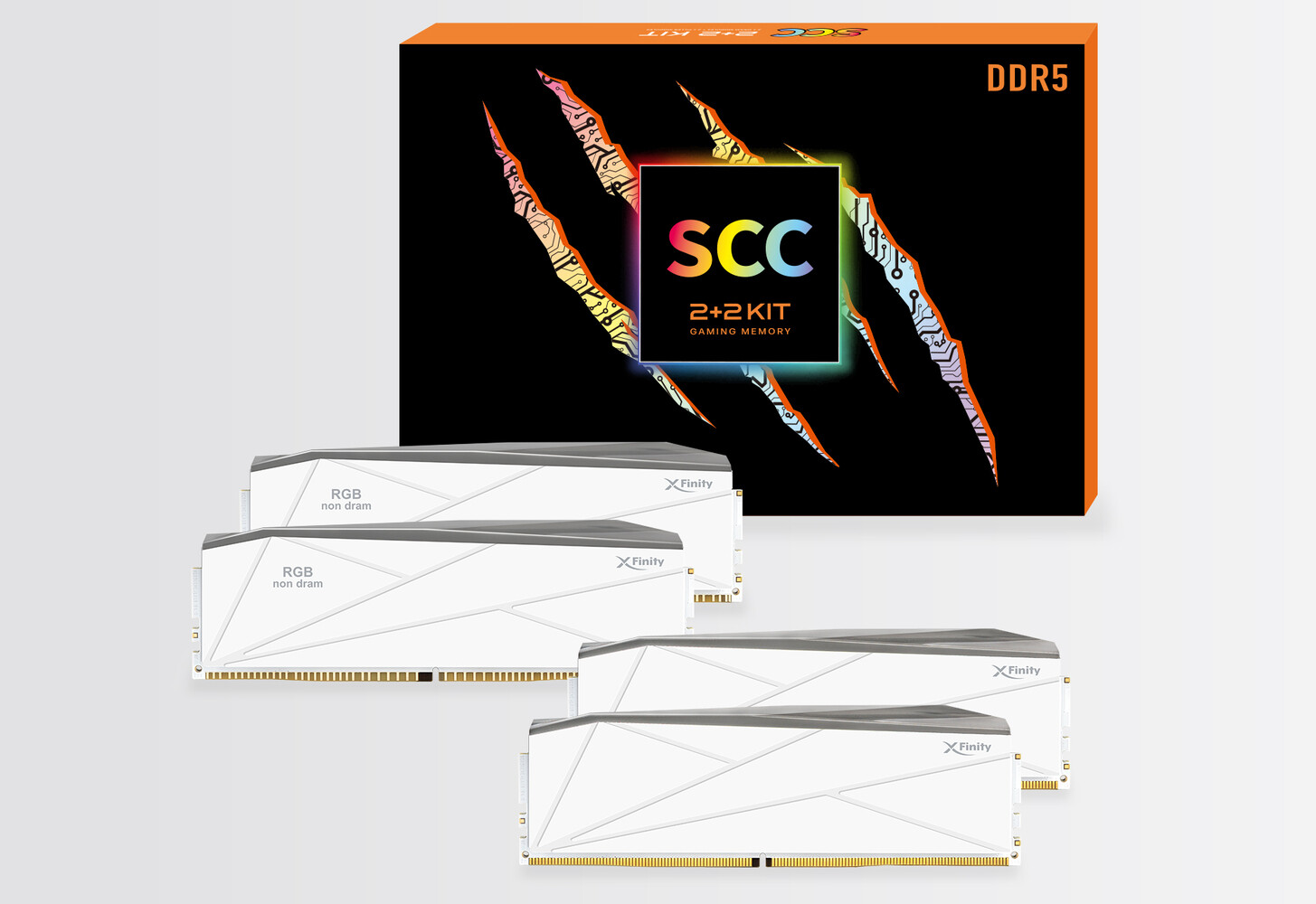
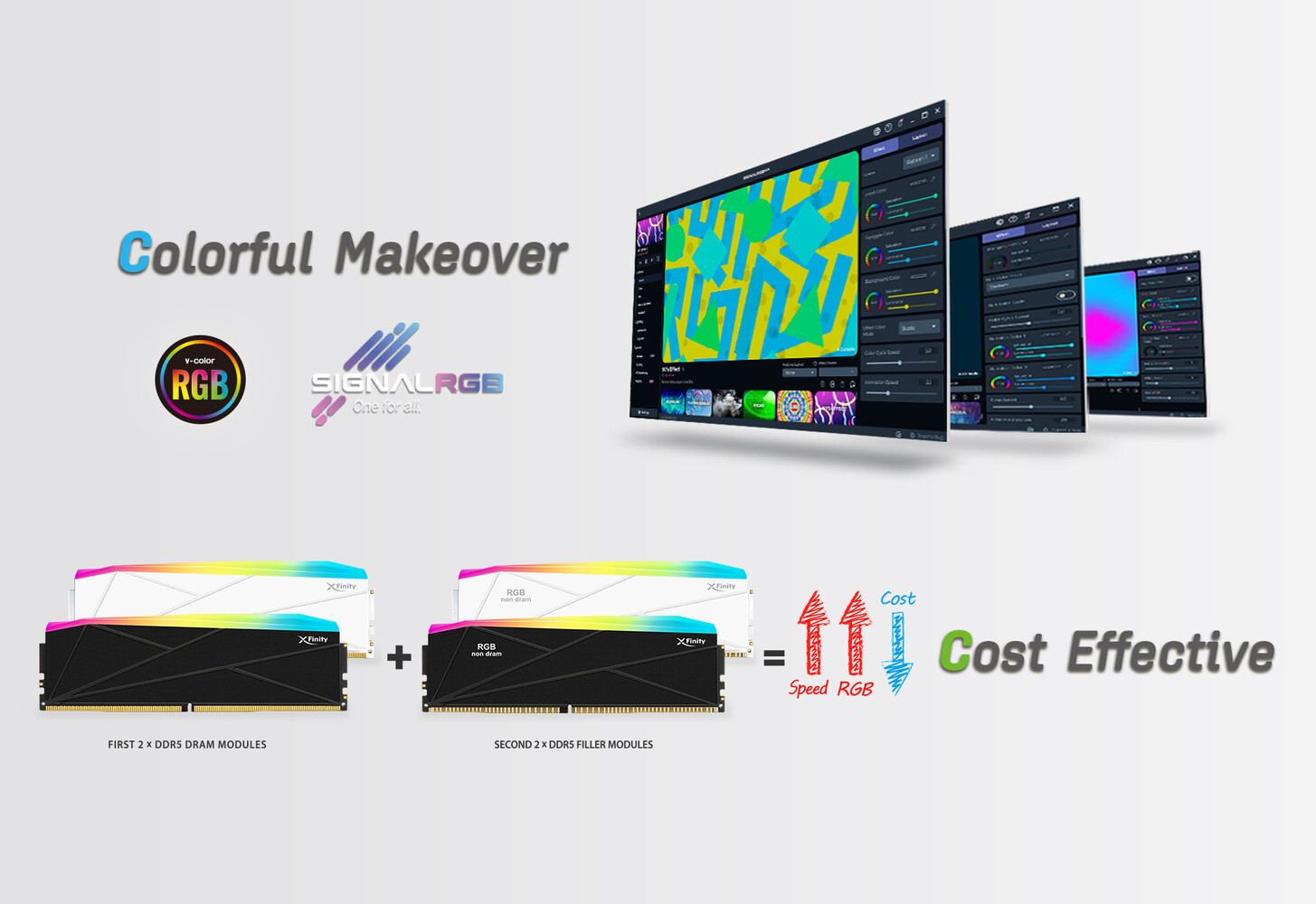
V-COLOR Technology Inc. proudly introduces the groundbreaking CKD SCC (Speed Booster, Colorful Makeover and Cost effective) O CUDIMM RGB Filler Kit 2+2 (2 DRAM Modules + 2 Filler Modules) additions to its DDR5 memory lineup, redefining high-performance and customization. With the launch of the new SCC O CUDIMM RGB Filler Kit now compatible with Intel Core Ultra CPUs Motherboards 800 series up to 8800 MT/s and not only that, the already existent SCC UDIMM kit just got a massive upgrade now reaching 8000 MT/s with dual profiles for Intel XMP 3.0 and AMD EXPO. This new SCC line will be under the family of the already amazing XFinity series that continues to push the boundaries of memory innovation.

The latest CKD SCC O CUDIMM is optimized for Intel Core Ultra CPUs and Z890 series motherboards, offering unmatched performance and stability. With speeds reaching 8000 MT/s ~ 8200 MT/s for 32 GB (2x 16 GB) configurations and 7000 MT/s ~ 8800 MT/s for 48 GB (2x 24 GB) configurations. The latest lineup of SCC technology doesn't just revolutionize the new O CUDIMM memory modules; it also pushes the boundaries of already existing UDIMMs to unprecedented levels. Speeds now reach an impressive 7200 MT/s up to 8000 MT/s, while the addition of dual profiles ensures seamless compatibility and performance optimization for both AMD EXPO and Intel XMP 3.0 systems. This development bridges accessibility across platforms, offering next-level performance for enthusiasts and professionals alike.

SK hynix Acquires TISAX Certification for the First Time in the Memory Industry

SK hynix Inc. announced today that it has acquired TISAX, the global automobile industry information security certification, for the first time in the memory industry. SK hynix has obtained TISAX for all domestic sites located in Icheon, Bundang and Cheongju, and has been internationally accepted for the security capabilities required by the global automobile industry. Through this, the company aims to accelerate the development of high-performance memory solutions essential for realizing AI-based future automobile technology.

With the expansion of the electric vehicle market, autonomous driving, and the development of connected car technology, the importance of electronic parts is growing rapidly. In line with these changes, automotive semiconductors, which are widely used in electric equipment, are positioned as major components of automobiles. In particular, automotive semiconductors are applied to key safety systems of automobiles such as ADAS, brake systems and engine control, requiring a higher level of reliability than general semiconductors. In addition, as hacking and malicious code attacks targeting automobiles have increased recently, systematic security management in the manufacturing process is being emphasized as well as strengthening the performance of semiconductors themselves.

JEDEC Announces Updates to Universal Flash Storage (UFS) and Memory Interface Standards

JEDEC Solid State Technology Association, the global leader in the development of standards for the microelectronics industry, today announced the publication of JESD220G: Universal Flash Storage 4.1. In addition, an update to the complementary JESD223F UFS Host Controller Interface (UFSHCI) version 4.1 standard has also been published. Developed for mobile applications and computing systems requiring high performance with low power consumption, UFS 4.1 offers faster data access and improved performance over the earlier version of the standard while maintaining hardware compatibility to UFS 4.0. Both standards are available for download from the JEDEC website.

"JEDEC members are continually innovating to shape the standards that will drive the next generation of mobile devices and advanced applications, and the committee's dedication to ongoing improvements to the UFS series is paving the way for future innovation," said Mian Quddus, Chairman of the JEDEC Board of Directors and the JC-64 Committee for Embedded Memory Storage and Removable Memory Cards.

SK Hynix Reports Third Quarter 2024 Financial Results

SK hynix Inc. announced today that it recorded 17.5731 trillion won in revenues, 7.03 trillion won in operating profit (with an operating margin of 40%), and 5.7534 trillion won in net profit (with a net margin of 33%) in the third quarter this year. Quarterly revenues marked all-time high, exceeding the previous record of 16.4233 trillion won in the second quarter of this year by more than 1 trillion won. Operating profit and net profit also far exceeded the record of 6.4724 trillion won and 4.6922 trillion won in the third quarter of 2018 during the semiconductor super boom.

SK hynix emphasized that the demand for AI memory continued to be strong centered on data center customers, and the company marked its highest revenue since its foundation by expanding sales of premium products such as HBM and eSSD. In particular, HBM sales showed excellent growth, up more than 70% from the previous quarter and more than 330% from the same period last year.
Return to Keyword Browsing
Nov 11th, 2026 03:50 CST change timezone

New Forum Posts

Popular Reviews

TPU on YouTube

Controversial News Posts