News Posts matching #Lisa Su

Return to Keyword Browsing

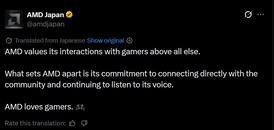
AMD's "We Love Gamers" Post Clashes With Its Own CEO's Comments

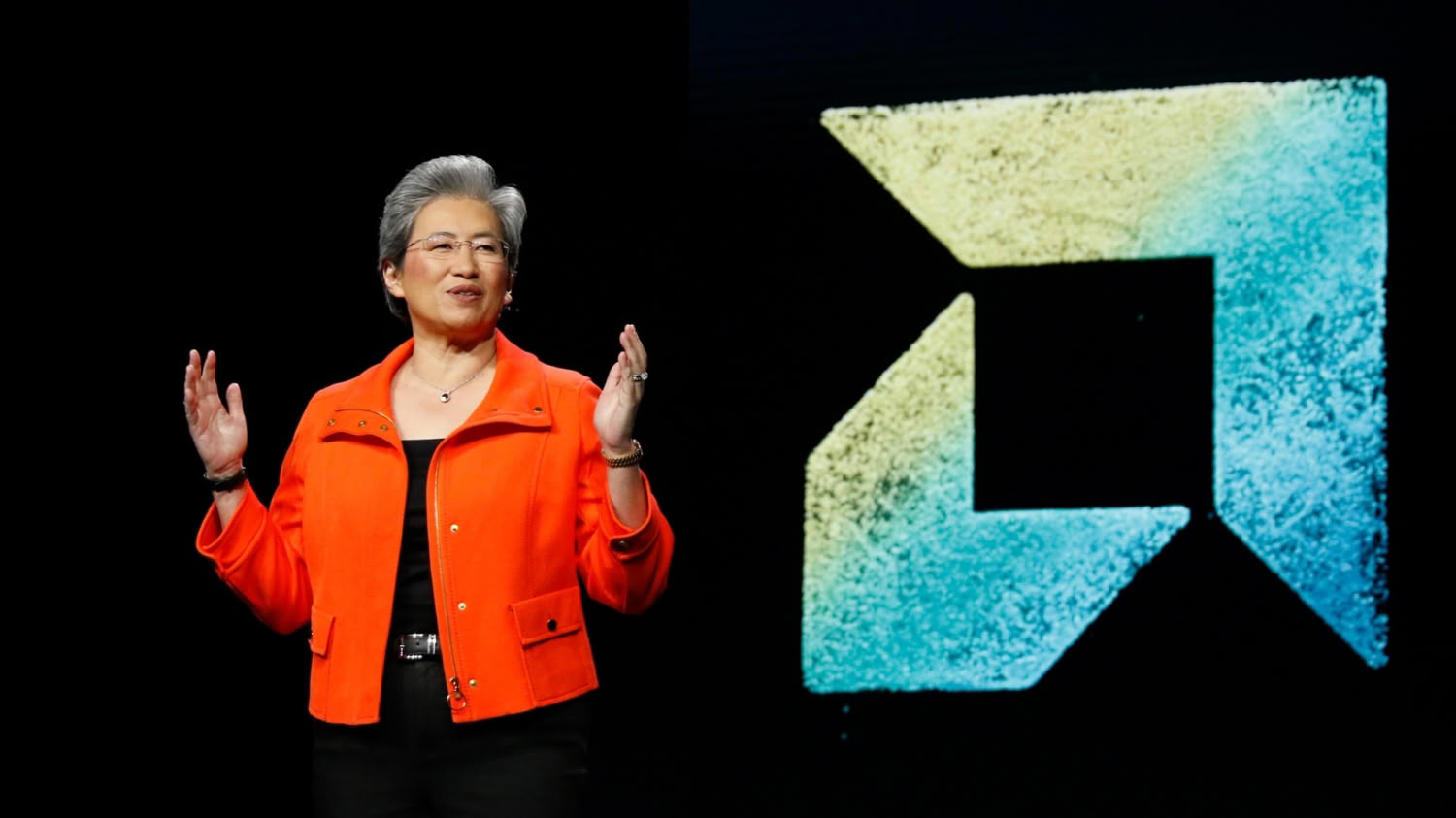
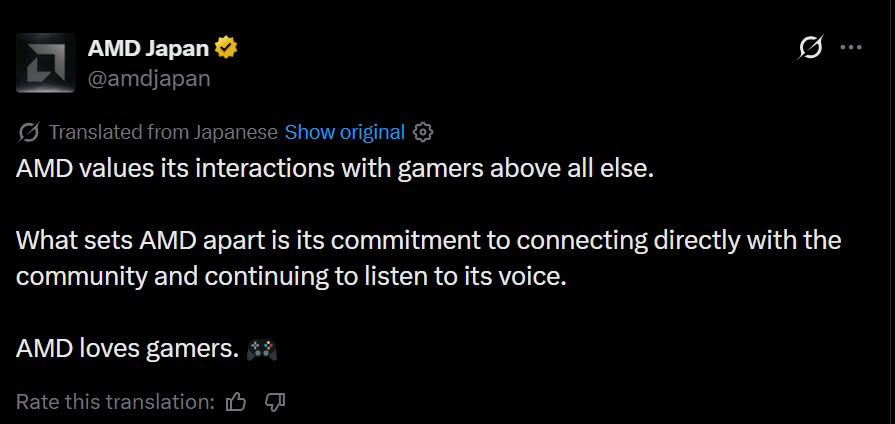
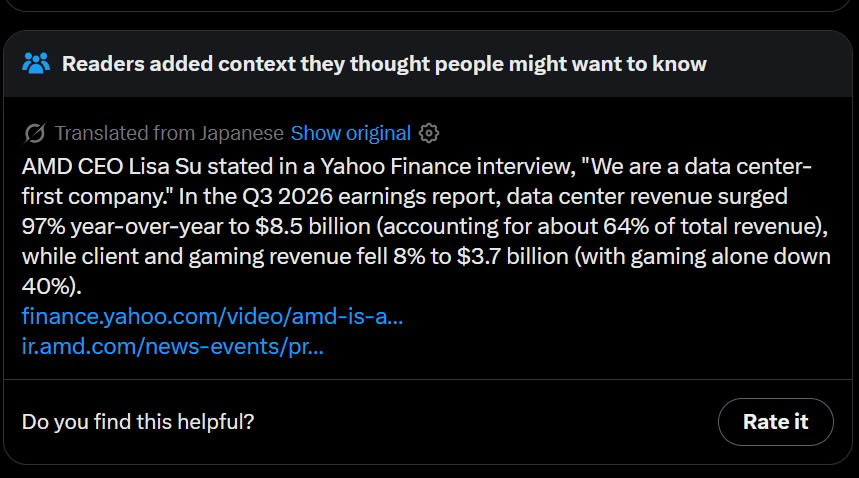
AMD Japan took to X today to say "AMD loves gamers," while also claiming that the company values its interactions with gamers above all else. The post was a quote tweet to coverage of CEO Dr. Lisa Su attending the opening of Micro Center's new Austin store. AMD handed out 300 swag bags and also raffled off a Radeon RX 9070 XT signed by Dr. Su at that event. However, that gesture was certainly not enough to undo Dr. Lisa Su's comments less than two weeks ago, where she called AMD a "data center first" company. The replies, and later a community note, were quick to remind AMD Japan of that contradiction.

In addition to its own CEO's comments, AMD's latest earnings also don't agree with its X post today. AMD posted record Q3 2026 revenue of $13.4 billion, up 45% year over year, and the Data Center segment did most of the heavy lifting. It brought in a record $8.5 billion, 64% of the total revenue, which was up 97% year over year. By comparison, the Client and Gaming segment fell 8% to $3.7 billion. This is the part that caters to gamers, and what's more interesting is that the Client revenue actually grew 7%, which means that the damage sits almost entirely in gaming. The latter dropped 40% to $773 million, under 6% of AMD's total revenue now. Not to mention, AMD expects data center sales to grow roughly 50% from Q3 to Q4, while there's nothing officially on the horizon for gamers except a CES 2027 teaser.


AMD Completes Acquisition of World Labs

AMD today announced the completion of its acquisition of World Labs, expanding its capabilities across the AI stack with a world-class model team. The acquisition brings together leading AI model researchers and AMD engineers to shape the next generation of AMD hardware, software and systems for the open AI ecosystem.

"Delivering the infrastructure that will power the next era of superintelligence requires us to optimize compute platforms and models together," said Dr. Lisa Su, chair and CEO of AMD. "We are thrilled to welcome Fei-Fei Li and the exceptional World Labs team to AMD. Their pioneering model research will help shape our future hardware, software and systems. Together, we will enable researchers and developers across the ecosystem to push the boundaries of what AI can do."

AMD Pushes Back on NVIDIA and Arm's "Agentic CPU" Marketing

AMD's Madhu Rangarajan, corporate VP of Compute and Enterprise AI, says the company never set out to build its Zen 6 EPYC 9006 "Venice" chips around agentic AI, a not-so-subtle dig at NVIDIA and Arm, which both pitch their latest server CPUs as made for that exact job. Rangarajan still called EPYC 9006 the best CPU for agentic workloads during a media session covered by Tom's Hardware. Chief Zen architect Mike Clark said much the same in a separate talk, admitting AMD didn't see agentic computing coming, though he added that the company always expected the CPU to keep a role in AI software. Here's what Rangarajan said:
We think that the EPYC 9006 CPU is the best CPU for the agentic era, and spoiler alert, we didn't magically know four years ago that agentic was going to be a thing and purpose-built something for agentic. The reality is an agentic workflow is a diverse set of tasks… and in order to execute those tasks well, you need compute that is able to handle a diverse set of workloads with a full portfolio.

AMD Goes "Data Center First" While Gaming Revenue Drops 40%

AMD CEO Lisa Su now calls AMD a "data center first" company, two days after AMD reported a 40% drop in gaming revenue. Speaking to Yahoo Finance's Brian Sozzi on November 5, Su said AMD's data center business should grow 50% sequentially from Q3 to Q4, and suggested it could more than double next year. Here's how she put it:
Dr. Lisa Su, AMD CEOWe are a data center first company, that is our profile, and you know, people need more computing to power all these applications.
Data Center brought in a record $8.5 billion in Q3, up 97%, and now makes up 64% of AMD's $13.4 billion total, up from 47% a year ago. Gaming fell to $773 million, or under 6% of revenue. AMD blames it mostly on lower semi-custom sales, meaning the console chips it makes for Sony and Microsoft, along with weaker graphics demand. Gaming was flat against Q2, though, and last year's Q3 was boosted by a 181% console-driven jump to $1.3 billion. Su used the same "data center first" line back in 2024, when data center was just over half of revenue.

Samsung's 2 nm Taylor Fab 2 Reportedly Fully Booked, Mostly by AMD

Samsung has reportedly booked the entire planned output of its second fab in Taylor, Texas, and most of it is going to AMD. According to an exclusive from Korea's Maeil Business Newspaper, citing industry sources, Taylor Fab 2 will make HBM base dies for AMD and NVIDIA on a 2 nm process, with AMD's orders making up the bulk of it. Apparently, AMD's volume alone is enough to stretch the fab's capacity. Samsung declined to comment, saying it can't confirm customer-related details.

These aren't AMD's CPUs or GPUs, though. The base die is the logic chip at the bottom of an HBM stack, and Samsung plans to pair the Texas-made dies with DRAM produced in South Korea and ship them as finished HBM. Its current HBM4 and the sampled HBM4E use 4 nm base dies, so 2 nm or smaller seems aimed at later HBM generations. The deal also follows Lisa Su's visit to Samsung in October, where Samsung reportedly wanted foundry orders from AMD in return for the HBM that AMD urgently needs. A March MOU had already made Samsung the primary HBM4 supplier for the Instinct MI455X.

AMD Guidance Points to Its First Quarter Ever With More Revenue Than Intel

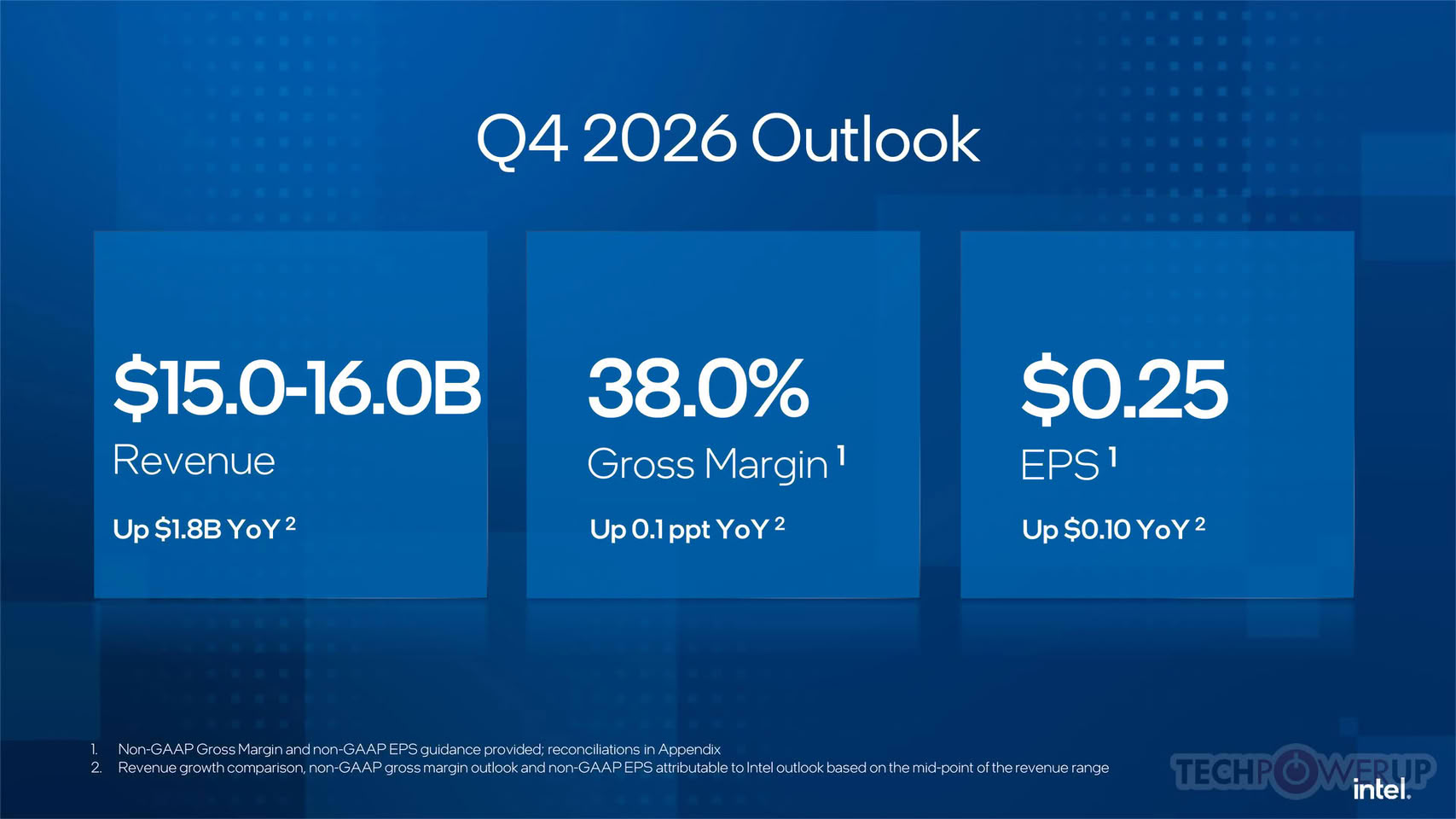
AMD looks set to bring in more quarterly revenue than Intel for what appears to be the first time ever. Alongside its record Q3 2026 results, AMD guided Q4 revenue to approximately $17 billion, plus or minus 3%, or roughly $16.5 billion to $17.5 billion. Intel, on the other hand, expects Q4 revenue between $15 billion and $16 billion. Even the bottom of AMD's range sits above the top of Intel's, so unless either company misses its guidance badly, the flip is pretty much locked in.

Most of AMD's growth comes from the data center. AMD's Data Center segment hit a record $8.5 billion in Q3, up 97% year over year, on strong EPYC demand and the launch of the Instinct MI450 Series GPUs inside its Helios racks. AMD expects the segment to grow about 50% sequentially in Q4, while Client and Gaming is expected to drop by more than 20%. Intel's Q4 outlook, meanwhile, came in well below expectations, partly due to a two-week shutdown at Fab 28 in Israel that Intel says will cost about $300 million in Q4 revenue.

Samsung Hosts OpenAI's Sam Altman for AI Seminar, No Supply Deal Announced

Two days after arguing that the DRAM in home PCs would be put to better use in data centers, OpenAI CEO Sam Altman sat down with around 50 Samsung presidents on Saturday, October 31. The group went well past the chip business, with leaders from Samsung's finance and biotech arms joining the electronics side at the company's training center in Yongin. Samsung presented it as part of a leadership seminar series for its company-wide AI push, and the talks apparently covered where AI is headed, the markets it could open up, and how it changes the way large companies make decisions. According to Samsung, Altman told the room that adopting AI alone doesn't give anyone an edge, and that the payoff comes from using it to move faster and build better products.

Nothing came out of it in terms of a new supply contract, at least publicly, and Samsung's own write-up stuck to AI strategy. Still, it's hard to look at the visit separately from the memory shortage. Samsung signed a letter of intent with OpenAI back in October 2025 to act as a memory partner for Stargate, with OpenAI's demand projected at up to 900,000 DRAM wafers per month. Separately, on October 31, SK Group chairman Chey Tae-won also reportedly met Altman in Seoul, with SK hynix and SK Telecom executives joining, according to industry sources. Last month, AMD's Lisa Su spent hours with Samsung's chip chief chasing HBM supply, and amid all these meetings, Micron's CEO expects the memory crunch to get worse in 2027 and 2028. It seems like every major buyer is knocking on the same Korean doors.

Intel's Lip-Bu Tan Discusses Possible AMD Cooperation, Lays Out CPU and Foundry Plans

Intel CEO Lip-Bu Tan has spoken with AMD CEO Lisa Su about exploring potential areas of cooperation. Tan brought it up during an October 24 fireside chat with Jimmy Cheng, president of the Chinese American Semiconductor Professional Association (CASPA), though he didn't say what those areas are, and neither company has announced anything. AMD was earlier reported to be evaluating Intel's 14A node, so foundry work seems like an obvious guess. However, it could just as well be packaging, software, or something else entirely.

Most of the chat was about Intel's own turnaround. Tan reportedly said Intel has to "reclaim the leadership in CPU" and that it will now tailor chips like Xeon to customer needs, something he admitted the company was too proud to do before. He named ASICs, co-packaged optics, physical AI and advanced packaging as possible growth areas, and wants two or three of them to eventually bring in around 10% of Intel's revenue each. On the foundry side, 18A is in volume production, while 14A has its 0.5 PDK out, with 0.9 next and 1.0 for volume production early next year. Intel had targeted October for handing the 0.9 PDK to outside customers, and Tan's "stay tuned" suggests it hasn't happened just yet.

AMD CEO Visits Samsung for HBM, Samsung Wants Foundry Orders in Return

AMD CEO Dr. Lisa Su reportedly visited Samsung on October 7th and spent about three hours with Samsung chip chief Jun Young-hyun in Seoul on Wednesday, and a Korean media report suggests the two sides want different things from each other. As relayed by @jukan05 on X, Samsung apparently wants AMD to place orders with Samsung Foundry in return for HBM and other memory, which AMD urgently needs. A senior semiconductor industry official quoted in the report said "AMD sees entrusting its foundry work to Samsung Electronics as too risky," and added that this gap is what brought about the talks. Neither company has confirmed any of it, so it is best treated as an industry report for now.

Su's public comments were far more diplomatic. Speaking to Reuters and other reporters in Seoul ahead of the meeting, she said AMD continues to explore opportunities with Samsung in both memory and foundry. Asked directly whether AMD would build chips at Samsung, she stopped short of confirming any plans. She was more direct about memory, urging suppliers to "build faster, as fast as possible" and noting that AMD is working with customers to trim their memory footprint.

AMD CEO Lisa Su Says 2027 Will Bring a "Substantial" Supply Increase

AMD will "substantially" increase its chip supply in 2027, CEO Lisa Su told reporters in Taipei on Tuesday, while admitting that demand is still running ahead of what the company can ship. Su is on her third trip to Taiwan this year, meeting partners such as Foxconn, Quanta, Acer, and ASUS, with TSMC also on the schedule. She is reportedly heading to South Korea later this week to sit down with memory suppliers Samsung and SK Hynix. Here's what she said:
We've been able to increase our supply as we've gone through 2026, and we're going to substantially increase our supply in 2027, but we can definitely use more. There's very, very high demand for the next several years. We can see very high demand, and so we need more advanced wafer capacity.

Microsoft to Deploy Next-Gen AMD Instinct and AMD EPYC Processors

AMD today announced an expanded strategic partnership spanning AMD GPUs, CPUs, networking and software on Microsoft Azure. At the center of this expansion, Microsoft will deploy the AMD Helios Rackscale Solution, to power frontier model AI inference for Microsoft, its AI customers and support Azure AI services. Azure will also add two new AMD EPYC CPU-powered VM series and broaden its deployment of Pensando DPUs to support Azure networking services. AMD will begin shipping Helios to customers, including Microsoft, in the second half of 2026.

AMD Helios combines AMD Instinct MI455X GPUs, AMD EPYC "Venice" CPUs, Pensando networking and ROCm software in an open, integrated rackscale platform built for large-scale AI training and inference. The Azure deployment will use Helios for inference workloads spanning frontier models, Azure AI services and customer applications.

AMD Announces More Than $10 Billion in Taiwan Ecosystem Investments to Accelerate AI Infrastructure

To meet the growing demand for AI infrastructure, AMD (NASDAQ: AMD) today announced more than $10 billion in investments across the Taiwan ecosystem to expand strategic partnerships and scale advanced packaging manufacturing for next-generation AI infrastructure. Working with strategic partners in Taiwan and globally, AMD is advancing leading-edge silicon, packaging and manufacturing technologies that enable higher performance, greater efficiency and faster deployment of AI systems. These efforts build on AMD's deep ecosystem partnerships and long-standing leadership in chiplet architectures, high-bandwidth memory integration, 3D hybrid bonding and rack-scale system design for next-generation AI infrastructure.

"As AI adoption accelerates, our global customers are rapidly scaling AI infrastructure to meet growing compute demand," said Dr. Lisa Su, Chair and CEO, AMD. "By combining AMD leadership in high-performance computing with the Taiwan ecosystem and our strategic global partners, we are enabling integrated, rack-scale AI infrastructure that helps customers accelerate deployment of next-generation AI systems."

PC Motherboard Sales Face Sharp 25%+ Decline Amid Weak Demand

PC motherboard sales are on track for some of the biggest corrections in recent times as manufacturers struggle with weak demand, according to a DigiTimes report. What began as AI data center expansion quickly started affecting consumer PC DIY endeavors, as severe silicon shortages across the industry drove DRAM and CPU demand so high that prices have increased significantly for DDR4 and DDR5 memory kits, while regular CPUs have also seen a large price increase. In response, PC motherboard makers are caught in the middle of this shortage, seeing their motherboard unit sales revised down significantly. The report notes that all Taiwanese motherboard makers have significantly lowered their 2026 shipment targets, with some experiencing more than a 25% decrease in projected unit sales.

Interestingly, it's not only CPU and memory shortages driving this lowered demand; there are indications that consumers have slowed down their NVIDIA GPU upgrade cycles, which is impacting new motherboard sales. Particularly with the "Blackwell" GPU generation, consumers began purchasing PCIe 5.0 motherboards to achieve the greatest performance increase. However, as these GPUs became rarer and more expensive due to the global DRAM shortage, consumers have become reluctant to upgrade. ASUS is projected to sell about 10 million motherboards in 2026, while MSI and GIGABYTE are now projecting sales of less than 10 million units each. This represents about a 25% yearly decrease from 2025 sales. The worst position is estimated for ASRock, which is expected to see a 30% decrease according to the report.

AMD to Expand EPYC Lineup With Specialized CPUs for AI, HPC, and Cloud

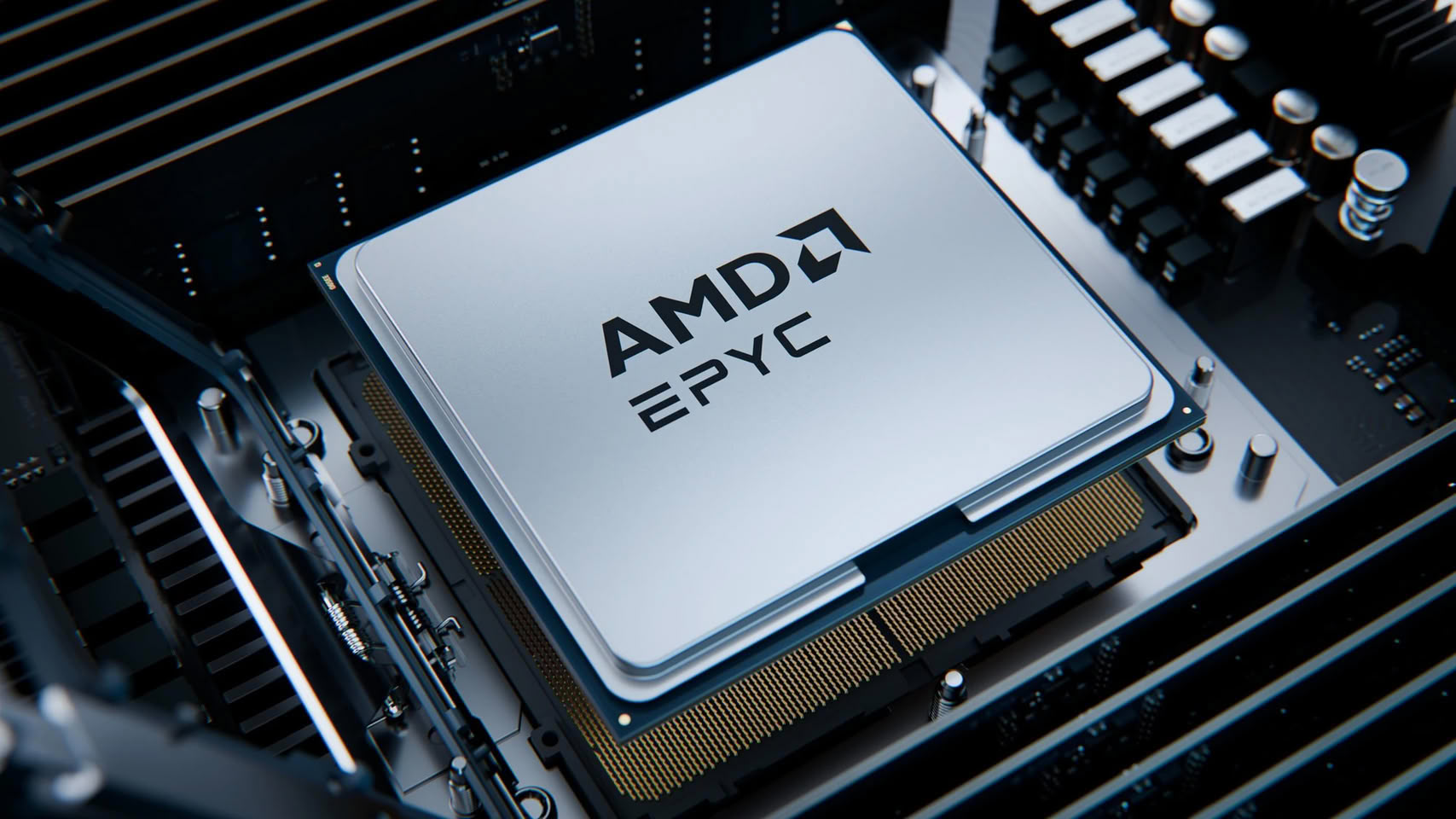
AMD's CPU offerings will soon expand into more categories, specializing in different tasks and use cases. During the latest Q1 earnings call, AMD CEO Dr. Lisa Su confirmed that customers are increasingly interested in specialized EPYC solutions and that future CPU generations will cater to different customer needs. This means that agentic AI will receive a dedicated EPYC CPU SKU, HPC workloads will have their own EPYC CPU SKU, AI training and inference will get a separate EPYC SKU, and cloud workloads will have a distinct SKU. This expansion of task-specialized CPU designs will go beyond the "Venice" CPU platform, which is expected to be released this year. At CES 2026, AMD confirmed that EPYC "Venice" will be a highly dense CPU package with up to 256 cores and 512 threads of "Zen 6c" cores, while the regular "Zen 6" configuration will have a maximum of 96 cores and 192 threads.

With this generation of EPYC CPUs based on the "Zen 6" core IP, AMD will promote "Venice" CPUs broadly, while the "Venice" CPU generation will be complemented by the "Verano" CPUs. These appear to use the same "Zen 6" microarchitecture but have optimizations specifically designed for AI infrastructure. Contrary to previous assumptions that "Verano" would be a "Zen 7" IP, it is now confirmed to be part of the 6th-generation EPYC CPU family. This indicates that AMD is starting its CPU customization for different workloads as early as this year. As the server CPU market is projected to reach $120 billion by the end of this decade, less than 3.5 years away in 2030, it makes sense to have different CPU SKUs for each task and capture a significant portion of that revenue. Server CPUs are also expected to grow at a 35% compound annual growth rate, which is impressive for a relatively mature market.

AMD CEO Lisa Su Says Server CPU Demand "Far Exceeded" Expectations, Supply Now Tightening

AMD is seeing server CPU demand it didn't fully anticipate, with CEO Lisa Su describing it as having "far exceeded" her expectations. Speaking at the Morgan Stanley Technology, Media & Telecom Conference earlier today, Su outlined how the landscape has shifted as agentic AI applications have taken off, pushing CPUs back into the spotlight alongside accelerators. The CPU-to-GPU ratio in AI compute workloads has evolved dramatically over the past few months, and top customers reportedly told Su that CPU demand sitting alongside AI was "under-forecasted." Supply is tightening as a result. The sudden spike in customer commitments left little time for the supply chain to adjust, though AMD says it's working closely with partners to ease existing bottlenecks and expects capacity to expand over the coming year. Su expressed confidence that AMD's product lineup is well positioned to address training, inference, and agentic workloads going forward. We've also seen this play out at the customer level, with hyperscalers like Meta signing CPU agreements with AMD and NVIDIA, a sign that compute is diversifying away from a pure GPU focus.

Back in late January, Intel disclosed it had to reallocate wafer capacity from its PC division to Xeon production after hyperscalers started ordering larger quantities than anticipated, triggering a temporary shortage. Then, in early February, both Intel and AMD warned customers in China about tightening supplies, with Intel Xeon delivery times stretching to as long as six months and prices up more than 10%. AMD's situation is somewhat less difficult, but lead times have still pushed out to eight to ten weeks for some orders. On the consumer side, AMD's next-gen Ryzen 'Olympic Ridge' desktop processors based on Zen 6 are rumored to have slipped to 2027, possibly another sign that AMD is prioritizing Zen 6 chiplets for EPYC server processors.

AMD Ryzen AI PRO 400 AM5 Desktop APU Shown During Lenovo Presentation

Early last week, AMD briefed members of the press about a new Ryzen AI 400 series coming to desktop in the near future. At the time, details and visual material were scarce—fundamentally, 4 nm "Gorgon Point" monolithic silicon seems to be freeing itself from mobile platform origins. As CES 2026 wrapped up, detective work continued online. Late last week, VideoCardz realized that Saša Marinković (a senior director of Global Consumer Marketing at Team Red) had captured an important moment during Dr. Lisa Su's on-stage presentation at Lenovo Tech World.

In the background, a projected slide showed off three important upcoming new-gen families: EPYC, Instinct (accelerator), and the aforementioned Ryzen AI PRO 400 APU design. The latter was rendered/depicted in desktop socketed format, on the familiar AM5 platform. This likely reaffirms previous reports that AMD has moved on from past-gen desktop APU nomenclature; e.g. Ryzen 8000G. Up until the start of this year, many industry observers predicted an introduction of Ryzen 9000G APU products, armed with XDNA 2 NPUs, at the important January trade event. Going further into 2026, Team Red is expected to announce various Ryzen AI 400 desktop SKUs, featuring Zen 5/Zen 5c core configurations and RDNA 3.5-based iGPUs.

AMD Zen 6 EPYC "Venice" Introduces a Radical Package Redesign

AMD CEO Dr Lisa Su at the company's 2026 International CES event held up the next generation EPYC "Venice" enterprise processor driving the company's 2026 "Helios" AI racks powered by AMD MI455X AI GPUs. Each node in the rack features four MI455X GPUs, and one EPYC "Venice" processor with a 256-core/512-thread configuration. The package features a significantly different layout of chiplets compared to current EPYC chips. It sees two slender, centralized server I/O dies built on the 4 nm node, which are flanked on either sides by no more than eight CCDs, each built on the 2 nm foundry node, and packing 32 "Zen 6" cores.

At this point we don't know if these are full-sized "Zen 6" cores that can sustain high clock speeds, or compacted "Zen 6c" cores that feature identical ISA and IPC, but at lower maximum clock speeds. Each "Venice" package features a 16-channel DDR5 memory interface (32 sub-channels), which explains why AMD probably needed to disaggregate the sIOD into two chips that are joined at the hip using high-speed switching fabric. AMD is also expected to significantly increase the PCIe and CXL lane counts of "Venice" over the current-generation to support those four AI GPUs, DPUs, and 800G NICs.

AMD, Cisco and HUMAIN to Form Joint Venture to Deliver World-Leading AI Infrastructure

AMD, Cisco and HUMAIN, a PIF company delivering global full-stack AI solutions, announced today plans to establish a joint venture aimed to support the development of Saudi Arabia's position as a leading provider of world-class AI solutions for regional and global customers. AMD, Cisco and HUMAIN will serve as founding investors in the joint venture, which is expected to begin operations in 2026 with plans to combine HUMAIN's state-of-the-art data centers with AMD and Cisco technology, delivering modern data center capacity with efficient power and lower capital expenditures. AMD and Cisco will act as exclusive technology partners to the joint venture, contributing their portfolio of products and services to its development of up to 1 GW of AI infrastructure by 2030.

The companies also announced the first phase of the project as a buildout of 100 MW AI infrastructure, with the intent to include HUMAIN modern data center capacity, AMD Instinct MI450 Series GPUs and Cisco's industry-leading critical infrastructure.

Intel Data Center AI Executive Reportedly Departs for AMD

Intel is losing another senior figure from its data center and AI business, with Saurabh Kulkarni, Vice President of Data Center AI Product Management, set to depart for AMD. Kulkarni's last day at Intel is reportedly Friday, with Anil Nanduri, VP of AI Go-To-Market, stepping in to lead the AI product management organization. Kulkarni joined Intel a little over two years ago and most recently oversaw product management across AI systems, GPUs, and silicon design within the company's data center group. He previously defined Intel's AI systems strategy under Chief Technology and AI Officer Sachin Katti, including work on silicon photonics interconnects to improve GPU scalability for large-scale data center deployments. Before returning to Intel, Kulkarni held senior leadership roles at Graphcore and Lucata, and earlier in his career spent six years at Microsoft, leading engineering efforts for Azure's cloud and AI infrastructure. In February, Intel also lost Justin Hotard, who previously led its Data Center and AI (DCAI) division, after he announced his departure to become Nokia's new CEO.

Kulkarni's move comes as AMD ramps up its own data center AI push, driven by the Instinct GPU lineup and major design wins, including OpenAI. AMD projects its AI accelerator business could reach tens of billions in annual revenue by 2027, a target CEO Lisa Su reiterated earlier this week. Intel, meanwhile, continues to realign its AI and data center divisions under new CEO Lip-Bu Tan, following weaker-than-expected Gaudi accelerator revenue and a broader restructuring effort affecting roughly 15% of its core workforce. Several longtime Intel engineers, including Ronak Singhal and Rob Bruckner, have also departed this year as the company recruits new external talent to rebuild its AI leadership.

AMD Reports Second Quarter 2025 Financial Results

AMD (NASDAQ:AMD) today announced financial results for the second quarter of 2025. Second quarter revenue was a record $7.7 billion, gross margin was 40%, operating loss was $134 million, net income was $872 million and diluted earnings per share was $0.54. On a non-GAAP(*) basis, gross margin was 43%, operating income was $897 million, net income was $781 million and diluted earnings per share was $0.48. As previously announced, our second quarter results were impacted by the U.S. Government's export control on our AMD Instinct MI308 data center GPU products. For the quarter, these restrictions led to approximately $800 million in inventory and related charges. Excluding these charges, non-GAAP gross margin would have been approximately 54%.

"We delivered strong revenue growth in the second quarter led by record server and PC processor sales," said Dr. Lisa Su, AMD Chair and CEO. "We are seeing robust demand across our computing and AI product portfolio and are well positioned to deliver significant growth in the second half of the year, driven by the ramp of our AMD Instinct MI350 series accelerators and ongoing EPYC and Ryzen processor share gains."

AMD Chips Made at TSMC USA to Cost 5-20 Percent More, But Worth it: CEO Lisa Su

In an interview with Bloomberg, AMD CEO Dr Lisa Su revealed that the company's chips manufactured at the U.S. based fab of TSMC will cost anywhere between 5% to 20% more than the ones TSMC makes back home in Taiwan, but assured that the added cost and supply-chain resilience would make the price-hike worth the effort. Su alluded to the lack of supply-chain resilience being sorely felt by the tech industry during the COVID-19 pandemic years, causing significant second order effects across the world economy.

TSMC has a manufacturing facility in Arizona, but its most advanced node is 4 nm EUV, referred to internally as the N4 family of foundry nodes by TSMC. AMD makes various CPUs, GPUs, FPGAs, and other devices on the TSMC N4P node, but the company is transitioning to the new TSMC N2 (2 nm Nanosheet) node, starting with its next-generation "Zen 6" CPU family. It is widely expected that while the CCDs of "Zen 6" based Ryzen desktop and EPYC server processors are based on N2, the company will introduce new-generation I/O dies for both its client and server processors that will be built on TSMC N4P, advancing from the current TSMC N6.

Giga Computing Joins AMD Advancing AI 2025 to Share Advanced Cooling AI Solutions for AMD Instinct MI355X and MI350X GPUs

Giga Computing, a subsidiary of GIGABYTE and an industry leader in generative AI servers and advanced cooling technologies, today announced participation at AMD Advancing AI 2025 to join conversations with AI thought leaders and to share powerful GIGABYTE servers for AI innovations. This one-day event will be highlighted by the keynote from AMD's Dr. Lisa Su and afterwords attendees will join customer breakout sessions, workshops, and more, including discussions with the Giga Computing team.

At AMD Advancing AI Day, GIGABYTE servers demonstrate powerful solutions for AMD Instinct MI350X and MI355X GPUs. The new server platforms are highly efficient and compute dense, and the GIGABYTE G4L3 series exemplifies this with its support for direct liquid cooling (DLC) technology for the MI355X GPU. In traditional data centers without liquid cooling infrastructure, the GIGABYTE G893 Series provides a reliable air-cooled platform for the MI350X GPU. Together, these platforms showcase GIGABYTE's readiness to meet diverse deployment needs—whether maximizing performance with liquid cooling or ensuring broad compatibility in traditional air-cooled environments. With support for the latest AMD Instinct GPUs, GIGABYTE is driving the next wave of AI innovation.

AMD & HUMAIN Reveal Formation of $10 Billion Strategic Collab, Aimed at Advancing Global AI

AMD and HUMAIN, Saudi Arabia's new AI enterprise, today announced a landmark agreement to build the world's most open, scalable, resilient, and cost-efficient AI infrastructure, that will power the future of global intelligence through a network of AMD-based AI computing centers stretching from the Kingdom of Saudi Arabia to the United States. As part of the agreement, the parties will invest up to $10B to deploy 500 megawatts of AI compute capacity over the next five years. The AI superstructure built by AMD and HUMAIN will be open by design, accessible at scale, and optimized to power AI workloads across enterprise, start-up and sovereign markets. HUMAIN will oversee end-to-end delivery, including hyperscale data center, sustainable power systems, and global fiber interconnects, and AMD will provide the full spectrum of the AMD AI compute portfolio and the AMD ROCm open software ecosystem.

"At AMD, we have a bold vision to enable the future of AI everywhere—bringing open, high-performance computing to every developer, AI start-up and enterprise around the world," said Dr. Lisa Su, Chair and CEO, AMD. "Our investment with HUMAIN is a significant milestone in advancing global AI infrastructure. Together, we are building a globally significant AI platform that delivers performance, openness and reach at unprecedented levels." With initial deployments already underway across key global regions, the collaboration is on track to activate multi-exaflop capacity by early 2026, supported by next-gen AI silicon, modular data center zones, and a developer-enablement focused software platform stack built around open standards and interoperability.

AMD Achieves First TSMC N2 Product Silicon Milestone

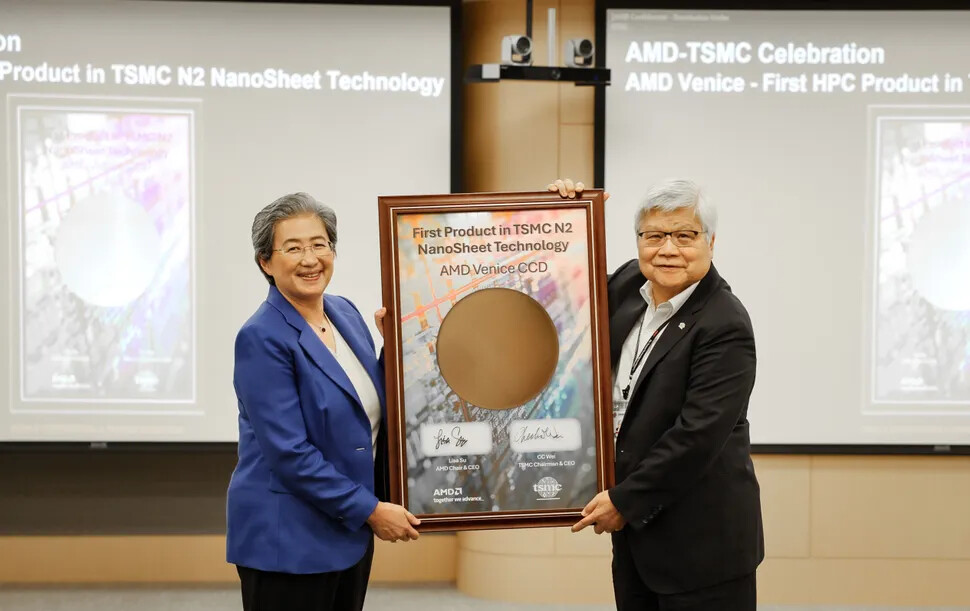
AMD today announced its next-generation AMD EPYC processor, codenamed "Venice," is the first HPC product in the industry to be taped out and brought up on the TSMC advanced 2 nm (N2) process technology. This highlights the strength of AMD and TSMC semiconductor manufacturing partnership to co-optimize new design architectures with leading-edge process technology. It also marks a major step forward in the execution of the AMD data center CPU roadmap, with "Venice" on track to launch next year. AMD also announced the successful bring up and validation of its 5th Gen AMD EPYC CPU products at TSMC's new fabrication facility in Arizona, underscoring its commitment to U.S. manufacturing.

"TSMC has been a key partner for many years and our deep collaboration with their R&D and manufacturing teams has enabled AMD to consistently deliver leadership products that push the limits of high-performance computing," said Dr. Lisa Su, chair and CEO, AMD. "Being a lead HPC customer for TSMC's N2 process and for TSMC Arizona Fab 21 are great examples of how we are working closely together to drive innovation and deliver the advanced technologies that will power the future of computing."

AMD Announces Advancing AI 2025

Today, AMD (NASDAQ: AMD) announced "Advancing AI 2025," an in-person and livestreamed event on June 12, 2025. The industry event will showcase the company's bold vision for AI, announce the next generation of AMD Instinct GPUs, AMD ROCm open software ecosystem progress, and reveal details on AI solutions for hyperscalers, enterprises, developers, startups and more. AMD executives and AI ecosystem partners, customers and developers will join Chair and CEO Dr. Lisa Su to discuss how AMD products and software are re-shaping the AI and high-performance computing landscape. The live stream will start at 9:30 a.m. PT on Thursday, June 12.
Return to Keyword Browsing
Nov 25th, 2026 02:50 CST change timezone

New Forum Posts

Popular Reviews

TPU on YouTube

Controversial News Posts