News Posts matching #Motherboard

Return to Keyword Browsing

GIGABYTE Intros B550 X Gaming Socket AM4 Motherboard

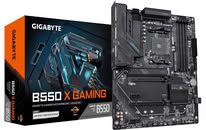
Supporting the recent Socket AM4 renaissance sparked by the memory pricing crisis is a new crop of motherboards, and GIGABYTE's latest addition is the B550 X Gaming. The board brings many of GIGABYTE's recent motherboard innovations to the aged platform. It is build in the ATX form-factor, and draws power from a combination of 24-pin ATX and 8-pin EPS connectors, conditioning it for the processor with an 8+2 phase duet-rail VRM that's sufficient to power the Ryzen 7 5800X3D. The socket is wired to four DDR4 DIMM slots, a PCI-Express 4.0 x16 slot, and an M.2 Gen 4 x4 NVMe slot. The board's second M.2 slot is Gen 3 x4, and wired to the B550 FCH, along with four SATA 6 Gbps ports. Other expansion slots include a PCI-Express x16 (electrical Gen 3 x4), and two PCIe x1.

The board features M.2 EZ-Latch design that makes it easy to install the M.2 SSD and the included heatsink for the M.2 Gen 4 NVMe slot. The board also features newer ARGB 2.0 headers. Display connectivity includes one each of standard DisplayPort and HDMI 2.1. There is no WLAN connectivity, the board's sole network connectivity is a 2.5 GbE interface driven by a Realtek 8125-series PHY. The board's onboard audio solution features an entry-level Realtek ALC892 codec. USB connectivity includes one 10 Gbps USB 3.2 Gen 2 port, three 5 Gbps USB 3.2 Gen 1 ports, one 5 Gbps USB type-C, two USB 2.0 ports on the rear panel, with two additional USB 3.2 ports via headers, and multiple USB 2.0 headers. Expect a price well under $150.
Gigabyte Launches Two New B450 Motherboards for Veteran AMD Socket AM4

Gigabyte has launched two new B450 microATX motherboards for the veteran AMD AM4 socket and yes, no mistake here, the boards use the B450 chipset that was launched way back in 2018. The B450M D3HP and B450M D3HP WIFI6E are aimed at budget builds and AM4 platform upgrades, offering support for AMD Ryzen 3000, 4000, and 5000 processors, four DDR4 slots and up to 128 GB of memory. For a motherboard built on eight-year-old silicon, the features are reasonable. There are two M.2 slots, one PCIe 3.0 x4 connected directly to the CPU and one PCIe 2.0 x2 via the chipset. Alongside, we have four SATA 6 Gb/s ports, one DisplayPort 1.2 and two HDMI 2.0b ports, a 5 Gbps USB-C front panel header and three addressable RGB headers. A Q-Flash Plus button on the rear I/O allows BIOS updates without a compatible CPU installed, which is useful for anyone looking to buy a new Ryzen processor. Both boards use a 4+2 phase power delivery and Gigabit Ethernet. The WIFI6E variant adds Wi-Fi 6E and Bluetooth 5.3.

However, the limitations are real, there is no PCIe 4.0, no DDR5 (obviously), and the second M.2 slot only runs at PCIe 2.0 x2. But for someone already having a Ryzen 5000 chip and DDR4 memory, or anyone putting together the cheapest possible functional PC, those trade-offs might not matter much. Surprisingly, though, AM4 refuses to die, and apparently Gigabyte is still willing to make use of it considering that a few weeks ago they released new AM4 motherboards using the B550 chipset launched six years ago. No pricing or exact availability was announced for either board.

AMD Acknowledges TPM Vulnerability, but Everything Is Now Patched

AMD has acknowledged today that a new vulnerability in the trusted platform module has been found, but fortunately, it was patched before the public announcement. According to AMD, a potential out-of-bounds (OOB) read was present in the TPM 2.0 reference implementation, which could send malicious commands to TPM 2.0 and completely bypass its functionality. If an attacker were able to access and even disable the TPM, all digital signing and encryption would be compromised, earning this vulnerability a very high severity score. Reported under CVE-2026-6726 with a CVSS score of 8.5, and the second being CVE-2026-6727 with a CVSS score of 8.3, these attacks affected every AMD Ryzen CPU from the 3000 to 9000 series of desktop processors.

Intel security researchers spotted the issue and reported it to the Trusted Computing Group (TCG) and its Vulnerability Response Team (VRT). AMD has been working with motherboard vendors to ship updates and secure the platforms. Motherboard OEMs have been distributing these patches since May of this year, with some shipping in June and July. However, the only remaining CPUs for the August update are the AMD Ryzen AI 300 series, Ryzen AI 400 desktop and notebook series, as well as the Ryzen AI Max 300 series of processors, which will receive their Pluton secure processor updates this month.

ASUS, GIGABYTE, and MSI to Raise Motherboard Prices in Q3

Motherboard manufacturers are currently facing a challenging situation where declining sales are impacting their revenue, and rising component costs are eroding their margins. According to the latest update from Board Partners, major motherboard manufacturers, including ASUS, GIGABYTE, and MSI, are expected to introduce a series of planned price increases to maintain their margins. Taiwanese motherboard makers are experiencing price increases across their supply chain, with the cost of bare PCBs used in manufacturing these motherboards expected to rise by at least 50% this year, significantly impacting component costs. Raw materials used in manufacturing, such as copper, are also in high demand, leading to price increases. Other electronic components like control chips, power devices, and surface-mount capacitors, such as MLCCs, are experiencing significant bottlenecks.

As a result, motherboard manufacturers are facing substantial price increases from their supply chain and are being forced to implement price hikes this quarter. The total bill of materials (BOM) for each motherboard design varies, as every platform uses a different number of capacitors, power components, and control chips. Additionally, each motherboard uses a different number of PCB layers, affecting the BOM. This means we are not yet certain how much motherboards will be impacted by the component shortage, as only motherboard manufacturers know exactly how much they need to adjust their pricing percentage-wise, likely on a per-motherboard SKU basis.

GIGABYTE Launches B550 X Series Socket AM4 Motherboards with Modern Connectivity

GIGABYTE TECHNOLOGY Co. Ltd, a leading manufacturer of motherboards, graphics cards, and hardware solutions, today unveiled its highly anticipated AORUS B550 X Series motherboards. Engineered to be the most powerful refresh of the AM4 platform motherboard, the B550 X Series is built as the perfect match for the legendary AMD Ryzen 7 5800X3D processor, giving gamers and builders a smarter path to elite performance without the cost premium of next-generation platforms.

The GIGABYTE B550 X Series was purpose-engineered around one of the most celebrated processors in PC gaming: the Ryzen 7 5800X3D, widely regarded as the best cost-to-performance processor on the market. The board is built to sustain the 5800X3D's 8 cores and 16 threads under extreme throughput while comfortably taming its massive 96 MB of L3 cache. The pairing delivers the kind of gaming performance that keeps frame rates high and total build cost low—a value proposition further strengthened by DDR4 memory compatible.

Intel "Nova Lake-S" 12 Xe3P iGPU to Draw Up to 65 Watts

Intel's upcoming "Nova Lake-S" is gearing up for a launch later this year. However, rumors suggest that certain "Nova Lake-S" models with large integrated graphics might require significant power, increasing the TDP and peak power. According to the well-known Intel leaker Jaykihn on X, Intel's 16-core CPU SKU with 12 Xe3P cores will need specialized power delivery, with 65 W dedicated to integrated graphics. This SKU includes four P-Cores, eight E-Cores, and four LPE-Cores, along with 12 Xe3P GPU cores. This 4+8+8+12 core configuration is one of the few processors where integrated graphics require two VCCGT phases. In regular SKUs, VCCGT is a single-phase power rail for the integrated graphics inside the processor. However, since Intel aims to enhance its iGPU performance with "Nova Lake," a single phase is insufficient.

Previously, we learned that Intel's top-end, overclocking-focused, dual compute die "Nova Lake-S" CPU with 52 cores will feature a PL2 mode with a power level of 474 W. This also includes the possibility of three 8-pin CPU power connectors on high-end Z990 motherboards, an intriguing design choice considering that most enthusiast boards typically have two 8-pin EPS CPU connectors. The three 8-pin connectors are mainly intended for the highest-end overclocking designs, rather than being necessary for running the dual compute die designs. Motherboards with either two or three EPS connectors are still expected to support Intel's upcoming high-end 44-core and 52-core processors on the 175 W platform. However, we are likely to see various configurations, and motherboard designs are preparing for higher TDPs. Below image is illustration only.

GIGABYTE Intros B550 AORUS Elite WiFi7 Socket AM4 Motherboard

GIGABYTE introduced a new Socket AM4 motherboard as part of a new wave of motherboards based on the older socket that supports DDR4 memory, timed with the re-launch of the Ryzen 7 5800X3D processor. The B550 AORUS Elite WiFi7 is essentially an upgrade of the B550 AORUS Elite AX V2, with a Wi-Fi 7 WLAN module replacing the Wi-Fi 6E module. GIGABYTE also took the opportunity to give the board its latest Wi-Fi antenna EZ-plug connector, replacing the older screw-type RP-SMA connectors. It also comes with a newer antenna. The WLAN module on this board is the Realtek RTL8922AE, which supports Wi-Fi 7 with 160 MHz channel width, along with Bluetooth 5.4 support, which is a significant upgrade over the MediaTek RZ608 or Realtek RTL8852CE module on the older board that supported Wi-Fi 6E with 80 MHz or 160 MHz channel widths (depending on the PCB revision), and Bluetooth 5.2.

The new B550 AORUS Elite WiFi7 is built in the ATX form-factor, and pulls power from a combination of 24-pin ATX and 8-pin EPS connectors, and uses a 12+2 phase VRM. The AM4 socket is wired to four DDR4 DIMM slots, a PCI-Express 4.0 x16 slot, and an M.2 Gen 4 NVMe slot. The board's second M.2 NVMe slot is Gen 3, and wired to the B550 FCH, and shares its lanes with a PCI-Express x16 (electrical x4) slot. There is a third x16 slot that's electrically x1, along with a physical x1 slot. Besides the contemporary WLAN module, the board comes with a 2.5 GbE wired LAN interface driven by a Realtek 8125-series controller. The onboard audio solution uses a Realtek ALC1200 HDA codec. USB connectivity includes a 5 Gbps USB-C header, two 5 Gbps USB 3.2 ports by headers, two 10 Gbps USB 3.2 Gen 2 ports, four 5 Gbps USB 3.2 Gen 1 ports, and a couple of USB 2.0 ports on the rear panel, besides four via headers. Expect a sub-$160 price.

Gigabyte Breaks the DDR5 Bottleneck: Full Motherboard Lineup Now Supports CXSH (CXMT) Memory

Gigabyte Technology Co. Ltd, a leading manufacturer of motherboards, graphics cards, and hardware solutions, today announced that its full lineup of DDR5 motherboards now supports CXSH (CXMT) chip-based memory, giving consumers more options and greater availability amid an ongoing industry-wide memory shortage. The BIOS optimization enables AM5 800/ 600 series motherboards to run CXSH (CXMT) chip-based memory stably at 8200 MT/s, while Intel 800/ 700 series platforms support CXSH (CXMT) chip-based memory out of the box.

Following AMD's release of AGESA 1.3.0.1c and Gigabyte's own memory optimization technology, AM5 motherboards across both the 800 series and 600 series now support CXSH (CXMT) chip-based memory, including 16 Gb and 24 Gb densities. With this update, Gigabyte AM5 motherboards can now stably run these DIMMs at speeds of up to 8200 MT/s, breaking the previous AM5 platform limitation and giving builders more performance headroom on AMD's platform. Meanwhile, Gigabyte's Intel 800 and 700 series motherboards already support CXSH (CXMT) chip-based memory through their current shipping BIOS, with no additional update required.

MSI Motherboards Deliver DDR5-8000+ Support for CXMT-Based Memory on Intel Platform

MSI today announced that its Intel 800-series motherboards are now fully optimized for DDR5 memory built on CXMT (ChangXin Memory Technologies) DRAM. Following dedicated BIOS memory tuning, MSI Z890 motherboards deliver stable DDR5-8000+ operation with CXMT-based modules, spanning from flagship overclocking designs all the way to mainstream 4-DIMM boards.

CXMT-based DDR5 modules have rapidly gained popularity thanks to their strong value proposition, but their frequency headroom has historically lagged behind established DRAM vendors, which is a gap defined less by the silicon itself than by how well motherboard firmware understands it. MSI took on exactly that challenge, developing dedicated memory training and timing optimizations for CXMT ICs and validating the results with rigorous stress testing.

GIGABYTE Intros the Micro-ATX B850M AORUS Stealth Motherboard

GIGABYTE today introduced the B850M AORUS Stealth, a Socket AM5 motherboard based on the AMD B850 chipset that offers backside connectors for better cable management and aesthetics. This is among the first of the company's motherboards in the microATX form-factor to feature backside connectivity. The board draws power from a combination of 24-pin ATX and a single 8-pin EPS connector. It uses an 8+2+2 phase CPU VRM design. The socket is wired to four DDR5 DIMM slots, the board's sole PCI-Express 5.0 x16 slot, and two M.2 NVMe slots, one of which is Gen 5 x4, and the other interestingly is Gen 4 x4 even though it comes from the CPU. There is a third M.2 Gen 4 x4 slot that's wired to the B850 chipset. Other storage connectivity includes two SATA 6 Gbps ports.

USB connectivity of the GIGABYTE B850M AORUS Stealth includes four 5 Gbps USB 3.2 Gen 1 type-A on the rear panel; four USB 2.0 type-A, also on the rear panel; two 10 Gbps USB 3.2 Gen 2, one of which is type-A and the other type-C, on the rear panel; two 5 Gbps USB 3.2 Gen 2 ports from a header; and a 20 Gbps USB 3.2 Gen 2x2 port from header. Network connectivity includes a Wi-Fi 7 160 MHz and Bluetooth 5.4 provided by a Realtek RTL8922AE WLAN module; and a 5 Gbps wired Ethernet interface driven by a Realtek RTL8126 series PHY. The onboard audio solution is driven by a Realtek ALC1220 HDA codec. The company didn't reveal pricing.

COMMELL Announces LV-6718 Mini-ITX Motherboard with Intel Panther Lake Core Ultra 7 366H CPU

Taiwan Commate Computer Inc. (COMMELL), a global leader in industrial single board computers, proudly introduces the LV-6718, a Mini-ITX mobile motherboard powered by Intel Core Ultra Series 3 Processors (PTL-H / Panther Lake-H Platform). Designed for next-generation industrial, edge AI, automation, and smart embedded applications, the LV-6718 delivers powerful computing performance, high-speed memory, advanced AI acceleration, rich I/O connectivity, and flexible display support in a compact Mini-ITX form factor.

Next-Generation Performance with DDR5 and AI Acceleration
The LV-6718 supports Intel Core Ultra Series 3 Processors with advanced 3D performance hybrid architecture, providing excellent computing efficiency for modern embedded workloads. With 2x DDR5 SO-DIMM slots supporting up to 128 GB at 7200 MHz, the LV-6718 offers high memory bandwidth for multitasking, data processing, industrial control, and AI applications.

GIGABYTE Formally Launches X870 AORUS Infinity Motherboard

GIGABYTE formally launched the X870 AORUS Infinity Socket AM5 motherboard for competitive overclockers. The board was part of GIGABYTE's G.Skill Computex Memory OC competition, and was a part of the company's 40th Anniversary showcase. Although built in the ATX form-factor, this board features a layout that's optimized for test benches, and not cases. Most of its key connectors are pointed sideways, such as its 24-pin ATX power input, while there's a conveniently organized onboard control panel with two sets of ISA 80h readouts, and SMD buttons, which include a cold reboot button. The CPU socket is rotated 90° CCW to enable the memory slots to line its top edge.

The board draws power from a combination of one 24-pin ATX, two 8-pin EPS, and an 8-pin PCIe power supplementary input that enables 65 W USB-PD on the type-C ports. The board features an 18+2+2 phase CPU VRM that uses 110 A DrMOS and high-grade tantalum capacitors. This is among the rare few high-end motherboards that use a 10-layer PCB. The CPU socket is wired to two DDR5 DIMM slots in a 1-DIMM per channel topology that's best suited for memory overclocking, particularly tightening memory timings. It is also wired to two M.2 NVMe Gen 5 x4 slots, and two PCI-Express 5.0 x16 slots (x8/x8 Gen 5 when both are populated). The AMD X870 chipset puts out a third M.2 slot, which runs at Gen 4 x4 speed.

Colorful Intros iGame B850I Mini OC V14 Motherboard

Colorful today introduced the iGame B850I Mini OC V14, a fairly premium Socket AM5 motherboard in the Mini-ITX form-factor, which aesthetically matches its iGame Mini line of SFF-ready GeForce RTX 50-series graphics cards, including the very capable RTX 5070 Mini OC. The board draws power from a combination of 24-pin ATX and a single 8-pin EPS power connector; and conditions it for the CPU with a 9+2+1 phase VRM solution that uses 60 A DrMOS. The Socket AM5 SoC is wired to two reinforced DDR5 DIMM slots, and the board's sole expansion slot, a reinforced PCI-Express 5.0 x16. Both the M.2-2280 slots on this board—one on the obverse side, and the other reverse—are Gen 5, and wired to the processor in a way that they don't subtract lanes from the PEG slot.

The M.2 slot on the obverse side gets a chunky aluminium heatsink. Besides the two M.2 Gen 5 slots, you get two SATA 6 Gbps ports. USB connectivity includes a 20 Gbps USB 3.2 Gen 2x2 front-panel header, and two additional USB 3.2 Gen 1 ports from a separate front-panel header. The rear panel has one 10 Gbps USB 3.2 Gen 2 type-A, two 5 Gbps USB 3.2 Gen 1, and four USB 2.0. Display outputs include both HDMI and DisplayPort. Network connectivity includes Wi-Fi 7 and Bluetooth 5.4 from a MediaTek MT7925 160 MHz WLAN adapter, and a 5 GbE interface driven by a Realtek RTL8126-CG PHY. The onboard audio solution uses a Realtek ALC1200 HDA codec. The company didn't reveal pricing.

ASRock Intros B550 Rock WiFi Socket AM4 Motherboard

Socket AM4 is here to stay as long as DDR4 memory remains affordable, and AMD resurrected the Ryzen 7 5800X3D to restore a flagship gaming processor and upgrade path for this platform. Motherboard vendors are trickling out a new crop of AM4 motherboards. ASRock recently debuted its Rock brand of entry-mainstream motherboards and recently a new product to its lineup, the B550 Rock WiFi. Built in the ATX form-factor, this board features a modern product styling from the Rock series, with its blocky chipset/VRM heatsinks. It draws power from a combination of 24-pin ATX and single 8-pin EPS connectors; and uses an 8+2 phase CPU VRM.

The Socket AM4 is wired to four DDR4 DIMM slots, supporting a maximum of 128 GB of DDR4-3200 memory; the board's PCI-Express 4.0 x16 slot, and an M.2 NVMe Gen 4 x4 slot with an included heatsink. Besides this M.2 slot, the board offers two M.2 Gen 3 slots, one of which is x4, the other x2, and four SATA 6 Gbps ports. Networking options include a 2.5 GbE wired Ethernet driven by a Realtek DragonLAN RTL8125BG controller; and a Realtek RTL8852CE WLAN module in an easy to upgrade M.2-2230 E-key slot that offers Wi-Fi 6E and Bluetooth 5.3 interfaces. The onboard audio solution is an entry-level one, driven by a Realtek ALC897 HDA codec.

Biostar Releases the New B850MS-E Motherboard

BIOSTAR, a leading manufacturer of motherboards, edge computing solutions, industrial motherboards, graphics cards, and storage devices, today is excited to introduce the B850MS-E motherboard, a modern AMD B850 platform engineered for efficient productivity, immersive home entertainment, and reliable system integration.

Built to bring current-generation features to mainstream AMD Socket AM5 PC builds, the B850MS-E combines DDR5 memory support, PCIe 5.0 M.2 storage, and Wi-Fi 7 readiness in a versatile Micro ATX platform designed for everyday productivity, home entertainment, and business deployment. Supporting AMD Ryzen 9000 / 8000 / 7000 series processors, with readiness for future AMD Ryzen processors via BIOS update, the B850MS-E delivers a strong foundation for users seeking dependable performance across office workloads, multimedia streaming, and customer-facing applications.

Maxsun Shows Off iCraft Z890 ITX Wi-Fi Motherboard at Computex 2026

Maxsun has officially shown off its new iCraft Z890 ITX motherboard at Computex, with active chipset and VRM cooling in an ITX form factor. The Z890 ITX is built for the Intel LGA-1851 socket, with support for Intel's Core Ultra 2 series CPUs in mind. Maxsun claims that the Z890 ITX is capable of powering a CPU with a 250 W TDP, thanks to an 8+1+1 power circuit design, making it powerful enough even for the likes of the Core Ultra 9 285K at stock clocks, according to the testing in the TechPowerUp Core Ultra 9 285K in-depth technical review. Pricing and a launch date have not yet been revealed for the Maxsun iCraft Z890 ITX Wi-Fi motherboard.


Physically, the new motherboard sports a full-length PCIe 5.0 ×16 slot and two DDR5 memory slots for dual-channel memory configurations, and it has active cooling on both the VRM and in the M.2 heat sink under the PCIe slot. It supports 1× PCIe 5.0 ×4 M.2 SSD on the front of the motherboard, 1× PCIe 4.0 ×4 M.2 SSD in a rear-mounted M.2 slot, and 4× PCIe 4.0 Slim SAS SFF-8654 4i SSDs. As for network connectivity, the motherboard sports Bluetooth 5.4 and Wi-Fi 7, as well as Realtek 5G LAN, and the rear I/O has both DisplayPort 1.4 and HDMI 2.1, 3× USB Type-C 20 Gbps ports, 6× USB Type-A 10 Gbps ports, 2× USB 5 Gbps ports, and 4× USB 2.0 ports. The motherboard also features a built-in 5 v ARGB connector for case and fan customization purposes.

ASRock Celebrates A Decade of Taichi Mastery and Expands Its AI Ecosystem at Computex

ASRock, a global leader in motherboards, graphics cards, gaming monitors, mini PCs, power supply units, and AIO liquid coolers, will participate in COMPUTEX 2026 from June 2 to June 5. This year's showcase will focus on gaming hardware and AI-related application solutions, highlighting ASRock's continued expansion of its AI ecosystem and commitment to innovation.

At COMPUTEX 2026, ASRock will showcase its latest lineup of motherboards, AIO liquid coolers, gaming monitors, power supply units, and mini PCs. One of the major highlights of the exhibition is the celebration of the 10th anniversary of ASRock's flagship Taichi series. Since the launch of the X99 Taichi motherboard in 2016, the Taichi series has continously to evolve. To commemorate this milestone, ASRock will feature a dedicated Taichi 10th Anniversary exhibition zone, showcasing legendary Taichi products that reflect the series' decade-long evolution, innovation, and key milestones.

COLORFUL Introduces iGame B850M ULTRA Series microATX Motherboards

Colorful Technology Company Limited, a leading brand in gaming PC components, gaming laptops, and Hi-fi audio products, introduces the new iGame B850M ULTRA Series motherboards for AMD Ryzen platforms, featuring the iGame B850M ULTRA-S and the iGame B850M ULTRA-OC. Designed for gamers, creators, and PC enthusiasts, the new microATX motherboards combine advanced power delivery, high-speed DDR5 memory support, PCIe 5.0 connectivity, and modern networking technologies in compact form factors.

The iGame B850M ULTRA Series features a sleek all-black design with matte-finish cooling armor, created to complement the latest iGame GeForce RTX 50 Series ULTRA Series graphics cards for cohesive all-black PC builds. Combining modern aesthetics with high-performance hardware, the motherboards are designed for gaming, content creation, and overclocking applications.

Avalue Expands Edge HPC Portfolio with HPS-GNRU1A 1U Server and HPM-GNRUP Motherboard

As artificial intelligence (AI) and data-intensive applications continue to drive demand for real-time processing and low-latency computing, high-performance computing (HPC) is rapidly expanding beyond traditional data centers to the edge. Addressing this growing trend, Avalue Technology has launched the HPS-GNRU1A 1U high-density server system and the HPM-GNRUP industrial server board, combining the latest Intel Xeon 6 platform, PCIe Gen 5 architecture, and high-density NVMe storage to deliver flexible and high-performance solutions for emerging Edge HPC applications.

Unlike conventional HPC platforms primarily designed for centralized data centers, Avalue's latest Edge HPC portfolio is optimized for on-site computing environments. In smart manufacturing, AOI inspection systems require real-time image processing to improve production yield and process stability. In healthcare, image-guided therapy depends on precise and low-latency image analysis, while smart city applications such as airport security screening demand rapid processing of high-frequency imaging data. In life sciences, next-generation sequencing (NGS) workloads also require intensive computing performance for large-scale data analysis. These applications share common challenges, including massive data throughput, real-time processing requirements, and deployment in space-constrained environments, making Edge HPC a critical market focus.

ASUS Republic of Gamers Unveils ROG Crosshair 2006 Motherboard to Mark 20 Years of ROG

ASUS Republic of Gamers (ROG) today announced the ROG Crosshair 2006, a cousin of the Crosshair X870E Dark Hero that is an aesthetic throwback to the first motherboard ROG created 20 years ago.

Its potent gaming power is draped in time-traveling retro style. Decked with eye-catching colors and materials that harken back to one of PC gaming's most important formative eras, the ROG Crosshair 2006 is the new motherboard of choice for gamers who demand the best of past and present. This special edition is armed to the teeth with 2026's most innovative gaming tech, with the latest refinements equipping users for a supremely easy PC building experience. Its marquee feature is a 2-inch OLED screen on the primary M.2 slot, which can display useful system information such as CPU clock speed, device temperatures, or fan speeds. Users can also personalize the OLED display with their own custom images or animations.

GIGABYTE Launches AORUS ARI B850 Motherboard

GIGABYTE TECHNOLOGY Co. Ltd, a leading manufacturer of motherboards, graphics cards, and hardware solutions, today announced the B850 AORUS ELITE-P ICE, the newest addition to its AORUS ARI lineup and the brand's boldest step yet into anime-inspired PC hardware. Building on the massive success of the microATX B850 AORUS ARI motherboard, GIGABYTE now brings the same cultural energy to a full ATX B850 platform—proving that self-expression and uncompromising performance are not a trade-off.

The B850 AORUS ELITE-P ICE is more than a motherboard with an anime aesthetic—it is a cultural statement designed for a new generation of PC builders who demand both personality and power from their rigs. Featuring the most distinctive anime-inspired design on any B850 platform in the market today, the board ships with an exclusive ARI doll blind box accessory, turning the unboxing into an experience that rivals the build itself. For enthusiasts who see their rig as an extension of who they are, the AORUS ARI edition was not designed to fit their world—it was built from it.

MaxSun Releases MS-MoDT 230H/205H D4 WIFI Motherboards with Intel Core H-Series CPUs

MaxSun has launched two MoDT (Mobile on Desktop) motherboards with soldered Intel processors, the MS-MoDT 230H D4 WIFI and MS-MoDT 205H D4 WIFI. Both use the microATX form factor at 190 x 180 mm, suitable for a wide range of compact cases for SFF builds, workstations, and edge computing. Despite the naming, the Core 7 230H and Core 5 205H are Raptor Lake parts, not Arrow Lake. The MS-MoDT 230H board includes the Intel Core 7 230H processor with 10 cores (6P + 4E), 16 threads, up to 5.2 GHz boost, 24 MB cache, and 45 W base TDP with turbo scaling up to 115 W. It also gets a dedicated VRM heatsink and four USB 3.2 Gen 2 rear ports. The MS-MoDT 205H board steps down to the Intel Core 5 205H CPU that brings 8-core (4P+4E), 12 threads, up to 4.8 GHz, 12 MB cache, and the same 45 W / 115 W power envelope. Worth noting that neither chip has integrated graphics enabled.

Both motherboards share the same base specifications: two DDR4 DIMM slots for up to 64 GB at DDR4-3200, two PCIe 4.0 M.2 slots supporting 2242 and 2280 drives, two SATA 3.0 ports, Realtek Gigabit Ethernet, Wi-Fi 6, and Bluetooth 5.3. The MoDT form factor is not new, with several brands releasing similar products recently, including the Minisforum BD895i SE ITX powered by the AMD Ryzen 9 8945HX and Erying's microATX motherboard series based on Intel Core Ultra 200H processors. The MoDT format that integrates a mobile CPU directly onto a desktop board has the pricing advantage over similar CPU and board combos. The MaxSun Intel based MoDT motherboards' exact pricing and availability are yet unknown however, the pricing is estimated to be around $110-200.

PC Motherboard Sales Face Sharp 25%+ Decline Amid Weak Demand

PC motherboard sales are on track for some of the biggest corrections in recent times as manufacturers struggle with weak demand, according to a DigiTimes report. What began as AI data center expansion quickly started affecting consumer PC DIY endeavors, as severe silicon shortages across the industry drove DRAM and CPU demand so high that prices have increased significantly for DDR4 and DDR5 memory kits, while regular CPUs have also seen a large price increase. In response, PC motherboard makers are caught in the middle of this shortage, seeing their motherboard unit sales revised down significantly. The report notes that all Taiwanese motherboard makers have significantly lowered their 2026 shipment targets, with some experiencing more than a 25% decrease in projected unit sales.

Interestingly, it's not only CPU and memory shortages driving this lowered demand; there are indications that consumers have slowed down their NVIDIA GPU upgrade cycles, which is impacting new motherboard sales. Particularly with the "Blackwell" GPU generation, consumers began purchasing PCIe 5.0 motherboards to achieve the greatest performance increase. However, as these GPUs became rarer and more expensive due to the global DRAM shortage, consumers have become reluctant to upgrade. ASUS is projected to sell about 10 million motherboards in 2026, while MSI and GIGABYTE are now projecting sales of less than 10 million units each. This represents about a 25% yearly decrease from 2025 sales. The worst position is estimated for ASRock, which is expected to see a 30% decrease according to the report.

Gigabyte Unveils Z890 PLUS Series Motherboards

Gigabyte Technology Co., Ltd., a global leader in high-performance computer hardware, is excited to announce the official launch of its Z890 PLUS series motherboards. Engineered to maximize the value and power of the new Intel Core Ultra 200S Plus series processors, this lineup, led by the high-value Z890 AORUS ELITE PLUS, delivers a significant leap in gaming performance without the premium price tag.

High-Value Performance for Every Gamer
The Z890 PLUS series is specifically designed for enthusiasts who prioritize performance-per-dollar. By focusing on models like the Z890 AORUS ELITE WIFI7 PLUS, Gigabyte provides a feature-rich platform that supports the latest high-performance processors. Internal testing against Intel 14th Gen CPUs reveals that these new processors offer up to 28% better gaming performance. In separate internal benchmarks, the series also demonstrates up to 35% better productivity performance compared to the previous generation. These distinct improvements make the PLUS series the ideal choice for both modern competitive gaming and intensive creative workloads.

Gigabyte Motherboards Earn Supreme Recognition with 2026 Red Dot Design Honors

Gigabyte Technology Co. Ltd, a leading manufacturer of motherboards, graphics cards, and hardware solutions, today announced an unprecedented achievement: the X870 AORUS STEALTH ICE, X870E AORUS XTREME X3D AI TOP, X870E AORUS MASTER X3D ICE, and X870E AERO X3D WOOD winning Red Dot Design Awards 2026 in Product Design—one of the most coveted international distinctions in design excellence—across its major motherboard lineup. This milestone underscores Gigabyte's unwavering commitment to innovation and design excellence, further cementing its distinguished legacy in product design.

These four award recipients each received recognition for their unique fusion of bold aesthetics, precision engineering, and user-centric innovation. From the connector-reverse minimalism of the STEALTH ICE to the organic warmth of the AERO X3D WOOD, these four boards demonstrate that performance hardware and inspired design are not a compromise—they are one and the same.
Return to Keyword Browsing
Nov 11th, 2026 04:13 CST change timezone

New Forum Posts

Popular Reviews

TPU on YouTube

Controversial News Posts