News Posts matching #NVIDIA

Return to Keyword Browsing

Dell Technologies Accelerates Enterprise AI Innovation from PC to Data Center with NVIDIA

Marking one year since the launch of the Dell AI Factory with NVIDIA, Dell Technologies (NYSE: DELL) announces new AI PCs, infrastructure, software and services advancements to accelerate enterprise AI innovation at any scale. Successful AI deployments are vital for enterprises to remain competitive, but challenges like system integration and skill gaps can delay the value enterprises realize from AI. More than 75% of organizations want their infrastructure providers to deliver capabilities across all aspects of the AI adoption journey, driving customer demand for simplified AI deployments that can scale.

As the top provider of AI centric infrastructure, Dell Technologies - in collaboration with NVIDIA - provides a consistent experience across AI infrastructure, software and services, offering customers a one-stop shop to scale AI initiatives from deskside to large-scale data center deployments.

Giga Computing Showcases Rack Scale Solutions at NVIDIA GTC 2025

Giga Computing, a subsidiary of GIGABYTE and an industry leader in generative AI servers and advanced cooling technologies, today announced participation at NVIDIA GTC 2025 to bring to the market the best in GPU-based solutions for generative AI, media acceleration, and large language models (LLM). To this end, GIGABYTE booth #1409 at NVIDIA GTC showcases a rack-scale turnkey AI solution, GIGAPOD, that offers both air and liquid-cooling designs for the NVIDIA HGX B300 NVL16 system. Also, on display at the booth is a compute node from the newly announced NVIDIA GB300 NVL72 rack-scale solution. And for modularized compute architecture are two servers supporting the newly announced NVIDIA RTX PRO 6000 Blackwell Server Edition.

Complete AI solution - GIGAPOD
With the depth of expertise in hardware and system design, Giga Computing has combined infrastructure hardware, platform software, and architecting service to deliver scalable units composed of GIGABYTE GPU servers with NVIDIA GPU baseboards, while running GIGABYTE POD Manager, a powerful software suite designed to enhance operational efficiency, streamline management, and optimize resource utilization. GIGAPOD's scalable unit is designed for either nine air-cooled racks or five liquid-cooled racks. Giga Computing offers two approaches for the same goal, one powerful GPU cluster using NVIDIA HGX Hopper and Blackwell GPU platforms at scale to meet demand for all AI data centers.

NVIDIA Commercializes Silicon Photonics with InfiniBand and Ethernet Switches

NVIDIA has developed co-packaged optics (CPO) technology with TSMC for its upcoming Quantum-X InfiniBand and Spectrum-X Ethernet switches, integrating silicon photonics directly onto switch ASICs. The engineering approach reduces power consumption by 3.5x. It decreases signal loss from 22 dB to 4 dB compared to traditional pluggable optics, addressing critical power and connectivity limitations in large-scale GPU deployments, especially in 10,000+ GPU systems. The architecture incorporates continuous wave laser sources within the switch chassis, consuming 2 W per port, compared to the 10 W required by conventional externally modulated lasers in pluggable modules. This configuration, combined with integrated optical engines that use 7 W versus 20 W for traditional digital signal processors, reduces total optical interconnect power from approximately 72 MW to 21.6 MW in a 400,000 GPU data center scenario.

Specifications for the Quantum 3450-LD InfiniBand model include 144 ports running at 800 Gb/s, delivering 115 Tb/s of aggregate bandwidth using four Quantum-X CPO sockets in a liquid-cooled chassis. The Spectrum-X lineup features the SN6810 with 128 ports at 800 Gb/s (102.4 Tb/s) and the higher-density SN6800 providing 512 ports at 800 Gb/s for 409.6 Tb/s total throughput. The Quantum-X InfiniBand implementation uses a monolithic switch ASIC with six CPO modules supporting 36 ports at 800 Gb/s, while the Spectrum-X Ethernet design employs a multi-chip approach with a central packet processing engine surrounded by eight SerDes chiplets. Both architectures utilize 224 Gb/s signaling per lane with four lanes per port. NVIDIA's Quantum-X switches are scheduled for availability in H2 2025, with Spectrum-X models following in H2 2026.

NVIDIA to Build Accelerated Quantum Computing Research Center

NVIDIA today announced it is building a Boston-based research center to provide cutting-edge technologies to advance quantum computing. The NVIDIA Accelerated Quantum Research Center, or NVAQC, will integrate leading quantum hardware with AI supercomputers, enabling what is known as accelerated quantum supercomputing. The NVAQC will help solve quantum computing's most challenging problems, ranging from qubit noise to transforming experimental quantum processors into practical devices.

Leading quantum computing innovators, including Quantinuum, Quantum Machines and QuEra Computing, will tap into the NVAQC to drive advancements through collaborations with researchers from leading universities, such as the Harvard Quantum Initiative in Science and Engineering (HQI) and the Engineering Quantum Systems (EQuS) group at the Massachusetts Institute of Technology (MIT).

NVIDIA Unveils Vera CPU and Rubin Ultra AI GPU, Announces Feynman Architecture

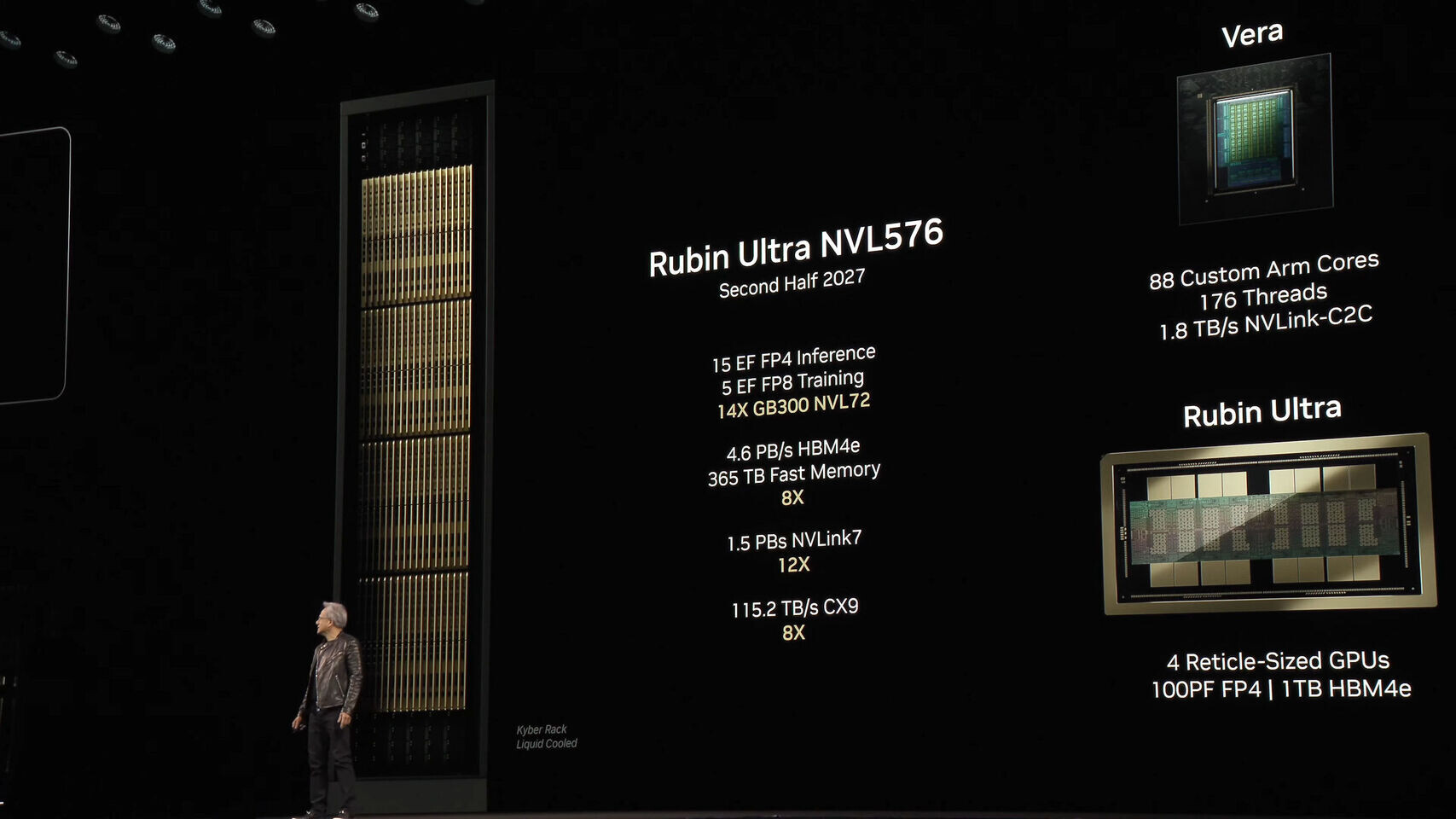
NVIDIA at GTC 2025 announced its next-generation flagship AI GPU, the Rubin Ultra. A successor to the Blackwell Ultra unveiled this year, Rubin Ultra is slated for the second half of 2027. A single Rubin Ultra package contains four AI GPU dies joined at the hip with die-to-die bonding and a fast interconnect that enables cache coherency. The package also features a whopping 1 TB of HBM4e memory. NVIDIA is claiming a performance target of 100 petaFLOPs FP4 per package.

The company also unveiled its next-generation CPU for AI supercomputers, called simply the Vera CPU. A successor to Grace, Vera comes with 88 Arm CPU cores. These are custom high-performance cores designed by NVIDIA, and aren't carried over from the reference Arm Cortex family. The cores support SMT, giving the CPU 176 logical processors. The chip comes with a 1.8 TB/s NVLink C2C connection. Lastly, the company announced that the architecture succeeding Rubin will be codenamed Feynman, after Richard Feynman. The company is looking to debut the first silicon based on Feynman in 2028.

NVIDIA Releases GeForce 572.83 WHQL Game Ready Drivers

NVIDIA today released the latest version of the GeForce graphics drivers. Version 572.83 WHQL comes with support for the new mobile GPU versions of the GeForce RTX 5090, RTX 5080, and RTX 5070 Ti. The drivers also come with Game Ready (day zero) optimization for the new "Half Life 2 RTX" Demo, which includes support for RTX Neural Shaders, and DLSS 4 with Multi Frame Generation. The drivers also come with optimization for "inZOI," a life simulator game, which includes support for NVIDIA Ace characters. Support is also added for "Warhammer 40,000: Darktide" DLSS 4 MFG update. Lastly, NVIDIA introduced overrides for DLSS 4 MFG to now support 100 titles. You use the NVIDIA App to override DLSS support for a given game. The 61 new titles supported are listed below.

Among the bugs fixed with this release are a glaring one that caused GeForce RTX 5090 and RTX 5080 cards to not run at full speeds on system reboot if manually overclocked. More instances of RTX 50-series GPUs crashing with black screens have been fixed. Some NVIDIA App and Control Panel settings getting immediately reset or throwing up errors have been fixed. A BSOD during gameplay with HDR enabled, has been fixed. An OptiX compile error with VRED 2026 has been fixed. Application stability for Derivative TouchDesigner has been improved.

DOWNLOAD: NVIDIA GeForce 572.83 WHQL

MSI Unveils Next-Level AI Platforms Powered by NVIDIA MGX at GTC 2025

MSI, a leading global provider of high-performance server solutions, showcased its cutting-edge 4U and 2U AI platforms built on the NVIDIA MGX reference architecture at GTC 2025, held from March 18-21 at booth 909. Designed to meet the diverse demands of AI, HPC, and data-intensive applications, MSI's MGX-based AI servers deliver scalable performance and robust resilience. These platforms cater to the needs of enterprise and cloud data centers, leveraging modular, building-block features to optimize the strengths of AI workloads and drive next-level high-performance computing.

"AI adoption has become a critical focus for enterprise data centers, as organizations look to harness advanced AI capabilities to gain competitive advantages," said Danny Hsu, General Manager of Enterprise Platform Solutions at MSI. "MSI's AI servers are designed to meet these evolving needs, offering the scalability, flexibility, and resilience required to keep pace with rapidly growing AI workloads. By integrating the NVIDIA MGX reference architecture, we empower enterprises to build future-proof infrastructure that maximizes performance while minimizing complexity and downtime."

ASUS Unveils the Latest ASUS AI POD Featuring NVIDIA GB300 NVL72

ASUS today joined GTC 2025 as a Diamond sponsor to showcase the latest ASUS AI POD with the NVIDIA GB300 NVL72 platform. The company is also proud to announce that it has already garnered substantial order placements, marking a significant milestone in the technology industry. At the forefront of AI innovation, ASUS also presents the latest AI servers in the Blackwell and HGX family line-up. These include ASUS XA NB3I-E12 powered by NVIDIA B300 NVL16, ASUS ESC NB8-E11 with NVIDIA DGX B200 8-GPU, ASUS ESC N8-E11V with NVIDIA HGX H200, and ASUS ESC8000A-E13P/ESC8000-E12P supporting NVIDIA RTX PRO 6000 Blackwell Server Edition with MGX architecture. With a strong focus on fostering AI adoption across industries, ASUS is positioned to provide comprehensive infrastructure solutions in combination with the NVIDIA AI Enterprise and NVIDIA Omniverse platforms, empowering clients to accelerate their time to market.

By integrating the immense power of the NVIDIA GB300 NVL72 server platform, ASUS AI POD offers exceptional processing capabilities—empowering enterprises to tackle massive AI challenges with ease. Built with NVIDIA Blackwell Ultra, GB300 NVL72 leads the new era of AI with optimized compute, increased memory, and high-performance networking, delivering breakthrough performance.

Micron Innovates From the Data Center to the Edge With NVIDIA

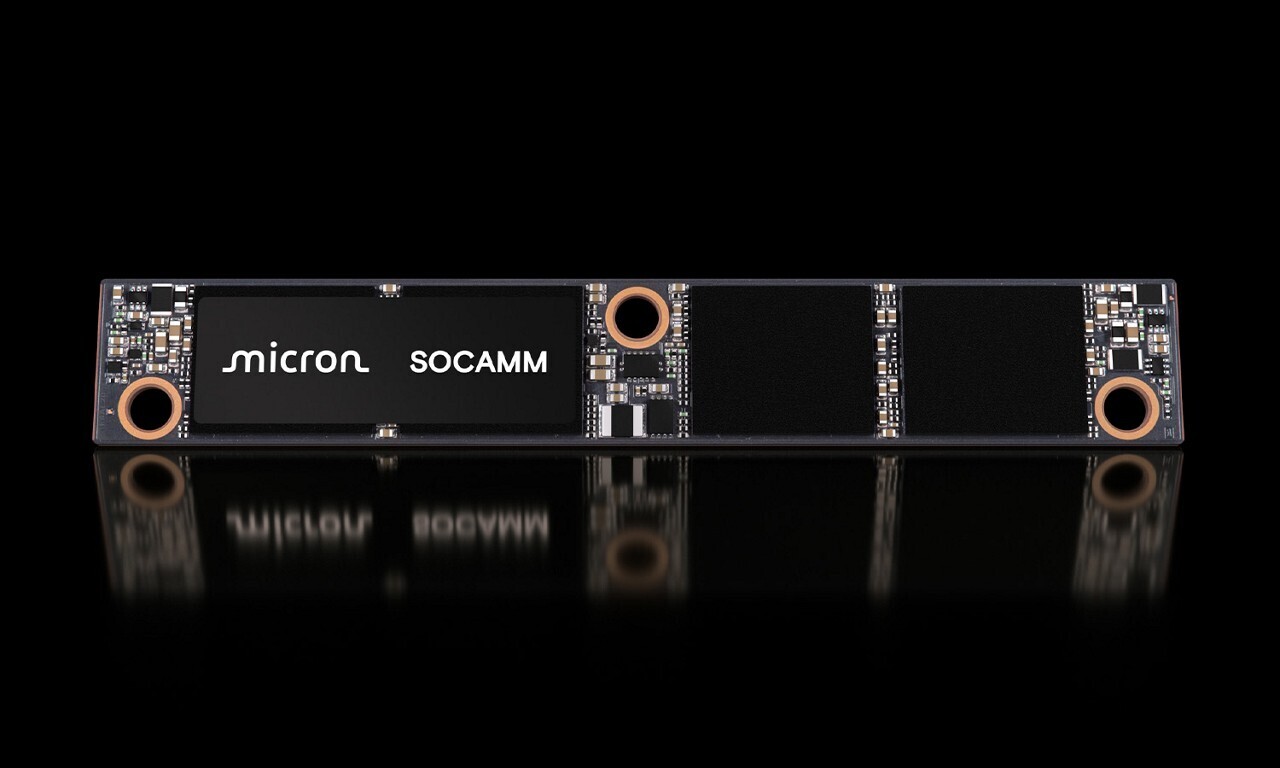
Secular growth of AI is built on the foundation of high-performance, high-bandwidth memory solutions. These high-performing memory solutions are critical to unlock the capabilities of GPUs and processors. Micron Technology, Inc., today announced it is the world's first and only memory company shipping both HBM3E and SOCAMM (small outline compression attached memory module) products for AI servers in the data center. This extends Micron's industry leadership in designing and delivering low-power DDR (LPDDR) for data center applications.

Micron's SOCAMM, a modular LPDDR5X memory solution, was developed in collaboration with NVIDIA to support the NVIDIA GB300 Grace Blackwell Ultra Superchip. The Micron HBM3E 12H 36 GB is also designed into the NVIDIA HGX B300 NVL16 and GB300 NVL72 platforms, while the HBM3E 8H 24 GB is available for the NVIDIA HGX B200 and GB200 NVL72 platforms. The deployment of Micron HBM3E products in NVIDIA Hopper and NVIDIA Blackwell systems underscores Micron's critical role in accelerating AI workloads.

ASUS Introduces Ascent GX10 AI Supercomputer Powered by NVIDIA GB10 Grace Blackwell Superchip

ASUS today announces its groundbreaking AI supercomputer, ASUS Ascent GX10, powered by the state-of-the-art NVIDIA GB10 Grace Blackwell Superchip. This revolutionary device places the formidable capabilities of a petaFLOP-scale AI supercomputer directly onto the desks of developers, AI researchers and data scientists around the globe.

As the size and complexity of generative AI models grow, local development efforts face increasing challenges. Prototyping, tuning and inferencing large models require substantial memory and compute performance. To address these needs, Ascent GX10 is designed to provide developers with a powerful, economical desktop solution for AI development.

Solidigm Develops Liquid-Cooled Enterprise SSDs for AI Deployments

Solidigm, a pioneer in enterprise data storage, unveiled at the GTC AI Conference today one of the world's first liquid-cooled enterprise solid state drives (eSSDs)—helping remove the fans historically needed for storage devices and enabling future fully liquid-cooled artificial intelligence (AI) servers. Until now, the ability to deploy a completely liquid-cooled training server has been hampered by challenges with certain components. Traditional SSD direct liquid cooling (DLC) designs cool only one side of each SSD and prevent hot swapping. To enable more compact designs and decrease cooling costs, it is imperative these servers adopt a complete liquid-cooling approach to enable more compact designs while addressing architectural needs for all the components.

Solidigm has worked with NVIDIA to address eSSD liquid-cooling challenges, such as hot swap-ability and single-side cooling constraints. At GTC 2025, Solidigm is demonstrating the first cold-plate cooled eSSDs featuring the Solidigm D7-PS1010 E1.S 9.5 mm form factor. "Solidigm shows how the combination of an innovative Solidigm E1.S SSD and liquid cold-plate kit—both first-to-market innovations—deliver significant benefits in thermal efficiency while maintaining data center grade serviceability," said Kevin Noh, Co-CEO of Solidigm.

Phison Expands aiDAPTIV+ GPU Memory Extension Capabilities

Phison Electronics (8299TT), a leading innovator in NAND flash technologies, today announced an array of expanded capabilities on aiDAPTIV+, the affordable AI training and inferencing solution for on-premises environments. aiDAPTIV+ will be integrated into a ML-series Maingear laptop, the first AI laptop PC capable of LLMOps, utilizing NVIDIA GPUs and available for concept demonstration and registration this week at NVIDIA GTC 2025. Customers will be able to fine-tune Large Language Models (LLMs) up to 8 billion parameters using their own data.

Phison also expanded aiDAPTIV+ capabilities to run on edge computing devices powered by the NVIDIA Jetson platform, for enhanced generative AI inference at the edge and robotics deployments. With today's announcement, new and current aiDAPTIV+ users can look forward to the new aiDAPTIVLink 3.0 middleware, which will provide faster Time to First Token (TTFT) recall and extend the token length for greater context, improving inferencing performance and accuracy. These expansions will unlock access for users ranging from university students and AI industry professionals learning to train LLMs, or researchers uncovering deeper insights within their own data using a PC, all the way to manufacturing engineers automating factory floor enhancements via edge devices.

NVIDIA Announces DGX Spark and DGX Station Personal AI Computers

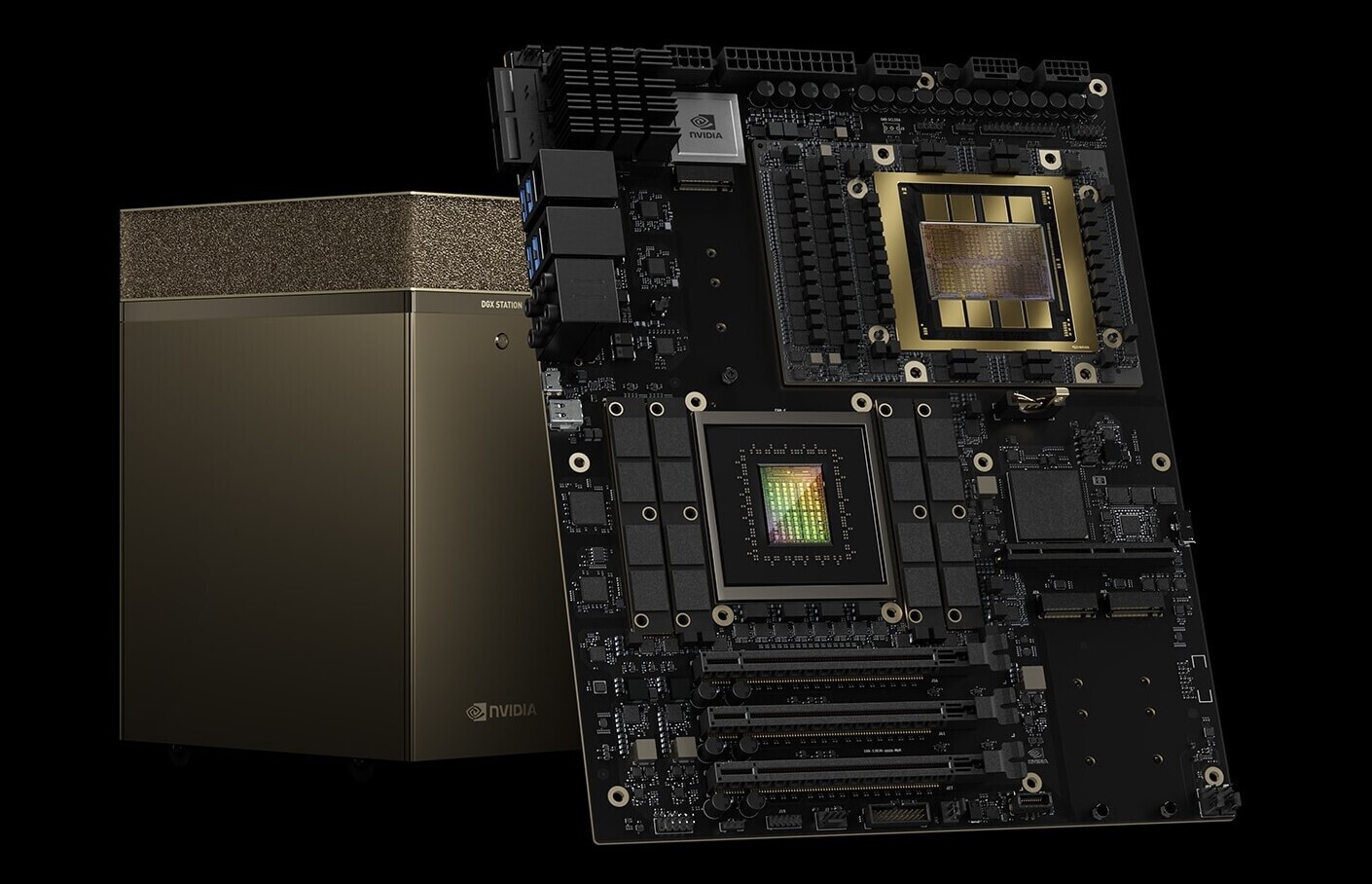
NVIDIA today unveiled NVIDIA DGX personal AI supercomputers powered by the NVIDIA Grace Blackwell platform. DGX Spark—formerly Project DIGITS—and DGX Station, a new high-performance NVIDIA Grace Blackwell desktop supercomputer powered by the NVIDIA Blackwell Ultra platform, enable AI developers, researchers, data scientists and students to prototype, fine-tune and inference large models on desktops. Users can run these models locally or deploy them on NVIDIA DGX Cloud or any other accelerated cloud or data center infrastructure.

DGX Spark and DGX Station bring the power of the Grace Blackwell architecture, previously only available in the data center, to the desktop. Global system builders to develop DGX Spark and DGX Station include ASUS, Dell, HP Inc. and Lenovo.

NVIDIA Announces Blackwell Ultra Platform for Next-Gen AI

NVIDIA today announced the next evolution of the NVIDIA Blackwell AI factory platform, NVIDIA Blackwell Ultra—paving the way for the age of AI reasoning. NVIDIA Blackwell Ultra boosts training and test-time scaling inference—the art of applying more compute during inference to improve accuracy—to enable organizations everywhere to accelerate applications such as AI reasoning, agentic AI and physical AI.

Built on the groundbreaking Blackwell architecture introduced a year ago, Blackwell Ultra includes the NVIDIA GB300 NVL72 rack-scale solution and the NVIDIA HGX B300 NVL16 system. The GB300 NVL72 delivers 1.5x more AI performance than the NVIDIA GB200 NVL72, as well as increases Blackwell's revenue opportunity by 50x for AI factories, compared with those built with NVIDIA Hopper.

NVIDIA Accelerates Science and Engineering With CUDA-X Libraries Powered by GH200 and GB200 Superchips

Scientists and engineers of all kinds are equipped to solve tough problems a lot faster with NVIDIA CUDA-X libraries powered by NVIDIA GB200 and GH200 superchips. Announced today at the NVIDIA GTC global AI conference, developers can now take advantage of tighter automatic integration and coordination between CPU and GPU resources - enabled by CUDA-X working with these latest superchip architectures - resulting in up to 11x speedups for computational engineering tools and 5x larger calculations compared with using traditional accelerated computing architectures.

This greatly accelerates and improves workflows in engineering simulation, design optimization and more, helping scientists and researchers reach groundbreaking results faster. NVIDIA released CUDA in 2006, opening up a world of applications to the power of accelerated computing. Since then, NVIDIA has built more than 900 domain-specific NVIDIA CUDA-X libraries and AI models, making it easier to adopt accelerated computing and driving incredible scientific breakthroughs. Now, CUDA-X brings accelerated computing to a broad new set of engineering disciplines, including astronomy, particle physics, quantum physics, automotive, aerospace and semiconductor design.

BOXX Workstations Upgraded With New NVIDIA RTX PRO 6000 Blackwell Workstation Edition GPUs

BOXX Technologies, the leading innovator of high-performance computers, rendering systems, and servers, announced that as a supplier of NVIDIA-Certified Systems, BOXX workstations will feature the new NVIDIA RTX PRO 6000 Blackwell Workstation Edition and NVIDIA RTX PRO 6000 Blackwell Max-Q Workstation Edition GPUs. Designed for creative professionals, these NVIDIA Blackwell architecture GPUs combine breakthrough AI inference, ray tracing, and neural rendering technology with major performance and memory improvements to drive demanding creative, design, and engineering workflows. BOXX will be among the first computer hardware manufacturers offering the new GPUs inside multiple workstation form factors.

"From our desk side APEXX workstations to our FLEXX and RAXX data center platforms, BOXX is taking our record-setting performance to new heights with NVIDIA RTX PRO 6000 Blackwell Workstation Edition GPUs," said BOXX CEO Kirk Schell. "Our systems equipped with these groundbreaking GPUs are purpose-built for creative professionals who demand the best, so whether its architects, engineers, and content creators, or data scientists and large scale enterprise deployments, BOXX accelerates mission critical work while maintaining unparalleled performance, reliability, and support."

NVIDIA Launches RTX PRO 6000 Blackwell Series Professional Graphics Cards

NVIDIA today launched the RTX PRO 6000 Blackwell series of professional graphics cards. These cards are based on the latest GeForce "Blackwell" graphics architecture, and the three chips the company already launched on it. Leading the pack, is the RTX PRO 6000, a card that completely maxes out the massive "GB202" silicon, featuring more shaders than even the GeForce RTX 5090, albeit at lower clock speeds. The idea behind this product is to give pro-vis users more shader power, driving a large amount of GDDR7 ECC memory. Specifically, the card comes with 24,064 CUDA cores across all 192 SM physically present on the silicon, besides 768 Tensor cores, 192 RT cores, 768 TMUs, and 192 ROPs. The card gets a humungous 96 GB of ECC GDDR7 memory across the chip's 512-bit wide memory interface, probably using 48 Gbit density memory chips. The card has a TGP of 600 W, making out the 12V2x6 power input. It comes with a board design resembling the RTX 5090.

Next up, is the RTX PRO 6000 Blackwell Max-Q. This card has essentially the same core-configuration as the RTX PRO 6000, but with a reduced TGP, and a simpler 2-slot board design that uses a lateral-blower. This card is meant for machines with multiple such cards installed, though something that isn't quite a rendering server. Lastly, there's the RTX PRO 6000 Server Edition. This card, again, has identical core-config to the others in the lineup, but with a board design optimized for rackmount servers and large rendering farms. The cooler relies on the rack's airflow for cooling.

Server Market Revenue Increased 91% During the Q4 2024, NVIDIA Continues Dominating the GPU Server Space

According to the International Data Corporation (IDC) Worldwide Quarterly Server Tracker, the server market reached a record $77.3 billion dollars in revenue during the last quarter of the year. This quarter showed the second highest growth rate since 2019 with a year-over-year increase of 91% in vendor revenue. Revenue generated from x86 servers increased 59.9% in 2024Q4 to $54.8 billion while Non-x86 servers increased 262.1% year over year to $22.5 billion.

Revenue for servers with an embedded GPU in the fourth quarter of 2024 grew 192.6% year-over-year and for the full year 2024, more than half of the server market revenue came from servers with an embedded GPU. NVIDIA continues dominating the server GPU space with over 90% of the total shipments with and embedded GPU in 2024Q4. The fast pace at which hyperscalers and cloud service providers have been adopting servers with embedded GPUs has fueled the server market growth which has more than doubled in size since 2020 with revenue of $235.7 billion dollars for the full year 2024.

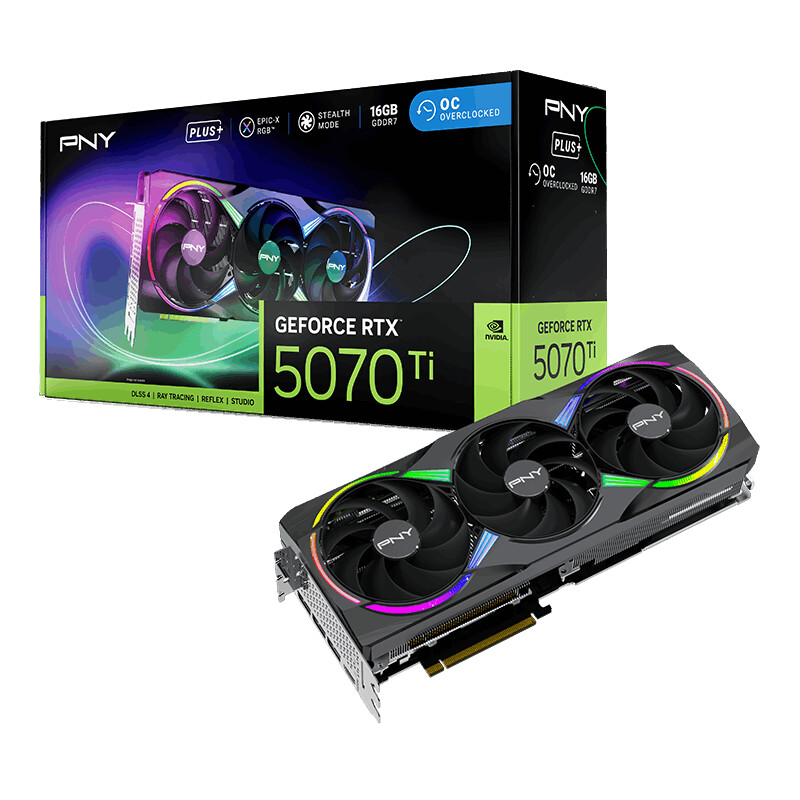
PNY Adds "Plus" Size Options to GeForce RTX 5070 Ti "Triple Fan" Lineup

PNY officially introduced its launch lineup of GeForce RTX 50-series graphics cards at CES 2025; all brand-new offerings were plainly labelled as "Triple Fan" models. Yesterday, VideoCardz alerted its readership to the emergence of "Plus" variants—all utilizing upper-mid-range NVIDIA's GeForce RTX 5070 Ti "Blackwell" GPU. In recent times, several of Team Green's board partners have stealthily added new products to web presences without any PR fanfare accompaniment. Last week, ZOTAC quietly expanded its SOLID GeForce RTX 5080 and RTX 5070 Ti product ranges with "slimmer" CORE options.

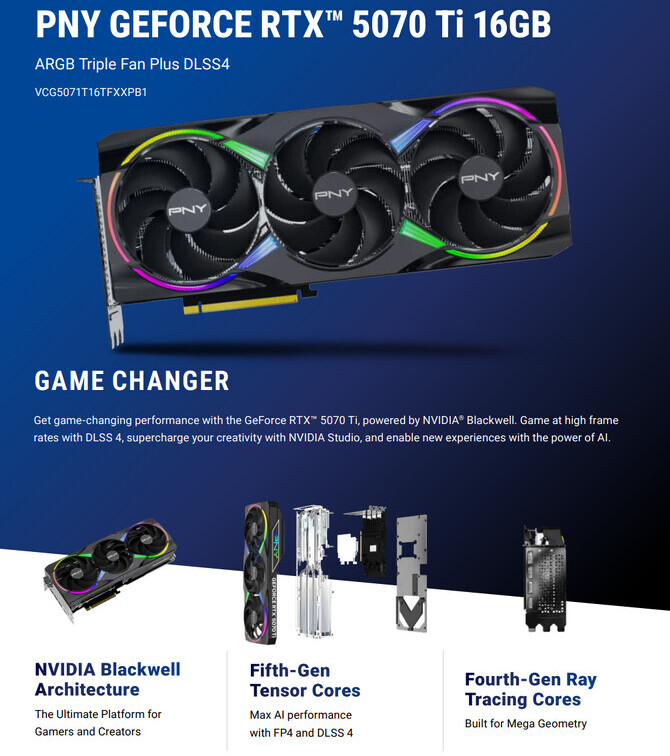
PNY's four freshest additions are dubbed "Triple Fan Plus"—quite fittingly, this updated moniker refers to larger card dimensions. Price and launch information was not available at the time of writing, but we can safely assume that their GeForce RTX 5070 Ti ARGB Triple Fan Plus OC SKU will sit at the top of the American AIB's resized pack. A non-overclocked ARGB-lit model is present on TPU's GPU database, alongside non-ARGB OC and standard variants. PNY's Triple Fan Plus shroud design is a chunky unit; VideoCardz noted growth (over vanilla variants) in two dimensions—gaining 1.7 cm in width, and roughly 3 cm in length. The already released Triple Fan housing officially occupied "2.8"-slots, but the larger "Plus" sibling is a proper 3-slot space filler. VideoCardz highlighted revised retail packaging—instead of a simple side-printed "GeForce RTX" logo, Plus boxes are adorned with a full GPU readout: "GeForce RTX 5070 Ti." The newer shroud design seems to sport shinier black accents, and wider ARGB lighting channels.

HP Announces a Wide Range of New Products at its Amplify Conference

At its annual Amplify Conference, HP Inc. today announced new products and services designed to shape the future of work, empowering people and businesses to create and manage their own way of working. The company unveiled more than 80 PCs, AI-powered print tools for SMBs, and Workforce Experience Platform enhancements all built to drive company growth and professional fulfillment.

"HP is translating AI into meaningful experiences that drive growth and fulfillment," said Enrique Lores, President and CEO at HP Inc. "We are shaping the future of work with game-changing AI innovations that seamlessly adapt to how people want to work."

MSI Powers the Future of Cloud Computing at CloudFest 2025

MSI, a leading global provider of high-performance server solutions, unveiled its next-generation server platforms—ORv3 Servers, DC-MHS Servers, and NVIDIA MGX AI Servers—at CloudFest 2025, held from March 18-20 at booth H02. The ORv3 Servers focus on modularity and standardization to enable seamless integration and rapid scalability for hyperscale growth. Complementing this, the DC-MHS Servers emphasize modular flexibility, allowing quick reconfiguration to adapt to diverse data center requirements while maximizing rack density for sustainable operations. Together with NVIDIA MGX AI Servers, which deliver exceptional performance for AI and HPC workloads, MSI's comprehensive solutions empower enterprises and hyperscalers to redefine cloud infrastructure with unmatched flexibility and performance.

"We're excited to present MSI's vision for the future of cloud infrastructure." said Danny Hsu, General Manager of MSI's Enterprise Platform Solutions. "Our next-generation server platforms address the critical needs of scalability, efficiency, and sustainability. By offering modular flexibility, seamless integration, and exceptional performance, we empower businesses, hyperscalers, and enterprise data centers to innovate, scale, and lead in this cloud-powered era."

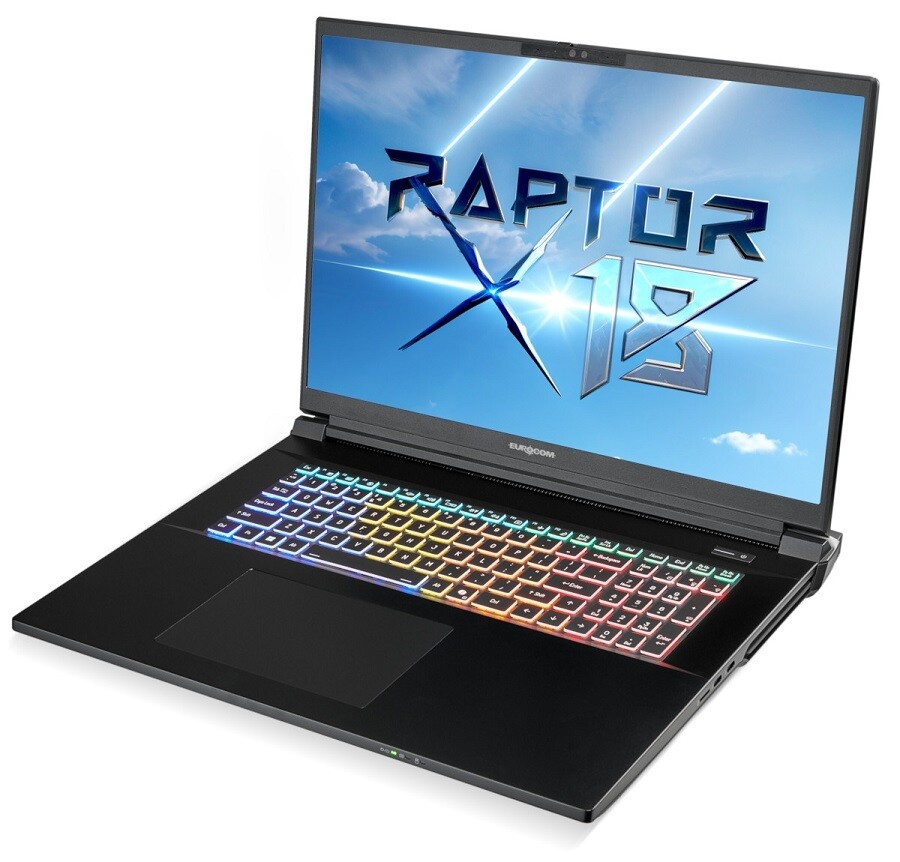
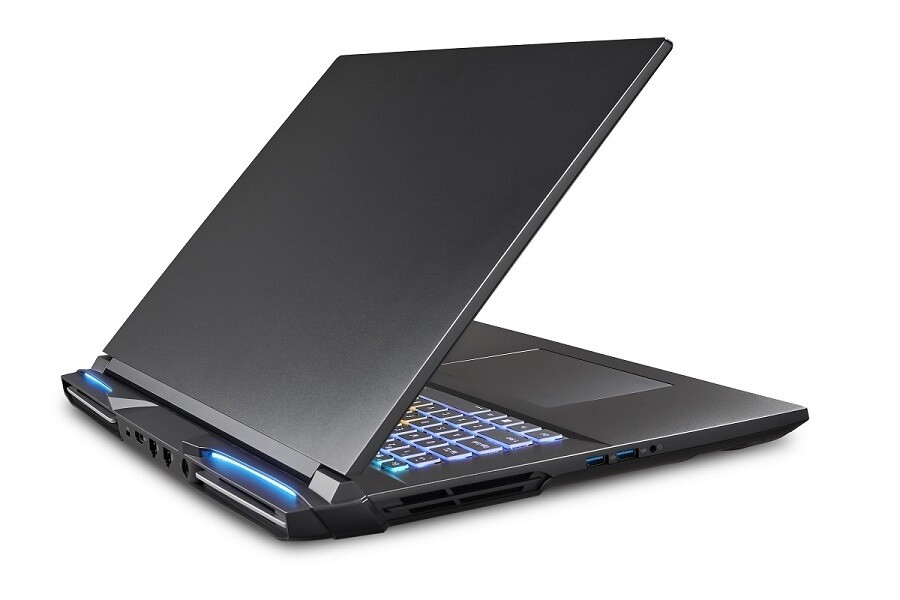
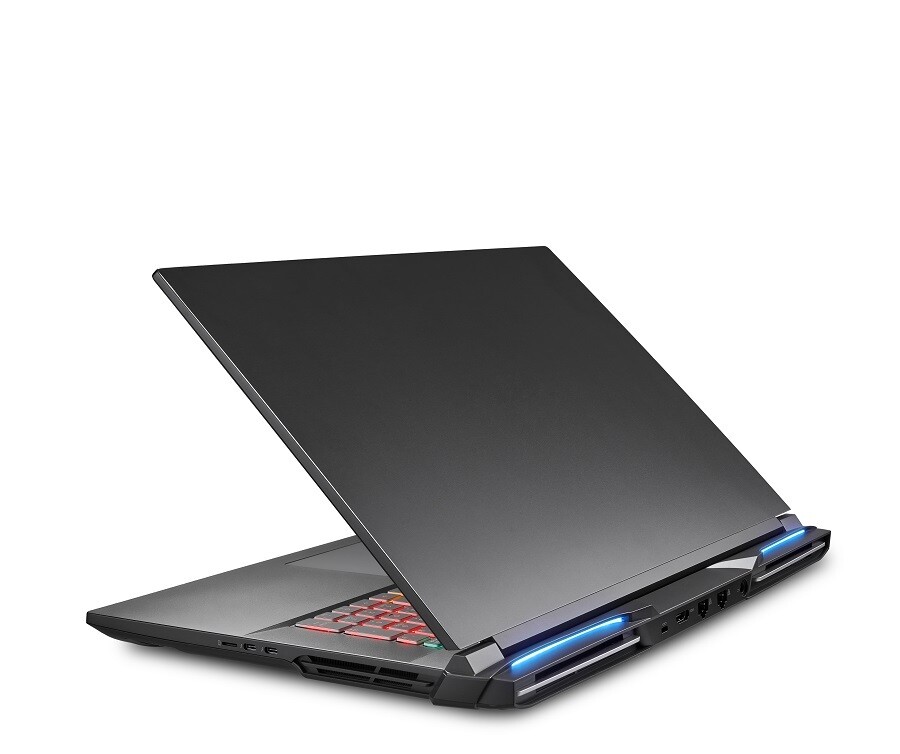
Eurocom Unleashes New 18-inch Raptor X18 Laptop With NVIDIA GeForce RTX 5090

Eurocom is launching the Raptor X18, the world's first customized 18" laptop powered by the newest 24 GB GDDR7 680 Tensor AI cores NVIDIA GeForce RTX 5090, 256 GB of DDR5 memory, 32 TB of RAID 0/1/5 four NVMe SSDs, and the Intel Core Ultra 9 275HX processor with 24 cores, 24 threads, and a massive 36 MB cache. Eurocom is pushing the boundaries of portable high-performance computing with the launch of the Raptor X18 Mobile Supercomputer, designed for those who demand extreme computational power—whether for AI development, deep learning, scientific simulations, engineering, content creation, or gaming at the highest levels.

Unparalleled Performance and Display
The Raptor X18 is the first laptop ever to feature an astonishing 256 GB of DDR5 memory, ensuring seamless multitasking for the most memory-intensive operations, including running large-scale LLM models offline and locally. Combined with 24 GB of next-gen GDDR7 VRAM from the NVIDIA GeForce RTX 5090 GPU (680 Tensor AI cores), this mobile supercomputer dominates AI processing, 3D modeling, complex simulations, and ultra-high-performance gaming. With up to 32 TB of NVMe SSD storage in RAID 0/1/5, users can store and access massive datasets with blazing speed, eliminating bottlenecks in high-end workflows. The Raptor X18 features an 18-inch UHD 200 Hz (3840x2400) display, offering impeccable clarity and smoothness for gaming, scientific visualization, and content creation.

Razer Blade 16 with GeForce RTX 5060 Mobile GPU Spotted in Leaked Doc, MSRP: $1999

Officially, NVIDIA has only revealed mobile variants of its GeForce RTX 50 "Blackwell" GPU series going down to RTX 5070. At CES 2025, Jensen Huang's keynote presentation proposed a $1299 entry point for GB206-equipped gaming laptops—rated up to 800 AI TOPS. As demonstrated by recent market trends, "MSRP" recommendations are widely viewed as whimsical recommendations (at best). Pre-orders for upper crust to mid-range GeForce RTX 50-series laptops opened up on February 25, but the missing ROP (Raster Operations Pipeline) problem has seemingly spread to Blackwell's mobile offshoot. Reports suggest that necessary investigations have pushed initial customer-bound deliveries into April. Presumably, unannounced lower end products—in GeForce RTX 5060 and RTX 5050 Mobile form—are similarly delayed.

Earlier today, momomo_us—a notable source of pre-launch information—unearthed an alleged "Razer-authored" new product document. The American-Singaporean brand appears to be preparing a multitude of Razer Blade 16 (2025) SKUs, with a series identified as "RZ09-0528." The leaked MSRP guide contains a major error; Razer's forthcoming flagship model—powered by an AMD Ryzen AI 9 HX 370 "Strix Point" APU and GeForce RTX 5090 Mobile GPU—will not arrive at retail/e-tail with a $1499 price tag. Focusing on the opposite end of Razer's chart, VideoCardz highlighted the $1999 OLED-equipped SKU—featuring a Ryzen AI 9 365 processor and Team Green's unannounced GeForce RTX 5060 Mobile GPU. The speculative steep asking price is not a big surprise, given the expected tagging on of Razer "premium tax." Mid-way through last week, "lowly" GeForce RTX 5050-powered laptops were accidentally listed by retail outlets. The cheapest offering was advertised with a $1720 (including VAT) price point—based on these recent (possibly unfinalized) data points, industry watchdogs have predicted steep asking prices for even the most basic of Blackwell mobile options.

AMD Radeon Captures 45% Market Share in Japan, Could Be Even Higher if Supply Chain Allows

AMD's Radeon GPU lineup has achieved a remarkable 45% market share in Japan, representing the brand's strongest position in the competitive graphics card market, according to AMD Japan executive Sato during a recent industry roundtable. This significant market penetration marks a turning point for Team Red in a region historically dominated by NVIDIA. The announcement came during a multi-vendor panel featuring representatives from ASRock, ASUS, GIGABYTE, MSI, PowerColor, and Sapphire at an AMD-focused event in Akihabara. While celebrating the milestone, industry partners pushed for more ambitious targets, with ASRock's Haraguchi challenging AMD to aim for a 70% market share. ASUS executive Ichikawa humorously noted the brand's historical underdog status, remarking, "We've never been the ruling party!"

The event also featured insights on AMD's latest hardware from prominent tech influencers. "Sir Gradeon" praised the Radeon RX 9070 series for its overclocking headroom and substantial VRAM capacity, highlighting that the GPUs don't require power supply upgrades. Fellow influencer "Shurarara!!" emphasized the RX 9070 XT's price-to-performance ratio, noting its ability to run demanding titles like Monster Hunter Wilds at 4K resolution with appropriate settings. Supply constraints emerged as a significant concern during the roundtable, with AIB partners expressing frustration over GPU allocation limitations despite strong demand. The candid admission from AMD's representative about the company "not being used to selling graphics cards" at this volume sparked laughter among attendees, showing the unexpected nature of AMD's market surge. The event attracted substantial attention, with long lines forming before doors opened. Attendees participated in the X-Walk Post Campaign across Akihabara's electronics district, with early purchasers of AMD products receiving exclusive promotional items.

CoolIT Showcases AI-Ready Liquid Cooling Technology at NVIDIA GTC 2025

CoolIT Systems (CoolIT), the world's leader in liquid cooling for computing, will showcase its latest liquid cooling technologies at NVIDIA GTC 2025. In addition to displaying CoolIT's highest-density coolant distribution units (CDUs), CoolIT's booth will feature its innovative cold plate cooling systems for next-generation AI systems.

"At GTC we are excited to reveal our next-generation AI cold plate systems that NVIDIA's server manufacturing partners can leverage to fast-track the development of their direct liquid-cooled servers," said Brandon Peterson, SVP of Business Development.
Return to Keyword Browsing
Nov 27th, 2026 18:51 CST change timezone

New Forum Posts

Popular Reviews

TPU on YouTube

Controversial News Posts