Tuesday, March 18th 2025

NVIDIA Announces DGX Spark and DGX Station Personal AI Computers

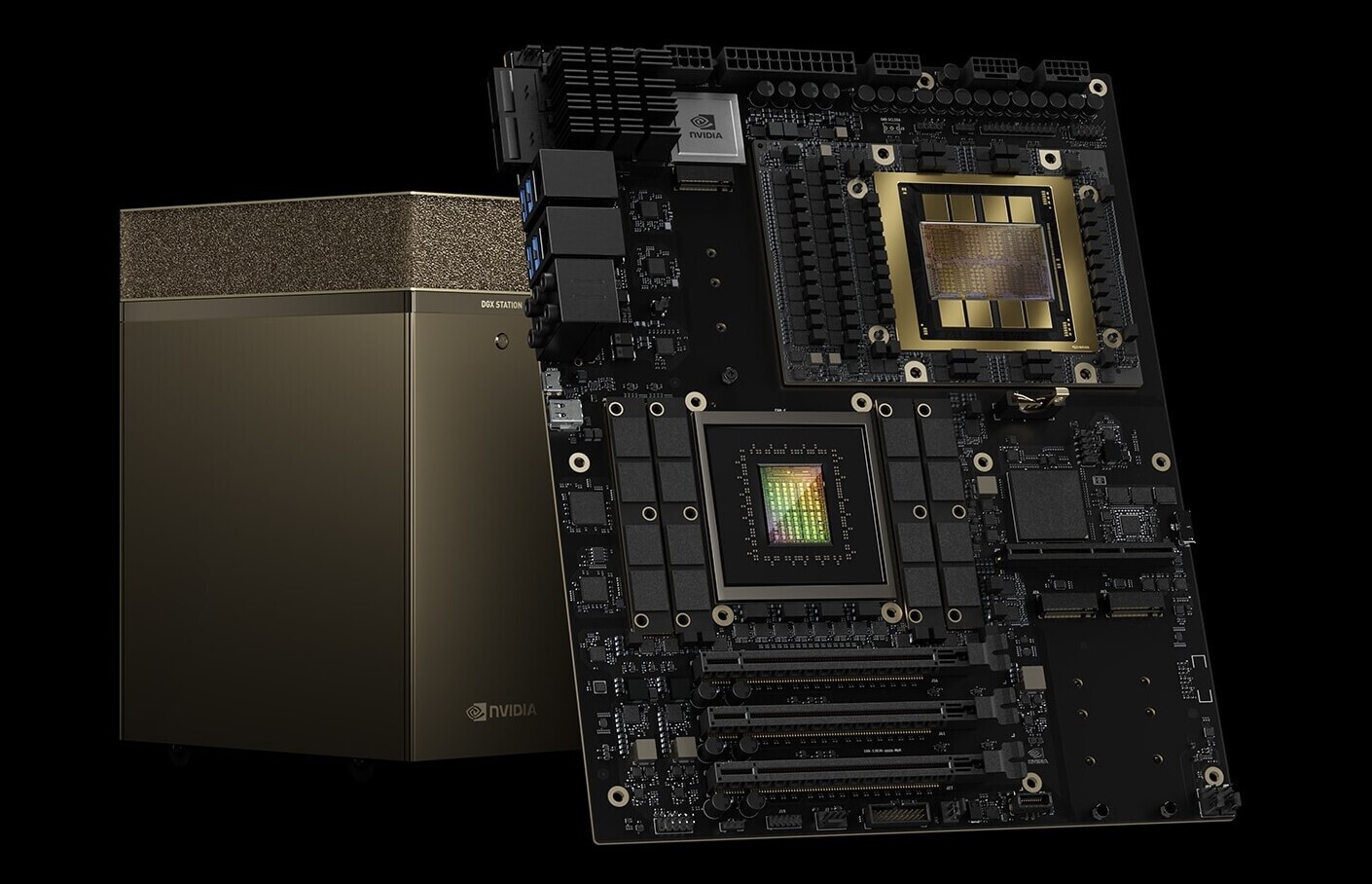
NVIDIA today unveiled NVIDIA DGX personal AI supercomputers powered by the NVIDIA Grace Blackwell platform. DGX Spark—formerly Project DIGITS—and DGX Station, a new high-performance NVIDIA Grace Blackwell desktop supercomputer powered by the NVIDIA Blackwell Ultra platform, enable AI developers, researchers, data scientists and students to prototype, fine-tune and inference large models on desktops. Users can run these models locally or deploy them on NVIDIA DGX Cloud or any other accelerated cloud or data center infrastructure.

DGX Spark and DGX Station bring the power of the Grace Blackwell architecture, previously only available in the data center, to the desktop. Global system builders to develop DGX Spark and DGX Station include ASUS, Dell, HP Inc. and Lenovo.
"AI has transformed every layer of the computing stack. It stands to reason a new class of computers would emerge—designed for AI-native developers and to run AI-native applications," said Jensen Huang, founder and CEO of NVIDIA. "With these new DGX personal AI computers, AI can span from cloud services to desktop and edge applications."
Igniting Innovation With DGX Spark
DGX Spark is the world's smallest AI supercomputer, empowering millions of researchers, data scientists, robotics developers and students to push the boundaries of generative and physical AI with massive performance and capabilities.

At the heart of DGX Spark is the NVIDIA GB10 Grace Blackwell Superchip, optimized for a desktop form factor. GB10 features a powerful NVIDIA Blackwell GPU with fifth-generation Tensor Cores and FP4 support, delivering up to 1,000 trillion operations per second of AI compute for fine-tuning and inference with the latest AI reasoning models, including the NVIDIA Cosmos Reason world foundation model and NVIDIA GR00T N1 robot foundation model.

The GB10 Superchip uses NVIDIA NVLink -C2C interconnect technology to deliver a CPU+GPU-coherent memory model with 5x the bandwidth of fifth-generation PCIe. This lets the superchip access data between a GPU and CPU to optimize performance for memory-intensive AI developer workloads.

NVIDIA's full-stack AI platform enables DGX Spark users to seamlessly move their models from their desktops to DGX Cloud or any accelerated cloud or data center infrastructure—with virtually no code changes—making it easier than ever to prototype, fine-tune and iterate on their workflows.

Full Speed Ahead With DGX Station
NVIDIA DGX Station brings data-center-level performance to desktops for AI development. The first desktop system to be built with the NVIDIA GB300 Grace Blackwell Ultra Desktop Superchip, DGX Station features a massive 784 GB of coherent memory space to accelerate large-scale training and inferencing workloads. The GB300 Desktop Superchip features an NVIDIA Blackwell Ultra GPU with latest-generation Tensor Cores and FP4 precision—connected to a high-performance NVIDIA Grace CPU via NVLink-C2C—delivering best-in-class system communication and performance.

DGX Station also features the NVIDIA ConnectX -8 SuperNIC, optimized to supercharge hyperscale AI computing workloads. With support for networking at up to 800 Gb/s, the ConnectX-8 SuperNIC delivers extremely fast, efficient network connectivity, enabling high-speed connectivity of multiple DGX Stations for even larger workloads, and network-accelerated data transfers for AI workloads.

Combining these state-of-the-art DGX Station capabilities with the NVIDIA CUDA-X AI platform, teams can achieve exceptional desktop AI development performance.

In addition, users gain access to NVIDIA NIM microservices with the NVIDIA AI Enterprise software platform, which offers highly optimized, easy-to-deploy inference microservices backed by enterprise support.

Availability
Reservations for DGX Spark systems open today at nvidia.com.

DGX Station is expected to be available from manufacturing partners like ASUS, BOXX, Dell, HP, Lambda and Supermicro later this year.
Source: NVIDIA
Add your own comment

30 Comments on NVIDIA Announces DGX Spark and DGX Station Personal AI Computers

#1
abysal
Oooo nice, is that 3x 12VHPWR? 3x chance of fire!
Posted on Reply
#2
trsttte
abysalOooo nice, is that 3x 12VHPWR? 3x chance of fire!
Right next to a larger standard ATX 24 pin on a regular ATX sized board, just why????
Posted on Reply
#4
igormp
HDBitdataIs the CPU ARM or x86?
ARM.
Posted on Reply
#5
Rover4444
igormpARM.
Should've been RISC-V if they really wanted to be wild with it.
Posted on Reply
#6
tpa-pr
I'm a layman for the Nvidia AI side of things: what's the better OS for AI workloads? Windows or Linux? I know on the AMD side it's Linux because of the ROCm support.
Posted on Reply
#7
10tothemin9volts
Many say that for 3000 $ the DGX Spark (128GB RAM at 273 GB/s memory bandwidth) is DOA/obsolete already:
  • Arm CPU, not x86 CPU, so playing (certain) games is going to be an issue
  • Supposedly requires a specialized NVIDIA Arm OS
  • Can't run serious models like the real DeepSeek-R1 quants, because can't fit even the smallest quant ("DeepSeek-R1-IQ1_S.gguf" is 133.56GB)
  • The overpriced Framework Desktop using AMD Max+ 395 128GB is still 1000 $ cheaper for similar bandwidth (256 GB/s) and has all the advantages of x86 compatibility
  • It's a given that it can't be used for training (maybe models in the millions of parameters, not billions), but even fine-tuning it isn't going to be great with the 273 GB/s memory bandwidth (maybe small models)
  • Soon there are going to be many AMD Max+ 395 128GB x86 mini-PC devices at half the price with all the compatibility advantages that x86 brings
What would be really needed are 256GB RAM devices with, say, at least twice the memory bandwidth (>500GB/s) to be able to run serious LLM like the real DeepSeek-R1 (luckily as a MOE model, it runs faster than dense models at the same size).
Maybe when AMD and NVIDIA designed the 128 GB RAM, 256-bit, quad-channel, SOCs (and to also catch up no APPLE's offerings), DeepSeek-R1 wasn't a thing (though maybe at that time there was Llama-3.1-405B, but as a dense model it would run much slower), but it is now.
Posted on Reply
#8
igormp
Rover4444Should've been RISC-V if they really wanted to be wild with it.
I don't think they wanted to be wild, just have good software support and slap their custom interconnect into a CPU. ARM already has a pretty good software support out there, especially in the python ecosystem.
Vera seems to be a custom core as well, unlike grace which was a neoverse design.
tpa-prI'm a layman for the Nvidia AI side of things: what's the better OS for AI workloads? Windows or Linux? I know on the AMD side it's Linux because of the ROCm support.
Linux for sure. Even on windows Nvidia is recommending people to use WSL instead of trying to do things natively.
10tothemin9voltsMany say that for 3000 $ the DGX Spark (128GB RAM at 273 GB/s memory bandwidth) is DOA/obsolete already:
  • Arm CPU, not x86 CPU, so playing (certain) games is going to be an issue
  • Supposedly requires a specialized NVIDIA Arm OS
  • Can't run serious models like the real DeepSeek-R1 quants, because can't fit even the smallest quant ("DeepSeek-R1-IQ1_S.gguf" is 133.56GB)
  • The overpriced Framework Desktop using AMD Max+ 395 128GB is still 1000 $ cheaper for similar bandwidth (256 GB/s) and has all the advantages of x86 compatibility
  • It's a given that it can't be used for training (maybe models in the millions of parameters, not billions), but even fine-tuning it isn't going to be great with the 273 GB/s memory bandwidth (maybe small models)
  • Soon there are going to be many AMD Max+ 395 128GB x86 mini-PC devices at half the price with all the compatibility advantages that x86 brings
What would be really needed are 256GB RAM devices with, say, at least twice the memory bandwidth (>500GB/s) to be able to run serious LLM like the real DeepSeek-R1 (luckily as a MOE model, it runs faster than dense models at the same size).
Maybe when AMD and NVIDIA designed the 128 GB RAM, 256-bit, quad-channel, SOCs (and to also catch up no APPLE's offerings), DeepSeek-R1 wasn't a thing (though maybe at that time there was Llama-3.1-405B, but as a dense model it would run much slower), but it is now.
Only saving point I see for spark is if you want to cluster multiple of those, given that it has connect-x. Not sure why one would spend that amount of money in such a setup, but it's an option.
Posted on Reply
#9
Rover4444
igormpI don't think they wanted to be wild, just have good software support and slap their custom interconnect into a CPU. ARM already has a pretty good software support out there, especially in the python ecosystem.
Vera seems to be a custom core as well, unlike grace which was a neoverse design.

Linux for sure. Even on windows Nvidia is recommending people to use WSL instead of trying to do things natively.

Only saving point I see for spark is if you want to cluster multiple of those, given that it has connect-x. Not sure why one would spend that amount of money in such a setup, but it's an option.
The networking's totally useless aside from loading/offloading onto a remote machine... which is pretty important when you're loading 100+ GB models, but it's something you only have to do once. For most people it's not worth the price.
Posted on Reply
#10
igormp
Rover4444The networking's totally useless aside from loading/offloading onto a remote machine... which is pretty important when you're loading 100+ GB models, but it's something you only have to do once. For most people it's not worth the price.
I don't disagree with that. That level of networking connectivity (400Gbps on CX7) is pretty close to a full PCIe 5.0 x16 bandwidth, so it'd be somewhat similar to just slapping another 128GB GPU into your mix.
But yeah, at this price point it may make more sense to go with a proper GPU setup.
Posted on Reply
#11
trsttte
Rover4444Should've been RISC-V if they really wanted to be wild with it.
RISC-V still has a LOT to mature, both in support and performance. Using it here would be the wrong kind of wild - as in completely nuts.
10tothemin9voltsThe overpriced Framework Desktop using AMD Max+ 395 128GB is still 1000 $ cheaper for similar bandwidth (256 GB/s) and has all the advantages of x86 compatibility
Counterpoint: CUDA and TensorRT. I think you make great points but I feel nvidia is leveraging their software stack and current market dominance to penny pinch their customers. AMD has a real chance to grab some market share but it still needs to just freaking do it!
Posted on Reply
#12
Rover4444
trsttteRISC-V still has a LOT to mature, both in support and performance. Using it here would be the wrong kind of wild - as in completely nuts.
It's a specialized part anyways and ARM is also pretty nuts for a part as expensive as this.
trsttteCounterpoint: CUDA and TensorRT. I think you make great points but I feel nvidia is leveraging their software stack and current market dominance to penny pinch their customers. AMD has a real chance to grab some market share but it still needs to just freaking do it!
This is made for LLMs, they're not really for imagegen so CUDA doesn't have much benefit here unless there's some sort of hardware deficiency with RDNA 3.5. I'm sure some renderers will love the huge memory but otherwise I don't know of any AI application that needs this much memory that ROCm doesn't cover already...
Posted on Reply
#13
igormp
Rover4444It's a specialized part anyways and ARM is also pretty nuts for a part as expensive as this.
I don't think that CPU is that "wild". The problem with risc-v is that there's simply no proper support for all the packages in the AI ecosystem.
There are no off-the-shelf wheels for pytorch or tensorflow, and that applies to most of the packages on pypi, as an example.
Rover4444This is made for LLMs, they're not really for imagegen so CUDA doesn't have much benefit here unless there's some sort of hardware deficiency with RDNA 3.5. I'm sure some renderers will love the huge memory but otherwise I don't know of any AI application that needs this much memory that ROCm doesn't cover already...
CUDA makes thing way easier. ROCm is not that easy to deal with, and has major annoyances and lack of performance when it comes to the major frameworks/engines.
Posted on Reply
#14
Rover4444
igormpI don't think that CPU is that "wild". The problem with risc-v is that there's simply no proper support for all the packages in the AI ecosystem.
There are no off-the-shelf wheels for pytorch or tensorflow, and that applies to most of the packages on pypi, as an example.
Alright. You're right, but I still don't think using ARM was a great decision.
igormpCUDA makes thing way easier. ROCm is not that easy to deal with, and has major annoyances and lack of performance when it comes to the major frameworks/engines.
On the AI side there's not really any problems with ROCm if the hardware's there. The hardware not being there is the actual problem, I'm not sure if 3.5 even has tensor cores. Other than that the features are all there, ROCm has flash attention, xformers, etc. For LLMs ROCm and CUDA are at parity now. I'd need some examples.
Posted on Reply
#15
osiris5972
Hi all,

I am currently running an application I developed with c++/Cuda on g5 instances on aws under Ubuntu. I saw yesterday's announcement about Spark which uses an arm cpu. If I recompile my code, would it work on spark? What would be the performance of its GPU?
This sounds like a wonderful solution for me but I am not sure it would work.
Thank you
Posted on Reply
#16
igormp
Rover4444Alright. You're right, but I still don't think using ARM was a great decision.
IIRC way back Nvidia wanted an x86 license, but couldn't get it, so they have no way to have an x86 CPU with NVLink built-in.
Previously they had some POWER offerings which had NVLink, but I guess we can agree that ARM was a way better ecosystem than POWER.

They don't really have many options regarding ISA. Grace also used an off-the-shelf core from Arm, whereas RISC-V has no design at the same scale.
Now that they went with a custom core design, they could've likely used RISC-V, but then the software ecosystem part comes into play, and that would also mean making the transition from Grace to Vera way harder.
Rover4444On the AI side there's not really any problems with ROCm if the hardware's there.
There is, a lot. Software support is really subpar, the performance is far from the theoretical performance the hardware can achieve, many operators are not properly supported.
Even at the enterprise level stuff can get really annoying. Here's a great post regarding such issues:
semianalysis.com/2024/12/22/mi300x-vs-h100-vs-h200-benchmark-part-1-training/
Rover4444The hardware not being there is the actual problem, I'm not sure if 3.5 even has tensor cores.
It doesn't.
Rover4444Other than that the features are all there, ROCm has flash attention, xformers, etc
After a hecking long time those got ported to ROCm.
Most of the other stuff never gets ROCm support, or takes a really long time to get support for.
Rover4444I'd need some examples.
FA2 and 3, CTranslate2, ktransformers*, and thunderkittens are some examples that I can think of right out of the bat.
*seems like ktransformers just got ROCm support this week, albeit with limitations:
github.com/kvcache-ai/ktransformers/pull/178
github.com/kvcache-ai/ktransformers/blob/main/doc/en/ROCm.md

Nonetheless, even with some stuff working, performance is still really subpar:
LocalLLaMA/comments/1ghvwsj
Randomfoo2 has a great site were they keep track of some of those things:
llm-tracker.info/howto/AMD-GPUs

The ecosystem has been evolving at a really nice pace, for sure, but it's not fast enough to keep up with all the CUDA stuff going on, and requires way more tinkering to get things going.
Posted on Reply
#17
Rover4444
igormpIIRC way back Nvidia wanted an x86 license, but couldn't get it, so they have no way to have an x86 CPU with NVLink built-in.
Previously they had some POWER offerings which had NVLink, but I guess we can agree that ARM was a way better ecosystem than POWER.

They don't really have many options regarding ISA. Grace also used an off-the-shelf core from Arm, whereas RISC-V has no design at the same scale.
Now that they went with a custom core design, they could've likely used RISC-V, but then the software ecosystem part comes into play, and that would also mean making the transition from Grace to Vera way harder.

There is, a lot. Software support is really subpar, the performance is far from the theoretical performance the hardware can achieve, many operators are not properly supported.
Even at the enterprise level stuff can get really annoying. Here's a great post regarding such issues:
semianalysis.com/2024/12/22/mi300x-vs-h100-vs-h200-benchmark-part-1-training/

It doesn't.

After a hecking long time those got ported to ROCm.
Most of the other stuff never gets ROCm support, or takes a really long time to get support for.

FA2 and 3, CTranslate2, ktransformers*, and thunderkittens are some examples that I can think of right out of the bat.
*seems like ktransformers just got ROCm support this week, albeit with limitations:
github.com/kvcache-ai/ktransformers/pull/178
github.com/kvcache-ai/ktransformers/blob/main/doc/en/ROCm.md

Nonetheless, even with some stuff working, performance is still really subpar:
LocalLLaMA/comments/1ghvwsj
Man I hate AMD and what they're doing with ROCm, it's like they don't give a shit. In the article you link it says the enterprise cards are slow because they're running the stable branch by the way. Also thought FA2 was supported on RDNA 3 onward but it's only for the Triton branch and it's not feature-complete. I'll have to take your word for the other instructions, I've never seen them talked about before.
igormpRandomfoo2 has a great site were they keep track of some of those things:
Something's going on with that guy's setup, there's no way in hell exllamav2's slower than llama.cpp.
igormpThe ecosystem has been evolving at a really nice pace, for sure, but it's not fast enough to keep up with all the CUDA stuff going on, and requires way more tinkering to get things going.
I think it's at a place where it's "good enough". It's much cheaper than NVIDIA and Apple, probably faster than the latter, and is x86. As for the "getting things going" part, I don't think it requires "way more" tinkering.
Posted on Reply
#18
igormp
Rover4444Something's going on with that guy's setup, there's no way in hell exllamav2's slower than llama.cpp.
Well, I really trust their results. If you have similar hardware, you could try to replicate and see for yourself.
Rover4444I think it's at a place where it's "good enough". It's much cheaper than NVIDIA and Apple, probably faster than the latter, and is x86. As for the "getting things going" part, I don't think it requires "way more" tinkering.
Compared to Apple and spark, I agree that it's a way cheaper option and more flexible in some regards, but the CUDA moat is still real, and if you want to do anything more complex than just running a LLM you may face some hardships.
Posted on Reply
#19
Rover4444
igormpWell, I really trust their results. If you have similar hardware, you could try to replicate and see for yourself.
I'll get around to it at some point. I don't have an RDNA 3 card though so my results will be different.
igormpCompared to Apple and spark, I agree that it's a way cheaper option and more flexible in some regards, but the CUDA moat is still real, and if you want to do anything more complex than just running a LLM you may face some hardships.
Yeah, but for everybody doing something more complex than running an LLM they can just... buy an NVIDIA card.
Posted on Reply
#20
10tothemin9volts
trsttteCounterpoint: CUDA and TensorRT. I think you make great points but I feel nvidia is leveraging their software stack and current market dominance to penny pinch their customers. AMD has a real chance to grab some market share but it still needs to just freaking do it!
Indeed. I'm seeing AMD hardware only in terms as inferencing (where the NV Spark would be mostly used), not training or finetuning (not that it's not possible), and there CUDA is not needed, but yes, AMD needs a CUDA alternative. CUDA works the same in expensive enterprise and in cheap consumer hardware. NV's software stack of ofc also a thing.
Posted on Reply
#21
10tothemin9volts
igormpOnly saving point I see for spark is if you want to cluster multiple of those, given that it has connect-x. Not sure why one would spend that amount of money in such a setup, but it's an option.
ConnectX-8 is 800 Gb/s = 100 GB/s, which is pretty slow vs the original internal 273 GB/s. Also there the hassle of dealing with several units.
One could argue: Why connect, say 2, of these units together, when one could get an APPLE Studio M4 Max with 256GB of unified memory at 410 GB/s for a similar price, actually cheaper (2*3000 $ vs 5600 $).
Posted on Reply
#22
Rover4444
10tothemin9voltsConnectX-8 is 800 Gb/s = 100 GB/s, which is pretty slow vs the original internal 273 GB/s. Also there the hassle of dealing with several units.
One could argue: Why connect, say 2, of these units together, when one could get an APPLE Studio M4 Max with 256GB of unified memory at 410 GB/s for a similar price, actually cheaper (2*3000 $ vs 5600 $).
Because Metal sucks.
Posted on Reply
#23
igormp
10tothemin9voltsConnectX-8 is 800 Gb/s = 100 GB/s, which is pretty slow vs the original internal 273 GB/s. Also there the hassle of dealing with several units.
Spark is using CX7, so half of that number. And the comparison should not be with the internal memory, but rather to interconnects such as PCIe.
10tothemin9voltsOne could argue: Why connect, say 2, of these units together, when one could get an APPLE Studio M4 Max with 256GB of unified memory at 410 GB/s for a similar price, actually cheaper (2*3000 $ vs 5600 $).
Yeah, a M4 Max/M3 Ultra would make more sense in this regard, but developing for it is kinda annoying (IMO), and the raw perf is also lacking when compared to any Nvidia dGPU.
As I said, idk why one would like to spend that amount of money, but it is an option, and it does sound like a fun (albeit expensive) project to tinker with.
Posted on Reply
#24
10tothemin9volts
igormpSpark is using CX7, so half of that number. And the comparison should not be with the internal memory, but rather to interconnects such as PCIe.

Yeah, a M4 Max/M3 Ultra would make more sense in this regard, but developing for it is kinda annoying (IMO), and the raw perf is also lacking when compared to any Nvidia dGPU.
As I said, idk why one would like to spend that amount of money, but it is an option, and it does sound like a fun (albeit expensive) project to tinker with.
I see, that's even worse. I did the comparison with the internal speeds because that's what matters for inference speeds, but when the units are connected by the relatively slow CX7, by how much does the inference speed then slow down and what becomes the bottleneck. If CX7 is offered, the reduction in LLM inference speed can't be that high?

Edit:
10tothemin9volts[..] What would be really needed are 256GB RAM devices with, say, at least twice the memory bandwidth (>500GB/s) [..]
Let me add, why at least 256 GB RAM: According to this (which was posted after my post, but it's kinda common knowledge at this point), recommended DeepSeek-V3 / -R1 quants are 2.42bit (203GB) / 2.71bit (231GB) and above.
Posted on Reply
#25
igormp
10tothemin9voltsI see, that's even worse. I did the comparison with the internal speeds because that's what matters for inference speeds, but when the units are connected by the relatively slow CX7, by how much does the inference speed then slow down and what becomes the bottleneck. If CX7 is offered, the reduction in LLM inference speed can't be that high?
For inference it depends on what model you're using. Since most LLMs do not have residual connections, their layers can be easily distributed, so the bottleneck caused by the GPU communication is not that bad. For reference, you can search around how much using NVLink with 3090s increases the inference perf (spoiler: it's not that much).
For training the communication cost is higher. But for just a pair of devices it wouldn't be that bad either. It starts to really become an issue when you have 4 or more devices, from my own experience.
Posted on Reply
Add your own comment
Nov 24th, 2026 04:42 CST change timezone

New Forum Posts

Popular Reviews

TPU on YouTube

Controversial News Posts