News Posts matching #NVIDIA

Return to Keyword Browsing

ASUS ROG Takes a Closer Look at Astral GeForce RTX 5090 & 5080 Models

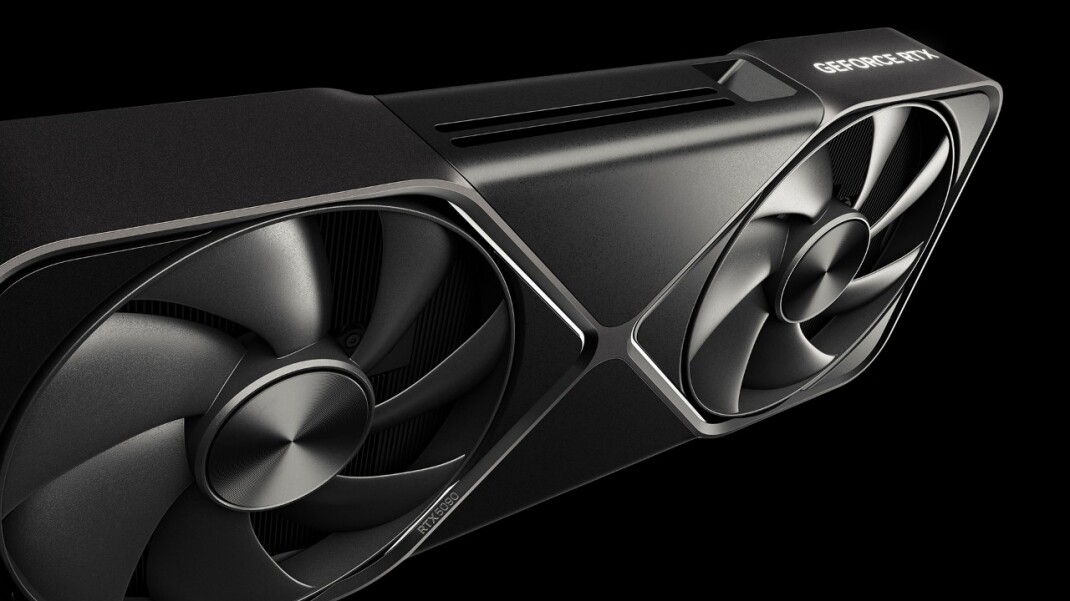
The next generation of graphics performance has arrived. We've prepared an all-new series of cards: ROG Astral. Featuring a new, sophisticated design and an outstanding cooling solution, the ROG Astral GeForce RTX 5090 and ROG Astral GeForce RTX 5080 are your premium picks for supercharging the performance of your gaming PC. All this new hardware in the ROG Astral GeForce RTX 5090 requires no small amount of power so that it can stretch its legs and run. Your PSU should be capable of at least 1000 W to run this card—more on that later. The circuitry that delivers this power is just as important, and it's one reason why many enthusiasts prefer ROG graphics cards. We've equipped the ROG Astral GeForce RTX 5090 and 5080 for premium power delivery with 80-amp MOSFETs that can supply over 35% more headroom than standard designs. A massive 24-phase VRM array for the GPU and a seven-phase VRM for the GDDR7 memory chips distribute the work of supplying power, ensuring rock-solid stability and long-lasting performance. To give you peace of mind that your 16-pin PCIe power connector is seated properly, we provide monitoring through Power Detector+ in the GPU Tweak III app so that you can verify that the connector is fully seated. The app can even tell you exactly which pin is not seated properly, if that ever becomes a concern.

Ada, meet Blackwell
With the GeForce RTX 50 Series, NVIDIA debuts its latest Blackwell architecture. Armed with fifth-gen Tensor cores, new streaming multiprocessors optimized for neural shaders, and fourth-gen Ray Tracing cores built for Mega Geometry, the new graphics cards unlock access to the next generation of graphics technologies. For many gamers, the highlight of the new architecture is DLSS 4. DLSS is a revolutionary suite of neural rendering technologies that uses AI to boost FPS, reduce latency, and improve image quality. The latest breakthrough, DLSS 4, brings new Multi Frame Generation and enhanced Ray Reconstruction and Super Resolution. But there's more. NVIDIA Reflex 2 with Frame Warp provides game-winning responsiveness, and these cards are equipped to give you the best experience with ray-traced graphics yet.

GeForce NOW Announces Addition of Kingdom Come: Deliverance II

GeForce NOW celebrates its fifth anniversary this February with a lineup of five major releases. The month kicks off with Kingdom Come: Deliverance II. Prepare for a journey back in time—Warhorse Studios' newest medieval role-playing game (RPG) comes to GeForce NOW on its launch day, bringing 15th-century Bohemia to devices everywhere. Experience the highly anticipated sequel's stunning open world at GeForce RTX quality in the cloud, available to stream across devices at launch. It leads seven games joining the GeForce NOW library of over 2,000 titles, along with MARVEL vs. CAPCOM Fighting Collection: Arcade Classics.

Chainmail Meets the Cloud
Kingdom Come: Deliverance II continues the epic, open-world RPG saga set in the brutal and realistic medieval world of Bohemia. Continue the story of Henry, a blacksmith's son turned warrior, as he navigates political intrigue and warfare. Explore a world twice the size of the original, whether in the bustling streets of Kuttenberg or the picturesque Bohemian Paradise. The game builds on its predecessor's realistic combat system by introducing crossbows, early firearms and a host of new weapons, while refining its already sophisticated melee combat mechanics. Navigate a complex narrative full of difficult decisions, forge alliances with powerful figures, engage in tactical large-scale battles and face moral dilemmas that impact both the journey and fate of the kingdom—all while experiencing a historically rich environment faithful to the period.

ASUS & MSI US Official Stores Raise GeForce RTX 5090 & 5080 MSRPs

The buying landscape for GeForce RTX 5090 and RTX 5080 graphics cards is looking barren, just one week post-launch—global demand has far outstretched initial supply. Mid-week news points to two of NVIDIA's board partners increasing MSRPs for the top-end Blackwell GPU models, seemingly adding insult to already inflicted injuries. ASUS and MSI's North American online stores are completely devoid of stock—at the time of writing, almost all product entries are accompanied by "notify me" tags. The two hardware manufacturers have implemented comprehensive price hikes—as reported by VideoCardz. The publication pinpointed flagship models, as prime examples. The liquid-cooled ASUS ROG Astral LC RTX 5090 OC Edition 32 GB model was already a pricey prospect at launch ($3099), but the official store has tacked on another $311. A total charge of $3410 gets you one of the nicest and feature-rich card designs on the market, but you will be paying a premium of $1411—above Team Green's official GeForce RTX 5090 MSRP of $1999—for the privilege of ownership and/or bragging rights. Further down in the product stack—TechSpot noted that a Prime GeForce RTX 5080 (non-OC) 16 GB model has jumped from an original figure of $999, up to $1,264. At the time of writing, this price has been re-adjusted back down to just below $1000—thanks to a special "deal." The overclocked Prime variant is currently priced at $1320.

Looking at the MSI US store, VideoCardz reported on all GeForce RTX 5090 and RTX 5080 cards being priced north of original MSRPs—they highlighted a lowly not-overclocked RTX 5080 16G VENTUS 3X model having its price adjusted upwards—now $1140, instead of the original $1000 (at launch). MSI's "cheapest" RTX 5090 card is another VENTUS 3X design—this non-OC model is now $380 more expensive than last week's asking price ($2000). Overall, MSI's US webshop has raised prices in the ranges of $140 to $500 for GeForce RTX 5080 cards, and $380 to $790 for RTX 5090 offering—according to VideoCardz research. The company's RTX 5090 SUPRIM LIQUID SOC flagship design is not quite expensive as the equivalently appointed ASUS liquid-cooled model, but the newly adjusted MSRP of $2790 is difficult to digest. Press outlets have noted that listings on Newegg are up to $40 more expensive, when compared to the prices published on MSI's first-party store. As an added incentive, the MSI North American store is offering potential buyers a saving of: "$200 on MPG 322URX QD-OLED at checkout with RTX 5080/5090 series purchase."

Nintendo Promises Measures To Protect Switch 2 From Scalpers

Well, unless someone has been living under a rock for the past four years, freshly launched gaming hardware getting scalped to oblivion should hardly come as a surprise. We witnessed this just recently with the launch of the NVIDIA RTX 50-series GPUs, considering the multiple-thousand-dollar premiums that the cards were sold for on platforms such as eBay. One might foresee a similar predicament for the much-awaited Nintendo Switch 2, but if Nintendo President Furakawa's recent statements are anything to go by, that might not be the case after all.

According to Furakawa, Nintendo is well-aware of the potential stock shortages that the Switch 2 may face, taking lessons from the OG Switch launch back in 2017, and is taking "all possible measures" to make sure the Switch 2 launch plays out smoothly. Of course, what this essentially means, is that Nintendo will be attempting its best to produce as many units of the Switch 2 as possible in order to meet customer demand at launch. This is exactly what Furakawa mentioned in his interview with Nikkei, citing that the supply chain constraints that hindered production in 2024 and 2023 no longer exist in 2025. As such, there should not be any further hurdles that hold back Nintendo from its production targets.

ASUS Unveils Gilded GeForce RTX 5090 ROG Astral Dhahab Edition

ASUS ROG Astral GeForce RTX 5090 was reviewed by us at launch, where we remarked that it is the most expensive custom-design, with a launch price of $2,800 against the NVIDIA baseline of $2,000 (a 40% premium). The card is further marked up by retailers, and is going for nearly $3,000. While this is going on, ASUS released its first halo variant, the ROG Astral RTX 5090 OC Dhahab Edition. Probably targeting the MENA (Middle-East and North Africa) markets, the Dhahab Edition is a luxurious collector's edition item that's finished in gold. Dhahab is Arabic for gold, and you can see elements of this across the cooler shroud, backplate, and the GPU retention bracket. Even the heatsink underneath has gold color. We don't know the exact material of this card—whether it is a gold-like polish, or gold electroplated.
Contrasting all this gold is a turquoise-like stone embellishment that refracts light in a blue-green tone, just like the actual stone. There are several other cultural elements to this design, including Arabic calligraphy, and motifs representing "strength, courage, and unity." The gold backplate even has machined regional motifs representing the desert, and skyscrapers. Given that the regular ROG Astral RTX 5090 OC is already at around $3,000 on the streets, sky is the limit for what ASUS could ask for this collector's item.

NVIDIA GeForce RTX 5060 and RTX 5060 Ti Could Use Standard 8-Pin PCI Power Connectors

The GPU market is heating this March as both NVIDIA and AMD prepare to launch competing mid-range graphics cards. NVIDIA's GeForce RTX 5060 and RTX 5060 Ti, part of its Blackwell architecture lineup, are rumored to debut alongside AMD's Radeon RX 9070 and 9070 XT, setting the stage for a high-stakes battle in the mainstream gaming segment. According to leaks from Chinese hardware sources at Douyin, including ZOTAC-affiliated leakers, the RTX 5060 series will retain traditional 8-pin power connectors instead of adopting NVIDIA's newer 12V-2x6 16-pin design, simplifying upgrades for users with older PSUs.

However, the cards will reportedly require a minimum 650 W power supply—a 100 W increase over the RTX 4060 series—with estimated total graphics power (TGP) of 150 W for the RTX 5060 and 200 W for the Ti variant. While NVIDIA has not confirmed specifications, the RTX 5060 Ti will reportedly launch in two variants: 8 GB and 16 GB GDDR7 configurations, leveraging a 128-bit bus.

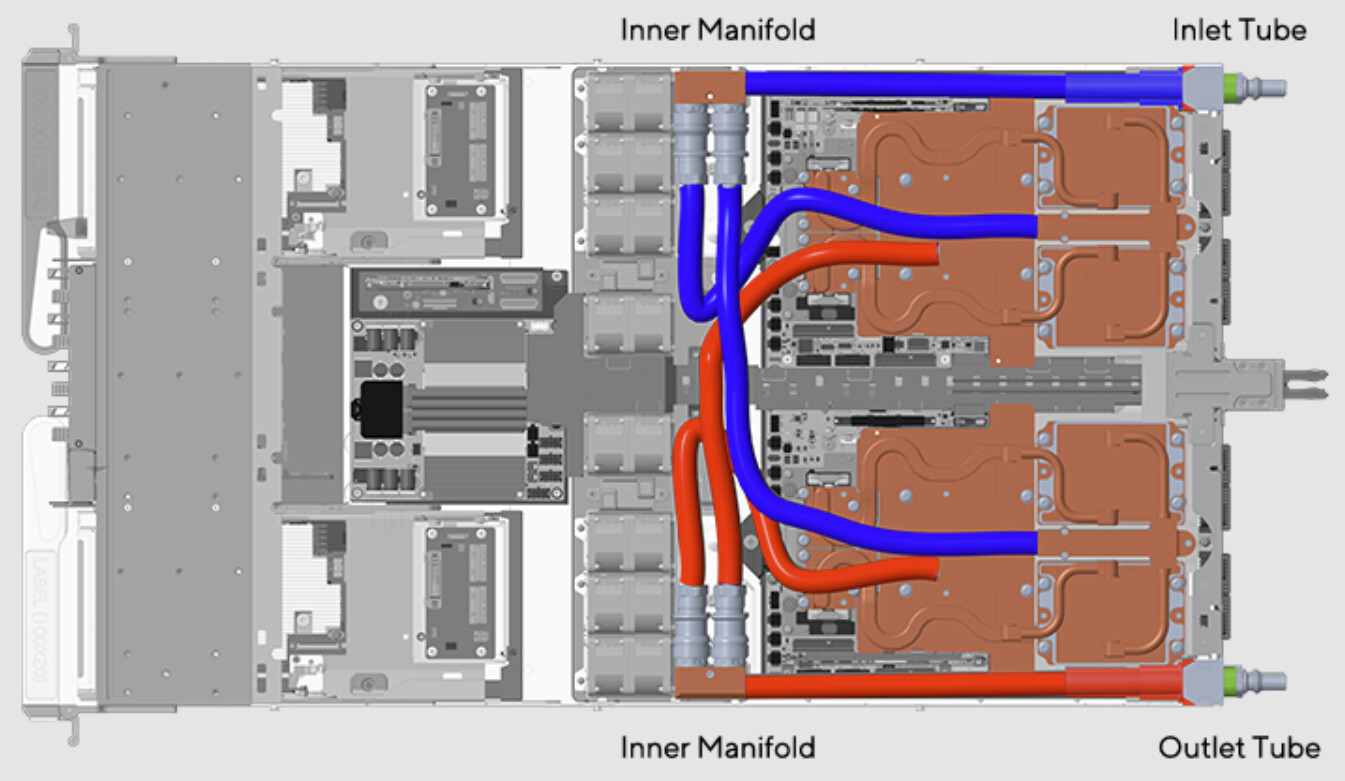
Supermicro Ramps Full Production of NVIDIA Blackwell Rack-Scale Solutions With NVIDIA HGX B200

Supermicro, Inc., a Total IT Solution Provider for AI/ML, HPC, Cloud, Storage, and 5G/Edge, is announcing full production availability of its end-to-end AI data center Building Block Solutions accelerated by the NVIDIA Blackwell platform. The Supermicro Building Block portfolio provides the core infrastructure elements necessary to scale Blackwell solutions with exceptional time to deployment. The portfolio includes a broad range of air-cooled and liquid-cooled systems with multiple CPU options. These include superior thermal design supporting traditional air cooling, liquid-to-liquid (L2L) and liquid-to-air (L2A) cooling. In addition, a full data center management software suite, rack-level integration, including full network switching and cabling and cluster-level L12 solution validation can be delivered as turn-key offering with global delivery, professional support, and service.

"In this transformative moment of AI, where scaling laws are pushing the limits of data center capabilities, our latest NVIDIA Blackwell-powered solutions, developed through close collaboration with NVIDIA, deliver outstanding computational power," said Charles Liang, president and CEO of Supermicro. "Supermicro's NVIDIA Blackwell GPU offerings in plug-and-play scalable units with advanced liquid cooling and air cooling are empowering customers to deploy an infrastructure that supports increasingly complex AI workloads while maintaining exceptional efficiency. This reinforces our commitment to providing sustainable, cutting-edge solutions that accelerate AI innovation."

NVIDIA DLSS Available in Kingdom Come: Deliverance II, FINAL FANTASY VII REBIRTH, The First Berserker: Khazan and More Games

More than 700 games and applications feature RTX technologies, and each week new games integrating NVIDIA DLSS, NVIDIA Reflex, and advanced ray-traced effects are released or announced, delivering the definitive PC experience for GeForce RTX players. This week, you can check out 6 new DLSS-enhanced games including Kingdom Come: Deliverance II, The First Berserker: Khazan, NINJA GAIDEN 2 Black, Ambulance Life: A Paramedic Simulator, FINAL FANTASY VII REBIRTH, and Level Zero: Extraction.

And DLSS 4 is now available, a major upgrade to our much-loved suite of technologies. DLSS Multi Frame Generation is introduced, multiplying performance on GeForce RTX 50 Series GPUs. DLSS Frame Generation's new AI model is faster and uses less VRAM. DLSS Resolution, DLSS Ray Reconstruction, and DLAA are upgraded to new, incredible transformer AI models that dramatically enhance image quality. And via the aforementioned NVIDIA app overrides, you can apply these enhancements to many of your games and apps. The complete suite of DLSS 4 upgrades, including DLSS 4 with Multi Frame Generation, are now available in Alan Wake 2, Cyberpunk 2077, and Hogwarts Legacy, and Star Wars Outlaws adds support soon.

ZOTAC GeForce RTX 5090 SOLID OC on Auction in China, Apparently Sourced from S. Korea

A South Korea-based hardware enthusiast—Harukaze5719—has discovered a curious listing of ZOTAC's GeForce RTX 5090 SOLID OC model on a Chinese auction site (asking price: ~$4175 USD). This finding was shared with their audience, via a social media post—a screenshot was accompanied by harukaze5719's short and succinct message: "OMG..." Officially, NVIDIA and its board partners cater to the Chinese hardware market with a restricted variant of the flagship "Blackwell" GPU—GeForce RTX 5090D. Despite under-the-hood nerfing, this region-exclusive model still offers enviable performance (when pushed).

The "full fat" GeForce RTX 5090 GPU appears to be an even hotter commodity—with demand (at launch) exceeding far exceeding supply. ZOTAC's South Korean branch warned potential customers about difficult conditions almost two weeks ahead of Blackwell's market debut on January 30. Harukaze5719 has likely expressed semi-personal frustration over apparent South Korea market-destined ZOTAC stock turning up for sale in China. So-called "Chinese GPU shopping tourists" could have made the journey to a South Korean PC hardware store, with their sole objective being the acquisition of GeForce RTX 5090 graphics cards. Tom's Hardware has gathered various related tidbits from Japanese and Taiwanese news sources—where local TV coverage explored the events of last week's launch event.

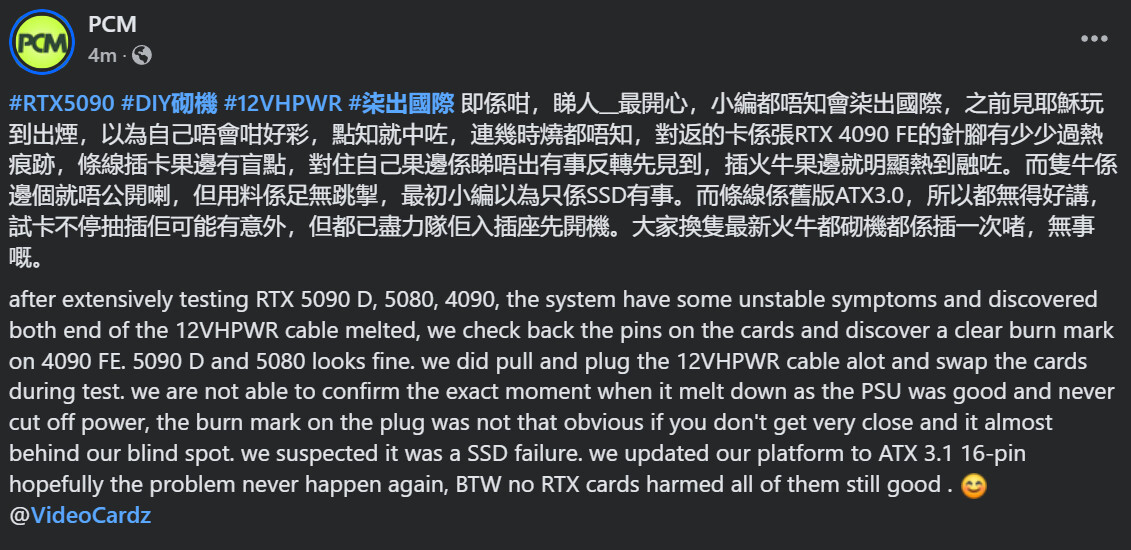
Human Error Reportedly Caused Latest 12VHPWR Cable Melting Incident

Late last month, NVIDIA claimed that 16-pin power connector issues were a thing of the past. The controversial 12VHPWR connection standard has fueled many online debates—prompting investigations from several prominent press outlets. Following NVIDIA's latest "safety" declaration—likely by coincidence—PCM Hong Kong reported another melting incident, affecting two cables and a power supply unit. The publication's hardware reviewer was recently engaged in the "full-load" testing of GeForce RTX 5090D and RTX 5080 graphics cards. Last week's evaluation session was interrupted by notable test system instabilities—upon downing tools, the PCM staffer discovered that their 1200 W PSU had given up the ghost. Additionally, two 16-pin cables had melted at both ends—initial detective work pointed to a GeForce RTX 4090 sample card being the main culprit.

VideoCardz and UNIKO's Hardware kept close tabs on PCM's next steps—online interactions, over the past weekend, spurred a re-evaluation of circumstances. According to PCM's latest update, they noticed burn marks on the GeForce RTX 4090 test unit—the two GeForce RTX-50-series cards did not exhibit any physical damage. Post-analysis, the reviewer now suspects that an SSD failure could be the root cause. They were happy to report that all involved RTX cards have survived, and that their test platform has been re-equipped with 12V-2x6 cables. An amended VideoCardz article proposes that everything came down to a simple human error.

Overclockers UK Expecting Next Batch of GeForce RTX 5090 GPUs in 3 to 16 Weeks

Overclockers UK (OcUK)—a well-known PC hardware retailer—has revealed estimated timeframes for renewed stock of GeForce RTX 5090 and RTX 5080 graphics cards. Late last week, its various web presences informed potential customers about anticipated lead times. The company's blog disclosed that: "due to incredibly high demand and limited stock, all 50 Series cards sold shortly after launch with some pre-orders taken in restricted quantities." New GeForce RTX 5090 stock is expected to arrive at the OcUK warehouse in about three to sixteen weeks. The British store reckons that they will receive GeForce RTX 5080 cards in two to six weeks time. TechPowerUp picked up on various online predictions—a week before the market launch of NVIDIA GeForce RTX 50-series GPUs—pointing to extremely low numbers of forthcoming launch stock. An OcUK employee disclosed that their inventory—of GeForce RTX 5090 graphics cards—was in single digits.

OcUK's dedicated RTX 50-series blog includes an apology—apparently their webstore experienced an outage shortly before launch time. They also informed customers about external factors affecting the re-opening of order books: "we have no plans to take pre-orders for any 50 Series cards until we have greater clarity on availability and have fulfilled the pre-orders we have taken." VideoCardz has discovered an informative post on the Megekko.nl discussion forum—where a new member has shared insider information. Board partners and suppliers are complaining about difficult conditions, according to the leaker's sources—they believe that ASUS and MSI have been forced into releasing forthcoming RTX 5090 stock via a staggered batch system (see screenshot below). The Verge has reached out to NVIDIA for comment—regarding shortages at launch—their request was not entertained.

ASUS AI POD With NVIDIA GB200 NVL72 Platform Ready to Ramp-Up Production for Scheduled Shipment in March

ASUS is proud to announce that ASUS AI POD, featuring the NVIDIA GB200 NVL72 platform, is ready to ramp-up production for a scheduled shipping date of March 2025. ASUS remains dedicated to providing comprehensive end-to-end solutions and software services, encompassing everything from AI supercomputing to cloud services. With a strong focus on fostering AI adoption across industries, ASUS is positioned to empower clients in accelerating their time to market by offering a full spectrum of solutions.

Proof of concept, funded by ASUS
Honoring the commitment to delivering exceptional value to clients, ASUS is set to launch a proof of concept (POC) for the groundbreaking ASUS AI POD, powered by the NVIDIA Blackwell platform. This exclusive opportunity is now open to a select group of innovators who are eager to harness the full potential of AI computing. Innovators and enterprises can experience firsthand the full potential of AI and deep learning solutions at exceptional scale. To take advantage of this limited-time offer, please complete this surveyi at: forms.office.com/r/FrAbm5BfH2. The expert ASUS team of NVIDIA GB200 specialists will guide users through the next steps.

Reports of Bricked NVIDIA GeForce RTX 5090 and RTX 5090D Surge

According to widespread user reports from Chinese tech forums and Reddit communities, multiple RTX 5090 and 5090D graphics cards are failing permanently after standard driver installation. The issue affects both the standard RTX 5090 and the export-modified 5090D variant released for the Chinese market on January 30th. Users report consistent failure patterns: upon initial driver installation, displays go dark, and systems permanently lose the ability to detect the GPU through both DisplayPort and HDMI interfaces. Hardware failures have been documented across multiple board partners, with Colorful, Manli, and Gigabyte cards showing identical symptoms. Third-party vendor reports sometimes indicate potential IC burn damage, suggesting hardware-level failure rather than recoverable software issues.

Some investigations point to PCIe Gen 5 implementation as a possible root cause. The RTX 5090 series represents NVIDIA's first fully Gen 5-compliant GPU architecture, introducing new signal integrity challenges. Some users report temporary mitigation by forcing PCIe 4.0 mode in BIOS settings, though this workaround remains unverified. Additional complications arise from modern motherboard designs that share PCIe lanes between M.2 storage and graphics slots. The failure pattern appears consistent across both domestic and international markets. On r/ASUS, users report identical detection failures persisting through CMOS resets and system rebuilds. Chinese forum documentation shows systematic failures across multiple board partner implementations, suggesting a fundamental architecture or driver compatibility issue rather than isolated manufacturing defects. NVIDIA has not issued official guidance on the failures.
Below are screenshots of the reported user problems:

Artificial Intelligence (AI) Chips Market to Grow by USD 902.6 Billion by 2029: Technavio

Report with market evolution powered by AI—The global artificial intelligence (AI) chips market size is estimated to grow by USD 902.6 billion from 2025-2029, according to Technavio. The market is estimated to grow at a CAGR of over 81.2% during the forecast period. Increased focus on developing AI chips for smartphones is driving market growth, with a trend towards convergence of AI and IoT. However, dearth of technically skilled workers for ai chips development poses a challenge. Key market players include Advanced Micro Devices Inc., Baidu Inc., Broadcom Inc., Cerebras, Fujitsu Ltd., Google LLC, Graphcore Ltd., Huawei Technologies Co. Ltd., Intel Corp., International Business Machines Corp., MediaTek Inc., Microchip Technology Inc., NVIDIA Corp., NXP Semiconductors NV, Qualcomm Inc., SambaNova Systems Inc., Samsung Electronics Co. Ltd., SenseTime Group Inc., Taiwan Semiconductor Manufacturing Co. Ltd., and Tesla Inc.

NVIDIA GeForce RTX 5090 Runs on 3x8-Pin PCI Power Adapter, RTX 5080 Not Booting on 2x8-Pin Configuration

NVIDIA's flagship GeForce RTX 5090 demonstrated flexibility in power compatibility, while its sibling, the RTX 5080, struggled with stricter requirements. Recent tests by a German tech outlet, ComputerBase, reveal that the RTX 5090 can operate with three 8-pin PCI power connectors instead of the recommended four, albeit with a performance trade-off. However, the RTX 5080 fails to boot when using only two 8-pin connectors. The RTX 5090, with a default TDP of 575 W, officially requires a 600 W 12V-2×6 connector or an adapter with four 8-pin PCI cables. However, tests on the ASUS ROG RTX 5090 Astral and Zotac RTX 5090 Solid show the GPU boots even with three 8-pin cables, capping its TDP at 450 W—matching the three connectors' 150 W-per-cable spec. Performance losses are modest: benchmarks indicate a 5% drop in average FPS at 450 W compared to full power.

In contrast, the RTX 5080's 360 W TDP proves less forgiving. Attempts to run the Founders Edition and Zotac RTX 5080 AMP Extreme Infinity with two 8-pin connectors (300 W total) resulted in failure: the screen remained blank, and the card refused to initialize. NVIDIA's firmware appears to lack a lower power-limit threshold for the RTX 5080, unlike the 5090, which automatically adjusts when detecting insufficient power delivery. This requirement forces users to adhere strictly to the three 8-pin or 12V-2×6 power connectors. While the RTX 5090 offers flexibility for users upgrading from older systems, the RTX 5080's limitations may frustrate owners of less powerful PSUs. For the RTX 5090, the 5% performance penalty at 450 W may be a reasonable trade-off for avoiding costly PSU upgrades, but RTX 5080 users have no such recourse. Verifying power supply compatibility, as underpowered setups risk instability or hardware damage, is a must, and when your $2000+ GPU runs, you should at least power it properly. This experiment is more a "for science" type of run.

ASUS Outlines PRIME RTX 5080 Model's SFF-Ready Profile

Many gamers aren't that concerned about the size of their graphics card. A wide range of today's most popular PC cases offer plenty of elbow room, even for unabashedly large cards like our new ROG Astral GeForce RTX 5090. That said, there's a community of gamers who are always on the lookout for cards that deliver the performance they need in a more compact profile. Some have their eye on a space-saving small-form-factor (SFF) chassis. Others need a slimmer heatsink that leaves their secondary PCIe x16 slot accessible, perhaps to leave room for a capture card. Whatever your needs, the Prime GeForce RTX 5080 is ready for the occasion.

Slim and trim for your SFF PC
In the past, building a petite gaming PC involved double and even triple-checking component sizes to ensure compatibility. Today, the process is much easier thanks to the NVIDIA GeForce SFF-Ready program, which simplifies the process of building a space-saving PC by labeling SFF-Ready cases and graphics cards. When you select a chassis and a GPU that are both SFF-Ready, you can be confident they'll be compatible, and you'll have a streamlined building experience. Just 50 mm thick and 304 mm long, the 2.5-slot Prime GeForce RTX 5080 fits comfortably within NVIDIA's recommended form factor guidelines for SFF PCs so that you can build your space-saving PC with confidence.

AMD Faces Investor Skepticism as AI Market Moves Toward Custom Chips

AMD is set to share its fourth-quarter results on Tuesday, Feb. 4 facing opportunities and problems in the fast-changing AI chip market as investors are expected to look closely at AMD's AI strategy. Reuters reports that experts think AMD's revenue will increase by over 22% to $7.53 billion. They expect its data center part to make up more than half of total sales at $4.15 billion. Yet, investors still worry about how AMD stands in the AI race. TD Cowen experts and Omdia believe AMD could sell $10 billion worth of AI chips this year, this is twice what AMD itself thinks it will sell, which is $5 billion. However, the scene is getting more complex with Big Tech firms like Microsoft, Amazon, and Meta making their own special chips for AI work. This move to custom chips, along with NVIDIA's strong market position and its popular CUDA software, makes things tough for AMD. The high costs of switching chipmakers also make it hard for AMD to grow its share of the market, however, the ongoing increase in AI spending by tech giants could help balance out these problems. Investors see "customer silicon and NVIDIA as the AI chip market going forward," said Ryuta Makino, analyst at AMD investor Gabelli Funds.

Supply chain issues make AMD's position more difficult as TSMC is boosting its advanced packaging ability to fix bottlenecks, while NVIDIA's production increase of its new "Blackwell" AI chips might restrict AMD's access to manufacturing resources. Yet, AMD's business has some good news, its personal computer unit should grow by almost 33% to $1.94 billion catching up to Intel.

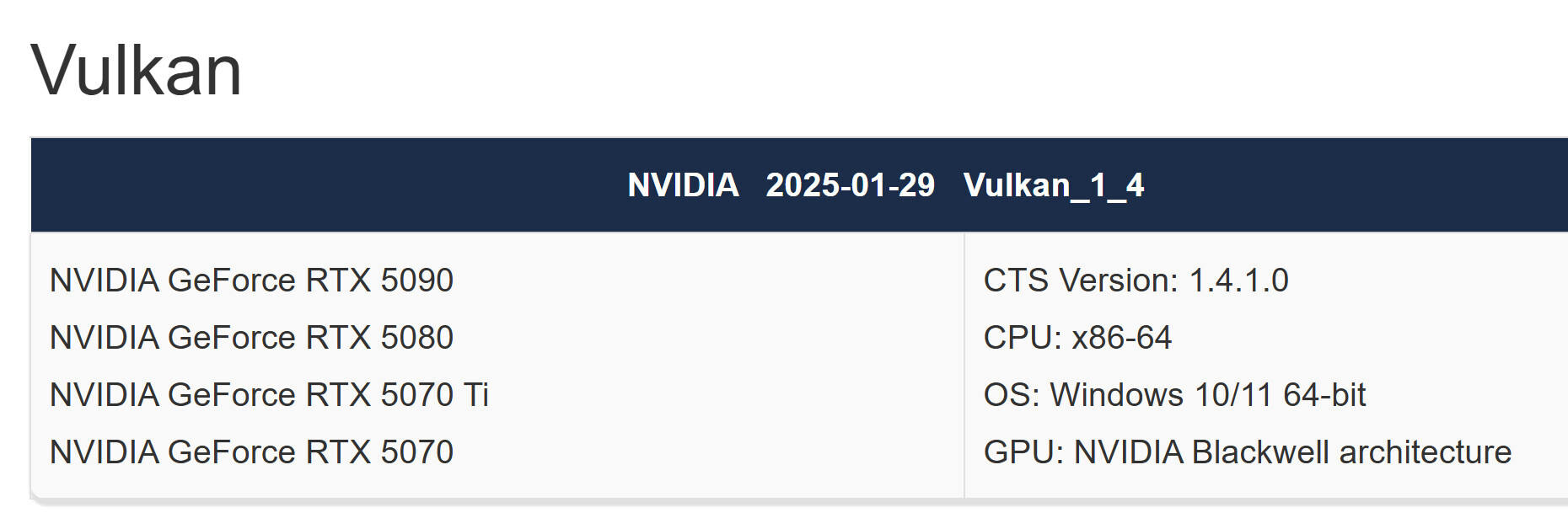
NVIDIA GeForce RTX 5070 Ti & 5070 GPUs Added to Vulkan 1.4 Support List

Khronos introduced version 1.4 of its Vulkan graphics API last December—at the time, industry watchdogs believed that this iteration was prepared with NVIDIA "Blackwell" GPU conformance in mind. A mid-January leak indicated that the GeForce RTX 5090 SKU was already present on the Vulkan API's support list. Recent official additions—of GeForce RTX 5070 Ti and RTX 5070 GPUs to the cross-platform API's compatibility registry—suggest an imminent launch at retail; insiders reckon that the 5070 Ti will arrive on February 20.

Last week, HWiNFO's development team revealed that they were readying an incoming build (8.21) with support for Team Green's GeForce RTX 5070 Ti GPU. Their "upcoming changes" list did not include the lower-specced GeForce RTX 5070 (non-Ti)—online speculation posits that this model will launch later on in February. The GeForce RTX 5070's inclusion on the latest Vulkan API conformance list is an encouraging sign. VideoCardz spent its weekend searching for any entries alluding to GeForce RTX 5060 Ti or GeForce RTX 5060 (non-Ti) SKUs—they discovered zero evidence. The developers at Khronos are likely keeping these lower-end models under a "confidential" category.

TechPowerUp Introduces TechPowerUp GPU-Z v2.62.0

TechPowerUp today released the latest version of TechPowerUp GPU-Z, the graphics sub-system information and monitoring utility for PC gamers and enthusiasts. The latest version 2.62.0 introduces full support for NVIDIA "Blackwell" generation of GPUs, which should cover not just the RTX 5090 and RTX 5080 that were recently released, but also preliminary support for upcoming SKUs such as the RTX 5070 Ti, and RTX 5070. Support is also added for the NVIDIA H200 NVLink compute GPU, and RTX 5000 Ada Generation Embedded pro-vis graphics card. Subvendor detection for Maxsun has been fixed. Grab GPU-Z from the link below.

DOWNLOAD: TechPowerUp GPU-Z 2.62.0

Edward Snowden Lashes Out at NVIDIA Over GeForce RTX 50 Pricing And Value

It's not every day that we witness a famous NSA whistleblower voice their disappointment over modern gaming hardware. Edward Snowden, who likely needs no introduction, did not bother to hold back his disapproval of NVIDIA's recently launched RTX 5090, RTX 5080, and RTX 5070 gaming GPUs. The reviews for the RTX 5090 have been mostly positive, although the same cannot be said for its affordable sibling, the RTX 5080. Snowden, voicing his thoughts on Twitter, claimed that NVIDIA is selling "F-tier value for S-tier prices".

Needless to say, there is no doubt that the RTX 5090's pricing is quite exorbitant, regardless of how anyone puts it. Snowden was particularly displeased with the amount of VRAM on offer, which is also hard to argue against. The RTX 5080 ships with "only" 16 GB of VRAM, whereas Snowden believes that it should have shipped with at least 24, or even 32 GB. He further adds that the RTX 5090, which ships with a whopping 32 GB of VRAM, should have been available with a 48 GB variant. As for the RTX 5070, the security consultant expressed desire for at least 16 GB of VRAM (instead of 12 GB).

NVIDIA GeForce RTX 5060 and RTX 5060 Ti Rumored to Launch in March 2025

A recently leaked slide from the Taiwanese company Chaintech has seemingly confirmed the launch dates for the RTX 5060 and RTX 5060 Ti GPUs. Previous leaks have hinted at an early Q2 launch for the mid-range gaming GPUs, in both 8 GB and 16 GB VRAM flavors. Chaintech's slide does not reveal any specifications regarding the GPUs, although we do have a pretty good idea of what the upcoming GPUs will bring to the table.

As per recent leaks, the RTX 5060 and 5060 Ti are both expected to sport the GB206 GPU, paired with 8 or 16 GB of VRAM on a 128-bit bus. Despite employing the speedy new GDDR7 standard, there is no denying that 8 GB of VRAM is far from sufficient for a comfortable ray-traced gaming experience in 2025, perhaps even less so in the near future. Considering that the Arc B580 ships with 50% more VRAM, the entry-level RTX 5060 is more than likely to be hard sell for many people, unless, of course, the RTX 5060/Ti somehow pulls off impressive performance uplifts.

DeepSeek-R1 Goes Live on NVIDIA NIM

DeepSeek-R1 is an open model with state-of-the-art reasoning capabilities. Instead of offering direct responses, reasoning models like DeepSeek-R1 perform multiple inference passes over a query, conducting chain-of-thought, consensus and search methods to generate the best answer. Performing this sequence of inference passes—using reason to arrive at the best answer—is known as test-time scaling. DeepSeek-R1 is a perfect example of this scaling law, demonstrating why accelerated computing is critical for the demands of agentic AI inference.

As models are allowed to iteratively "think" through the problem, they create more output tokens and longer generation cycles, so model quality continues to scale. Significant test-time compute is critical to enable both real-time inference and higher-quality responses from reasoning models like DeepSeek-R1, requiring larger inference deployments. R1 delivers leading accuracy for tasks demanding logical inference, reasoning, math, coding and language understanding while also delivering high inference efficiency.

Newegg Sold Out Most NVIDIA RTX 50 Series GPUs in Just 5 Minutes, Entire Stock Cleared in 20 Minutes

Newegg Commerce, Inc., a global leader in e-commerce for technology products, experienced an overwhelming response to the highly anticipated launch of the NVIDIA GeForce RTX 50 Series GPUs, with inventory selling out within minutes. Gaming enthusiasts, content creators, system integrators, and PC builders rushed to secure the first batch of the latest AI-powered graphics technology, driving demand to unprecedented levels and cementing the RTX 50 Series as one of the most sought-after GPU launches in history.

"The response to the NVIDIA RTX 50 Series has been extraordinary," said Jim Tseng, VP of Product Management at Newegg. "The overwhelming demand reaffirms the gaming and PC community's enthusiasm for the very best technology. For our customers who have not yet been able to secure a GPU, we're committed to working with NVIDIA and our AIB (Add-In Board) partners to ensure future restocks and continued availability." Tseng continued, "Getting the latest cards into our customers is our passion, and we're proud to also offer a GPU trade-in program that makes it more affordable for customers to upgrade to the latest generation of video cards."

UL Solutions Adds Support for DLSS 4 and DLSS Multi Frame Generation to the 3DMark NVIDIA DLSS Feature Test

We're excited to announce that in today's update to 3DMark, we're adding support for DLSS 4 and DLSS Multi Frame generation to the NVIDIA DLSS feature test. The NVIDIA DLSS feature test and this update were developed in partnership with NVIDIA. The 3DMark NVIDIA DLSS feature test lets you compare performance and image quality brought by enabling DLSS processing. If you have a new GeForce RTX 50 Series GPU, you'll also be able to compare performance with and without the full capabilities of DLSS 4.

You can choose to run the NVIDIA DLSS feature test using DLSS 4, DLSS 3 or DLSS 2. DLSS 4 includes the new DLSS Multi Frame Generation feature, and you can choose between several image quality modes—Quality, Balanced, Performance, Ultra Performance and DLAA. These modes are designed for different resolutions, from Full HD up to 8K. DLSS Multi Frame Generation uses AI to boost frame rates with up to three additional frames generated per traditionally rendered frame. In the 3DMark NVIDIA DLSS feature test, you are able to choose between 2x, 3x and 4x Frame Generation settings if you have an NVIDIA GeForce RTX 50 series GPU.

MAINGEAR Launches New Desktop Gaming PCs and Workstations With NVIDIA GeForce RTX 50 Series GPUs

MAINGEAR, the leader in premium-quality, high-performance gaming PCs, today unveiled a variety of custom-configurable "50 Series" gaming desktops, featuring NVIDIA's newly revealed GeForce RTX 5080 and RTX 5090 GPUs. Available across seven gaming chassis options—MG-1, North, shroud, shroud Signature Edition, Rush, Force, and Zero, as well as all Workstations—these systems can be custom configured with NVIDIA GeForce RTX 50-series GPUs and the latest CPU options from AMD and Intel to set a new benchmark for desktop gaming performance and customization.

Building on the excitement from CES 2025, MAINGEAR's "50 Series" also introduces non-APEX configurations of the hot new Rush and Force desktops, featuring 360 mm and 420 mm AIO coolers respectively, instead of open loop liquid cooling. Additionally, customers can order Rush desktops with custom chassis artwork for unparalleled personalization - as seen at CES. Available custom designs include Machina, Night Drive and Good Fortune.
Return to Keyword Browsing
Nov 27th, 2026 18:51 CST change timezone

New Forum Posts

Popular Reviews

TPU on YouTube

Controversial News Posts