News Posts matching #NVIDIA

Return to Keyword Browsing

NVIDIA GeForce Now Celebrates Fifth Anniversary, Announces Latest AAA Additions

GeForce NOW turns five this February. Five incredible years of high-performance gaming have been made possible thanks to the members who've joined the cloud gaming platform on its remarkable journey. Since exiting beta in 2020, GeForce NOW has changed how gamers access and enjoy their favorite titles. The cloud has come a long way, introducing groundbreaking new features and supporting over 2,000 games from celebrated publishers for members to play.

Five years of cloud gaming excellence deserves a celebration. As part of an epic February lineup of 17 games coming this month, every week, GeForce NOW will deliver a major game release in the cloud. This includes the highly anticipated Kingdom Come: Deliverance II from Warhorse Studios, Avowed from Obsidian Entertainment and Sid Meier's Civilization VII from 2K Games. Make sure to stay tuned to GFN Thursdays to see what else is in store. This GFN Thursday, check out the nine titles available to stream this week, including standout title Pax Dei, a medieval massively multiplayer online (MMO) game from Mainframe Industries. Whether seeking mythical exploration or heart-pounding sci-fi combat thrills, GeForce NOW provides unforgettable experiences for every kind of gamer.

New NVIDIA Broadcast AI Features Now Streaming With GeForce RTX 50 Series GPUs

New GeForce RTX 5090 and RTX 5080 GPUs - built on the NVIDIA Blackwell architecture - are now available to power generative AI content creation and accelerate creative performance. GeForce RTX 5090 and RTX 5080 GPUs feature fifth-generation Tensor Cores with support for FP4, reducing the VRAM requirements to run generative AI models while doubling performance. For example, Black Forest Labs' FLUX models - available on Hugging Face this week - at FP4 precision require less than 10 GB of VRAM, compared with over 23 GB at FP16. With a GeForce RTX 5090 GPU, the FLUX.1 [dev] model can generate images in just over five seconds, compared with 15 seconds on FP16 or 10 seconds on FP8 on a GeForce RTX 4090 GPU.

GeForce RTX 50 Series GPUs also come equipped with ninth-generation encoders and sixth-generation decoders that add support for 4:2:2 and increase encoding quality for HEVC and AV1. Fourth-generation RT Cores paired with DLSS 4 provide creators with super-smooth 3D rendering viewports. The GeForce RTX 5090 GPU includes 32 GB of ultra-fast GDDR7 memory and 1,792 GB/sec of total memory bandwidth - a 77% bandwidth increase over the GeForce RTX 4090 GPU. It also includes three encoders and two decoders, reducing export times by a third compared with the prior generation.

Corsair Launches New VENGEANCE Gaming PCs Powered by GeForce RTX 50 Series

Corsair today launched the new edition of its celebrated Vengeance Gaming PCs, featuring NVIDIA GeForce RTX 50 Series graphics cards paired with Intel Core Ultra or AMD Ryzen 9000 Series processors. Powered by NVIDIA Blackwell, GeForce RTX 50 Series GPUs bring game-changing capabilities to gamers and creators. Equipped with massive level of AI horsepower, the RTX 50 Series enables new experiences and next-level graphics fidelity with full ray tracing, further reduces latency with Reflex 2 technology, multiplies performance with NVIDIA DLSS, generates images at unprecedented speed, and unleashes your creativity with NVIDIA Studio.

Vengeance PCs with GeForce RTX 50 Series GPUs are NVIDIA NIM-ready RTX AI PCs, supporting the latest NIM microservices—optimized AI models for language, speech, vision, content generation, and more. These systems enable enthusiasts and developers to build AI assistants, productivity plug-ins, and innovative content creation workflows with peak performance.

Alphacool Presents the RTX 5080 / 5090 Core GPU Water Cooler

Alphacool International GmbH, based in Braunschweig, has been a pioneer in PC water cooling technology for over 20 years. With one of the most comprehensive product portfolios in the industry, Alphacool is now expanding its lineup with the introduction of new Core GPU water coolers for the latest NVIDIA GeForce RTX 5080 and 5090 series.

The GPU water coolers have been completely redesigned. Precise adjustments to the spacing between the cooler and the PCB, along with optimized water flow simulations and extensive practical testing, have resulted in significant improvements to the cooler base and jetplate. These enhancements ensure maximum cooling performance for the newest NVIDIA GeForce RTX generation. The GPU water coolers feature a precisely machined copper base with high-quality chrome plating for exceptional durability and a smooth surface. The design is further complemented by robust brass fittings with a nylon cover, ensuring maximum safety and reliability.

NVIDIA Releases GeForce 572.16 WHQL Game Ready Drivers

NVIDIA today released the latest version of its GeForce Game Ready drivers. Version 572.16 WHQL comes with support for the latest NVIDIA GeForce RTX 5080 and RTX 5090 "Blackwell" graphics cards, along with all the software framework needed for DLSS 4 and Multi Frame Generation. DLSS 4 and its updated Transformer-based models for super resolution, ray reconstruction, and frame generation are even available to older generations of GeForce RTX GPUs depending on their hardware capability. The updated super resolution model is available across the GeForce RTX series, the updated ray reconstruction to RTX 40-series and RTX 30-series; and the updated frame generation model to the RTX 40-series. Multi frame generation is exclusive to the RTX 50-series.

A bug that caused G-SYNC compatible monitors to flicker when framerate drops below 60 FPS has been fixed. Micro-stutters noticed with "Indiana Jones and the Great Circle" with V-sync disabled, has been fixed. Stability has been improved for Ubisoft games that use the Snowdrop game engine. The list of games with DLSS 4 multi frame generation support can be found in the table below.
DOWNLOAD: NVIDIA GeForce 572.16 WHQL

MSI's US Store Postpones GeForce RTX 5090 GPU Shipments, Delayed Until February 6

Earlier this week, MSI's China office admitted that it had only a limited supply of GeForce RTX 50 series graphics cards available for launch day. A VideoCardz report from last night points out similar problems affecting retail channels in North America. MSI's official US store has delayed shipments of GeForce RTX 5090 and RTX 5080 cards. This announcement was extracted from a conversation conducted via Discord—between a company representative (MSI Spence) and a VideoCardz staffer (WhyCry). In full, MSI stated: "we are going to allow GeForce RTX 5090 pre-orders on January 30, at 6 AM PST—with a ship date of February 6. The GeForce RTX 5080 will be available for purchase on January 30 at 6 AM PST, with an immediate ship date of (same day) January 30. GeForce RTX 5090 pre-orders will open on January 30 at 6 AM PST, with a ship date of February 6."

Additionally, StinceBuilt has corroborated reports of newly adjusted timeframes—the custom PC builder publicly disclosed its own dealings with the NVIDIA board partner: "we're being told by the MSI Team that the MSI RTX 5090 Variants are now being pushed back until February 6th for launch. RTX 5090 Day of Launch is going to be very rough, both on the consumer retail/ecommerce side, and to all system integrators. Stock is minimal at best. Please be patient. We've confirmed this with other shops like ourselves."

Comcast Introduces Nation's First Ultra-Low Lag Xfinity Internet Experience With Meta, NVIDIA, and Valve

Comcast is introducing the first customers in the world to a pioneering new, ultra-low lag connectivity experience when they use interactive applications like gaming, videoconferencing, and virtual reality. With the launch, Xfinity Internet latency will be dramatically reduced to faster than the blink of an eye, currently when using FaceTime on iPhone, iPad, Mac, Apple TV, and Apple Vision Pro, apps on Meta's mixed reality headsets that will support this technology, NVIDIA's GeForce NOW, many games on Valve's Steam games platform, and in the future on other applications that choose to leverage this open standard technology.

"Our connectivity is the key to unlocking a world of entertainment, sports, news and information and we're constantly pushing the limits of network innovation to create an experience that exceeds the expanding demands of our customers," said Emily Waldorf, Senior Vice President, Consumer Products, Comcast Connectivity and Platforms. "Modern applications are real-time and interactive and require more than just fast speeds. Xfinity Internet's lower lag times will be a differentiator for Comcast."

Reports Suggest DeepSeek Running Inference on Huawei Ascend 910C AI GPUs

Huawei's Ascend 910C AI chip was positioned as one of the better Chinese-developed alternatives to NVIDIA's H100 accelerator—reports from last autumn suggested that samples were being sent to highly important customers. The likes of Alibaba, Baidu, and Tencent have long relied on Team Green enterprise hardware for all manner of AI crunching, but trade sanctions have severely limited the supply and potency of Western-developed AI chips. NVIDIA's region-specific B20 "Blackwell" accelerator is due for release this year, but industry watchdogs reckon that the Ascend 910C AI GPU is a strong rival. The latest online rumblings have pointed to another major Huawei customer—DeepSeek—having Ascend silicon in their back pockets.

DeepSeek's recent unveiling of its R1 open-source large language model has disrupted international AI markets. A lot of press attention has focused on DeepSeek's CEO stating that his team can access up to 50,000 NVIDIA H100 GPUs, but many have not looked into the company's (alleged) pool of natively-made chips. Yesterday, Alexander Doria—an LLM enthusiast—shared an interesting insight: "I feel this should be a much bigger story—DeepSeek has trained on NVIDIA H800, but is running inference on the new home Chinese chips made by Huawei, the 910C." Experts believe that there will be a plentiful supply of Ascend 910C GPUs—estimates from last September posit that 70,000 chips (worth around $2 billion) were in the mass production pipeline. Additionally, industry whispers suggest that Huawei is already working on a—presumably, even more powerful—successor.

NVIDIA GeForce RTX 5070 Ti Launches on February 20

NVIDIA's third graphics card from the RTX 50-series "Blackwell" generation, the GeForce RTX 5070 Ti, reportedly launches on February 20, 2025, according to a VideoCardz report. Reviews of RTX 5070 Ti priced at the NVIDIA MSRP of USD $749 should go live on February 19, with reviews of cards priced above MSRP following on February 20. All cards go on sale from February 20.

The RTX 5070 Ti is based on the same 5 nm "GB203" silicon as the RTX 5080 that launches later this week, but while the RTX 5080 maxes the silicon out, enabling all 84 SM, the RTX 5070 Ti is slightly cut down, with 70 out of 84 SM being enabled, resulting in 8,960 CUDA cores, 280 Tensor cores, 70 RT cores, 280 TMUs, and an unknown number of ROPs. The memory size is 16 GB, across the chip's full 256-bit GDDR7 memory interface, although NVIDIA didn't confirm memory speeds. Its TGP is down to 300 W compared to the 360 W of the RTX 5080.

TechPowerUp NVCleanstall v1.18.0 Released, Adds NVIDIA App Support

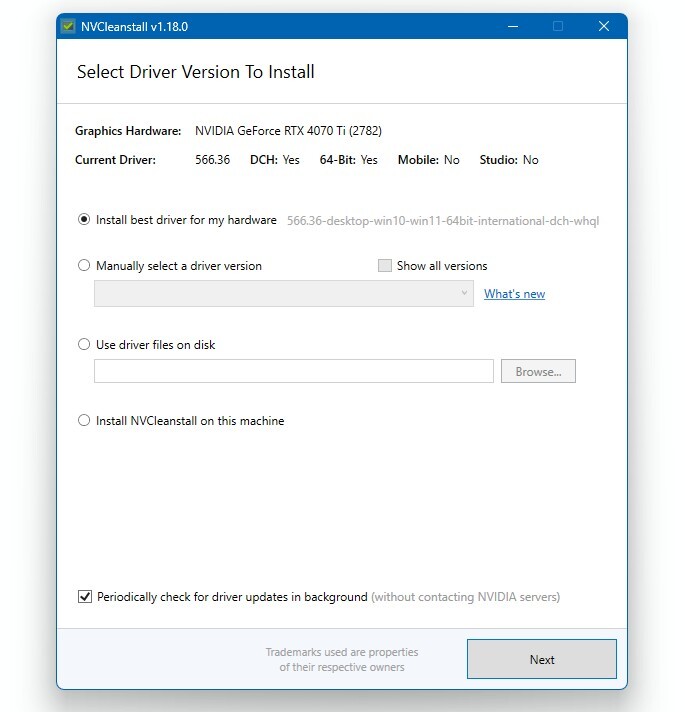
TechPowerUp today released the latest version of TechPowerUp NVCleanstall, our lightweight utility that lets you take control of your NVIDIA GeForce software installation, giving you fine control over which of its components and subcomponents you want installed, many of which the "Custom" option in NVIDIA's installer doesn't expose. It also simplifies the process of keeping your GeForce software up to date. Version 1.18.0 adds full support for NVIDIA App, the new software configuration frontend application for gamers by NVIDIA. NVCleanstall now lets you fetch the latest version of the NVIDIA App, or lets you opt out of its installation altogether. The release also fixes a compatibility issue we've been facing with GeForce Software version 566.36 WHQL and later. Grab NVCleanstall from the link below.

DOWNLOAD: TechPowerUp NVCleanstall 1.18.0

Trump Administration Plans to Impose 25-100% Tariffs on Taiwan-Sourced Chips, Including TSMC

The United States, currently led by the Trump administration, could be preparing a surprise package to its close silicon ally—Taiwan. During a House GOP issues conference in Florida, US President Donald Trump announced that he would impose 25% to 100% tariffs on Taiwan-made chips, including the world's leading silicon manufacturer, TSMC. Trump addressed the conference, saying, "In the very near future, we are going to be placing tariffs on foreign production of computer chips, semiconductors, and pharmaceuticals to return production of these essential goods to the United States. They left us and went to Taiwan; we want them to come back. We do not want to give them billions of dollars like this ridiculous program that Biden has given everybody billions of dollars. They already have billions of dollars. […] They did not need money. They needed an incentive. And the incentive is going to be they [do not want to] pay a 25%, 50% or even a 100% tax."

The issue for TSMC is its massive reliance on US companies to drive revenue. The majority of its cutting-edge silicon is going to only a handful of companies, including Apple, NVIDIA, Qualcomm, and Broadcom. With tariffs, the supply chain economics, especially in the world of semiconductors, will break. TSMC's most significant export country is the US, and US companies with trillions of US Dollars of market capitalization rely on Taiwanese silicon. As a result, TSMC will most likely raise its wafer prices, with results trickling down to US companies raising their product prices with additional price hikes. TSMC plans to bring its advanced manufacturing on American soil, but given that these tariffs might break the economic model it currently operates under, it may need to happen sooner. Taiwan-based silicon giant has planned to leave US facilities trailing behind by a generation or two of advanced manufacturing, while domestic facilities produce the newest nodes. If Trump decides to go through tariffs, TSMC could make additional changes to its US-based manufacturing plans.

Maxsun GeForce RTX 5060 Series Regulatory Filings Suggest 16GB and 8GB Variants of RTX 5060 Ti

NVIDIA is expected to release the GeForce RTX 5060 Ti and the all-important RTX 5060 in early Q2-2025. The RTX 5060 series releases last as it gives the market time to absorb inventory of the RTX 4060 Ti and the RTX 4060, both of which are very popular in their market segments. Maxsun has filed regulatory paperwork for its custom design RTX 5060 Ti and RTX 5060 graphics cards. The company is planning several custom design graphics card models under its iCraft line of graphics cards for both GPUs. What's interesting, though, is that the RTX 5060 Ti series appears to have two memory based variants just like the RTX 4060 Ti—16 GB and 8 GB.

The filings point to seven RTX 5060 Ti 16 GB custom graphics card SKUs, seven of them for the RTX 5060 Ti 8 GB, and eight of them for the RTX 5060 (non-Ti), which comes with a memory size of just 8 GB. Our recent reviews of the Intel Arc B580 "Battlemage" graphics card concluded that 8 GB was holding back performance of the RTX 4060 in games with ray tracing workloads, with the B580 enjoying not just 50% more memory at 12 GB, but also that much more memory bandwidth than the RTX 4060. It looks like NVIDIA will address at least one of the two shortcomings—bandwidth. The company is rumored to give both the RTX 5060 Ti and RTX 5060 faster GDDR7 memory.

NVIDIA Outlines Cost Benefits of Inference Platform

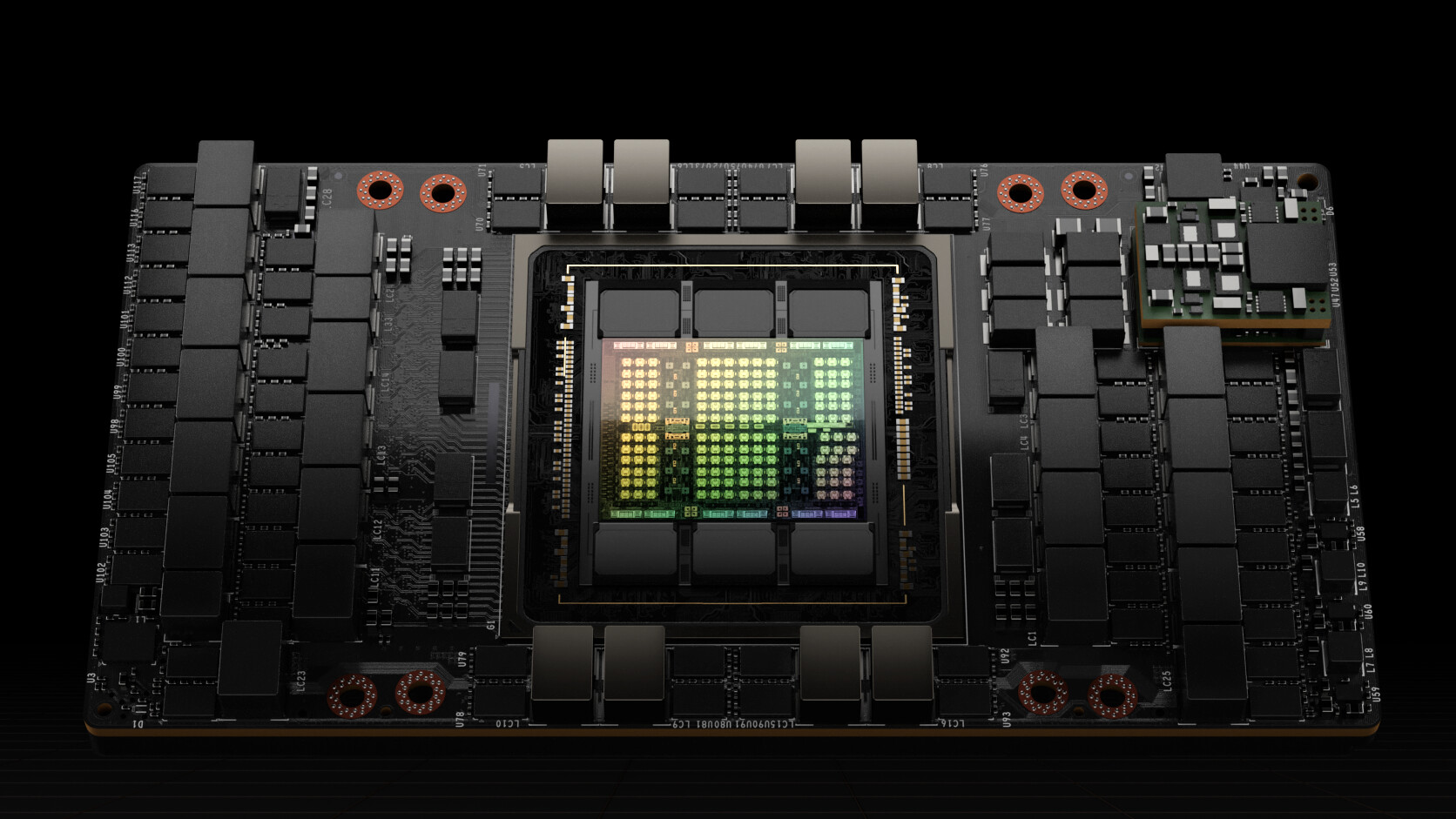
Businesses across every industry are rolling out AI services this year. For Microsoft, Oracle, Perplexity, Snap and hundreds of other leading companies, using the NVIDIA AI inference platform—a full stack comprising world-class silicon, systems and software—is the key to delivering high-throughput and low-latency inference and enabling great user experiences while lowering cost. NVIDIA's advancements in inference software optimization and the NVIDIA Hopper platform are helping industries serve the latest generative AI models, delivering excellent user experiences while optimizing total cost of ownership. The Hopper platform also helps deliver up to 15x more energy efficiency for inference workloads compared to previous generations.

AI inference is notoriously difficult, as it requires many steps to strike the right balance between throughput and user experience. But the underlying goal is simple: generate more tokens at a lower cost. Tokens represent words in a large language model (LLM) system—and with AI inference services typically charging for every million tokens generated, this goal offers the most visible return on AI investments and energy used per task. Full-stack software optimization offers the key to improving AI inference performance and achieving this goal.

Tech Stocks Brace for a DeepSeek Haircut, NVIDIA Down 12% in Pre-market Trading

The DeepSeek open-source large language model from China has been the hottest topic in the AI industry over the weekend. The model promises a leap in performance over OpenAI and Meta, and can be accelerated by far less complex hardware. The AI enthusiast community has been able to get it to run on much less complex accelerators such as the M4 SoCs of Mac minis, and gaming GPUs. The model could cause companies to reassess their AI strategy completely, perhaps pulling them away from big cloud companies, toward local acceleration on cheaper hardware; and cloud companies themselves would want to reconsider their orders of AI GPUs in the short-to-medium term.

All this puts the supply chain of AI acceleration hardware in a bit of a spot. The NVIDIA stock is down 12 percent in pre-market trading as of this writing. Microsoft and Meta Platforms also faced a cut, shedding over 3% each. Alphabet lost 3% and Apple 1.5%. Microsoft, Meta and Apple are slated to post their quarterly earnings this week. Companies within NVIDIA's supply chain, such as ASML and TSMC, also saw drops, with ASML and ASM International losing 10-14% in European pre-trading.

MSI Confirms Tight Supply of GeForce RTX 5090/5080 GPUs at Launch, Situation to Improve in February

MSI has officially confirmed that its upcoming GeForce RTX 50 series graphics cards will face limited availability when they launch on January 30, coinciding with the second day of the Lunar New Year. According to MSI's official account, the constrained supply originates from an insufficient allocation of GPU cores provided by NVIDIA, making it difficult for the manufacturer to meet the expected high demand. Some retailers even claimed they only receive single-digit quantities of these cards, leading to a dramatic price hike in certain regions. In extreme cases, prices have been observed at nearly twice the official MSRP, leaving many potential buyers concerned about availability and affordability. Taiwanese media outlet BenchLife.info previously indicated that "communication issues" between NVIDIA and its board partners contributed to the limited supply. These complications and holiday-related manufacturing and shipping disruptions have constrained how many units can be delivered to stores by launch day.

As a result, enthusiasts aiming to purchase a new GPU at MSRP—or even at slightly higher prices—might face an uphill battle. Despite the rocky start, supply levels will gradually improve in February. The precise rate of this improvement is unclear, but many anticipate that more stock will arrive as production normalizes and communication between NVIDIA and its partners recovers. For now, consumers should prepare for limited stock and potentially inflated prices, especially on day one of the launch. Those hoping to upgrade immediately may need to secure a pre-order or wait until supply becomes more stable in the coming weeks. Scalpers are already reserving "guaranteed" slots for RTX 5090 GPU at up to $7000 per GPU, indicating that supply is tight. However, we must wait for the official launch day to see if the situation improves.

NVIDIA GeForce RTX 5090D Overclocked to a Staggering 3.4 GHz and 34 Gbps Memory

Yes, the title is correct. One of NVIDIA's GeForce RTX 5090D "China" edition GPUs, not the regular RTX 5090, managed to run at 3.4 GHz under liquid nitrogen. With a staggering 575 W default TDP, Tony Yu, ASUS China's general manager, has performed physical modifications that allow the card to run up to 1000 W TDP. The RTX 5090D is a China-exclusive variant with virtually no difference from the regular RTX 5090, just limited general AI capability due to US export regulations. ASUS China used its top-end Astral OC variant for this stunt, which, as we proved in our review of the regular ASUS RTX 5090 Astral OC, has some pretty good chip binning, allowing the card to reach the highest overclock. We pushed the regular RTX 5090 Astral OC GPU on air to 3086 MHz, a +277 MHz over the stock boost setting. However, the RTX 5090D equivalent under LN2 manages to reach 3,390 MHz at peak loads, which is a +581 MHz difference.

For memory, the overclock is equally impressive with 34 Gbps. Regarding performance, the LN2-overclocked RTX 5090D surpassed stock performance by approximately 16%. During benchmark tests, the GPU outperformed multiple previous-generation graphics cards, including a dual RTX 3090 Ti configuration in Port Royal and a quad GTX 1080 Ti setup in Fire Strike. Power consumption figures indicate that 1,760 W was used in total for a rig with ASUS ROG Astral RTX 5090D, which is paired with the Ryzen 7 9800X3D on the ASUS ROG X870E Hero motherboard. This roughly yields a 1,000 W power consumption by the card, which has seen its PCB get physical modifications to output such high power.

New Leak Reveals NVIDIA RTX 5080 Is Slower Than RTX 4090

A set of newly leaked benchmarks has revealed the performance capabilities of NVIDIA's upcoming RTX 5080 GPU. Scheduled to launch alongside the RTX 5090 on January 30, the GPU was spotted on Geekbench under OpenCL and Vulkan benchmark tests—and based on the performance, it might not make it among the best graphics cards. The tested device was an MSI-branded RTX 5080 labeled as model MS-7E62. This setup had AMD's Ryzen 7 9800X3D processor, which many consider one of the best CPUs for gaming. It also included an MSI MPG 850 Edge TI Wi-Fi motherboard and 32 GB of DDR5-6000 memory.

The benchmark results show that the RTX 5080 scored 261,836 points in Vulkan and 256,138 points in OpenCL tests. Compared to the RTX 4080, its previous version, the RTX 5080 has a 22% boost in Vulkan performance and a small 6.7% gain in OpenCL. Reddit user TruthPhoenixV found that on the Blender Open Data platform, the GPU got a median score of 9,063.77. This score is 9.4% higher than the RTX 4080 and 8.2% better than the RTX 4080 Super. Even with these improvements, the RTX 5080 might not outperform the current-gen top-tier RTX 4090. In the past, NVIDIA's 80-class GPUs have beaten the 90-class GPUs from the previous generation, but these early numbers suggest this trend might not continue for the RTX 5080.

Scalpers Already Prepare NVIDIA GeForce RTX 5090 Listings, up to $7000 for "Guaranteed Slots"

A day after the NVIDIA GeForce RTX 5090 launch, scalpers are already in action to profit from the hype train. Many of these sellers on eBay claim to have "guaranteed" early access through connections with retailers, while others ask for astronomical prices that dwarf the rumored official MSRP. Currently, the graphics card is not widely available, yet eBay and similar sites list it at up to $7,000. Some individuals go so far as to promise customers "guaranteed slots" to secure the product, often with no refund or return policy. These tactics exploit consumer fear of missing out, especially after repeated GPU shortages and scalper-driven price hikes in recent years. NVIDIA has reportedly taken steps to manage supply, planning to "nitpick" distribution and limit bulk business-to-business sales, at least in some regions.

While these efforts may reduce scalping, other jurisdictions lack similar protections. Rumors from German outlets point to NVIDIA aiming to curb large-volume B2B purchases, but no equivalent strategy has been confirmed for markets like the United States or Asia. Interestingly, there are reports from Vietnam of select shops selling RTX 5080 cards before the launch date, heightening fears of a black market for the entire RTX 50 lineup. Additionally, some sellers have disclaimers that shift blame for any potential defects to manufacturers, leaving buyers with minimal recourse. E-commerce platforms typically permit dispute resolutions for damaged goods, rendering these disclaimers largely ineffective. Buying from scalpers encourages price hikes, and there are no guarantees of the product arriving/working, and there is no warranty for after-purchase care.

NVIDIA Likely Sending Maxwell, Pascal & Volta Architectures to CUDA Legacy Branch

Team Green's CUDA 12.8 release notes have revealed upcoming changes for three older GPU architectures—the document's "Deprecated and Dropped Features" section outlines forthcoming changes. A brief sentence outlines a less active future for affected families: "architecture support for Maxwell, Pascal, and Volta is considered feature-complete and will be frozen in an upcoming release." Further down, NVIDIA states that a small selection of operating systems have been dropped from support lists, including Microsoft Windows 10 21H2 and Debian 11.

Refocusing on matters of hardware—Michael Larabel, Phoronix's editor-in-chief, has kindly provided a bit of history and context. "Four years ago with the NVIDIA 470 series was the legacy branch for GeForce GTX 600 and 700 Kepler series and now as we embark on the NVIDIA 570 driver series, it looks like it could end up being the legacy branch for Maxwell, Pascal, and Volta generations of GPUs." Larabel and other industry watchdogs reckon that the incoming "Blackwell" generation is taking priority, with Team Green likely freeing up resources and concentrating less on taking care of decade+ old hardware. VideoCardz believes that gaming GPU support will continue—at least for Maxwell (e.g. GeForce GTX 900) and Pascal (GeForce GTX 10 series)—based on a playtesting of the toolkit's latest set of integrated drivers (version 571.96).

COLORFUL iGame GeForce RTX 5080 Ultra W OC Available at Retail in Vietnam

A brave Vietnamese high-end GPU enthusiast uploaded photo evidence of a freshly made purchase—COLORFUL's iGame GeForce RTX 5080 Ultra W OC model—onto the NVIDIA subreddit. Undoubtedly, a retailer in the Southeast Asia region had thrown caution to the wind and let stock prematurely float onto shelves. The plucky customer claimed that the transaction had taken place around a week ago—so well in advance of the official January 30 launch. The original post and several photos have been deleted, but several news outlets have preserved these details. The buyer alleges that they handed over $1400 for this "beautiful" triple-slot custom design—emblazoned with a funky graffiti-inspired lighting system and street art graphics.

The $401 upcharge above baseline MSRP ($999 in the U.S.) indicates that COLORFUL has outfitted this particular model with a beefy cooling solution and other premium features (e.g. stainless steel I/O plate with an attached one-click overclocking button). This custom GeForce RTX 5080 "Blackwell" GPU-based model was added to a working PC build—one photo shows off a B650 motherboard—but the lucky owner will have to deal with a lack of publicly released drivers. Fortunately, they have skipped ahead a step—less fortunate day one customers (across the globe) are seemingly faced with an incoming storm at retail.

RTX 5090 FE Liquid Metal Swap: Thermal Paste Performs Just Fine

Did you catch our launch review of the NVIDIA GeForce RTX 5090 Founders Edition graphics card? If you did, you'd have noticed the hoops we had to jump through to disassemble the card without breaking anything. As we carefully peeled the card's aesthetic finery and worked out way down to the GPU, we found that NVIDIA is using a liquid-metal thermal interface material (TIM) between the "GB202" GPU and the unified vapor chamber plate of the Double Flow Through cooling solution. After our photography the problem arose of putting the card back together, and we wondered if using a mainstream thermal paste would be a suitable replacement since we didn't have the patience to toy with liquid metal given our review volume. So we pulled out our trusty tube of Arctic MX6, gave it a suitable application, skipped the gasket, and put the card back together.

Here's what we found—the GPU temperatures rise by about 2°C on average over the stock liquid metal TIM. In the graph below, you will see both TIM applications compete with each other over a 370-second stress from a benchmark run. In the chart the start temperatures are slightly different, this does not mean that idle temperatures are higher with liquid metal. At the end of test the maximum temperature reached with the stock liquid metal TIM is around 77.6°C. The Arctic MX6, on the other hand settles to 79.4°C. This +1.8°C temperature increase really isn't significant at all—room temperature changes between summer and winter will cause bigger swings. We also tested performance, and it was spot on, the same as pre-disassembly—not a hint of thermal throttling. Both values are safely below the 90°C thermal threshold for the RTX 5090—that's right, NVIDIA raised the thermal throttle point, it's not 83°C anymore like on the RTX 40-series Ada. Taking the RTX 5090 apart and putting it back together was a challenging experience, but we're glad we didn't have to do a liquid metal application to ensure trouble-free operation. This is good news for all DIYers—don't bother with replacing the liquid metal—a thin thermal paste application works fine, too.

GeForce RTX 5090 Power Excursions Tested: Can Spike to 901W Under 1ms

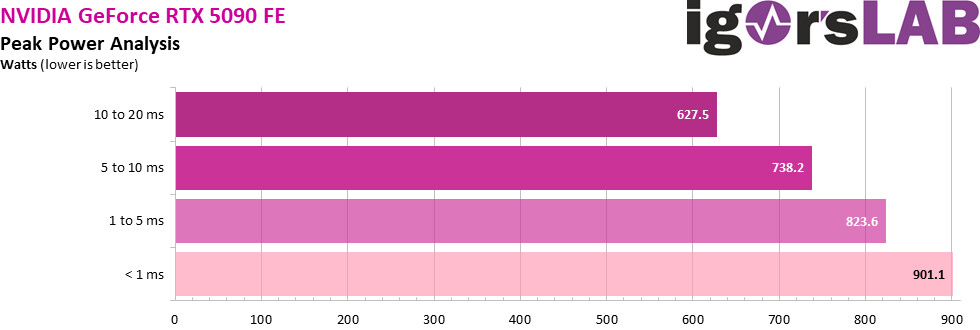
Igor's Lab conducted an in-depth analysis of the power management system of the new NVIDIA GeForce RTX 5090 graphics card, including the way the card draws peak power within the tolerances of the ATX 3.1 specification. This analysis should prove particularly useful for those still on older ATX v2.51 PSUs, and plan to use the included power adapter that converts four 8-pin PCIe power connectors to a 12V2x6. Igor's peak power analysis shows that the RTX 5090 is capable of excursions as high as 627.5 W for 10 ms to 20 ms durations; as high as 738.2 W in 5 ms to 10 ms durations, as high as 823.6 W in the 1 ms to 5 ms category, and as high as 901.1 W in spikes under 1 ms in duration.

An excursion is a brief increase in power draw beyond the continuous power delivery limit of the connector (600 W in case of the RTX 5090's single 12V2x6 input and adapter that converts four 150 W 8-pin PCIe inputs). There is nothing particularly alarming about these numbers, and the excursions part of Igor's analysis fall within the specification of the ATX 3.1 standard, which calls for excursions of up to 200% (1200 W) up to 1 ms. Any PSU meeting the ATX 3.1 specs that even has a continuous power output of less than 1200 W will be capable of handling these spikes. It's only with the much older generations of PSUs, such as ATX v2.51 (mid-2010s) that excursions can trigger OCP. Find other great insights in the Igor's Lab review linked below.

DOOM: The Dark Ages Requires RT. Release Date, PC System Requirements, and New Gameplay Trailer Revealed

The time draws near to Reign in Hell when DOOM: The Dark Ages releases May 15, 2025, on Game Pass, Xbox Series X|S, PlayStation 5 and PC. Preorder your copy today! For PC players, check that your setup is battle-ready by consulting our PC Requirements below, including listings for Minimum, Recommended and even Ultra 4K settings.

A NEW GENERATION OF IDTECH
id Software's most ambitious title yet, DOOM: The Dark Ages pushes new standards in visual fidelity and performance with the power of idTech8. Taking full advantage of modern hardware on all platforms, idTech8 ushers in a new era of gameplay performance and visual fidelity featuring all-new dynamic interactive ray-traced lighting and shadows, higher-fidelity image quality, increased gore and destruction and so much more. With the largest environments ever in a DOOM game, DOOM: The Dark Ages delivers an epic experience full of worlds to explore, hordes of demons to destroy and an action story worthy of the Slayer's legend. Whether soaring through the air with his dragon or smashing giant Titan-sized demons using his Atlan mech, the Slayer is taking on his biggest battles yet - all beautifully rendered and running at a buttery-smooth 60 frames per second on all platforms.

Cyberpunk 2077 Gets DLSS 4 Support With Patch 2.21. All RTX Users Can Try the New Transformers DLSS Model

CD Projekt RED has released the latest Patch 2.21 for Cyberpunk 2077, which is available for PC, PlayStation 5, and Xbox Series X/S. The new patch brings various fixes on all platforms, but also adds support for DLSS 4 with Multi Frame Generation for the NVIDIA GeForce RTX 50 Series graphics cards.

According to details provided in the release notes, the feature "boosts FPS by using AI to generate up to three times per traditionally rendered frame." It also introduces faster single Frame Generation which should bring reduced memory usage on RTX 50 and RTX 40 Series graphics cards. The patch also adds an option to choose between the CNN model or the new Transformer model for DLSS Ray Reconstruction, DLSS Super Resolution, and DLAA on all NVIDIA GeForce RTX graphics cards. According to CD Projekt RED, the new Transformer model should enhance stability, lighting, and detail in motion.

NVIDIA GeForce Now Expands Mod Support for Baldur's Gate 3

GeForce NOW is expanding mod support for hit game Baldur's Gate 3 in collaboration with Larian Studios and mod.io for Ultimate and Performance members. This expanded mod support arrives alongside seven new games joining the cloud this week.

Level Up Gaming
Time to roll for initiative—adventurers in the Forgotten Realms can now enjoy a range of curated mods uploaded to mod.io for Baldur's Gate 3. Ultimate and Performance members can enhance their Baldur's Gate 3 journeys across realms and devices with a wide array of customization options. Stay tuned to GFN Thursday for more information on expanding mod support for more of the game's PC mods at a later time.
Return to Keyword Browsing
Nov 27th, 2026 19:01 CST change timezone

New Forum Posts

Popular Reviews

TPU on YouTube

Controversial News Posts