News Posts matching #RX 9000

Return to Keyword Browsing

Windows 7 Gets Unofficial DirectX 12 Support for Modern GPUs

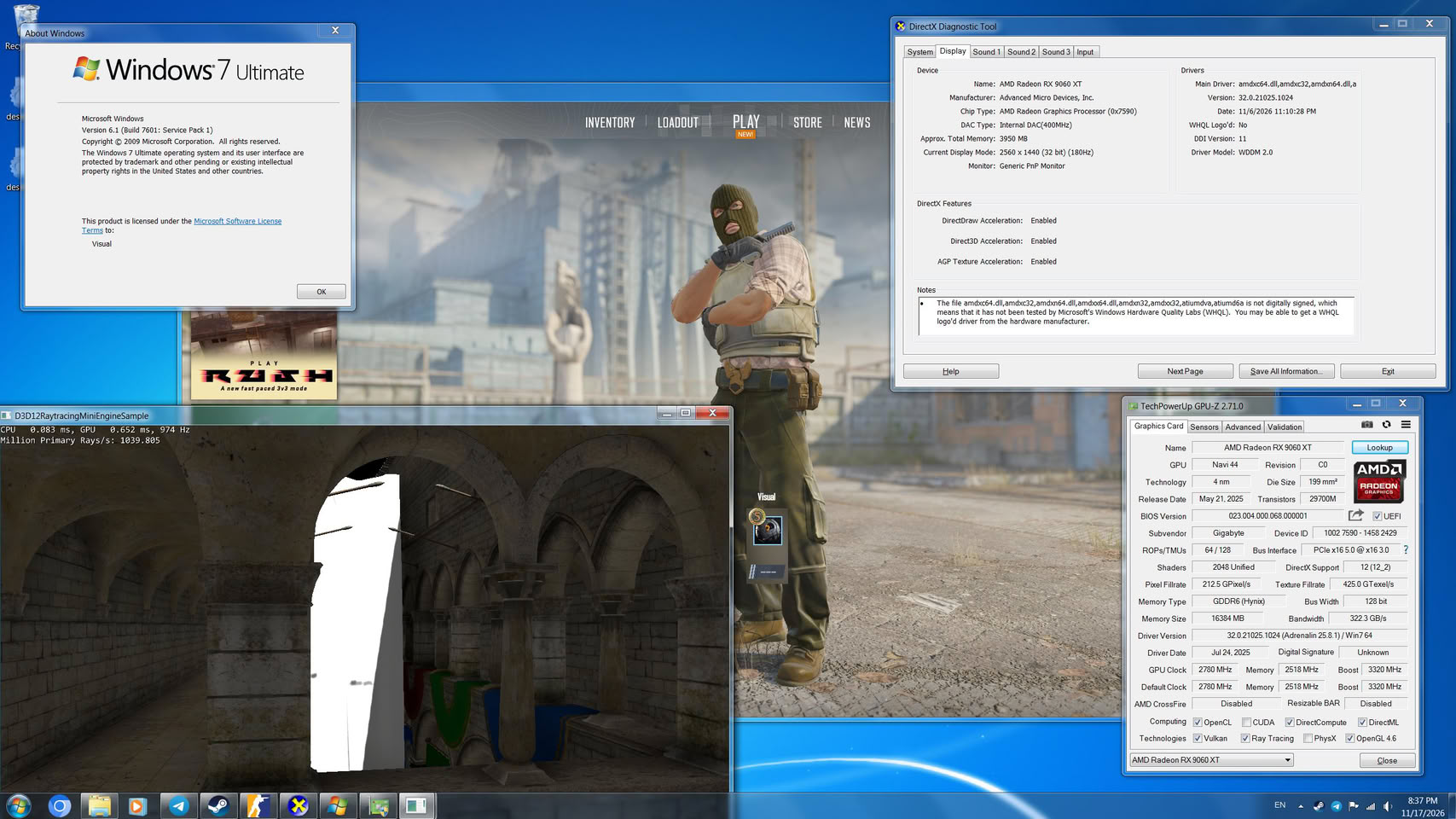
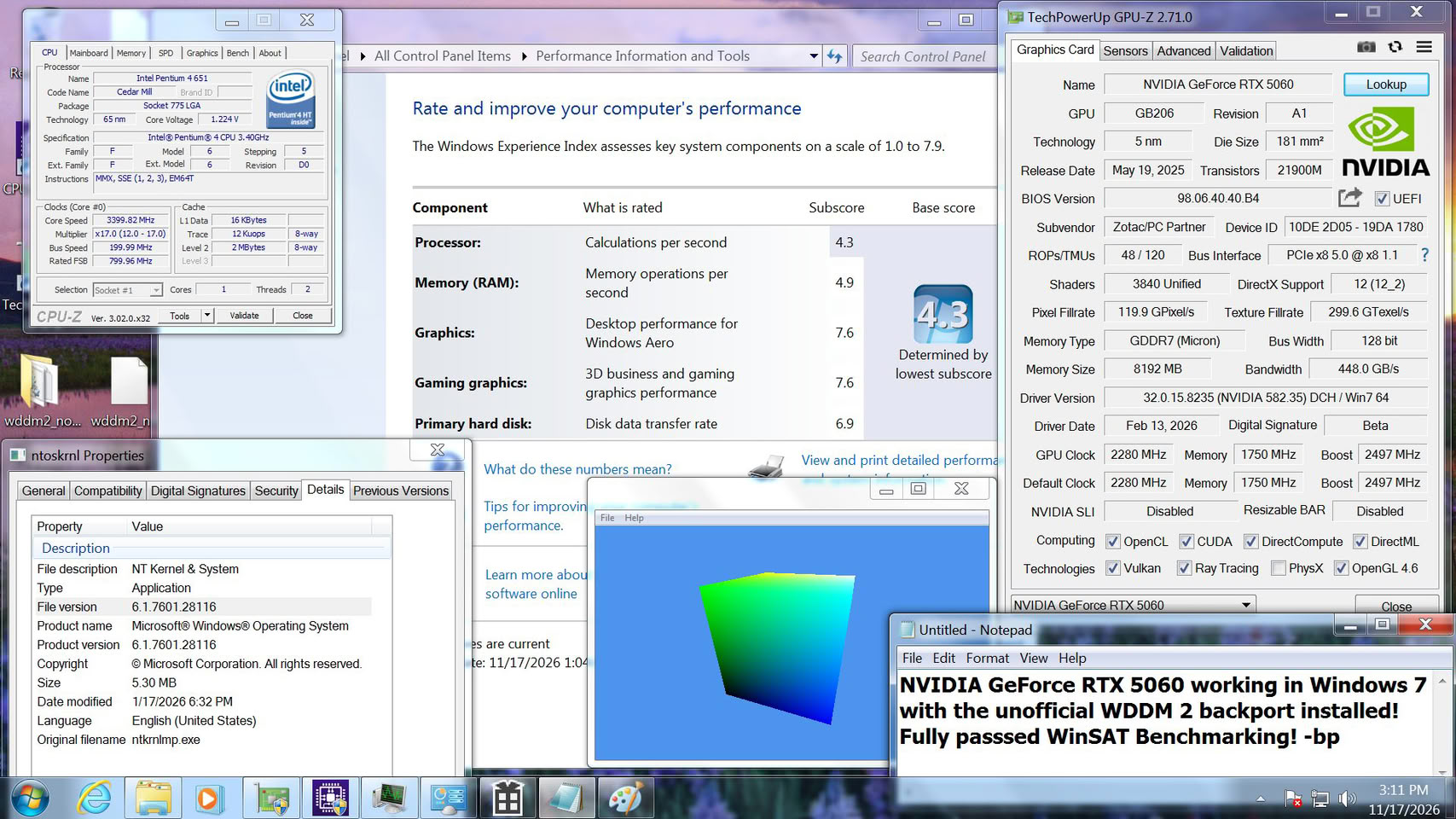
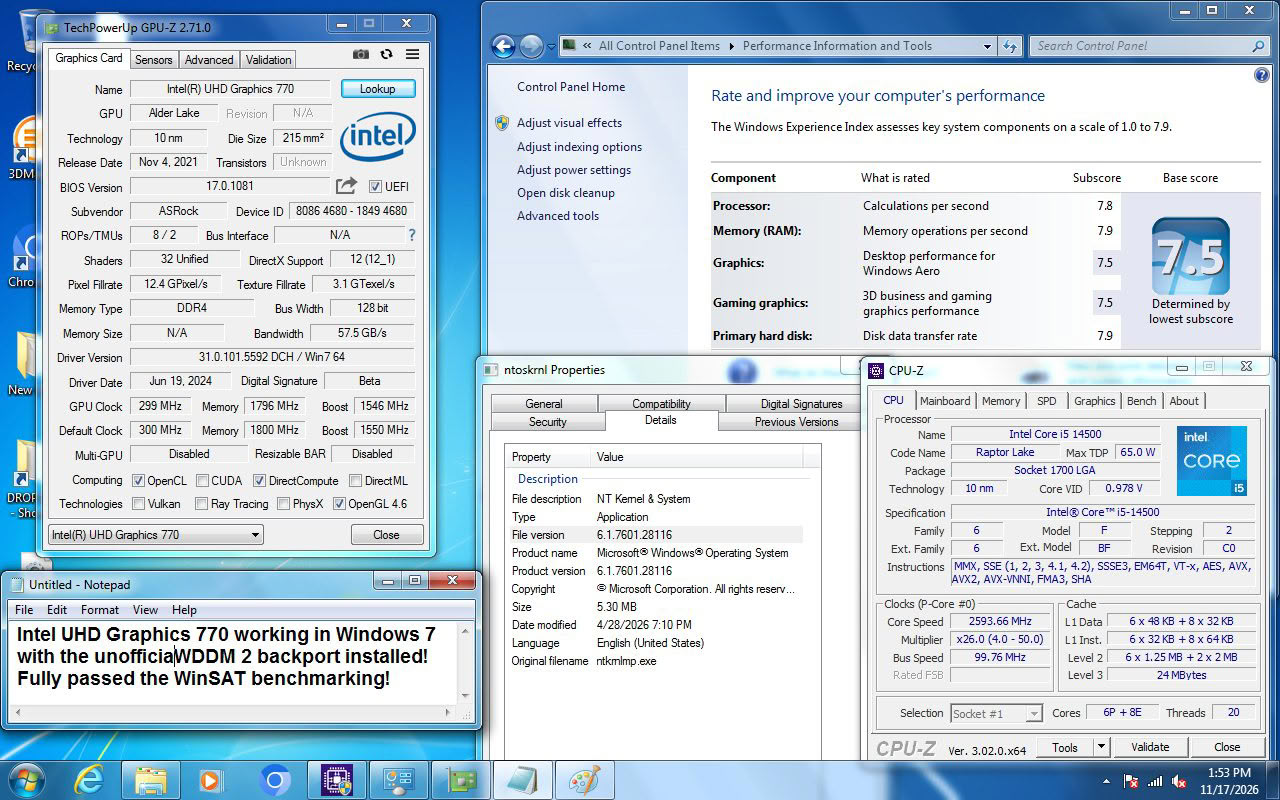
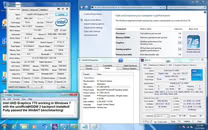
Windows 7 was a beloved operating system for many, and if you're still running a machine with that OS, this release might be for you. Three Windows 7 enthusiasts have managed to get current-generation GPUs and DirectX 12 running on Microsoft's 17-year-old OS. Bob Pony shared the project on X, called WDDM2Win7, an unofficial backport of the Windows Display Driver Model (WDDM) 2. The screenshots show Intel UHD Graphics 770, an NVIDIA GeForce RTX 5060, and an AMD Radeon RX 9060 XT, all detected in TechPowerUp's GPU-Z and running in Windows 7. According to the developer, GeForce RTX 40-series and 50-series cards, as well as Radeon RX 7000 and RX 9000 series cards, work. Intel UHD and Xe graphics are also supported, and DirectX 12 works as well.

Windows 7 originally shipped with WDDM 1.1, while WDDM 2.0 arrived alongside Windows 10 in 2015, bringing DirectX 12 along with it. Microsoft then brought DirectX 12 to Windows 7 in 2019, though only as a user-mode runtime. Individual games like World of Warcraft had to ship it themselves, which limited compatibility. The developers behind this project also backported the Steam client beta to Windows 7 last December after Valve dropped support for the OS in early 2024. As for WDDM2Win7, there is still plenty of testing to be done, but so far there are screenshots showing various GPUs being detected and some DX12 games working. Windows 7 stopped getting free security updates in January 2020, so if you have to try this, make sure it is on a secondary or offline machine.
AMD Software Adrenalin 26.11.2 WHQL Drivers Released

AMD has released the latest Adrenalin 26.11.2 WHQL graphics drivers. This release fixes the excessive system drive write bug for Radeon RX 5000 and RX 6000 owners on Windows 10. The earlier 26.11.1 optional release only listed Radeon RX 7000 and newer cards for that fix, but now AMD is bringing that patch to older generations as well. The update also adds ROCm 10.2 support, along with game support for Phantom Blade Zero and the Crimson Desert: Charting the Unknown DLC. AMD has also sorted out the issue of Smart Access Memory switching itself off after a driver install. Other fixes include a memory leak on RX 5000 and newer cards, and crashes or driver timeouts while streaming with OBS Studio on RX 9000 series cards.

There are some known issues as well. Crimson Desert may fail to launch on RX 6000 series cards, and AMD suggests staying on 26.11.1 if that happens. Users may also experience some crashes in Assassin's Creed Black Flag Resynced on Radeon RX 7000 cards. You can grab the new driver from the link, and the full changelog is listed below as well.

DOWNLOAD: AMD Software Adrenalin 26.11.2 WHQL

AMD Patches Radeon SSD Write Bug in Adrenalin 26.11.1 Optional Driver

AMD's Adrenalin 26.11.1 optional driver is now available with the promised fix for the Radeon bug that kept system drives writing in the background. According to the release notes, the update addresses excessive writes to the system drive while the PC is idle on Radeon RX 7000 series cards and newer. It also fixes a related case where excessive writes could show up while moving or resizing application windows.

AMD confirmed the problem earlier this week, tracing it to the External Events Client Module (atieclxx.exe) in the 26.10.1 and 26.10.2 drivers. User reports put the write rate anywhere from 0.3 MB/s to 5 MB/s, which works out to roughly 26 GB to 432 GB a day on a machine that's doing nothing. Until now, affected users had to disable the External Events Utility, turn off Resizable BAR, or use a community-made open-source tool that blocks the writes. The release notes only mention RX 7000 and newer for the idle fix, so it isn't clear whether older Radeon cards were affected at all.

DOWNLOAD: AMD Software Adrenalin 26.11.1 Optional

AMD Reportedly Plans Another Radeon GPU and GDDR6 Kit Price Hike for November

AMD is reportedly getting ready to raise prices on its Radeon GPU and GDDR6 memory kits again in November. According to a new post from Board Channels, the increase would follow an earlier adjustment in October, when AMD apparently started charging its board partners more for GDDR6 from October 1. The exact scope of the November hike isn't known yet. The main reason seems to be memory, since GDDR6 prices reportedly went up by around 8 to 10% in the third quarter. Board Channels also claims AMD now reviews its kit pricing every quarter to keep up with rising GPU and memory costs. AMD sells its GPUs to add-in board partners bundled with memory, so any increase there usually ends up in the price of the finished card.

This would add to a long list of reported increases this year. A 10% hike on Radeon GPU kits was reported for July, another 10% increase across GPUs, chipsets, and possibly CPUs followed in September, and AMD's suggested Radeon prices in China went up in early October. Retail prices are already moving, too. According to Hardware Unboxed's latest pricing survey, cited by Videocardz, the RX 9060 XT 16 GB costs 17% more than it did in September, while the RX 9070 and RX 9070 XT are up 12%. Of course, AMD hasn't officially confirmed any of this. How much the November change affects store prices will depend on board partner pricing and existing inventory, so buyers who were already planning on a Radeon RX 9000 card might want to buy sooner rather than later.

Microsoft Unifies GPU Crash Diagnostics with DirectX Dump Files

Microsoft is bringing some of its Xbox console technology to Windows PCs with the introduction of DirectX Dump Files. When a GPU crashes on your PC, you can investigate what happened in the same way Xbox developers do with their GPU crashes, gaining insight into the underlying issues. With the latest Agility SDK 1.620 and PIX 2610.28, DirectX Dump Files provide data from Windows, Direct3D, and GPU drivers to help investigate a crash, understand its cause, and improve the graphics rendering pipeline to prevent future crashes. Joining Microsoft in this effort are AMD, Intel, NVIDIA, and Qualcomm.

The process begins with a GPU crash. Once the GPU stops its graphics processing, DirectX creates a new dump file containing traces of what occurred before Windows resets the GPU. This includes the last Direct3D runtime state, hardware and driver data, and up to 2 MB of data from the game developer that might be traced. These files can be saved on developers' machines, but on players' PCs in production, they aren't saved by default. However, game developers can set up a crash pipeline to send crash data back to them for analysis. Once the data is available, Microsoft's PIX tool, used for performance-tuning and debugging DirectX 12 games, helps analyze the situation. PIX decodes data, analyzes dump files, identifies hang points, and traces shaders and resources that caused the crash. This allows developers to quickly isolate and fix the problem.

AMD RDNA 5 Likely Scheduled for Second Half of 2027

AMD's next-generation gaming graphics cards featuring the RDNA 5 GPU architecture are unlikely to debut before the second half of 2027, according to well-known hardware leaker Kepler_L2. The leaker suggests that AMD is unlikely to release any RDNA 5 desktop graphics cards before Computex 2027, indicating that these GPUs will probably arrive in the latter half of that year. AMD is expected to lead with the silicon codenamed "AT2," which is part of a family of discrete RDNA 5 GPUs. This will be followed by "AT0," "AT3," and "AT4," which are expected to launch a few quarters later in 2028. Since "AT2" likely refers to a mid-range design, AMD might begin its rollout with a mid-range GPU first, followed by flagship and lower-end models in 2028.

Previously, we learned that AMD's RDNA 5 GPUs will incorporate GDDR7 memory with unknown capacities, as GDDR7 is now listed among the supported VRAM types in the AMDGPU driver. Currently, AMD's graphics cards use GDDR6 for the consumer RDNA 4-based Radeon RX 9000 series, while Instinct MI data center and workstation GPUs use HBM3E and HBM4 memory. Since AMD is developing data center GPUs with HBM and consumer cards are the only models using GDDR, the GDDR7 placeholder suggests future support for RDNA 5.

Modder Squeezes 74% More Performance Out of DLSS 5 on AMD Radeon in One Day

Modders working on bringing NVIDIA's DLSS 5 Neural Rendering to AMD Radeon GPUs just had their busiest day yet. The developer behind the DLSS-NR-on-AMD tool shipped two new versions within 24 hours, Alpha 0.3.3 and Alpha 0.4.0, together adding roughly 74% performance on Radeon hardware, according to the project's own GitHub release notes. YouTuber Ancient Gameplays tested the update in Cyberpunk 2077 at 3440x1440, and saw framerates climb from around 30 FPS on earlier builds to roughly 50 FPS on Alpha 0.4.0. That's a big jump for a workaround that started out barely playable. The original mod release had poor performance, but it looks like that's being addressed.

The tool works by feeding NVIDIA's own DLSS 5 DLL into Radeon RX 9000 GPUs, and reportedly RX 7000 cards too, intercepting the calls the DLL expects and routing the neural computation onto AMD hardware, since RDNA 4 supports the FP8 math DLSS 5 relies on. Alpha 0.3.3 also added a graphical installer with a built-in settings editor and overlay controls, so getting Neural Rendering running on Radeon apparently no longer means digging through file paths manually. Moreover, just today, the Alpha 0.4.1 update brought another 8% jump in overall performance, and a 9% performance increase under heavy gameplay loads.

Modders Get DLSS 5 Working on AMD Graphics Cards, Though Performance is Rough

A modder has ported DLSS 5 Neural Rendering onto an AMD GPU for the first time, less than a week after the tech started spreading to older NVIDIA cards. Developer danielblnc released a tool called DLSS-NR for AMD, which allows AMD's RDNA 4 GPUs to run NVIDIA's neural rendering model in supported games. The setup works by dropping a small installer and NVIDIA's own nvngx_dlssnr.dll file into a game's bin folder, then toggling neural rendering through an FSR 3 or FSR 4 profile. It has been tested on Cyberpunk 2077 and GTA V: Enhanced so far, with older AMD GPUs reportedly not supported. Anti-cheat games will block the DLL entirely, so this is single-player territory only for now.

According to tests by YouTuber Ancient Gameplays, performance is still the bottleneck. Early builds tanked Cyberpunk 2077 from over 80 FPS down to around 11-12 FPS at 1080p on the Radeon RX 9070 XT. The modder's latest Alpha v0.2.7 update has clawed back roughly 12%, pushing it to about 30 FPS, still a steep cost for a card that handles native rendering well. The reason this works at all is quite straightforward. DLSS 5 runs on FP8 math, and AMD's RDNA 4 architecture, which powers the RX 9000 series, has native FP8 support, just like NVIDIA's RTX 50-series and 40-series cards.

AMD Software Adrenalin 26.7.1 WHQL Drivers Released

AMD has released its first Adrenalin Edition July driver, named 26.7.1 WHQL, which brings support for the newly announced AMD Radeon RX 9050 4 GB and 8 GB SKUs. These GPUs are entry-level RDNA 4 models featuring 1,024 Streaming Processors and either 4 GB or 8 GB of GDDR6 memory, depending on the configuration. Although the release wasn't widely advertised, this driver update confirms that availability is coming soon. Additionally, the WHQL driver includes support for new games, such as Gears of War: E-Day Open Beta Early Access and Out of Control Evolution. Fixed issues primarily address problems with RDNA 3 and RDNA 4 when running Blender and Maxon Cinema 4D. For a complete list of fixed and known issues, please see below. We are working on uploading this driver version to the official download area.

DOWNLOAD: AMD Software Adrenalin 26.7.1 WHQL

AMD FSR Multi-Frame Generation With Up to 8x Mode in Development

AMD has reportedly been testing a new and highly anticipated FSR multi-frame generation (MFG) technology for its Radeon RX GPUs. This information comes from a third-party software called RadeonTuner, which allows access to Radeon driver settings without using the AMD Software: Adrenalin Edition application. RadeonTuner has revealed that AMD is already incorporating preliminary support for multi-frame generation into its Radeon drivers, though the feature remains hidden until the software is finalized. According to the tool's developer, AMD often places placeholders for features like this well in advance of their release, indicating that the company is extensively testing the multi-frame generation feature with options for 1x to 8x variants, which are expected to be available once the feature is fully developed.

One user attempted to enable the multi-frame generation feature using the latest driver installation and a Radeon RX 9060 XT graphics card to see if it could work with any game. However, the user discovered that the feature is currently non-functional, as AMD has not yet released the necessary model to support multi-frame generation at any setting. This suggests that only the placeholder for the feature has been included, with no underlying driver support to make it operational. Even when testing games that frequently receive FSR updates, such as Forza Horizon 6, Pragmata, Resident Evil 9, Crimson Desert, and Death Stranding 2, the feature could not be activated. It seems we are still months away from the final release of multi-frame generation support.

AMD Adrenalin Edition 26.6.2 WHQL Drivers Face Issues on Windows 10, Hotfix Available

On Monday, AMD released its Adrenalin Edition 26.6.2 WHQL Drivers to provide day-one game support for Assassin's Creed Black Flag Resynced and DOOM: The Dark Ages | Revelations across all RDNA generations. An interesting feature of this driver is the introduction of FSR Upscaling 4.1 for the RDNA 3 GPU generation. However, users have reported several issues when running this driver on Microsoft's Windows 10 operating system. For users of Windows 10 under the ESU program, or those simply running the operating system that has reached end of life, Radeon RX 7000 series and Radeon RX 9000 series GPUs have not been working properly. This means that the drivers for these GPUs weren't installing at all on Windows 10, which is problematic for enthusiasts still using the older operating system.

In response, AMD has released a hotfix to address this issue. The Adrenalin Edition 26.6.3 Hotfix includes a fix for the "intermittent install issue seen when installing AMD Software: Adrenalin Edition 26.6.2 on Windows 10 systems for Radeon RX 7000 series and above graphics products." For those running Windows 10 and experiencing issues, the Adrenalin Edition 26.6.3 Hotfix can be downloaded directly from AMD's website.

AMD Releases Adrenalin Edition 26.6.2 WHQL Drivers

AMD has released its latest Adrenalin Edition 26.6.2 WHQL Drivers today, bringing FSR Upscaling 4.1 to the RDNA 3 GPU family, commonly known as the Radeon RX 7000 series. This driver release is the second in June, specifically tailored for RDNA 3 gamers, with general improvements for everyone else as well. Starting with new game support, the Adrenalin Edition 26.6.2 WHQL drivers introduce support for Assassin's Creed Black Flag Resynced and DOOM: The Dark Ages | Revelations across all RDNA generations. This means Radeon GPUs will now power these titles without any issues. Interestingly, there have been a few fixes for issues such as playing RoadCraft on Radeon RX 7000 series, as well as screen corruption when using third-party VR headsets on the Radeon RX 6000 series of GPUs. Some known issues, like Battlefield 6 crashing on Ryzen AI 9 HX 370 APU, remain, and AMD is working on a fix that will likely be included in the next driver release.

DOWNLOAD: AMD Software Adrenalin 26.6.2 WHQL.
For a full list of details, check the release notes below.

007 First Light Ships with Baked-in FSR 3.1, Lacks FSR 4 Support, DLL Mods Don't Work

007 First Light launched yesterday, but gamers on AMD Radeon RX 9000 series RDNA 4 GPUs noticed that the game doesn't support FSR 4.1 upscaling. This is a fairly demanding game on modern GPUs as our testing has shown, and it helps to have the latest upscaling technology for gamers on mid-range hardware to enjoy the game at 1440p or 4K Ultra HD resolutions. While the game supports the latest DLSS 4.5 for gamers on NVIDIA GeForce RTX 30-series or later; it is limited to AMD FSR 3.1.5 integrated with the game.

At launch, 007 First Light lacks AMD FSR 4 support, and as ComputerBase.de notes, it is not possible to swap its FSR library files to try and manually give it AMD FSR 4.1 support on Radeon RX 9000 series GPUs. This is because the game's FSR 3.1.5 implementation is baked directly into the game engine. There is a significant difference in image quality between FSR 3.1 and FSR 4.1, as AMD fundamentally changed the upscaling algorithm with a new one that uses machine learning, something that currently requires an RX 9000 series GPU, but which AMD plans to extend to RX 7000 series and RX 6000 series later this year. In related news, the game also lacks support for Intel XeSS, something that would have helped gamers on Intel Arc GPUs that fit into the mid-performance segments.

AMD FSR Upscaling 4.1 Officially Arrives to Radeon RX 7000/6000 GPUs

AMD has responded to what gamers have been most vocal about: bringing its FSR 4.1 upscaling technology to older RDNA 3 and RDNA 2 GPUs. Today, we learn that this dream is becoming a reality, as AMD is officially introducing its FSR Upscaling 4.1 technology to millions of Radeon RX 7000 Series graphics cards worldwide. Arriving this July, millions of RDNA 3 gamers will enjoy official support for FSR Upscaling 4.1 in over 300 supported games. This means that, just like the latest RDNA 4-based Radeon RX 9000 Series, RDNA 3 gamers will also benefit from the upscaling algorithms based on various machine learning techniques without needing to upgrade to the latest Radeon RX 9000 GPUs if their current GPU performs adequately.

Interestingly, the FSR Upscaling 4.1 will use the same underlying model on RDNA 3 as it does on RDNA 4. However, differences in hardware create some background variations, as RDNA 4 has FP8 processing units and INT8, whereas RDNA 3 only has INT8. AMD explains that the company has developed FSR Upscaling 4.1 with the FP8 format in mind, while the latest ML algorithm has been optimized and ported for the INT8 data format to work with RDNA 3. This difference in hardware support delayed AMD's port of FSR technologies to RDNA GPU IP below version four, but it is now finally making an appearance.

AMD Radeon 9050 Leaks With 8 GB VRAM, More Stream Processors Than 9060

It seems as though AMD's Radeon RX 9000-series GPU family may finally be getting a true entry-level variant. According to a recent report by VideoCardz citing a source inside one of AMD's AIB partners, AMD will soon announce the AMD Radeon RX 9050 with 8 GB of GDDR6 VRAM and a down-clocked version of AMD's Navi 44 GPU also used in the RX 9060. AMD has not yet revealed any details about the potential upcoming GPU, but there is a spec sheet divulging some of the details of the GPU, including a higher core count than the RX 9060. The card is expected to require a minimum 450 W PSU, suggesting reasonably low power draw, although likely not low enough to power off the PCIe slot alone.

The aforementioned spec sheet lists a Game clock of 1920 MHz and a Boost clock of up to 2600 MHz for the RX 9050, although, notably, the actual stream processor count is up from 1792 on the RX 9060 to 2048 on the 9050. It's entirely possible that we will see the GPU modding community come up with some way to hack a higher clock speed onto the 9050 via something like a 9060 XT vBIOS or some similar trick, but until then it's entirely likely that performance will be lower than the 9060, because the clock speeds are slower on the 9050—13% lower Boost clocks and 20% slower Game clocks. The reports also note that the specifications are preliminary, so it may be the case that some of the stream processors will be disabled to put the 9050 below the 9060. This non-finalized spec means we are also unlikely to see the Radeon RX 9050 launch anytime soon. The spec sheet also lists a PCIe 5 ×16 bus width and an HDMI 2.1b and dual DisplayPort 2.1a ports.

AMD Releases Adrenalin Edition 26.5.1 WHQL Drivers

AMD has released Adrenalin Edition 26.5.1 WHQL, adding game support for PRAGMATA, Honor of Kings: World, INDUSTRIA 2, Tides of Tomorrow, and MONGIL: STAR DIVE. On the bug fix side, two issues are resolved: intermittent stuttering while playing Resident Evil Requiem on the "Raccoon City" map on Radeon RX 9000 series, and corruption while playing God of War on Radeon RX 9000 series.

A few known issues remain. Battlefield 6 continues to see intermittent crashes on Ryzen AI 9 HX 370 systems, texture flickering when AMD Record and Stream is active, and FSR Upscaling and Frame Generation showing as inactive on RX 9000 cards. RoadCraft is also experiencing crashes on RX 9000 series, and a new known issue notes corruption in Satisfactory on RX 9000 series products.

DOWNLOAD: AMD Software Adrenalin 26.5.1 WHQL

Microsoft's Shader Model 6.10 Opens Direct Access to GPU AI Engines

Microsoft has released the Shader Model 6.10 preview, included in the new AgilitySDK 1.720-preview build. This preview introduces a compelling feature related to GPU-dedicated AI engine control. According to the developer blog, Shader Model 6.10 features a new, streamlined algebra matrix API that reveals all known matrix operations for popular gaming GPUs from AMD, Intel, and NVIDIA. This means that modern GPUs have dedicated hardware for processing AI workloads, typically involving matrix multiplication and accumulation. Modern machine learning-based upscaling relies on this hardware, whether it's Tensor cores from NVIDIA, XMX cores from Intel, or AI accelerators in AMD GPUs, each with its own communication method. To unify access, Microsoft is introducing a new API from the class linalg::Matrix, which will expose all matrix operations to the shader language. This allows neural rendering operations to be executed across multiple GPUs with a single programming effort.

As the developer behind the DirectX 12 API, Microsoft is observing a significant increase in graphics features utilizing neural network-based rendering techniques to enhance user graphics. This will require more matrix units in modern gaming GPUs. To provide a unified layer of abstraction for programming and executing neural rendering operations, Microsoft hopes that Shader Model 6.10 will become the standard for every GPU maker. Interestingly, this feature is supported across all NVIDIA RTX hardware, as it includes Tensor cores. Intel support is planned for an upcoming release, with B-series GPUs expected to be compatible. Only AMD's RDNA 4-based Radeon RX 9000 series GPUs support this feature, with no support planned for older models like the RX 7000 series and below.

AMD Releases FSR SDK v2.2 with FSR 4.1 and Ray Regeneration 1.1

AMD has released its official FSR Software Development Kit version 2.2, which includes the latest set of FSR technologies. This release features FSR Upscaling 4.1 and Ray Regeneration 1.1, showcased late last week as part of the Adrenalin Edition 26.3.1 WHQL driver. The updated FSR "Redstone" SDK v2.2 introduces a much improved FSR 4.1 upscaling technology for the RDNA 4 family of graphics cards. The transition from FSR 4.0 to FSR 4.1 demonstrates that the latest version provides much finer details of game scenery, especially when objects are in motion. In the Crimson Desert game demo, grass moved by the wind appears much more detailed with FSR 4.1 compared to FSR 4.0, which previously applied a somewhat blurry effect to the grass. This improvement brings the visuals closer to native rendering.

Additionally, AMD has included Ray Regeneration 1.1 in the FSR SDK 2.2. AMD's FSR Ray Regeneration processes the noisy output that ray tracing naturally produces and cleans it up in real time, resulting in noticeably sharper and more polished visuals without requiring developers to overhaul their existing pipelines. With the update to version 1.1, it delivers much better and deeper shadows, immersive lighting, and more. You can check out the images below for comparison. The latest SDK also includes AMD FSR Frame Generation 4.0.0 in its vanilla version, as well as AMD FSR Radiance Caching 0.9.0, which is now in technical preview.

AMD Releases Adrenalin Edition 26.3.1 WHQL Drivers

AMD has released Adrenalin Edition 26.3.1 WHQL, adding game support for Crimson Desert and Death Stranding 2: On the Beach, along with FSR Upscaling 4.1 support for Radeon RX 9000 series cards. On the bug fix side, four issues are resolved: a Cyberpunk 2077 crash when loading a saved game with Path Tracing enabled, intermittent loss of mouse and keyboard input in-game and on the desktop when interacting with AMD Software, system crashes when repeatedly changing in-game settings or alt-tabbing on RX 7000 and above, and a failure to enable AMD Noise Suppression on RX 6000 and above.

A few known issues remain. Battlefield 6 still experiences intermittent crashes on Ryzen AI 9 HX 370 systems, texture flickering when AMD Record and Stream is active, and FSR Upscaling and Frame Generation showing as inactive on RX 9000 cards. Death Stranding 2 has intermittent crashes on RX 5000 series, and RoadCraft is also seeing crashes on RX 9000 products. AMD says it is working with developers on the Battlefield 6 issues.

DOWNLOAD: AMD Software Adrenalin 26.3.1 WHQL

ASUS Raises GeForce RTX 50 Series "Blackwell" Pricing in China, Radeon Pricing Unchanged

ASUS has reportedly updated its product pricing in the Chinese market to reflect the memory component shortage across the semiconductor industry. According to Board Channels, ASUS is adjusting the pricing for the GeForce RTX 50 Series "Blackwell" GPUs with GDDR7 memory, while the pricing strategy for AMD Radeon RX 9000/7000 and other series remains unchanged. At the very top, ASUS is increasing the price of its RTX 5090 D v2 SKUs by about 500 yuan, which is approximately $72 at the time of writing. Other SKUs like the GeForce RTX 5080, RTX 5070 Ti, regular RTX 5070, and RTX 5060 Ti with 16 GB of VRAM are experiencing an increase of anywhere from $14.50 to $45. Interestingly, some older and low-end SKUs like the popular GT 1030 and GT 710 series, which provide basic graphics output for many prebuilt PCs, are also seeing a price increase of up to $8. AMD's Radeon series reportedly remains unchanged, which can be explained by these GPUs already having gone through a price increase cycle and GDDR6 memory being in better supply than GDDR7.
You can check out the entire list with proposed price changes below.

Blind Testing Shows Gamers Prefer NVIDIA DLSS 4.5 Over Native Resolution Rendering and AMD FSR 4

ComputerBase conducted a massive online blind test, allowing thousands of gamers to vote on their preferred game video output. The options included NVIDIA's latest Deep Learning Super Sampling 4.5, AMD's FSR Upscaling AI with FSR 4 on Radeon RX 9000 series GPUs, and native resolution rendering without AI upscaling. Interestingly, DLSS 4.5 received the highest percentage of votes, winning in every scenario. ComputerBase tested various games like Anno 117, ARC Raiders, Cyberpunk 2077, Horizon Forbidden West, Satisfactory, and The Last of Us Part II. Only in Cyberpunk 2077 did gamers almost equally prefer native resolution rendering, but DLSS 4.5 still came out on top with a slight edge.

Initially, the ComputerBase team conducted the comparison using videos labeled only with options like 1/2/3/4, without revealing which rendering method was used, to ensure a fully blind test. After two weeks of testing and thousands of votes, the results showed a significant preference for NVIDIA's latest DLSS 4.5 technology. This conclusion highlights that NVIDIA's newest technology is now so refined that its video output offers superior visual appeal. DLSS 4.5 uses a second-generation Transformer model trained on a much larger dataset of video games, with five times the computational investment of the first DLSS 4 Transformer upscaler. It utilizes the FP8 data format, allowing for more processing with minimal precision loss. The new algorithm is more context-aware, and NVIDIA confirmed that the input for upscaling is used more intelligently, resulting in much more detailed and precise video output.

AMD on FSR 4 for RDNA 3 and Older GPUs: "No Updates to Share at This Time."

AMD's FidelityFX Super Resolution 4 technology, now known simply as FSR 4, is currently supported in many games, but not across all AMD RDNA GPU generations. In response to an inquiry from Hardware Unboxed, AMD mentioned that it is still uncertain whether official FSR 4 support will be extended to the Radeon RX 7000 series and older GPUs, as the company reportedly has "no updates to share at this time." AMD official product separation stems from its RDNA 4 architecture and the support for 8-bit floating point instructions. While the latest RDNA 4 hardware supports Wave Matrix Multiply Accumulate in FP8 format, older RDNA generations like RDNA 3 and RDNA 2 lack this hardware instruction support and can't process 8-bit floating point data in this format.

However, older Radeon GPUs can instead rely on the 8-bit integer (INT8) data formats, which Radeon RX 7000 series fully supports. AMD accidentally leaked FSR 4 INT8 on its AMD GPUOpen platform, showing that FSR 4 on older GPUs is a possibility, which is just kept hidden for now. Later on, ComputerBase tested this leaked library, finding that FSR 4 offers a balance between native image quality and FSR 3.1 performance on both RDNA 3 and RDNA 2 hardware. In tests with Cyberpunk 2077 in 4K on Ultra settings using the AMD Radeon RX 7900 XTX, FSR 4 delivered 11% faster performance than native, but was 16% slower than FSR 3.1. Interestingly, performance may be the reason why AMD is holding these INT8 FPR 4 libraries back, but another point could be product separation.

AMD Releases Adrenalin Edition 26.1.1 WHQL Drivers

AMD has released its latest AMD Software Adrenalin Edition 26.1.1 WHQL drivers, introducing support for new Ryzen AI mobile processors alongside several game fixes and known issues. The driver adds optional installation of the AMD AI Bundle, and expands product support to the latest Ryzen AI 300-series processors, including the Ryzen AI 9 HX 475 and Ryzen AI 5 430. New game support is also included for Starsand Island and Avatar: Frontiers of Pandora - From the Ashes Edition.

Several issues have been resolved including incorrect shadow rendering in Call of Duty: Black Ops 7, texture corruption in Enshrouded, launch failures in Diablo IV when using non-English usernames, and visual corruption in Chromium- and Electron-based applications on RX 5000 and RX 6000 series GPUs. AMD has also fixed crashes related to Unreal Engine 5.6 with Lumen HWRT enabled, as well as rendering issues in Microsoft Flight Simulator 2024 and Baldur's Gate 3. Known issues remain. AMD notes intermittent crashes or driver timeouts in Cyberpunk 2077 with Path Tracing enabled, instability in Battlefield 6 on Ryzen AI 9 HX 370 systems, task-switching crashes in Roblox Player on RX 7000 series GPUs, and texture flickering in Battlefield 6 when using Record & Stream. AMD says it is actively working on fixes for these problems.

DOWNLOAD: AMD Software Adrenalin 26.1.1 WHQL
[Editor's note: Our in-depth review of the AMD AI Bundle is now live]

AMD Closely Tracking Memory Ecosystem and Working With AIBs to Maintain Radeon MSRPs

David McAfee, AMD VP and GM of client channel business, has sat down with a number of press outlets in early January. Various interviews were conducted during CES 2026 week, with one roundtable session highlighting his team's exploration of bringing back an unknown selection of "Zen 3" AM4 desktop processors. Volatile computer memory market conditions have prompted countless modern and legacy product "re-strategizations" at tech companies. Gizmodo managed to bring up the topic of "keeping GPU costs low" when they conducted their to and fro with McAfee. As of December, a first wave of price hikes came into effect across Team Red's current-gen Radeon RX 9000 family. Gaming graphics card enthusiasts have anticipated further increases coming into effect in 2026, but AMD leadership seems keen to maintain Radeon prices at reasonable levels in a time of crisis.

When asked about the ongoing situation, McAfee described a solid foundation: "we have very strategic partnerships over many, many years with all the DRAM manufacturers to make sure that both the amount of supply that we need and the economics of what we're able to buy from them are what we can support in our graphics business." Gizmodo noted that the Team Red executive admitted that he cannot foretell all future trends, but current relationships with add-in card (AIC) partners could prove helpful. McAfee described trying to strike an ideal balance: "without the memory at the right price, building graphics cards with our add-in-board (AIB) partners that hit the right price and market, that's tough math to put together...So managing that memory ecosystem very closely is absolutely something that is a core part of what we do."

First AMD Radeon RX 9000 Series GPU Appears in Steam Survey Rankings

Back in December, AMD's current RDNA 4 GPU lineup apparently showed little impact on Steam's Hardware and Software Survey results. However, as we enter 2026, data from December 2025 has been processed, and the first Radeon RX 9000 series GPU has appeared in the survey rankings. At 100+ ranking, the first AMD Radeon RX 9000 series GPU based on the RDNA 4 IP is the Radeon RX 9070 SKU, commanding a 0.22% share of all gamers participating in the survey. This is also the only RDNA 4 GPU present on the list, meaning that all the remaining SKUs are below 0.15% of the total share, hence not shown in this ranking.

For other AMD GPU SKUs, there is a slight change in the overall structure, where the RDNA 3-based Radeon RX 7800 XT is the most popular AMD gamer GPU with a 1.57% share this December. This dethrones the previous RDNA 2-based Radeon RX 6600, which now stands at 1.51% of the overall group. This includes the market share of AMD GPUs on both Windows and Linux-based PCs. Additionally, this is the first time RDNA 4-based GPUs have appeared on the Steam Survey list since the initial launch in March, finally showcasing the share of the latest AMD graphics.
Return to Keyword Browsing
Nov 19th, 2026 17:28 CST change timezone

New Forum Posts

Popular Reviews

TPU on YouTube

Controversial News Posts