Monday, September 22nd 2025

FSR 4 on Older Radeon GPUs Tested: Improves Image Quality With Minor Performance Hit
After AMD recently leaked its own FSR 4 libraries on its GPUOpen GitHub repo, replete with libraries that support older hardware, it was only a matter of time before enterprising modders started demonstrating how those libraries could be used to port FSR to older RDNA GPUs. An enterprising Reddit user and modder recently posted a how-to guide explaining how to get FSR 4 implemented in games on RDNA 2 GPUs, and the results reveal improved image quality at the cost of performance. There are other caveats, as well, like having to use a very outdated driver or dive deep into configuration files to rename DLL files to get the upscaler working.
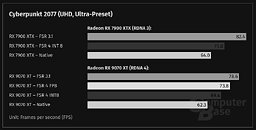
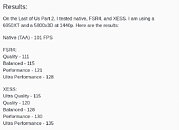
According to both the results posted in the Reddit thread and testing done by Computerbase, FSR 4 seems to offer a balance between native image quality and FSR 3.1 performance on both RDNA 3 and RDNA 2 hardware. Computerbase tested Cyberpunk 2077 in 4K on the Ultra settings preset using the AMD Radeon RX 7900 XTX, and FSR 4 delivered 11% faster performance than native, but fell short of FSR 3.1 frame rates by 16%. The Reddit user who posted the how-to guide tested an AMD RX6950 XT across a range of FSR 4 quality presets, and found that even when set to "Quality," the RDNA 2 GPU gained around 10% performance compared to native rendering in The Last of Us Part 2 at 1440p. Both sources comment that the image quality is a noticeable improvement over FSR 3, and it was more stable than XeSS, which, to its credit, beat out FSR 4 on RDNA 2 in The Last of Us Part 2 by up to 10%, depending on the quality preset. Curiously, similar performance deltas were observed when comparing the unofficial INT8 FSR 4 libraries on RDNA 4 to the officially supported FP8 libraries, and the performance difference between FSR 3.1 and FSR 4 is almost identical, as well.
Sources:
Computerbase.de, u/NaM_777 on Reddit
According to both the results posted in the Reddit thread and testing done by Computerbase, FSR 4 seems to offer a balance between native image quality and FSR 3.1 performance on both RDNA 3 and RDNA 2 hardware. Computerbase tested Cyberpunk 2077 in 4K on the Ultra settings preset using the AMD Radeon RX 7900 XTX, and FSR 4 delivered 11% faster performance than native, but fell short of FSR 3.1 frame rates by 16%. The Reddit user who posted the how-to guide tested an AMD RX6950 XT across a range of FSR 4 quality presets, and found that even when set to "Quality," the RDNA 2 GPU gained around 10% performance compared to native rendering in The Last of Us Part 2 at 1440p. Both sources comment that the image quality is a noticeable improvement over FSR 3, and it was more stable than XeSS, which, to its credit, beat out FSR 4 on RDNA 2 in The Last of Us Part 2 by up to 10%, depending on the quality preset. Curiously, similar performance deltas were observed when comparing the unofficial INT8 FSR 4 libraries on RDNA 4 to the officially supported FP8 libraries, and the performance difference between FSR 3.1 and FSR 4 is almost identical, as well.


30 Comments on FSR 4 on Older Radeon GPUs Tested: Improves Image Quality With Minor Performance Hit
1. When may it be officially suported on RDNA2 and RDNA 3.0 / RDNA 3.5?
AMD, take a hint, give us a choice; FSR4 does not have to be the default (why, though?), let us flip the switch.
2. What is the performance impact of FSR4 on Radeon 780M on Phoenix / Hawk Point (7840/8840/Z1E etc., RDNA 3.0) or on Radeon 890M on Strix Point (HX370/Z2E etc., RDNA 3.5)?
FSR4 would be really helpful there and they have good compute in relation to bandwidth. Both 7900XTX and 6950XT have 4-7 times the compute power, though.
3. What is the performance impact of FSR4 on Radeon 8060S/8050S on Strix Halo (390/395 MAX etc., RDNA 3.5)?
As above, but even more compute in both relative and absolute sense than 780M / 890M.
4. Could FSR4 be done on NPU?
It would not help on Z1/Z1E/Z2/Z2E etc. (no FPU), but 7840/8840 parts have 10/16 TOPS NPU and HX370 and 395 MAX have larger/newer NPU, maybe that would free some processing power in the GPU.
Though I guess all that work could be deemed worthless if/once AMD releases an official and better optimized INT8 FSR4 version for RDNA3.I don't think it'll ever be officially supported on RDNA2, to be honest. Just use either FSR3.1 or XeSS DP4a on RDNA2.The INT8 version (good for RDNA3, lower quality than FP8) on Quality mode is taking ~3.3ms for 720p output to 6.6m for 1080p output on the 780M:
If this isn't bandwidth-limited, I'm guessing it'll be around 15-30% faster on the 890M (2.5-4.6ms).Probably half to a third of the compute time you see on the 890M.Most probably not. The NPU can't access the GPU caches in the Strix and Phoenix SoCs, so any data coherency must go through the RAM which would probably add a ton of latency while reducing effective bandwidth for the iGPU.
The only thing the NPU can do is a spatial upscaler which is what Microsoft implemented on the Windows Qualcomm machines and is bound to implement on the Xbox Ally X because it also has the NPU active. The result doesn't seem to be all that much better than FSR1 / RSR, though.
- It works with RDNA2 and RDNA3, in my testing it does NOT perform worse on RDNA2 (compared to ppls results on RDNA3).
- It is a heavier algorithm than FSR3. You get about 10% less FPS compared to what you get with FSR3 eg. If FSR3 Quality gives you 30% uplift, you get 20% with this.
- It looks drastically better than FSR3. Especially on some games where FSR implementation is sh-t (like CP2077) it is night and day.
- Even 1440p FSR4 Performance is quite acceptable in my tested games (CP2077, DL: The Beast, Satisfactory, Horizon FW). So even though it performs worse, you can easily use more aggressive upscaling to make up for it and I can comfortably say it still looks similar if not better than something like FSR3 Quality.
- It can be used with newest driver IF you swap some .dll files from 23.9.1 driver (there are videos on youtube for files). I'm currently running it on 25.9.2.
From the video you linked the fps seems to dip only slightly between FSR versions. It seems awfully optimistic considering previously reported compute requirements increase between FSR versions.
I'd guess INT8 FSR4 as shown looks like "general" version of XeSS, so compatible with more systems and more performant but lower quality than original FP8 FSR4.I would not be so sure. While Strix Point and Phoenix / Hawk Point would have to create separate data buffers, probably in RAM, Strix Halo's GPU works through 32 MB MALL cache. I remember reading that MALL cache is currently dedicated to the GPU, but this may change if needed - so in this case, it would not rule out NPU at least accessing the data that GPU left for it to process.
All NPUs have their own data buffers though, so maybe it's possible anyway.
Obviously, this means much more work to implement it with NPU, making it even less probable than RDNA 3.x FSR4 versions made by AMD; PC/Xbox handhelds may tip the scale, and as most of them don't have NPUs, it's FSR4 INT8 (or similar) that I'd hope for in the future.
But if that was available on Strix Halo and it would be a little bit cheaper (perhaps a full GPU + 1 CCD only), it would make incredible steam machine.
I think AMD have an opportunities to get better mindshare here but knowing them, i bet they won't take it.
FSR3 isnt very good, going to 4 is easily worth that slight loss of performance.
Now its still a non advertised feature. Stupid idiots, they just don't want to win do they?The 10% uplift isn't exactly going to make or break any gaming use case. If you already have RDNA3 7900GRE or above, why would you upgrade to begin with?
And if you have RDNA2, moving to a 9070XT is full of advantages.Yep... and with that AMD broke a promise that set them apart from Nvidia, nuking their brand image into the ground further.
After all, it was AMD that prior to FSR4 always said they wanted to offer the featureset to all cards that 'could'. So now that they FINALLY, after three whopping gens have a decent upscaler, they artifically segment it :D Penny wise, pound foolish... as if the customers funding RDNA1-3 didn't already suffer three fucked up upscalers and paid for them.
AMD does this every time. Similar things occur with pricing. Its like every time they release a new GPU they get arrogant for five minutes and make an offer everyone can easily refuse. Even the 9070XT had its pricing / partner communication oopsie alongside a last minute postponed launch... in a critical moment. Epic facepalms are not enough here.
Let's say AMD thinks 7800 xt is equal to 4070 super, with fsr3 they trade blows, with fsr4, 7800 xt is dead.
No idea if the older generation really performs marginally better but the RX9070XT made me disinterested in the RX7900XT.
Personally I'm more invested in the creator features. Does this make me a candidate for buying into RTX5000 series? Maybe.
For the longest time I haven't been a fan of team green and I'm just not ready to dive into that rabbit hole.
Check Daniel Owen's recent RDNA2 & RDNA3 FSR4 videos, the 7900 XTX gets about 30% increase in frames with better quality mode comparable to DLSS. If you think that's "barely a benefit" then enjoy your RT "missing" 3050.