
News Posts matching #XCC

Return to Keyword Browsing

Flagship Intel Xeon 698X "Granite Rapids-WS" with 86 Cores and 336 MB L3 Cache Appears

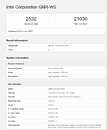
Intel's flagship "Granite Rapids-WS" processor has appeared on Geekbench, confirming the specifications that will power Intel's HEDT platform for the upcoming year. The tested model is a Xeon 698X CPU, featuring 86 cores and 172 threads, with a base frequency of 2.0 GHz and a boost frequency of 4.6 GHz. With 86 cores, it is unclear whether this boost frequency applies to all cores or only select ones. Nonetheless, the CPU achieved a score of 2,532 points in the single-core test and 21,030 points in the multicore test on Geekbench v6.5, running on the Ubuntu 24.04.3 LTS operating system. This CPU SKU also includes an impressive 336 MB of L3 cache. Built on Intel's XCC server compute dies, the design likely involves a multi-chip-module SoC working together to achieve the high core count. These specifications are not yet public, so the exact die configuration will be revealed when the platform launches.

For the W890 workstation platform hosting these CPUs, Intel has chosen a socket E2 design with 4,710 LGA pins, capable of supporting TDP ratings up to 350 watts. Intel is adopting a two-tier approach with distinct "Expert" and "Mainstream" configurations. The Expert-class offers 112 PCIe lanes (96 PCIe 5.0 lanes plus 16 PCIe 4.0 lanes), while the Mainstream tier provides 80 PCIe 5.0 lanes. As for pricing, these CPUs are expected to be expensive. Earlier listings indicated that the lineup peaks at a price point of $8,300 for the flagship Xeon 698X SKU.

Intel W890 Workstation Platform Details Leak Ahead of "Granite Rapids-WS" Launch

Intel's W890 workstation platform, the foundation for its upcoming "Granite Rapids-WS" HEDT workstation Xeon processors, has been leaked. The platform introduces a new Socket E2 design with 4,710 LGA pins built to support CPUs with TDP ratings reaching 350 watts. Intel is taking a two-tier approach with distinct "Expert" and "Mainstream" configurations: Expert-class implementations unlock 112 PCIe lanes (96 PCIe 5.0 lanes plus 16 PCIe 4.0 lanes), while the Mainstream tier delivers 80 PCIe 5.0 lanes. This will support a XCC-based "Granite Rapids-WS" processor with 86 cores and 172 threads, achieving single-core boost speeds near 4.8 GHz with 336 MB of L3 cache.

Memory capabilities mark a significant evolution from previous workstation platforms. The W890 chipset supports registered DDR5 modules, with RDIMMs validated for speeds up to 5,200 MT/s. In a quad-channel configuration with two DIMMs per channel, systems can address up to 2 TB of memory per processor socket. The connectivity suite includes a 2.5 Gigabit Ethernet controller, numerous USB 3.2 and USB 2.0 ports, multiple SATA III interfaces, and dual SlimSAS connectors that each provide PCIe 4.0 x4 bandwidth. Server-grade management infrastructure includes an ASPEED AST2600 BMC and a Nuvoton system supervisor, while power delivery provisions mandate a standard 24-pin ATX connector alongside support for up to four supplementary 8-pin CPU power headers.

Intel "Granite Rapids-WS" Workstation Xeon SKUs Appear With Up to 336 MB of Cache

Intel is gearing up for a return to the high-end desktop (HEDT) workstation market with the launch of the "Granite Rapids-WS" Xeon processors. A well-known hardware leaker, @momomo_us, has provided a list of potential SKUs, detailing their L3 cache capacities and clock speeds. At the top of this preliminary list is a SKU labeled as the "698X," featuring 336 MB of L3 cache and a clock speed of 2.0 GHz across all cores. The lower clock speed combined with naming conventions suggesting it's a top end SKU tier suggests this should be a higher-core SKU, though this is yet to be confirmed. The Granite Rapids-WS design is based on Intel's XCC server compute dies, incorporating two compute tiles that deliver up to 86 cores with two I/O tiles for connectivity, such as PCIe and memory controllers. To exceed 86 cores, Intel would likely need to adopt the larger UCC die and a bigger package.

The specifics of memory support for the workstation SKU are still uncertain. However, the server XCC family supports DDR5-6400 and can achieve higher effective speeds with MR-DIMMs. For workstations, Intel is likely to opt for an eight-channel memory configuration to balance capacity and board complexity, although a 12-channel memory setup is also possible. The Granite Rapids-WS processors are derived from Intel's server XCC dies, allowing for a quicker path to higher core counts in workstations. These "Granite Rapids" server dies are modified with a new socket and package to suit the specific needs of workstations. Intel manufactures the I/O die for Granite Rapids on the Intel 7 node, while the compute tiles are produced using Intel 3.

Intel "Granite Rapids-WS" Appears with 86 Cores and 172 Threads Built for HEDT

According to listing on OpenBenchmark.org, spotted by @momomo_us on X, appears to show a "Granite Rapids-WS" engineering sample running with 86 cores and 172 threads. The entry lists peak core speeds near 4.8 GHz, which likely reflects a turboboost on a few cores rather than a sustained all-core clock. Several important fields are empty in the submission, including power figures and other platform metrics, so the entry should be viewed as an early leak rather than a finished specification. The Granite Rapids-WS is a design built from Intel's XCC server compute dies, featuring two compute tiles that deliver 86 cores and two I/O tiles that handle connectivity, including PCIe and memory controllers. To go beyond 86, Intel would probably need to move to the larger UCC die and a bigger package.

Memory support for a workstation SKU remains unclear, although the server XCC family supports DDR5-6400 and can achieve higher effective speeds with MR-DIMMs. For a workstation, Intel is likely to choose an eight-channel memory configuration to balance capacity and board complexity. Thermal envelope and base clock frequencies are not reported, leaving questions about cooling and real-world expectations unanswered. If the entry is accurate, a Granite Rapids-WS part built from a server die could give Intel a quicker path to higher core counts for workstations. Intel has recently promoted Arrow Lake as a workstation option, while professional users have been left with a choice of an older workstation platform or AMD Threadripper, as Intel has recently scaled back its involvement in HEDT. For professionals and OEMs, the decisive factors will be validated core counts, power efficiency, memory and I/O capabilities, and how well software scales on the new hardware.
Return to Keyword Browsing
Nov 11th, 2026 04:20 CST change timezone

New Forum Posts

Popular Reviews

TPU on YouTube

Controversial News Posts