Monday, November 24th 2025

Intel W890 Workstation Platform Details Leak Ahead of "Granite Rapids-WS" Launch
Intel's W890 workstation platform, the foundation for its upcoming "Granite Rapids-WS" HEDT workstation Xeon processors, has been leaked. The platform introduces a new Socket E2 design with 4,710 LGA pins built to support CPUs with TDP ratings reaching 350 watts. Intel is taking a two-tier approach with distinct "Expert" and "Mainstream" configurations: Expert-class implementations unlock 112 PCIe lanes (96 PCIe 5.0 lanes plus 16 PCIe 4.0 lanes), while the Mainstream tier delivers 80 PCIe 5.0 lanes. This will support a XCC-based "Granite Rapids-WS" processor with 86 cores and 172 threads, achieving single-core boost speeds near 4.8 GHz with 336 MB of L3 cache.
Memory capabilities mark a significant evolution from previous workstation platforms. The W890 chipset supports registered DDR5 modules, with RDIMMs validated for speeds up to 5,200 MT/s. In a quad-channel configuration with two DIMMs per channel, systems can address up to 2 TB of memory per processor socket. The connectivity suite includes a 2.5 Gigabit Ethernet controller, numerous USB 3.2 and USB 2.0 ports, multiple SATA III interfaces, and dual SlimSAS connectors that each provide PCIe 4.0 x4 bandwidth. Server-grade management infrastructure includes an ASPEED AST2600 BMC and a Nuvoton system supervisor, while power delivery provisions mandate a standard 24-pin ATX connector alongside support for up to four supplementary 8-pin CPU power headers.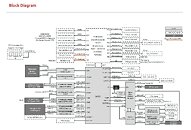 The W890 positions Intel to compete directly with AMD's Threadripper ecosystem in the premium HEDT segment. Although AMD continues to lead in maximum core counts and cache capacity, Intel's refined platform counters with improved memory speeds and a flexible PCIe topology designed to optimize throughput. The W890 represents a significant advancement over the current W790 generation, particularly in memory subsystem performance. All eyes are on CES 2026 when Intel is expected to officially unveil the platform. However, final evaluations will depend on the production processor specifications and motherboard designs.
Sources:
@momomo_us, via Wccftech
Memory capabilities mark a significant evolution from previous workstation platforms. The W890 chipset supports registered DDR5 modules, with RDIMMs validated for speeds up to 5,200 MT/s. In a quad-channel configuration with two DIMMs per channel, systems can address up to 2 TB of memory per processor socket. The connectivity suite includes a 2.5 Gigabit Ethernet controller, numerous USB 3.2 and USB 2.0 ports, multiple SATA III interfaces, and dual SlimSAS connectors that each provide PCIe 4.0 x4 bandwidth. Server-grade management infrastructure includes an ASPEED AST2600 BMC and a Nuvoton system supervisor, while power delivery provisions mandate a standard 24-pin ATX connector alongside support for up to four supplementary 8-pin CPU power headers.

47 Comments on Intel W890 Workstation Platform Details Leak Ahead of "Granite Rapids-WS" Launch
2026 release HEDT, platform for CPUs with up to 112 PCIe lanes and best you offer from the platform, is 2.5GbE NIC? Is this kinda running joke in your R&D team? A lot of Threadrippers nowadays come with 10GbE NICs, heck even some of Intel and AMD desktop platforms come with 10GbE NIC.
HEDT without 10GbE NIC is an absolute joke. Of course you can add that thing through a separate card but seriously: HEDT are for heavy computations so it would be necessary to have proper modern NIC for high bandwidth dataflow, rather than a meme of a standard 2.5GbE. Standard that not all switches don't even support as they might only support 1 or 10GbE.
Atleast it's 2.5GbE and not 1GbE.
Intel has to make money and eat their pride asap before they can really compete again with ANY company let alone primarily AMD!!!
The quad channel platform hopefully will be cheap enough to compete with TRX50. The octa channel platform seems more interesting.
Obviously UDIMM should be much cheaper than RDIMM by that point, hopefully 🤞.
The block diagram shows the chipset PCIe gen 4 lanes going to SlimSAS, but motherboard makers can take just one lane out of that and it will be enough for a 10 GbE NIC. And if the second SlimSAS connector is important, they can make another one from the CPU lanes. Or maybe use the CPU lanes for the NIC, whatever. It's all very flexible.
The chipset W890 is essentially Z690, for expanded connectivity. The workhorse of WS platforms are memory channels and PCIe lanes, not the chipset.
www.tomshardware.com/pc-components/cpus/intel-quietly-slashes-prices-of-xeon-6-cpus-by-up-to-usd5-340
In 140 tests, 2P Xeon system with 256 big cores is on par in performance with single Bergamo CPU with 128 small cores. 2P 9755 EPYC system with 256 big cores is 40% faster than 2P 6980P Xeon system with 256 big core, and it uses much less power at the same time.
1P Granite Rapids system with 128 big cores is 2% faster than...64 core 9575F EPYC. Double amount of cores, 2% faster. What are we talking about here?
www.phoronix.com/review/amd-epyc-9965-9755-benchmarks/14
In desktop workstation, the difference is expected to be even bigger, as Threadrippers are clocked much higher than EPYCs.