News Posts matching #Xeon

Return to Keyword Browsing

Intel Lands an Unnamed External Customer for Its 18A-P Node

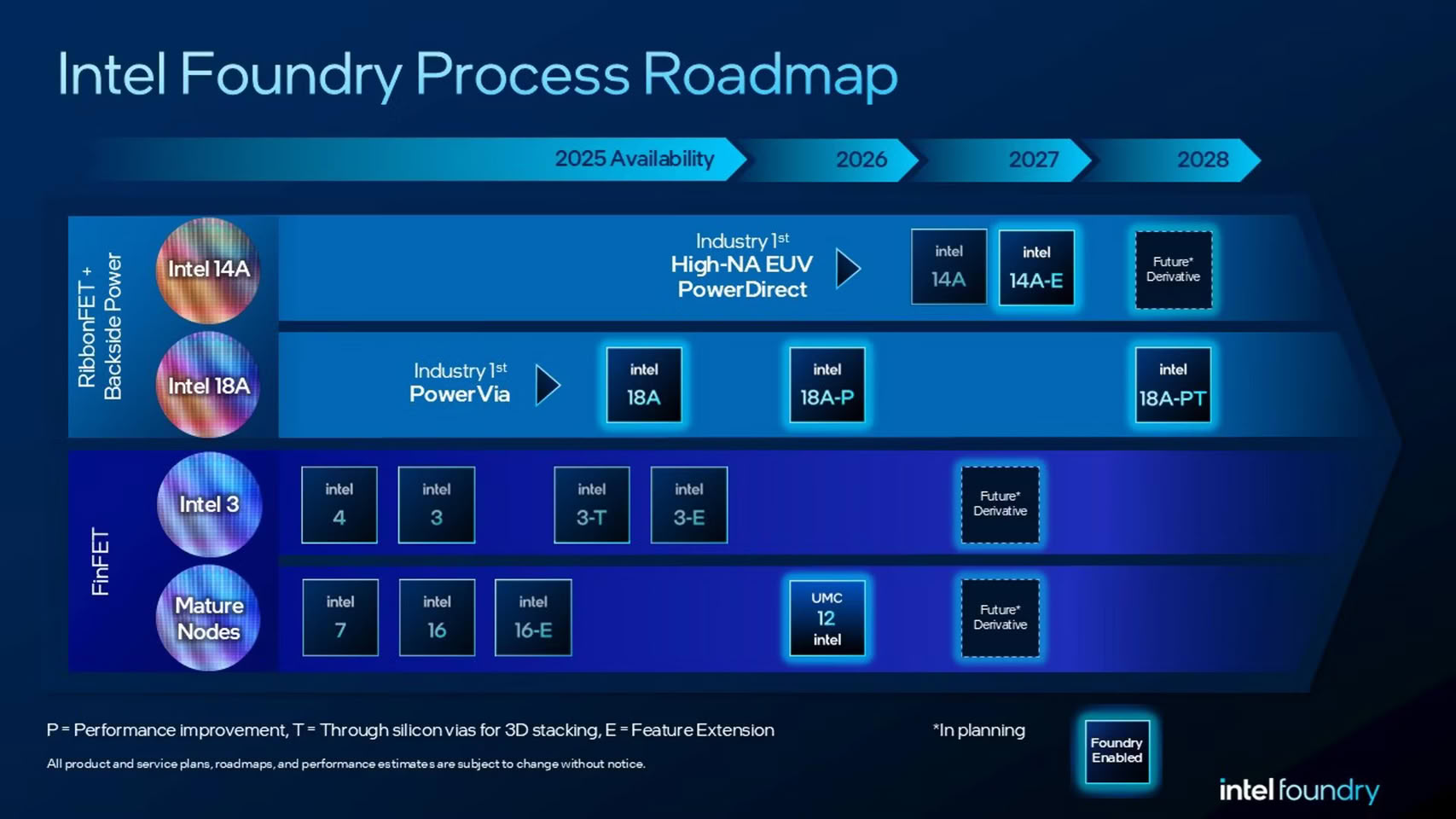
Intel CEO Lip-Bu Tan says the company has signed its first outside customer for 18A, although he kept the customer anonymous. It was first reported by CNBC that Tan mentioned the Intel 18A node while speaking at the TomorrowX Summit in Austin last Wednesday, but Intel CTO Pushkar Ranade later confirmed on X that the deal was for 18A-P specifically. That node entered risk production in June, and Intel claims it offers 9% higher performance at the same power, or 18% lower power at the same performance, compared to 18A. This deal is for the first external customer, but Intel is using the 18A-P node internally. For instance, Lip-Bu Tan has confirmed that the upcoming Nova Lake CPU lineup is set to use Intel 18A-P as well. That node is also design-rule compatible with 18A, so existing designs should carry over without requiring any major rework.

Of course, the specifics are quite limited at this point. Intel hasn't shared which customer it is, what volumes are being discussed, or a production timeline for when we can expect external products on this node. There are also some conflicting reports about the "first" label, since Socionext said back in August that it would use the 18A-P node for its custom SoCs. However, it's possible that this is the first signed manufacturing deal, and the specifics of the Socionext contract were a bit different. On the same day, Microsoft confirmed it will use Intel's EMIB packaging for its Azure chips and also secured multi-year Xeon supply. That will most likely include the new "Diamond Rapids" platform as well. Attendees also quoted Tan as saying 18A yields are now at 70%, but those reports are unconfirmed for now. It looks like Intel Foundry is slowly gaining momentum, but a lot of questions still remain, including about Intel's next-gen 14A node.

Intel Faces Class Action Lawsuit Over PC Sales Slowdown Disclosures

A class action lawsuit has been filed against Intel on November 13 in federal court in San Jose, naming CEO Lip-Bu Tan and CFO David Zinsner as defendants. Reuters reports that a Michigan pension fund is leading the shareholder lawsuit, which also covers investors who bought shares between July 23 and October 29. The main claim in the lawsuit is that Intel did not appropriately disclose just how badly its PC business was slowing down, to put it in plain terms. The lawsuit argues that Intel was too slow to disclose its weak consumer CPU demand, the excess inventory it was sitting on, and how that would hurt sales. The claim also points to August 2026, when Intel sold $23 billion worth of stock to raise capital, at $95 per share.

Intel has been struggling with sales in the client segment recently, as evidenced by its Q3 2026 earnings. In Q3, its client segment slipped 5% year over year to $8.1 billion, while its Q4 guidance of $15 to $16 billion came below Wall Street expectations. That sent Intel's stock price down about 29% the next day. Intel and AMD both expect PC sales to slow down in 2027, and CFO David Zinsner has given figures of about 12% in 2026 and another 10% in 2027. The culprit is said to be the global memory crisis, which has resulted in higher overall system prices and lower sales. Due to this weaker demand in the consumer segment, we have seen Intel move some production capacity from Oregon's 18A fab to Xeon chips.

MSI Powers the Next Era of AI Infrastructure at SC26

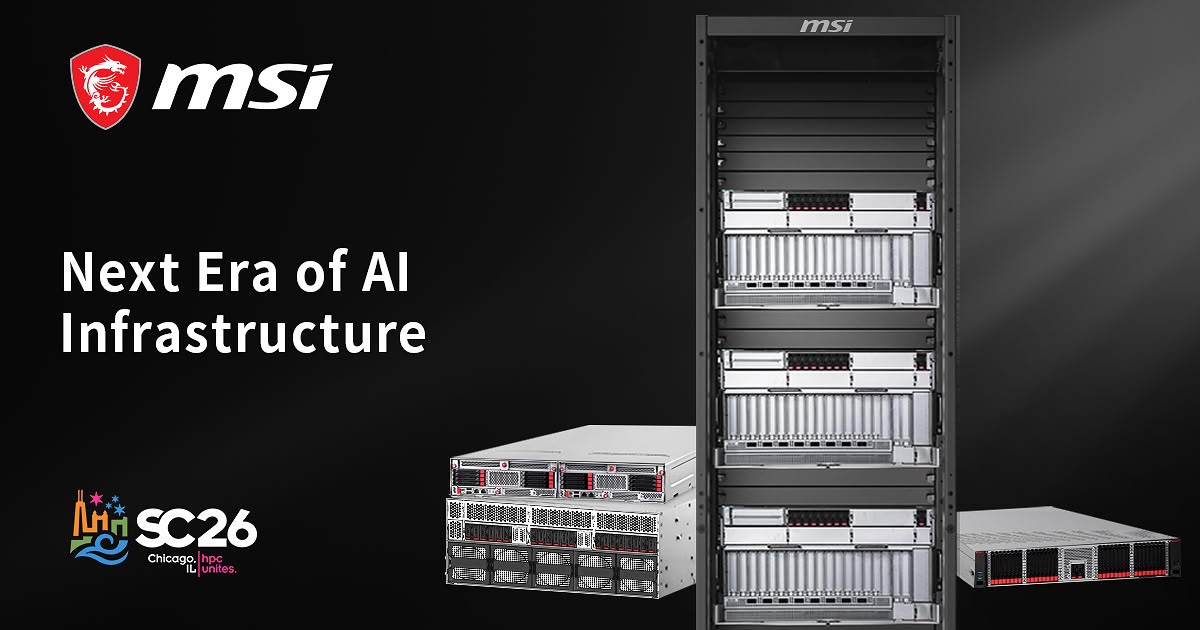
MSI, a leading global provider of high-performance server solutions, showcases its latest AI innovations at SuperComputing 2026 (SC26), booth #5429. From liquid-cooled platforms based on NVIDIA MGX and desktop AI supercomputing based on NVIDIA DGX Station architecture to next-generation multi-node compute and enterprise servers, MSI delivers a comprehensive portfolio designed to power agentic AI and AI factory deployments. Spanning the latest AMD and Intel processor architectures, MSI's solutions combine rack-scale compute density with flexible, balanced performance to support enterprise AI workloads, from large-scale infrastructure to local AI development.
Danny Hsu, General Manager of Enterprise Platform Solutions at MSI"Building a modern data center takes more than computing power. It requires strong technology partnerships and a trusted infrastructure foundation that can turn innovation into real-world value," "Through our collaborations with AMD, Intel, and NVIDIA, we combine leading-edge technologies with MSI's system integration expertise to deliver reliable, flexible, and efficient infrastructure that helps customers maximize their investments, scale with confidence, and prepare for the next era of AI."

Intel's ISA Reference Confirms Razor Lake Desktop and Laptop Model IDs

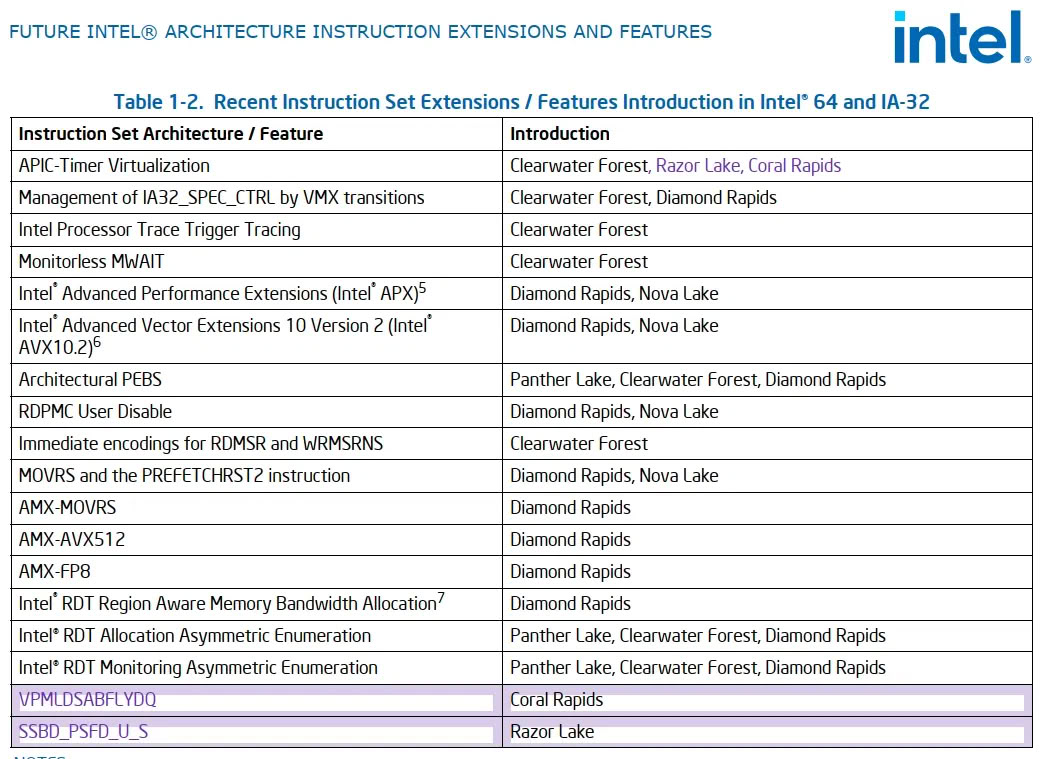
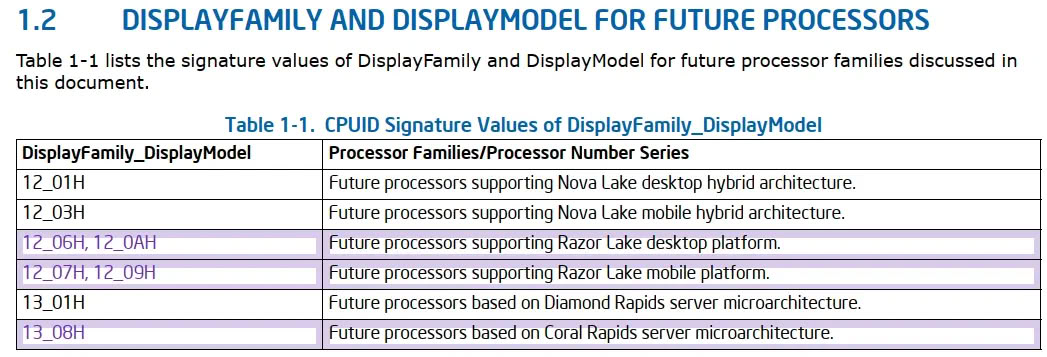
Intel has added Razor Lake and Coral Rapids to the November edition of its Architecture Instruction Set Extensions Programming Reference, the document developers use to prepare software for upcoming chips. Revision 063 gives Razor Lake four new model values under family 18 (12H), the same family as Nova Lake, with 12_06H and 12_0AH covering desktop parts and 12_07H and 12_09H covering laptops. The Coral Rapids Xeon family gets 13_08H, following Diamond Rapids at 13_01H. InstLatX64 spotted the update and shared it on Bluesky.

The new feature entries are fairly small. Razor Lake picks up SSBD_PSFD_U_S, which seems to allow separate user-mode and supervisor-mode control over certain speculative memory behavior, while both families gain APIC-Timer Virtualization for virtual machines. Coral Rapids also gets a new instruction called VPMLDSABFLYDQ, aimed at ML-DSA, the quantum-resistant digital signature standard. According to Intel's GCC patches, posted this week, Razor Lake carries the same ISA feature set as Nova Lake, which should mean AVX10.2 and APX carry over, though the reference itself doesn't list Razor Lake under those rows yet. Coral Rapids sticks with AVX10.2 rather than the newer AVX10.3, at least for now.

First Photos of Intel's 256-Core Xeon 7 "Diamond Rapids" Package Surface

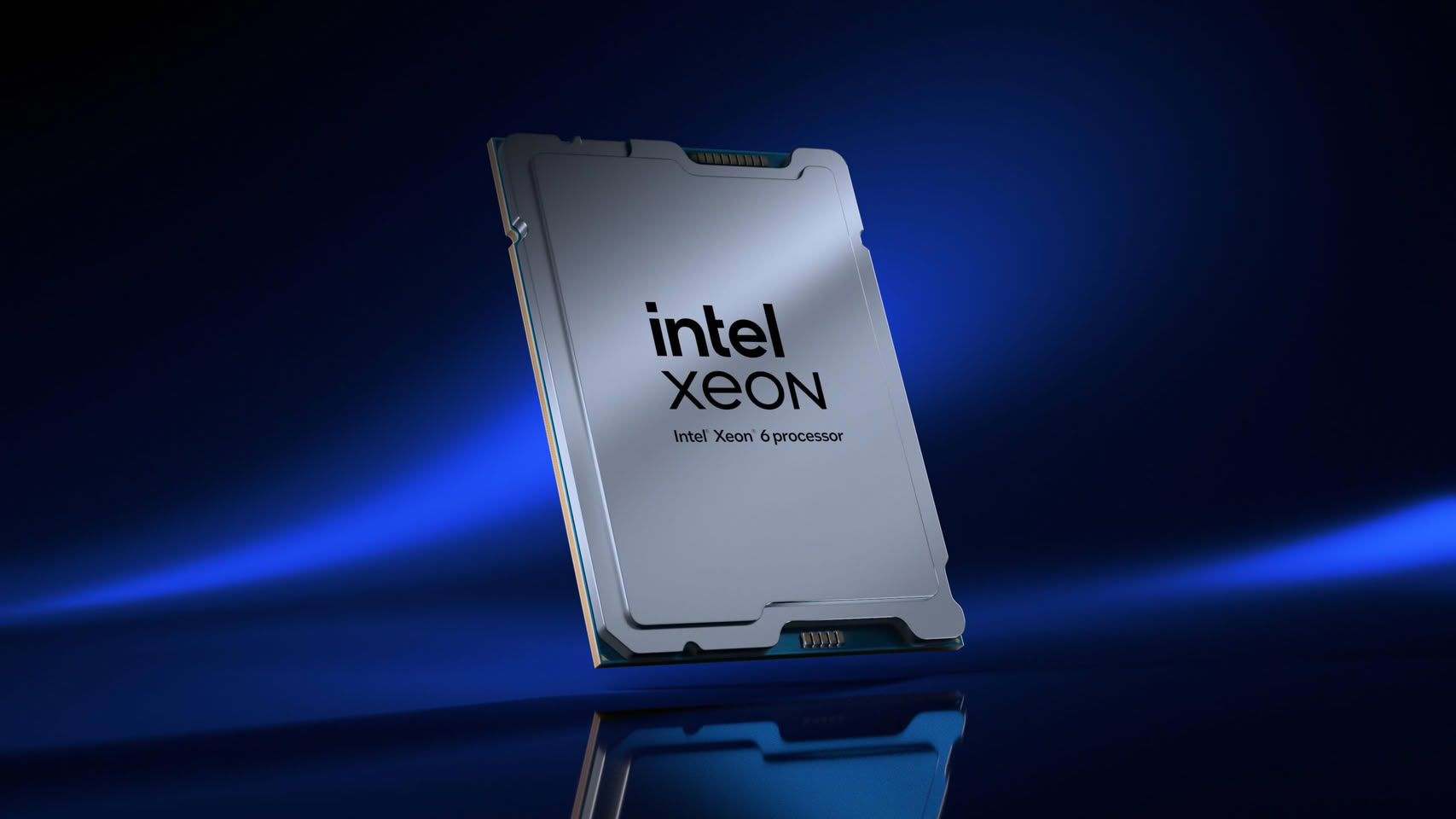
Intel's Xeon 7 "Diamond Rapids" seems to have made its first public appearance as actual silicon. Intel had two packages on display at the Tencent Global Digital Ecosystem Conference in Shenzhen on October 29, one showing the heat spreader and the other flipped to show the contact side, though photos of them are only now making the rounds. These chips are meant for the massive LGA 9324 socket on Intel's Oak Stream platform, and the bottom side shows a huge pad area to match.

The specs themselves aren't new, since Intel detailed the package design at HOT CHIPS back in August. The flagship packs up to 256 Panther Cove P-cores without SMT, spread across 16 compute chiplets built on Intel 18A-P, along with 1.28 GB of last-level cache. It also gets 16 memory channels with MRDIMM support up to 12,800 MT/s and 128 PCIe Gen 6 lanes. At the event, Intel pitched Diamond Rapids as a CPU designed for agentic AI infrastructure and reportedly announced joint development with Tencent Cloud for its CVM instances. The new Tencent Cloud instances launched at the same event, however, run on Xeon 6+ "Clearwater Forest" chips.

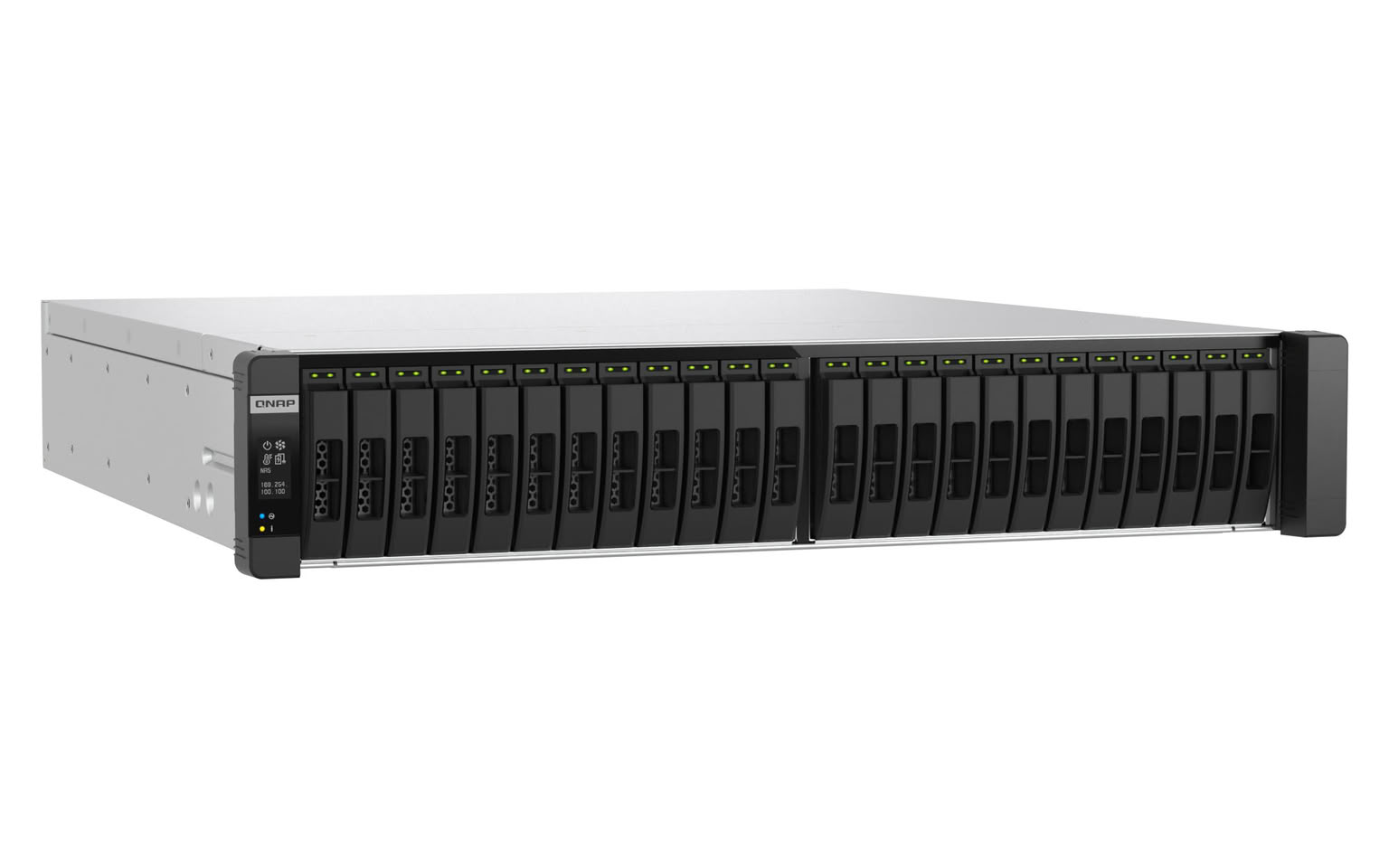
QNAP Releases 24-Bay Dual-Active Controller ES2486AFdc

QNAP Systems, Inc., a leading innovator in storage, networking, and data protection solutions, today launched the ES2486AFdc, a high-availability (HA) NVMe all-flash storage array engineered for mission-critical applications. The ES2486AFdc is QNAP's first enterprise-class storage combining Active-Active dual controllers with a U.2/U.3 NVMe all-flash architecture. Addressing the market challenges of high costs and limited availability caused by a shrinking number of SAS SSD suppliers, it breaks the performance bottlenecks of traditional HA systems limited by SAS interfaces. Utilizing a PCIe Gen 4 architecture, it delivers exceptional low latency and high throughput. Powered by the ZFS-based QES operating system, it ensures zero data loss and serves as the perfect foundation for enterprise virtualization environments, VDI desktop deployments, and core databases, providing outstanding reliability to minimize downtime and prevent business interruptions.

With the high cost of enterprise-grade SAS SSDs today, the ES2486AFdc's active-active shared storage architecture enables dual controllers to share a single all-flash storage pool. This eliminates the heavy expense of building two separate storage systems, greatly maximizes hardware resource utilization, and significantly reduces the total cost of ownership (TCO) for enterprises.

ASRock Rack Shows Early Xeon 7 "Diamond Rapids" Motherboard for Up to 4 TB of DDR5

ASRock Rack is promising up to 4 TB of DDR5 on a single socket with its DMRD16-2L+, one of the first motherboards built for Intel's upcoming Xeon 7 "Diamond Rapids" processors. The board was shown at the OCP Global Summit 2026 and has since been detailed by ServeTheHome. It has 16 DIMM slots in a one-DIMM-per-channel layout, matching the 16-channel memory setup Intel detailed at HOT CHIPS. Regular RDIMMs top out at 128 GB per module and 8000 MT/s, while MRDIMMs run at up to 12,800 MT/s, with taller 2U MRDIMMs reaching 256 GB each. Populate all 16 slots with those, and you hit 4 TB, along with a theoretical bandwidth of roughly 1.6 TB/s.

Expansion is unusual, with no standard PCIe slots and no OCP NIC 3.0 connector. All I/O goes through up to 16 MCIO x8 connectors, each rated for PCIe 6.0 or CXL 3.0, for 128 lanes in total. The rest is fairly basic: one PCIe 5.0 x4 M.2 slot, two Intel I350 Gigabit Ethernet ports, an ASPEED AST2700 BMC with a dedicated management port, and VGA output. ASRock Rack fits it all on a 12 x 13-inch EEB PCB, about the size of a large E-ATX board, so it could squeeze into some bigger workstation cases. Pricing and availability have not been shared yet, but that is hardly surprising, since Intel has the Xeon 7 family slated for a 2027 debut on the new LGA9324 socket. The board is aimed at servers, though anyone planning a high-memory workstation for local AI will probably keep an eye on it.

Intel Razor Lake-S Reportedly Due in 2028 on LGA-1954

Intel's Razor Lake desktop processors, the generation that follows Nova Lake-S, are currently slated for 2028, according to well-known Intel leaker Jaykihn. When asked on X whether Razor Lake-S was planned for 2027, Jaykihn replied "not currently," then followed up saying Razor Lake is a 2028 product for now. A leaked partner slide placed the first Nova Lake-S SKUs in Q1 2027 and indicated Intel plans to keep LGA-1954 for multiple generations, so Razor Lake-S should drop into the same boards roughly a year later. Apparently, Razor Lake will use new Griffin Cove P-cores, which Jaykihn previously called "an entire tock" rather than a refinement. The same core will reportedly also power Intel's next-generation Coral Rapids Xeon processors, though simultaneous multithreading (SMT) stays exclusive to Xeon.

Jaykihn says the client and server versions are separate architectures built around a similar core, comparing it to how Coyote Cove relates to Panther Cove. Earlier leaks pointed to Intel using TSMC's N2X node for some Razor Lake production, and the 12 Xe3P core iGPU SKU originally meant for Nova Lake-S was reportedly pushed to Razor Lake. HWiNFO also added support for Razor Lake-H, HX, and S in a recent beta. If the plan holds, Nova Lake-S buyers would get a proper CPU upgrade path without swapping motherboards, which is a welcome change after Intel went through three sockets in the last five years. Of course, timelines this far out can move, and Intel hasn't confirmed any of this, so it's reasonable to treat 2028 as a target for now.

Intel "Larrabee" GPU System Surfaces with Working Drivers

Recovered drivers have reportedly restored 3D acceleration to an Intel "Larrabee" prototype, offering the community a rare chance to test the company's abandoned graphics project. Reddit user "pkellythompson" discovered the hardware in equipment purchased at a storage auction, along with two USB drives containing Intel's development software. The Intel Visual Adrenaline system includes a DX58SO motherboard, a C0 stepping "Larrabee" sample, and a diagnostic board. Getting it running required using DVI instead of HDMI and adjusting the storage controller's BIOS settings, so Windows 7 could boot. The recovered archives, approximately 82 MB and 728 MB, include drivers, documentation, development utilities, and VBIOS instructions.

First publicly detailed in 2008, the "Larrabee" project aimed to challenge NVIDIA and AMD's dedicated graphics cards. Larrabee handled much of its graphics processing through software running on simple in-order x86 cores with wide vector units, assisted by dedicated texture hardware. Intel canceled its consumer graphics launch in December 2009 after development fell behind expectations, although the architecture later powered Xeon Phi accelerators. The restored prototype reportedly ran Crysis at 1280×720p with Medium settings and antialiasing disabled. Initial results exceeded 17 FPS, with another recovered driver boosting performance to around 36 FPS.

Intel Diverts 18A Capacity From Panther Lake to Meet Xeon Demand

Intel is moving some manufacturing capacity away from consumer chips to keep up with demand for its Xeon server processors. During its Q3 2026 earnings call, the company said it will convert some Intel 18A resources at its Oregon facilities to Intel 3, the node behind Xeon 6 "Granite Rapids." According to CFO Dave Zinsner, those 18A wafers "are generally going to build Panther Lake products." Zinsner also indicated that weaker PC demand gives Intel room to make the switch, as the company expects the PC slowdown to last at least through the first half of next year. CEO Lip-Bu Tan said the added Intel 3 capacity should be in production in the second half of 2027.
Intel CEO Lip-Bu TanThe industry continues to navigate one of the most significant supply shortages in the history, driven by the unprecedented demand for Super Intelligence. Against this backdrop, I am pleased by the progress we made growing our server supply in Q3. I'm mindful about the ongoing challenges we face in the future quarters to keep pace with the server demand.

Intel Data Center Revenue Jumps 78%, but Weak Q4 Guidance Drags Stock Down 30%

Intel shares fell roughly 29% on Friday to $65.76 after the company's fourth-quarter outlook came in well below Wall Street expectations. According to CNBC, it was the stock's worst day since the 1970s. Intel had closed at $92.07 on Thursday, right before it posted its third-quarter 2026 results. Oddly enough, the quarter itself was a good one. Revenue came in at $16.5 billion, up 21% year over year, and adjusted EPS of $0.52 easily beat the roughly $0.40 analysts were expecting. Data Center and AI revenue jumped 78% to $7.3 billion, while the Client Computing Group slipped 5% to $8.1 billion.

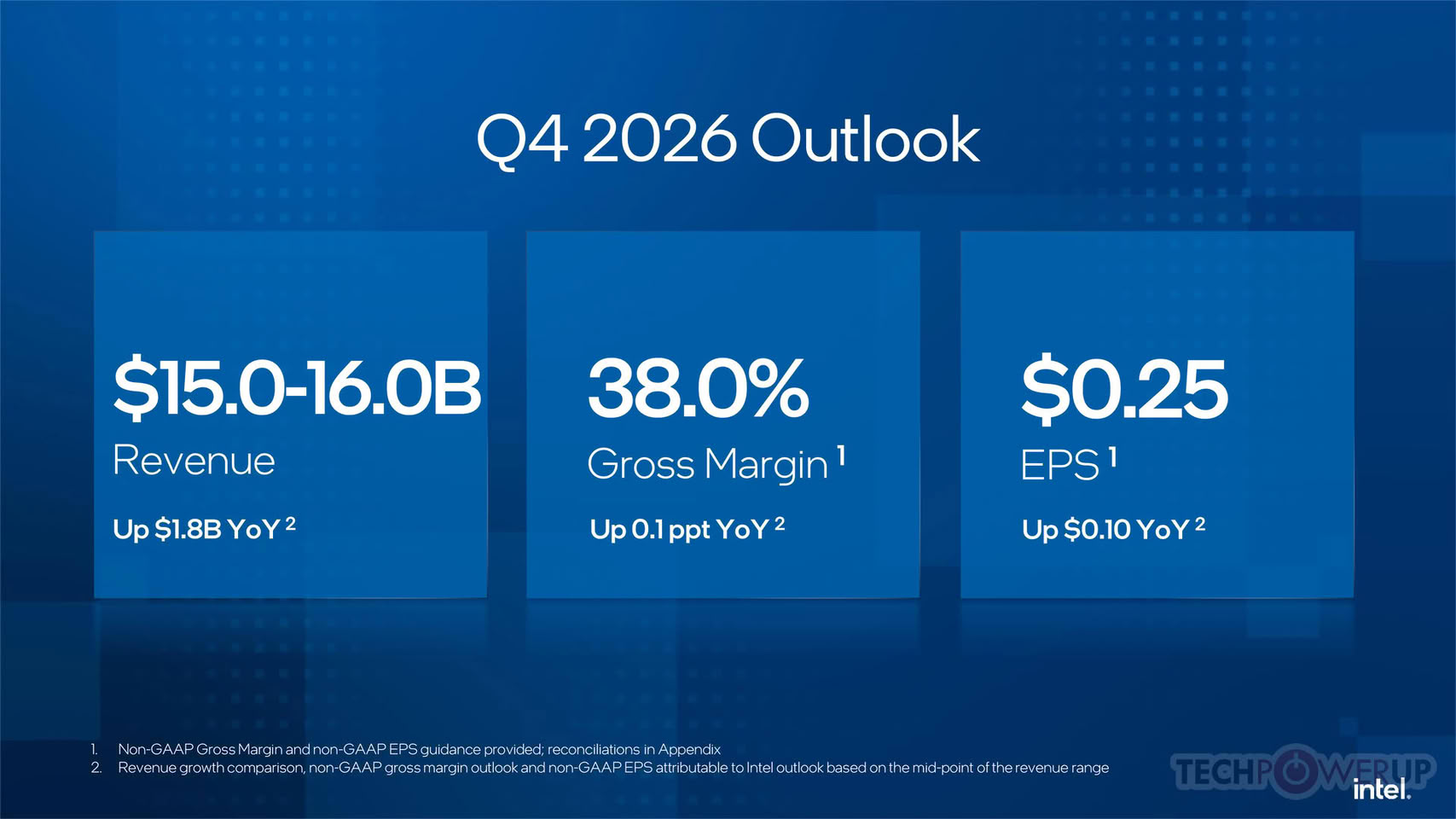
Investors, however, were looking at Q4. Intel expects revenue between $15 billion and $16 billion, against a consensus of around $17 billion, with adjusted EPS of just $0.25. Non-GAAP gross margin is also expected to fall to about 38% from 44% in Q3. Part of the shortfall comes from a plant shutdown in Israel. CFO David Zinsner said Intel sees "the PC slowdown continuing at least through the first half of next year." On the earnings call, the company said it expects the PC market to shrink by about 12% in units this year, and it reportedly sees another 10% decline in 2027.

Intel Fab 28 Shutdown to Cost $600 Million in Lost Revenue, Production to Restart Soon

Intel's global foundry operations are crucial to the company's revenue generation, and impacting any part of the supply chain directly harms the business. When explosions occurred at Fab 28 in Kiryat Gat, Israel, Intel's operations there briefly halted 10 nm node production for two weeks. During this time, the assessment of both equipment and production output is estimated to result in about $300 million of lost revenue in the upcoming Q4 2026, as well as another $300 million in Q1 2027. Just two weeks of downtime has destroyed a massive amount of 10 nm wafers that Fab 28 has been manufacturing.
Intel CFO David ZinsnerWe have been shut down for about two weeks. We feel like we are going to be starting up production here by the end of this week. While we are doing that, we are trying to assess all the wafers that are in the line and what is usable and what is not usable from those materials. This is somewhat of an early assessment, both really of 4Q and of 1Q. But I think the current thinking is that we will have about a $300 million impact to the fourth quarter. That is likely to be similar in the first quarter.

Intel "Nova Lake" Xeon E Series Carries Only P-Core or E-Core SKUs, No Hybrid Configurations

Intel is preparing to launch its upcoming "Nova Lake" processors in multiple versions, and the latest leaks highlight a particularly interesting Xeon E lineup. According to well-known leaker Jaykihn, Intel will be releasing its Xeon E-series based on "Nova Lake" silicon in two versions: big P-Core only or efficiency E-Core only SKUs. Reportedly, the P-Core only lineup will include five configurations with 4, 6, 8, 12, and 16 P-Cores. Meanwhile, the E-Core lineup will be slightly smaller, featuring four SKUs with 4, 8, 16, and 32 E-Core versions. At the top of the range, Intel Xeon E-series buyers can choose between a 16 P-Core design or a 32 E-Core configuration. There will be no hybrid SKUs with both P-Cores and E-Cores, as those will be reserved for the regular "Nova Lake-S" desktop processors.

Intel's new Xeon E designs will be powered by the W980 chipset platform. Motherboards with the W980 chipset will support native DDR5 memory with ECC, up to 48 PCIe lanes, including 12 PCIe 5.0 lanes directly from the chipset alongside 12 PCIe 4.0 lanes, and Intel vPro technology, along with numerous other optimizations typical of workstation chipsets. The DMI chipset bus bandwidth is set to 128 Gbps per direction, thanks to the implementation of DMI 5.0 x4, which is another great platform addition. It also offers two 40 Gbps USB4 or Thunderbolt 4 ports from the CPU. The PCI-Express 5.0 x16 PEG slot from the processor can be segmented into x8/x8 or other combinations using lane switches. Both CPU-attached M.2 NVMe slots can be configured as Gen 5.

TerraMaster Announces New U-725 Rackmount NAS Series for Enterprise Storage

TerraMaster, a professional brand specializing in innovative storage products, today announced the launch of four new enterprise rackmount storage servers: the U8-725, U12-725, U12-725 Plus and U16-725 Plus. Designed for medium and large businesses, creative studios, virtualization environments, surveillance deployments and AI-driven workloads, the new lineup combines high-performance processing, flexible storage expansion, high-speed networking and integrated data protection to provide a scalable platform for demanding business environments.

Powered by TerraMaster's TOS 7 AI-native operating system, the new servers are designed to support multiple business-critical workloads from a single platform, including enterprise file services, media collaboration, virtualization, centralized surveillance storage, AI dataset access, backup and disaster recovery. The Ux-725 series is built around Intel Xeon D processors and features ECC memory, NVMe SSD cache acceleration and high-bandwidth networking to provide responsive performance for business applications, virtual machines and large file transfers.

AMD Claims EPYC "Venice" Beats NVIDIA Vera by 2.24x in New White Paper

AMD has published a white paper on its 6th Gen EPYC 9006 "Venice" server CPUs, and it takes direct aim at NVIDIA's Vera. These are first-party figures from AMD, so it is important to be cautious about their validity. In SPECrate 2026 Integer, AMD says the 256-core EPYC 9996 delivers 2.24 times the platform-level performance of an 88-core Vera system, while a 96-core, high-frequency Venice chip is claimed to be 1.2 times faster per core. Against Intel's Xeon 6980P, AMD reports gains of 2.4x to 3.7x in server-side Java, OpenSSL, MongoDB, Redis, NGINX and transaction processing, and up to 3.13x in HPC tests like GROMACS. Neither AMD nor NVIDIA can publish official SPEC results yet, so all of it is estimated.

The Vera figures come from NVIDIA's own white paper, and the 96-core part is an EPYC 9996 with several of its cores turned off. The per-subtest results also used GCC 16.1 on the AMD side against GCC 15.2 for NVIDIA, which Tom's Hardware notes is not best practice. The 2.24x figure compares a 512-thread flagship with Vera's 176 threads, so it is not a like-for-like matchup. AMD says Venice is in production, with major OEM platforms on track to launch and cloud providers starting deployments later this year. It's likely we will only get a real answer once independent reviewers get both chips on the same test bench.

Intel Details Xeon 7 "Diamond Rapids" Package Design at HOT CHIPS

Intel, in a detailed presentation, detailed the package design of its next-generation Xeon 7 "Diamond Rapids" server processor. The processor is designed to be a versatile serial processing powerhouse for enterprise-scale agentic AI. Intel's design goal with the processor is to offer up to 256 P-cores, cushioned by up to 1.28 GB of last-level cache, per socket. The chip also features contemporary I/O, including PCI-Express Gen 6. Intel is leveraging its latest in-house foundry node, the Intel 18A-P, to design the core complex chiplets.

Xeon 7 "Diamond Rapids" is built on essentially the same disaggregation philosophy as AMD EPYC—that of CPU cores being spun out in small groups of CPU core complexes (CCXs) contained in CPU core dies (CCDs), groups of which interface with a centralized server I/O die (sIOD), which serves as a system agent and I/O hub. The "Diamond Rapids" MCM consists of two Fabric Hub Tiles (FHTs), four CPU core Base Tiles, and a total of 16 core chiplets, each containing 16 "Panther Cove" P-cores. The core-count per compute base tile is 64, and four of these add up to 256 cores.

CachyOS and AlmaLinux Beat out Windows 11 in Workstation Benchmarks

With the advent of the Steam Deck and the bump in Linux adoption that we've seen since then, a number of Linux distributions have appeared that make tweaks to the Linux kernel in the hopes of gaining performance. CachyOS is one such Linux distribution, and it appears that those kernel performance tweaks are paying off, according to some recent testing by Phoronix.

In a comparison between CachyOS, AlmaLinux 10.2, Ubuntu 26.04, Fedora Workstation 44, and Windows 11, CachyOS consistently performed at or near the top of the list, with CachyOS in performance mode claiming first place in the geometric mean of the results of a workstation benchmark. Windows 11 Pro was right at the bottom of the chart, coming in 14.9% slower than CachyOS in performance mode.

Intel "Nova Lake-S" Tested with AVX-512 and APX Enabled

Intel's upcoming "Nova Lake-S" series of desktop processors is set to bring some exciting changes. As previous rumors suggested, the company is incorporating the AVX-512 and APX instruction sets into this new processor lineup. Late last year, Intel published its 60th Architecture Instruction Set Extensions and Future Features manual, indicating that ultra-fast vector processing with 512-bit width is returning to desktops after years of absence from this sector. Thanks to @InstLatX64 on X, we have learned that the company is testing two SKUs—a 24-core model running at 3.4 GHz and a 28-core model running at 3.2 GHz—both featuring AVX-512 and APX instruction support. This further supports the claim that Intel's desktop processors are returning to their full potential.

Powered by "Coyote Cove" P-Cores and "Arctic Wolf" E-Cores, both models will support AVX-512 and APX, aligning software optimization and support with the HEDT and Xeon server segments that already use these vector and advanced accelerators. Initially, Intel chose to disable AVX-512 for the "Alder Lake" and "Raptor Lake" client-oriented CPU lineups, meaning only server-grade Xeon CPUs benefited from the accelerated 512-bit data paths. This decision was due to differences in P-Core and E-Core designs, which complicated software optimization on the consumer side. However, with "Nova Lake," these features are finally making a comeback.

Intel's New CPU Cores Debut on "Nova Lake-S" Desktop Before Xeon Servers

Intel's approach to releasing the latest CPU technology differs significantly from AMD's. Robert Hallock, the company's VP and general manager of the enthusiast business, confirms that desktop PC DIY enthusiasts are the first to experience the latest CPU cores. In an interview with Tom's Hardware, Hallock emphasized that Intel prioritizes bringing its newest CPU cores to desktops first, subtly hinting at the upcoming "Nova Lake-S" processor generation. Unlike AMD, which introduces its latest core designs in the server segment first, Intel debuts them on the desktop. While these cores will eventually be used in Xeon server processors, they initially appear on the desktop platform. This means that the "Coyote Cove" P-Cores and "Arctic Wolf" E-Cores will first be available for desktops, in contrast to AMD's Zen 6 CPU technology, which debuts with the EPYC "Venice" and only later appears in desktop CPUs.
Intel's Robert HallockWhat I would say is, as we think about our own roadmap, I have a new core. It's coming to desktop first. I mean, I hope enthusiasts do the math about that one, and that's all I'm going to say.

Intel Reports Second-Quarter 2026 Financial Results, Sales Rose 25%

Intel Corporation today reported second-quarter 2026 financial results. "AI is driving unprecedented demand for compute, and as we continue to execute, Intel is well-positioned to capture sustainable growth across our CPU franchise, ASICs, advanced packaging and vast wafer foundry network," said Lip-Bu Tan, Intel CEO. "Our Q2 results represent our strongest revenue growth in more than fifteen years, enabled by greater speed, accountability, and customer focus."

"We delivered a strong second quarter, exceeding our financial guidance on robust demand and improved execution, including volume upside driven by higher factory yields and improved cycle times," said Dave Zinsner, Intel CFO. "AI-driven compute continues to strengthen, and to support expected growth this year and next across products and foundry, we are meaningfully increasing our investments in equipment, clean room space, and substrates."

Intel Invests €5 Billion to Expand Manufacturing in Europe

Intel today announced a €5 billion ($5.7 billion) capital investment at its Leixlip campus in Ireland, marking the next phase in the site's capacity expansion. Global demand for AI and high-performance computing is driving the need for advanced silicon to power AI Factories, and Intel is scaling capacity in Ireland to deliver Intel Xeon 6 and next gen Intel Xeon built on its Intel 3 node. This strategic investment expands current production output, advances research and development activities and utilises capacity across existing cleanroom space, strengthening Europe's semiconductor supply chain and serving industry need.

The expansion involves upgrading existing fabrication facilities and the installation of leading-edge manufacturing equipment. Key infrastructure enhancements include the expansion of the automated track system to integrate disparate campus modules into a singular, high-velocity production environment.

Asetek Unveils Next-Gen AIO Liquid Cooling Architecture for AI Workstation and AI PC at Computex 2026

As AI-driven computing continues to escalate demands for higher power density and thermal efficiency, Asetek, the pioneer of global liquid cooling technology, today announced the debut of its next-generation liquid cooling platform architecture at Computex 2026. Developed specifically to address the high-performance thermal demands of the AI era, the new architecture sets a new milestone in cooling efficiency and low-acoustic performance. Featuring an optimized 4 mm comprehensive offset cold plate design, Asetek is effectively redefining the thermal standard for high-performance AI computing.

The company also highlighted a broader strategic direction following its strategic integration with Chunqiu Electronic (CQ), combining Asetek's long-established liquid cooling engineering expertise in Denmark with CQ's expanded global manufacturing scale and supply chain infrastructure in Asia. At this year's showcase, Asetek is focusing on the generational evolution of its premium consumer liquid cooling platforms, positioning these advanced thermal architecture developments as the primary technology foundation to anchor future high-density computing and AI thermal infrastructure opportunities.

NVIDIA "Vera" CPU Benchmarked: Beating Intel Xeon and AMD EPYC in Select Workloads

Phoronix conducted an exclusive round of testing with NVIDIA's latest "Vera" CPU, showcasing early benchmarks that highlight NVIDIA's advancements in custom CPU design. The initial results indicate that this Arm-based CPU platform is powerful enough to outperform the latest Intel Xeon and AMD EPYC models in the data center sector. The "Vera" CPU is equipped with 88 custom Armv9.2 "Olympus" cores, featuring 176 threads through physical resource partitioning. These custom cores support native FP8 processing, allowing certain AI workloads to be executed directly on the CPU with a 6x128-bit SVE2 implementation. The chip offers 1.2 TB/s of memory bandwidth and supports up to 1.5 TB of LPDDR5X memory in the SOCAMM2 format. A second-generation Scalable Coherency Fabric provides 3.4 TB/s of bisection bandwidth, connecting the cores across a unified monolithic die and eliminating the latency issues common in chiplet architectures.

For comparison, Phoronix tested single and dual Intel Xeon "Granite Rapids" 6980P CPUs, as well as AMD EPYC "Turin" and "Turin Dense" models like the AMD EPYC 9755, 9575F, and 9475F. They also included NVIDIA's first-generation "Grace" design based on Arm Neoverse V2 cores. NVIDIA allowed only a specific subset of tests on this pre-release chip, including standard workloads like code compilation, stream memory performance, video encoding, Python/Java, and database performance. In the geometric mean of all test results, NVIDIA's "Vera" topped the chart, performing nearly 11% better than AMD's most advanced designs and about 55.3% better than the best single-socket Intel Xeon. It also outperformed dual-socket configurations, suggesting that some workloads have scaling issues across multiple sockets. These limited results place "Vera" above any Arm-based design, with a 450 W TDP for the CPU and 50 W for the 768 GB memory pool.

Inno3D Announces NVIDIA MGX 4U GPU Server

INNO3D proudly announces the launch of its latest enterprise solution, the INNO3D NVIDIA MGX 4U GPU Server with NVIDIA ConnectX 8 SuperNIC - AGS-4UMGX-R1, engineered to empower businesses and institutions with cutting-edge performance for the most demanding workloads. The INNO3D NVIDIA MGX 4U GPU Server leverages the parallel processing power of NVIDIA GPUs to accelerate capabilities across High-Performance Computing (HPC), data analysis, genomics, 3D modeling and imaging, machine learning, simulations, deep learning, and AI training. Designed for professionals, this server is ideal for Large Language Model (LLM) training, cloud AI deployments, and enterprise-scale innovation.

Dell Technologies Introduces Dell Deskside Agentic AI Series

Dell Technologies (NYSE: DELL) introduces Dell Deskside Agentic AI, a new addition to the Dell AI Factory with NVIDIA that gives workgroups the ability to deploy and scale agentic AI workflows locally without the cost, latency and data sovereignty constraints of cloud-only approaches. With the NVIDIA OpenShell runtime now supported across the entire Dell AI Factory with NVIDIA, enterprises benefit from a single security and policy enforcement layer from deskside workstations to Dell PowerEdge XE servers.

Why it matters
As AI workflows shift toward agentic architectures, token usage compounds at an accelerating rate, driving cloud costs that can quickly become unsustainable despite falling token prices. Cloud-only strategies fall short on what matters at scale: economics, security and data sovereignty. Organizations running agentic AI need infrastructure that addresses all three and scales with workloads without requiring a rebuild every time they mature.
Return to Keyword Browsing
Nov 27th, 2026 23:34 CST change timezone

New Forum Posts

Popular Reviews

TPU on YouTube

Controversial News Posts