News Posts matching #dGPU

Return to Keyword Browsing

Minisforum AtomMan G1 Pro-89A6 Mini PC Launches With RX 9060 XT Joining RTX 5060 SKU

Minisforum launched an NVIDIA GeForce RTX 5070-powered AtomMan G7 Pro mini PC in January 2026, and the brand has just announced the latest iteration in the AtomMan line-up, the AtomMan G1 Pro-89A6, which is now available with the AMD Radeon RX 9060 XT GPU with 16 GB of VRAM. The G1 Pro-89A6 is built on AMD's Ryzen 9 8945HX, a mobile CPU with 16 cores and 32 threads and a maximum boost clock of 5.4 GHz. Pricing on the RX 9060 XT mini PC starts at $1,759 during the launch promotion, with the MSRP jumping to $2,199 after that ends. The only configuration available has 32 GB of DDR5-5200 memory, which is upgradeable via SODIMM slots, and a 1 TB M.2 PCIe SSD.

The chassis of the new AtomMan G1 Pro-89A6 measures in at just 3.8 L, which is made all the more impressive by the 140 W TGP of its dGPU and its built-in 350 W PSU—which means no external power brick cluttering up whatever space the mini PC ends up in. The CPU and GPU are cooled by what appear to be two separate cooling solutions, with five copper heat pipes between them and each with its own exhaust vents. The CPU is cooled by a single-fan blower-style cooler, and the GPU is cooled by a triple-fan setup. The PSU also has its own compartmentalized cooling system. Although Minisforum hasn't specified what fans it's using, it claims to be using silent fans that spin at up to 3,600 RPM.



Colorful Resorts to RTX 3050 and DDR4 for P15E Budget Gaming Laptop

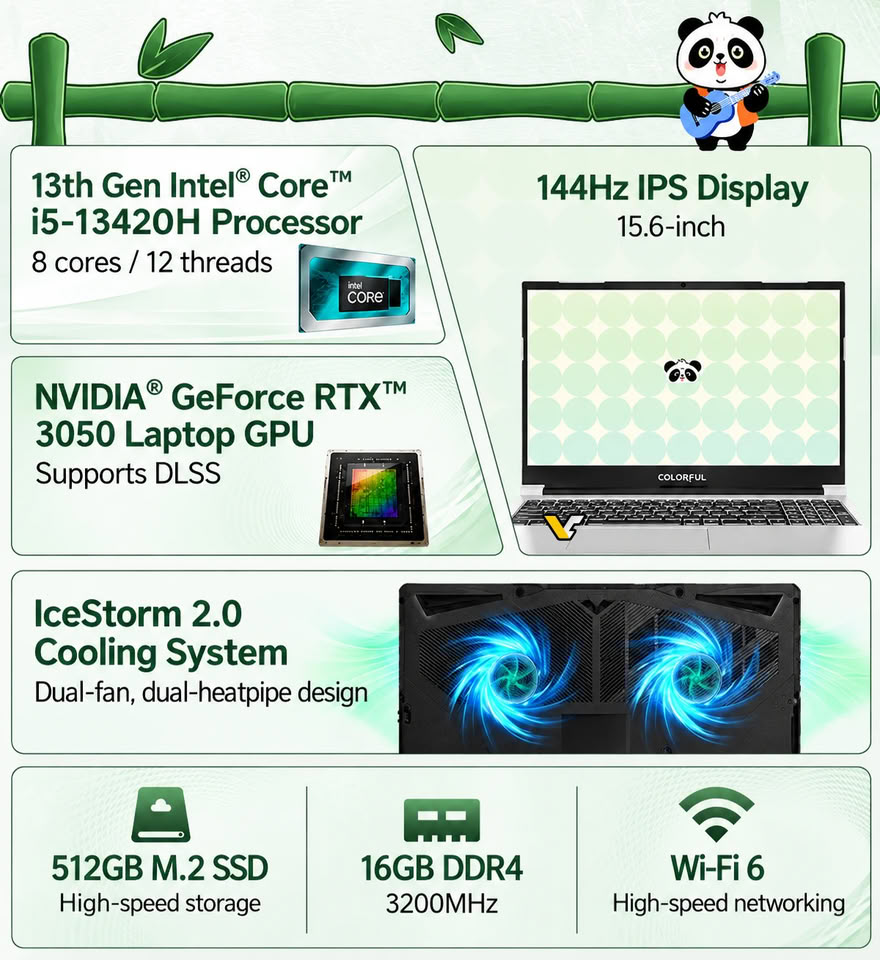
Seemingly in light of the recent PC hardware crisis, which has affected PC OEMs big and small alike, Colorful has just revived the NVIDIA GeForce RTX 3050 for its latest Panda laptop design. The latest revision of the Colorful Panda P15E features the typical 15-inch form factor and chassis from the RTX 5050 version the brand previously sold, but it carries a significant downgrade in internals.

The new CPU in the Panda P15E is the Intel Core i5-13420H, an 8-core, 12-thread part with 4 P-Cores and 4 E-Cores and an Intel Iris Xe 80EU iGPU, while the dGPU featured in the new laptop is the NVIDIA GeForce RTX 3050. As a result of the older platform, the laptop also resorts to 16 GB of DDR4-3200 memory and a 512 GB M.2 SSD. The display is a 144 Hz IPS unit that measures in at 15.6 inches. At the time of writing, it does not appear as though there is an international version of the RTX 3050 version of the laptop, but it is available on JD.com for RMB 6,299, which converts to roughly $938.70.

AMD Radeon RX 9070 XT is AMD's Most Popular Discrete GPU on Steam Survey

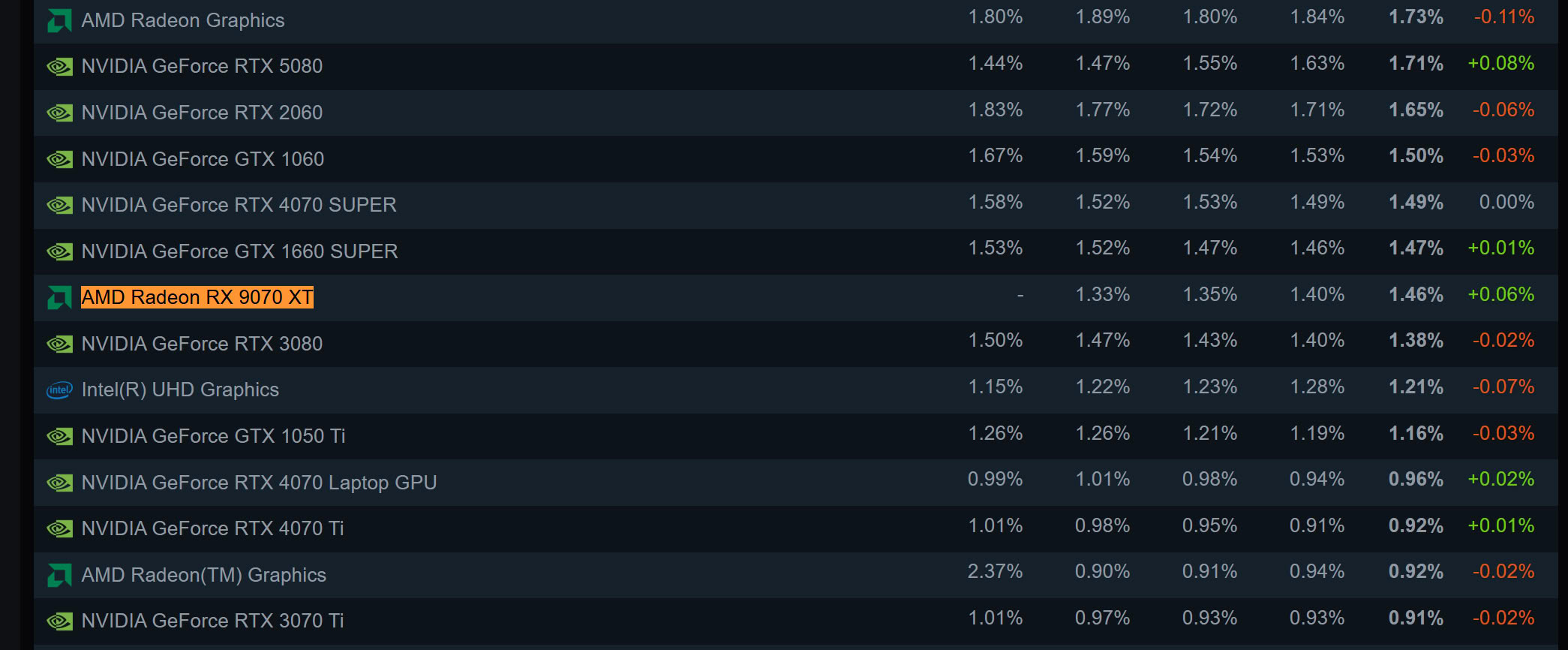
According to the latest Steam Hardware and Software Survey update, in August, AMD's Radeon RX 9070 XT, the flagship of the RDNA 4 family, became the company's most popular discrete graphics card. With a share of 1.46% among surveyed Steam gamers, the Radeon RX 9070 XT ranks 24th in the graphics card popularity and market share list. From an immeasurable market share in April, Steam is seeing growth to about 1.33% in May, 1.35% in June, 1.40% in July, and finally reaching 1.46% in August. Currently, this places AMD's top RDNA 4 card just above NVIDIA's GeForce RTX 3080 and below the GeForce GTX 1660 SUPER.

In comparison, NVIDIA's current GeForce RTX 50-Series "Blackwell" generation shows a strong presence, with the GeForce RTX 5070 ranking third on the list with a 3.77% share, the GeForce RTX 5060 at 3.16%, and the RTX 5060 Ti at 2.55% among gamers. NVIDIA's discrete GPUs appear to have significantly higher market penetration with the current "Blackwell" family, as even the high-end GeForce RTX 5080 holds a 1.71% share. It's worth noting that AMD still commands a large percentage of integrated graphics solutions, but when focusing on discrete GPUs, the second-best RDNA 4 share is the Radeon RX 9060 XT with a 0.80% share.

Windows 11 Deletes ASUS GPU Drivers After Extended Eco Mode Usage

As was recently discovered by an ASUS ROG Zephyrus G14 owner on Reddit, there is apparently a conflict between Windows 11's built-in driver management tools and ASUS's proprietary power profiles. After leaving their Zephyrus G14 laptop, with an NVIDIA GeForce RTX 5070 Ti dGPU, in Eco Mode for a number of weeks, Reddit user u/OK-Horse-3169 switched their laptop back into performance mode in order to play some games, only to discover that Windows had deleted the GPU driver. According to ASUS's support documentation, this is expected behavior.

As it turns out, on basically any laptop with a MUX switch that disables the dGPU entirely, Windows 11 will automatically remove the drivers, because the driver is no longer necessary for a device that's no longer connected—it treats it much like it would a removable USB drive or peripheral. The source of the problem, as discovered by the redditor, is called pnpclean.dll, a maintenance task that deletes the aforementioned drivers if a device hasn't been connected for 15-30 days. After the driver was deleted, Windows recognized the user's RTX 5070 Ti as a generic display adaptor until the driver was reinstalled.

Intel Arc B580 Running SteamOS Impresses Despite Missing XeSS Driver Support

Valve's SteamOS has been gaining a lot of new hardware support in recent months, including support for dGPUs and Intel's Arc GPUs. ETA Prime, the YouTuber who has become synonymous with gaming handheld and SteamOS testing, has put Intel's Arc B580 to the test on SteamOS, finding impressive performance but an unfortunate lack of support for built-in Xe Matrix eXtensions (XMX) hardware.

For starters, it's impressive to see that Intel's Arc B580 GPUs now boot on SteamOS without the workarounds or experimental support that was previously required. Despite the seamless boot and installation, the Mesa driver being used by SteamOS still doesn't have support for Intel's XMX engines, making the experience of running XeSS far less worthwhile. In testing, XeSS still technically works, but quality and performance both suffer compared to XeSS running on the proper hardware. The lack of support for XMX engines also completely disables XeSS Multi-Frame Generation.

SteamOS Beta Update Adds dGPU VRAM Management Patch

In April 2026, Natalie Vock, a software engineer famous for contributions to Valve's Linux gaming stack, published a series of patches to improve VRAM usage on Linux, largely directed at devices with dGPUs with limited VRAM, and now that patch has seemingly also been adopted by Valve itself in the latest SteamOS Beta update 3.8.20. The update notes denote this as "Greatly improved VRAM management, improving performance and stability in cases where VRAM is limited," which should help improve performance for Valve's Steam Machine at higher resolutions. Of course, this update should also improve performance for DIY Steam Machines and other dGPU gaming machines running Valve's SteamOS. It should be noted that there may be little to no performance improvements for iGPUs, since they share system memory and VRAM already, and overflowing to system memory was what was causing performance issues.

In Vock's testing and subsequent testing of an implementation of the dmemcg-booster and the patches on CachyOS, performance on low-VRAM GPUs was nearly doubled in some cases, making games that were previously unplayable just barely smooth enough to play on the aging hardware. The SteamOS 3.8.20 Beta update also updates the Mesa graphics driver to a new major release, specifically Mesa version 26.1.2, which adds support for a number of ray tracing features and improves support for new Intel GPU hardware and stability for both frame rates and shader compilation under OpenGL and Vulkan. It also includes fixes for bugs with the Legion Go S SD card reader, issues with streaming in desktop mode, and graphics driver issues preventing Sniper Elite 5 from rendering correctly.
Return to Keyword Browsing
Nov 11th, 2026 06:14 CST change timezone

New Forum Posts

Popular Reviews

TPU on YouTube

Controversial News Posts