Monday, June 29th 2026
SteamOS Beta Update Adds dGPU VRAM Management Patch
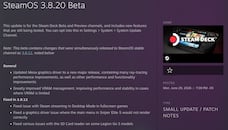
In April 2026, Natalie Vock, a software engineer famous for contributions to Valve's Linux gaming stack, published a series of patches to improve VRAM usage on Linux, largely directed at devices with dGPUs with limited VRAM, and now that patch has seemingly also been adopted by Valve itself in the latest SteamOS Beta update 3.8.20. The update notes denote this as "Greatly improved VRAM management, improving performance and stability in cases where VRAM is limited," which should help improve performance for Valve's Steam Machine at higher resolutions. Of course, this update should also improve performance for DIY Steam Machines and other dGPU gaming machines running Valve's SteamOS. It should be noted that there may be little to no performance improvements for iGPUs, since they share system memory and VRAM already, and overflowing to system memory was what was causing performance issues.
In Vock's testing and subsequent testing of an implementation of the dmemcg-booster and the patches on CachyOS, performance on low-VRAM GPUs was nearly doubled in some cases, making games that were previously unplayable just barely smooth enough to play on the aging hardware. The SteamOS 3.8.20 Beta update also updates the Mesa graphics driver to a new major release, specifically Mesa version 26.1.2, which adds support for a number of ray tracing features and improves support for new Intel GPU hardware and stability for both frame rates and shader compilation under OpenGL and Vulkan. It also includes fixes for bugs with the Legion Go S SD card reader, issues with streaming in desktop mode, and graphics driver issues preventing Sniper Elite 5 from rendering correctly.
Source:
Valve
In Vock's testing and subsequent testing of an implementation of the dmemcg-booster and the patches on CachyOS, performance on low-VRAM GPUs was nearly doubled in some cases, making games that were previously unplayable just barely smooth enough to play on the aging hardware. The SteamOS 3.8.20 Beta update also updates the Mesa graphics driver to a new major release, specifically Mesa version 26.1.2, which adds support for a number of ray tracing features and improves support for new Intel GPU hardware and stability for both frame rates and shader compilation under OpenGL and Vulkan. It also includes fixes for bugs with the Legion Go S SD card reader, issues with streaming in desktop mode, and graphics driver issues preventing Sniper Elite 5 from rendering correctly.


7 Comments on SteamOS Beta Update Adds dGPU VRAM Management Patch
- This: "... which should help improve performance for Valve's Steam Deck at higher resolutions."
- And this: "It should be noted that there may be little to no performance improvements for iGPUs, since they share system memory and VRAM already, and overflowing to system memory was what was causing performance issues."
the moment it shits itself is when it has to have a spillover to a physically separate memory pool because then you're dependent on the latency of the interconnect of those two pools, which is notoriously abysmally slow for the intended result
it will still perform like crap if your game use more than the amount of VRAM you have, but at least, SteamOS (or other linux distro using the patch) will maximise the VRAM for your games.
For the exact details, there is the blog of the author.
pixelcluster.github.io/VRAM-Mgmt-fixed/