Friday, February 20th 2026

Intel's "Bartlett Lake-S" Core 200E Family Leaks: Up to 12 P-Cores and 5.9 GHz ST Boost
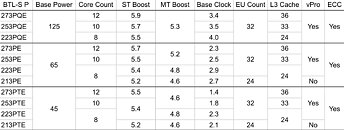
Thanks to a new table specification matrix published by a known leaker Jaykihn on X, we are seeing the final specifications of Intel's long-rumored "Bartlett Lake-S" Core 200E family of CPUs with P-Cores only. This platform is designed to fit inside Intel's LGA-1700 socket, but from a consumer standpoint represents a non-existent product that will not reach their hands, as Intel has abandoned the plan to launch this highly anticipated gamer CPU. Instead, Intel will only offer it for its edge and embedded products. At the top of the stack is the Core 9 273 PQE SKU, which is a 12 P-Core variant with 24 threads and a base frequency of 3.4 GHz. This model can boost all of its 12 cores to 5.3 GHz, while a single thread can go up to 5.9 GHz independently for tasks that require intensive single-threaded performance. It is equipped with 36 MB of L3 cache and an integrated GPU with 32 EUs of Xe-LP graphics.
Interestingly, the entire lineup is separated into three categories. One is a high-TDP PQE with a base power of 125 W, while the middle PE models are 65 W designs with lower clocks. The weakest models are the PTE SKUs that have a TDP of 45 W, which are more ideal for edge deployments where power/efficiency is the most important factor. Across the lineup, there are versions with 8, 10, and 12 cores, all with Hyper-Threading for 16, 20, and 24 threads. Some SKUs from the PE and PTE lineups do not enjoy Intel vPro and ECC memory support, while the PQE high-power SKUs are all equipped with vPro and ECC memory support. You can check out the complete table comparison and product segmentation below for more specific information on different models.
 Finally, it is again worth pointing out that Intel will not officially support these CPUs on its LGA-1700 platforms for gamers. Some motherboard manufacturers might release BIOS updates for their LGA-1700 boards to support these CPUs, but an official launch for consumers is no longer planned. Intel basically scrapped that idea and instead decided to push out the "Arrow Lake Refresh" for the LGA-1851 rather than bringing another CPU generation to its older LGA-1700. Companies like ASRock have confirmed that the "Bartlett Lake-S" Core 200E will not be coming to consumer motherboards and will instead only end up in the embedded and edge computer sector.
Sources:
@jaykihn0 on X, via VideoCardz
Interestingly, the entire lineup is separated into three categories. One is a high-TDP PQE with a base power of 125 W, while the middle PE models are 65 W designs with lower clocks. The weakest models are the PTE SKUs that have a TDP of 45 W, which are more ideal for edge deployments where power/efficiency is the most important factor. Across the lineup, there are versions with 8, 10, and 12 cores, all with Hyper-Threading for 16, 20, and 24 threads. Some SKUs from the PE and PTE lineups do not enjoy Intel vPro and ECC memory support, while the PQE high-power SKUs are all equipped with vPro and ECC memory support. You can check out the complete table comparison and product segmentation below for more specific information on different models.


20 Comments on Intel's "Bartlett Lake-S" Core 200E Family Leaks: Up to 12 P-Cores and 5.9 GHz ST Boost
www.overclock.net/posts/29559249/
www.mouser.com/ProductDetail/Intel/CM8071506031056?qs=PBDs2xEllI%2FGaJ6%2F%2F1hBuQ%3D%3D
Also compared to a 9900X, its a monolithic die vs. having 12 cores split between 2 CCD's and an IO Die.
Pretty much no capacity for us peasants
Everything you wrote is logical. It is just that none of it matters to the large majority of DIY gamers. Throwing us a bone aka gaming centric DDR4 compatible Bartletts would be a big W.