Friday, May 1st 2026

AMD Ryzen AI Halo Mini-PC to Arrive in June
AMD previewed its Ryzen AI Halo mini-PC during the CES 2026 showcase, and the machine is set to be released as soon as June arrives. According to a Reddit user, AMD presented a Ryzen AI Halo box during AMD AI Dev Day, showcasing the system in its full glory. This machine is powered by a Ryzen AI Max 395+ APU, featuring a 16-core/32-thread "Zen 5" CPU, a large integrated GPU based on the RDNA 3.5 graphics architecture with 40 compute units, and a Microsoft Copilot+ ready NPU with 50 TOPS. It supports up to 128 GB of unified LPDDR5X memory, is compatible with Windows 11 and Linux, and comes with pre-loaded AI models optimized for the hardware. At the AI Dev Day, AMD demonstrated the device running on the Ubuntu operating system, which is likely to be the preferred OS for many AI developers targeted by this system.
AMD has developed an innovative cooling solution for the "Strix Halo" SoC, which includes a baseplate, a network of direct-touch flat heatpipes, an aluminium channel heatsink, and two lateral airflow blowers. AMD stated that the Ryzen AI Halo AI developer platform will be available from Q2 2026 which matches this supposed June launch. Interestingly, the price of this 128 GB model remains unknown, which is the biggest mystery, but don't expect it to come cheap. Below are some of the first real-life pictures, showcasing the design illuminated by a programmable RGB strip surrounding the box.
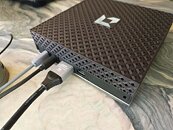
 While users could run games on it, the device features an integrated RDNA 3.5 GPU with 40 CUs, which is not the latest and most powerful graphics that AMD offers. The primary audience for this device would be local AI developers, as AMD has placed its most powerful APU in a compact box to provide an alternative to NVIDIA's DGX Spark platform. This should be sufficient for good compute performance and local AI development. With its large unified VRAM, large language models with sizes beyond 70 billion parameters should run on this box without issues, although we are still awaiting the first benchmarks.
Sources:
Reddit, via VideoCardz
AMD has developed an innovative cooling solution for the "Strix Halo" SoC, which includes a baseplate, a network of direct-touch flat heatpipes, an aluminium channel heatsink, and two lateral airflow blowers. AMD stated that the Ryzen AI Halo AI developer platform will be available from Q2 2026 which matches this supposed June launch. Interestingly, the price of this 128 GB model remains unknown, which is the biggest mystery, but don't expect it to come cheap. Below are some of the first real-life pictures, showcasing the design illuminated by a programmable RGB strip surrounding the box.


9 Comments on AMD Ryzen AI Halo Mini-PC to Arrive in June
Who is the target market for this? Everybody who wants this kind of APU but doesn't need Nvidia hardware has certainly already bought Strix Halo from Framework, Corsair, etc. (or gotten a Mac Studio). And why would new customers who want this product buy AMD's first-party box instead of a third-party box from a vendor they may already have a relationship with?
I have myself a laptop (g1a with all the ram, bought months before the rampocalypse) with the chip and I'm looking at something similar to be my home LLM machine.
But I doubt that'll be the case and I believe they just want the extra profit and will price it higher than partners, similar to how Nvidia has done with the DGX Spark.
Releasing a first-party model an entire year later is just nonsensical. Why even bother? Was anybody waiting a year for a first-party model before buying a Strix Halo desktop? No, of course not.
AMD never misses an opportunity to miss an opportunity.