News Posts matching #price hike

Return to Keyword Browsing

Memory Shortage Just Started, Major Price Hikes Ahead, Warns Team Group

Memory markets are currently facing a significant supply shortage, with December contract prices for key DRAM categories increasing by 80 to 100%, according to Team Group general manager Gerry Chen. He described this substantial price hike as the beginning of a multiyear memory upcycle and warned that the most severe impact will be felt in the first half of 2026, once distributors deplete their inventories. This price shock is already affecting the system bills of materials for OEMs, with memory's share in PC and notebook BOMs rising from the mid-teens to the mid-20s and higher, depending on the configuration.

Costs for DDR5 and SSDs have, on average, increased two to three times. For overall DRAM, it is 171.8% year-over-year. Cloud service providers are securing allocations for 2026 and 2027, which reduces the available supply for consumer and mainstream devices. This situation risks significant shipment declines in cost-sensitive segments like mainstream PCs, notebooks, and Chromebooks. However, even the powerful hyperscalers cannot secure all the DRAM allocations, as Tier-1 U.S. and Chinese cloud order books are filled to an effective 70% capacity, eliminating the safety stock that most buyers thought they had secured.

NAND Flash Wafer Supply Tightens Further, Some Products See Over 60% Contract Price Hikes in November

TrendForce's latest research shows that demand for NAND Flash stayed strong in November 2025, fueled by AI applications and solid enterprise SSD orders. Meanwhile, suppliers continued to focus on capacity for high-margin enterprise and premium products, while old-node capacity was quickly phased out.

This led to a further tightening of wafer supply, causing November contract prices for mainstream wafers to rise sharply. Monthly average price increases varied from 20% to over 60% across all product categories, with the surge quickly expanding to all density segments.

HP to Raise Prices, Cut Specs Due to Memory Cost Surge

HP says rising memory costs will likely push PC prices higher next year, or force the company to ship systems with less RAM. The warning comes as DDR5 pricing has surged more than 200% in recent weeks due to the ongoing memory shortage. CEO Enrique Lores told investors yesterday during HP's earnings call that HP has enough RAM stockpiled to get through the first half of its fiscal year, which began this month. But starting in May, higher memory costs will begin hitting margins. To compensate, HP is preparing to source cheaper suppliers, redesign some products with lower memory configurations, cut internal costs, and raise prices where necessary. According to Lores, the impact will be felt mostly in lower-end PC categories, which tend to be more sensitive to component cost changes. Any price increases will be rolled out selectively based on market and product segment.

HP isn't alone. CyberPowerPC, announced on X that the company will implement a price increase across all its SKUs on December 7, 2025. MAINGEAR, a major prebuilt PC manufacturer, is feeling the effects of ongoing memory shortages. CEO Wallace Santos told Wccftech that prices will keep rising and lead times will stretch as stock becomes limited. "We are in constant communication with our vendors and will delay these increases for as long as possible," Santos said. With the DRAM and NAND flash shortage showing no signs of ending, the situation could persist for some time. On its marketplace, Framework now lists all DDR5 or DDR4 SODIMMs as "coming soon," effectively halting standalone RAM sales. We'll end on that note, after a month overflowing with news of rising component costs.

Framework Halts Selling of Standalone RAM, Anticipates Increased Memory Prices

Framework has updated some of its component store listings, in reaction to fluid conditions that have affected computer memory supplies. In a reply to Jeff Geerling's musings regarding recent ludicrous price hikes, the North American modular PC specialist provided a short explanation: "the memory market is in a bad spot. We haven't changed our memory pricing, but we did have to delist standalone memory from our Marketplace to head off scalpers and preserve inventory for people buying it with our DIY Edition laptops." Over the past week and a half, several tech large players have started shifting production priorities.

At the time of writing, Framework's marketplace does not display any available stock of DDR5 or DDR4 SODIMMs. Every relevant item is marked with a "coming soon" tag. The company's prioritization of DIY laptop customers is a noble gesture, but this morning's social media activity also disclosed some troubling developments: "our memory costs from our suppliers are increasing substantially though, so it is likely we will need to increase memory pricing soon."

AMD Prepares 10% GPU Price Hike Amid Memory Shortage

AMD has reportedly notified its supply chain that it will increase pricing across its entire GPU product line by about 10%. The main driver behind this is the massive memory shortage driving DRAM prices to skyrocket and eating up all the margins for GPU makers. Apparently, AMD's AIB partners have been notified that AMD plans to implement a 10% price increase across the board, which AIBs will likely match in the coming weeks to preserve their margins. GPU makers like AMD (and NVIDIA/Intel) bundle their GPU dies with GDDR memory and send that to AIBs as a kit. In situations like this, when AMD raises GPU prices, it is due to the cost of the DRAM bundled with the GPU, as the costs of AMD's raw silicon remain stable for now.

Additionally, this is AMD's second recent GPU price increase. The company did some price restructuring in October, but it seems that the memory supply chain is now starting to show signs of weakness and that a full 10% increase is needed. We have reported that AMD's long-standing AIB partner, PowerColor, is now urging gamers to purchase GPUs during this holiday season, and that 2026 is when we will see this price hike. It could be that AIBs have locked their pricing mechanisms for now with the old AMD pricing, and that 2026 will be implementing the new pricing strategy. This is also happening just as AMD's Radeon RX 9070 and Radeon RX 9070 XT graphics cards have finally reached their MSRPs of $549 and $599, respectively.

NVIDIA Demand May Double LPDDR5X and Server DRAM Prices in 2026

Counterpoint Research expects memory prices to keep climbing through 2025 and into early 2026. The firm says DRAM prices could rise another 30% in Q4 2025, followed by up to 20% more early next year. This comes on top of roughly 50% price increases already seen this year. The main pressure right now is on older memory. LPDDR4 supply has tightened as manufacturers shift production to newer parts for AI hardware. That shift has created odd price gaps: DDR5 for PCs and servers is trading around $1.50 per gigabit, while DDR4, used in low-end phones and other consumer gear is selling for about $2.10. Even HBM3e is currently cheaper at around $1.70. Counterpoint expects DRAM output to grow by more than 20% in 2026 as Samsung, SK hynix, Micron, and China's CXMT ramp up production. But the bigger problem may be further ahead. NVIDIA's plan to use LPDDR in future AI systems puts it on par with a major smartphone vendor, something the LPDDR supply chain has never had to support. LPDDR also shifts error correction away from DDR5 ECC modules and onto the CPU, a change that could reshape server designs.

In a tight supply scenario, Counterpoint warns DDR5 RDIMM prices could double between early 2025 and the end of 2026. For now, the worst impact is hitting budget smartphones that still rely on LPDDR4. But analysts expect the strain to spread to mid-range and high-end devices, raising bill-of-materials costs by as much as 25% for some models. That could squeeze margins or slow shipment growth—or both. The report adds that broader risks like tariffs, geopolitics, and labor costs make the outlook even more volatile.

GPU Price Hikes Coming in 2026, Warns PowerColor

A series of shocking news about price hikes continues to unfold, as we now receive official "warnings" from GPU AIB partners about the situation. On the official PowerColor subreddit, a representative noted that Holiday 2025 discounts are about to commence, but also claimed that prices will rise in 2026, urging gamers to buy before the increase. While this could be a marketing tactic, the recurring theme of warnings is becoming more prominent in the supply chain. Previously, we reported that DRAM prices have risen significantly—171.8% year-over-year—driving costs to new levels for this essential component found in every GPU, smartphone, PC, and console.

South Korean memory giants, such as Samsung and SK Hynix, are currently unable to fulfill all orders, completing only 70% of them. Smaller OEMs and channel distributors have been informed to expect only 35-40% fulfillment through the first quarter of 2026. Even some larger AIBs, like PowerColor, may face shortages in DRAM supply, potentially leaving their GPUs without installed DRAM modules. This situation not only delays their planned product rollouts but also jeopardizes their expected revenue streams if it persists. They are faced with the choice of either gambling on the spot market for a significant markup or leaving their production lines idle. Additionally, the shortage could ultimately increase the price of GPUs that are shipped, as they now contain a rarer commodity—DRAM.

AMD Reportedly Planning GPU Price Increase as Memory Costs Spike

AMD is reportedly preparing for a round of GPU price increases, with rising memory costs cited as the reason. Posts on the Chinese Board Channels forum claim AMD told partners that memory prices have climbed enough that its next wave of GPUs will ship at higher prices. The first price increase, back in October, was small and never showed up at retail, but this new increase is said to be larger and apply to all models, from Radeon gaming cards to workstation GPUs and AI parts. There's no confirmed date, and AMD hasn't commented publicly. The memory market has tightened sharply as AI demand consumes available supply. DDR5 prices have jumped as much as 60% since September, and broader DRAM pricing is up roughly 170% year over year. GDDR6, the memory used in most graphics cards, has climbed by around 30% as manufacturers shift more capacity toward server DDR5, HBM, and AI hardware.

For gamers, the timing isn't great. Radeon RX 9070 XT prices had only just started to stabilize; one ASRock Challenger card in the US recently slipped to its official $599 MSRP, and European pricing has finally settled near launch levels after months of inflated street prices. NVIDIA is also rumored to be planning a similar price hike in early 2026. Neither AMD nor NVIDIA is driving the increases, both are caught in the same memory crunch. As usual with reports like this, it can take weeks before any change appears at retail.

Capacity Constraints Hit Intel as Demand Outstrips Intel 10/7 Node Supply

Intel's Q3 earnings delivered a solid number, but a few interesting things are happening at Intel's Fabs that aren't related to any leading-edge node production. According to Intel CFO David Zinsner, "In Q3, Intel Foundry delivered Intel 10 and 7 volume above expectations," indicating that demand for Intel's products built on these nodes is significantly exceeding supply. Zinsner noted, "Capacity constraints, especially on Intel 10 and Intel 7, limited our ability to fully meet demand in Q3 for both data center and client products," suggesting strong demand for Core and Xeon processors built on these nodes.

Intel first introduced Intel 7 node, previously known as 10 nm Enhanced SuperFin, with 12th Generation "Alder Lake." However, that is now discontinued and Intel continues to ship 13th Generation "Raptor Lake" and 14th Generation Core "Raptor Lake Refresh" client CPUs on the Intel 7 node. For Xeon server chips, the company uses the Intel 7 node for the 4th Generation "Sapphire Rapids," 5th Generation "Emerald Rapids" Xeon Scalable and manufactures the I/O die for the latest "Granite Rapids" Xeon 6, where the compute dies are made on the Intel 3 node. High demand from the gaming sector for 13th and 14th Gen gaming CPUs, along with strong demand for Xeon processors, has created a manufacturing bottleneck. Intel will prioritize delivering data center products first and gaming products second.

DRAM Prices to Continue Rising in 4Q25, Server Demand Surges Ahead While Legacy Process Products See Steeper Increases

TrendForce's latest investigations reveal that the three major DRAM suppliers continue to allocate advanced process capacity primarily to high-end server DRAM and HBM, crowding out capacity for PC, mobile, and consumer applications. Combined with diverging demand across end products, this dynamic is keeping legacy-process DRAM price hikes pronounced, while newer-generation products are seeing more modest gains. Overall, conventional DRAM prices are expected to rise 8-13% QoQ in 4Q25, and when HBM is included, the increase could widen to 13-18%.

PC DRAM prices edge up slightly, U.S. CSPs consider early server DRAM procurement
Shipments of finished PCs are projected to decline with PC promotions and restocking momentum slowing in 4Q25, leading major OEMs to cut DRAM bit procurement. Meanwhile, as the three suppliers aggressively shift capacity toward server DDR5, the supply of both PC DDR5 and DDR4 remains constrained. As a result, PC DRAM prices are forecast to continue edging upward through the quarter.

SK Hynix Begins 1b DRAM Pilot Production While Negotiating Customer Price Adjustments

SK Hynix is installing a new pilot production line at its M15X facility in Cheongju, bringing online a new 1b DRAM manufacturing line designed to address surging HBM demand, The Bell reports. Equipment installation is scheduled to be completed by November with the pilot line targeting an initial monthly output of 10,000 wafers. The move highlights different approaches among memory leaders, while Samsung pursues 1c DRAM technology for HBM4 applications, both SK Hynix and Micron have committed to 1b DRAM architecture, according to Aju News. This difference reflects varying technical roadmaps as companies race to capture as much as they can from the expanding AI memory markets.

On the other hand it seems that memory price adjustments have become a widespread practice. TrendForce reports citing SeDaily and Business Korea notes that SK Hynix has entered price negotiations with customers, however, no formal announcement has been made yet. The company is tweaking its prices in line with current market trends. This hints at a unified industry shift towards pricier memory across all big-name suppliers. Micron kicked things off in September first letting its channel partners know about 20-30% price hikes for DRAM. Samsung followed by informing major customers that Q4 contract prices for DRAM products, including LPDDR4X and LPDDR5/5X variants, would rise 15-30%. NAND pricing isn't immune either—eMMC and UFS contract prices are expected to climb 5-10%. On the same note, TrendForce indicates suppliers are ramping QLC SSD production, with capacity utilization projected to continue its growth through 2026. Inference AI workloads are expected to sustain demand into 2027, potentially creating enterprise SSD supply constraints by 2026.

Western Digital Announces HDD Price Hikes Effective Immediately

Industry insiders cited by TrendForce say wait times for HDDs now stretch to almost a year. This has pushed Western Digital to join other companies in raising storage prices across its whole HDD range. Western Digital becomes the third major storage maker to change its prices. SanDisk upped its NAND prices by 10%, while Micron froze its prices for a week. The company points to sky-high demand for all its HDD sizes as the reason for these gradual price hikes. It also cites ongoing work on cutting-edge technology. Western Digital plans to ship more products by sea, which will add 6-10 weeks to current shipping times. The company asks customers to keep these longer delivery times in mind when they place orders.

With cloud giants like Google and Oracle increasing efforts to enhance their infrastructure, the impact on the demand for high-capacity storage is adding tension to the storage market, causing a significant mismatch between supply and demand. To tackle the long wait times for HDDs, memory makers are working hard to come up with Nearline SSD options. They aim to shrink the price difference between SSDs and HDDs from 4 to 5 times to about 3 times making SSDs more tempting for customers who don't want to wait for HDDs. The storage industry is adjusting its prices because of the huge demand for infrastructure as AI services grow fast and suppliers are having a tough time ramping up production to keep up with the sky-high demand for all types of storage.

Flash Memory and Chip Prices Rise as TSMC, SanDisk Announce Hikes

TSMC will implement significant price adjustments beginning in 2026, targeting advanced nodes below 5 nm with increases ranging from 5% to 10%, TrendForce reports. The world's largest contract chipmaker currently sells 3 nm wafers for approximately $20,000 each, but expects 2 nm wafers to exceed $30,000 when mass production begins in late 2025. These changes affect major customers including Apple and NVIDIA. TSMC's investments of over $65 billion in Arizona facilities represent a key factor in this pricing strategy since the U.S. plant started 4 nm production in early 2025. AMD's Lisa Su confirmed these overseas facilities cost 5-20% more to operate than Taiwan-based manufacturing due to various operational factors. The price increases show TSMC's efforts to maintain gross margins above 53% while Arizona operations are expected to reduce company-wide margins by 2-3% initially, potentially reaching 3-4% over time.

Meanwhile SanDisk announced a 10% price increase for all channel partners and consumer products, effective for new orders placed after September 5th. SanDisk says this decision is based on the increasing demand from AI applications, data centers, and mobile devices. The company plans regular price reviews with potential future modifications, while TSMC may reduce prices for mature manufacturing processes where cost pressures remain manageable.

DDR4 and LPDDR4 Supply Tightens Sharply in 2H25 as Structural Shortage Drives Strong Price Surge

TrendForce's latest findings reveal the DDR4 market is set to remain in a persistent state of undersupply and strong price growth through 2H25. Rigid server orders are crowding out supply for the PC and consumer markets, forcing PC OEMs to accelerate DDR5 adoption.

Manufacturers of consumer electronics, meanwhile, are struggling with high prices and material shortages. The tight DRAM supply-demand balance has also pushed up mobile DRAM contract prices, with 3Q25 LPPR4X posting the largest single-quarter increase in nearly a decade.

Original Nintendo Switch Gets Price Bump in Canada

Mere weeks after Nintendo launched the Switch 2 to international audiences, the Japanese gaming giant has announced that the original Nintendo Switch will be subject to price increases in Canada. In a press release announcing the price increase, Nintendo of Canada confirms that all original Nintendo Switch consoles, including th OLED and Lite models, physical and digital games, and Switch accessories—as well as the Amiibo and Nintendo Switch Online memberships—will be affected by the price change.

In the announcement, Nintendo blames "market conditions" for the price change and specifies that the Nintendo Switch 2 will not be affected by the price change. According to Eurogamer, the price adjustment may be related to the strained international trade relations between Canada and the United States, and the price change comes after Nintendo briefly delayed the Switch 2's launch in both the US and Canada in response to tariffs imposed by the United States. Nintendo has not announced what the price increase will look like, but it has confirmed that the price increases will take effect on August 1, whereupon Nintendo of Canada will announce the new pricing.

DDR5 Price Uptrend Weakens, Overall DRAM Prices to Cool Down in Q3 2025

The memory market starts to show a slowdown after months of steady price hikes according to TrendForce's latest memory spot price trend report. DDR5 memory prices, which had been going up consistently, are now stabilizing as they've hit fairly high levels that sometimes go beyond contract prices. While DDR5 still sees small price increases compared to DDR4, buyers and traders are growing more wary and leaning towards DDR4 products. The common DDR4 chips (i.e., DDR4 1Gx8 3200 MT/s) saw a big 12.8% rise this week going from $2.18 to $2.46, but industry experts think these big price jumps will ease off in the third quarter.

NAND flash memory prices are cooling off after big jumps since late February. NAND flash chip costs have shot up, but customers are losing interest as more products flood the market. This change in supply and demand is showing up in the numbers - 512 GB TLC chips dipped by 0.18% this week to $2.73, as buyers take a "wait and see" approach. The big picture hints that the memory market might be settling down after months of steep price hikes. Nevertheless, major North American cloud providers' AI investments drive enterprise SSD demand surge, creating a supply shortage and supporting up to 10% quarterly price increases in Q3 2025.

Sony Leadership Contemplating Price Hikes & Potential US Production Line for PS5

A month ago, Sony increased its PlayStation 5 home console prices for EMEA and ANZ regions—affecting customers in Europe, Middle East, Africa, Australia and New Zealand. At the time, industry experts surmised that company leadership was considering a similar strategy for a primary market: North America. Instead of freshly implemented 25% upward hikes for certain products/packages, reports suggested a 30% climb—for the North American market. Weeks later, company leadership has discussed this hot topic. During yesterday's (projected) earnings call with investors, top brass confirmed their consideration of "passing along" additional costs to consumers—in response to a reported/anticipated 100 billion yen (~$680 million) impact from US tariffs. They outlined a stockpile of PS5 consoles; enough units have been accumulated for roughly three months of supply—unaffected by adjusted conditions, in the States.

Despite this provision, Hiroki Totoki—Sony's president/CEO—is open to exploring alternative production avenues, in the face of looming extra charges. When asked about this matter, he replied with: "hardware can of course be produced locally, I think that would be an efficient strategy. PS5 is being manufactured in many areas, whether it is going to be manufactured in the US or not—it needs to be considered going forward." In efforts to navigate a trying situation, Nintendo has juggled its geographic manufacturing footprint—recent-ish developments have shifted away from a complete reliance on Chinese facilities. Industry insiders reckon that the bulk of US-bound Switch 2 units will be Vietnamese-made. Like Sony, Nintendo's executive team has publicly disclosed thoughts about future price hikes—maybe following the launch of its much-anticipated "next-gen" hybrid console. Earlier this month, Microsoft upped modern Xbox portfolio price tags—affecting customers across the world.

NVIDIA Reportedly Warns Chinese AICs About Potential GeForce RTX 5090D GPU Supply Cut-off

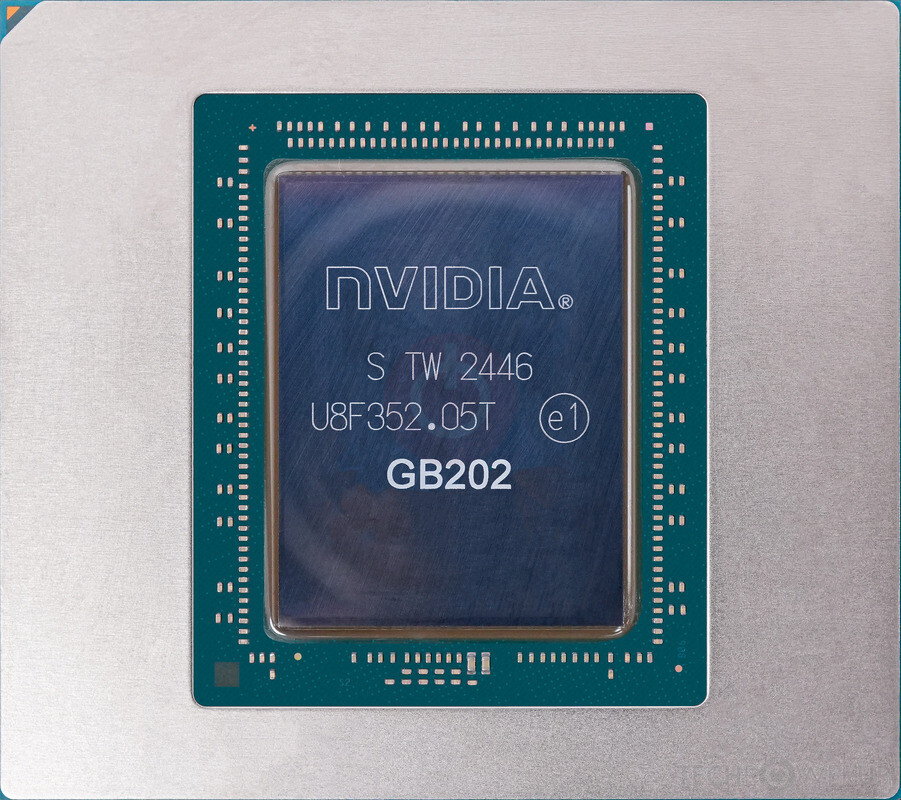
Mid-way through April, we heard about sanctions affecting shipments of NVIDIA's H20 AI chips into China. Despite (rumored) best efforts made by Jensen Huang and colleagues, the US government has banned the export of Team Green's formerly sanction-conformant design. Similarly, NVIDIA prepared a slightly less potent GPU for gaming applications—exclusively for the Chinese market. Despite sporting a restricted GB202 "Blackwell" GPU die, the GeForce RTX 5090D 32 GB is still a monstrous prospect. According to Chinese PC hardware news sources, Team Green representatives have sent alerts to "all" of its Chinese add-in-card partners (AICs)—early warning signs have indicated a possible cut-off of GB202 GPUs in the near future. A member of the Chiphell forum disclosed some insider knowledge and dismissed unfounded speculation about RTX 5090D cards being replaced by "full fat" RTX 5090 options.

sthuasheng commented on Team Green's alleged bulletin—distributed at some point last week: "the notice only said that the supply of RTX 5090D was suspended, ...this did not mean any sales or transportation ban; it urged everyone not to make any speculations or judgments unless there was an official notice issued at a later date. After this notice was issued, each AIC began to notify agents to suspend sales, because the inventory of 5090D has always been very small, so it is necessary to keep these stocks to observe the subsequent situation and deal with the subsequent after-sales. At the same time, we might as well speculate that each AIC and dealer may also have the intention to stockpile 5090D units and then sell them at an elevated price." BenchLife.info decided to reach out to industry moles, following an absorption of various Chiphell whispers.

Notebook Industry Remains Cautious Amid Tariff Negotiations; 2025 Brand Shipments Growth Revised Down to 1.4%

TrendForce's latest research reveals that although the U.S. has granted a 90-day grace period before implementing reciprocal tariffs—offering temporary relief for notebook brands—the broader market remains clouded by policy and economic uncertainty. Brands began frontloading inventory in late 2024, pushing Q4 shipment growth to 5.1%, with 1Q25 seeing a 7.2% YoY increase.

However, given persistent economic weakness and rising tariff risks, TrendForce has revised the full-year 2025 notebook brand shipment growth forecast downward from 3.6% to just 1.4%.

Sony Increases the PS5 Pricing in EMEA and ANZ by Around 25 Percent

Sony has announced that it has increased its pricing for the Playstation 5 consoles by around 25 percent from today in several regions. For now, it's Europe, Middle East, Africa, Australia and New Zealand that are being affected, but there are reports of Sony also planning on increasing the price in the US by at least 30 percent. Sony's official reason behind the rather steep price increase is due to "a backdrop of a challenging economic environment, including high inflation and fluctuating exchange rates".

The new pricing for the PS5 Digital Edition will be €499.99 in the Eurozone, £429.99 in the UK, AU$749.95 in Australia and NZ$859.95 in New Zealand. Sony didn't reveal pricing in other currencies and instead says to check with your local retailer for the new pricing. For now, the EU and the UK avoid price hikes on the PS5 with Ultra HD Blu-ray disc drive as Sony so elegantly calls it, whereas in Australia it'll increase to US$829.95 and in New Zealand it'll cost NZ$949.95. Sony will also announced a decrease in the price on the stand alone Blu-ray drive today and it will cost €79.99, £69.99, AU$124.95 and NZ$139.95. The PS5 Pro is not receiving a price hike for the time being.

Samsung's 2 nm GAA Node Process Test Yields Reportedly Pass 40% Mark

According to the latest South Korean semiconductor industry whispers, Samsung's 2 nm GAA node process (aka SF2) development team has hit another pleasing experimental production milestone. An Asia Economy SK news article has sourced insights from inside track players—one unnamed mole posited that: "the 2 nm yield currently under development at Samsung Foundry is much better than previously known...and more positive than the (reportedly abandoned) 3 nm process." A combination of relatively new leadership and a rumored welcoming of first wave High-NA EUV equipment has likely bolstered next-gen efforts, after late 2024's alleged failure of 3 nm prototypes. Leaks from earlier in 2025 indicated SF2 test yields wavering around 20-30%; far from ideal—back then, insider reports suggested that TSMC was well on the way to achieving 60% rates with a competing 2 nm product line. Asia Economy has picked up on mutterings about Samsung's current progress—latest outputs: "have exceeded 40% in the wafer testing stage at a post-processing company."

Industry watchdogs reckon that the South Korean's foundry business is making good progress; perhaps on track to commence speculated mass production by the third quarter of this year—just in time to get finalized flagship "Exynos 2600" mobile chips in the manufacturing pipeline. The Taiwanese rumor mill indicated a major milestone "completion" of TSMC's 2 nm trial phase at some point last month—insiders mentioned excellent yield rates: in the region of 70-80%. Cross-facility mass production could start later this year, but experts propose that the market leader will be implementing price hikes. These "elevated charges" could send loyal TSMC customers in the direction of an alternate source of 2 nm wafers: Samsung. Fresh semicon biz gossip has the likes of Apple, AMD and NVIDIA in the picture.

NVIDIA Adjusts GeForce RTX 50 Series Pricing in Europe; Slight Reduction Result of Favourable Exchange Rate

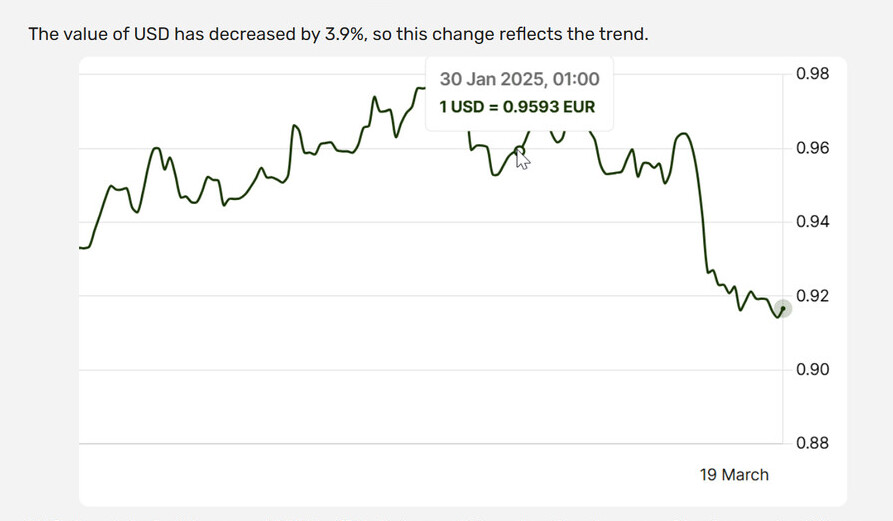
Graphics card price watchers have highlighted refreshing downward motion in Europe, apparently affecting three out of the four GeForce RTX 50 series graphics cards. VideoCardz received a couple of email tip-offs from its pan-European audience, prompting the publication of a short investigative piece. NVIDIA's slight adjustment of official pricing for GeForce RTX 5090, RTX 5080, and RTX 5070 models is the result of a strengthened Euro. The US dollar's value has dropped by roughly 3.9 %; according to recent detective work, focusing on German trends. Team Green's "generous" reductions have arrived roughly two weeks after a stabilization of the USD-EUR exchange rate.

Curiously, the GeForce RTX 5070 Ti is an outlier here—NVIDIA did not reduce its German guide price (€879 + VAT) for this upper-mid-range offer. A Founders Edition does not exist at this GPU level, so Team Green has tasked its board partners with the creation of so-called "MSRP conformant" alternatives. One of VideoCardz's tipsters has observed various GeForce RTX 50 series models simply "rotting on shelves," due to potential buyers balking at unreasonable retailer-implemented price hikes. NVIDIA's minor changes (4.3 to 4.6 %) are unlikely to make a noticeable impact across the Euro zone.

ASUS Implements Another GeForce RTX 5090 Price Hike, PRIME RX 9070 XT "MSRP" Adjusted to $719

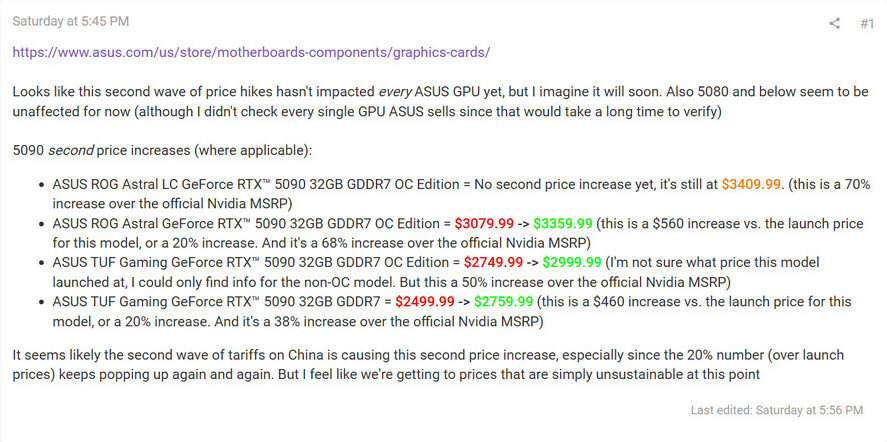
"Second wave" ASUS price hikes were documented online over the past weekend; affecting air-cooled premium ROG Astral and mid-tier TUF Gaming GeForce RTX 5090 models. Looking at the company's North American webshop, visitors noticed a freshly adjusted price for the ROG Astral GeForce RTX 5090 32 GB OC Edition—going from a previous level of $3079.99 up to $3359.99. Curiously, the asking price of a liquid-cooled sibling was not adjusted—remaining at a "first wave" point of $3409.99. The "cheapest" model—TUF Gaming GeForce RTX 5090 (non-OC)—experienced a $460 (representing 20%) price hike, bringing total cost of ownership up to $2759.99. As a reminder, NVIDIA's baseline MSRP guideline was $1999—as announced at CES 2025—but ROG Astral and TUF Gaming designs demand a premium or two for fancier feature sets. VideoCardz has fervently explored worrying market trends in the recent past; several of NVIDIA's big board partner players have jacked up asking prices for GeForce RTX 50-series graphics cards. Availability of stock is still a major sore point for potential buyers, who were not able to secure launch day wares. Despite a driving up of costs, the ASUS US webstore has absolutely zero stock of GeForce RTX 5090 SKUs—at the time of writing.

In addition, VideoCardz and other PC hardware media outlets noted price hikes affecting the manufacturer's stable of recently launched AMD Radeon RX 9070 Series TUF Gaming and PRIME models. In the absence of AMD-built (MBA) reference card designs, board partners were tasked with the providing of baseline "MSRP" conformant custom cards. The ASUS PRIME Radeon RX 9070 XT OC and RX 9070 OC Editions were readied as $599 and $549 options (respectively). Weekend sleuthing work put the spotlight on newly adjusted price points of $719.99 and $659.99 (respectively)—representing further cases of plain 20% elevations over baseline. AMD's debut batch of RDNA 4 cards was met with unprecedented demand earlier on in March, but secondary/tertiary stock shipments face unclear market conditions—Team Red GPU enthusiasts have (similarly) voiced their collective displeasure about elevated prices at retail. Mid-way through last week, the PC hardware community heard about ASUS leadership considering a new pricing strategy. The company is reportedly accelerating its manufacturing exodus from China.

Reports Point to Price Hiking of MSI GeForce RTX 5070 Ti "MSRP" Cards

Over the past weekend, PC hardware news outlets spent time analyzing NVIDIA GeForce RTX 50-series price fluctuations. One keen market watcher—VideoCardz—has consistently stuck to a main theory of Team Green AIBs implementing last minute price hikes/market manipulations; coinciding with product launch periods. Almost two weeks ago, the online publication directed ire at ASUS and MSI—noted as very high profile board partners. The current GeForce RTX 5070 Ti graphics card lineup is populated by custom designs only; a Founders Edition was not made available within this tier. VideoCardz and Hardware & Co. have observed worrying price trends with AIB-produced models that are supposed to conform to NVIDIA's baseline MSRP of $749 (USD). Their latest reports singled out MSI's North American webstore—already a source of some contention.

Hardware & Co. (a French outlet) observed movement at the bottom-end of the manufacturer's "Blackwell" GPU lineup: "in the case of the GeForce RTX 5070 Ti launched on February 20, 2025, it took nine days...for a "big" brand to officially turn its back on NVIDIA MSRP. On Saturday (March 1), MSI has just updated its RTX 50-series catalog on its official American website with new prices for the RTX 5070 Ti. From now on, the cheapest reference is $820, $70 more than MSRP." VideoCardz is steadfast in its belief that GeForce RTX 50-series "MSRPs are a joke" at this point in time. MSI's VENTUS 3X and (newer) SHADOW 3X models are barebones packages that are designed as alternatives to basic first-party solutions (i.e. Founders Editions)—but VideoCardz has accused the manufacturer of becoming its own "scalper," with (apparently) little intervention coming from NVIDIA. At the time of writing, MSI's US webstore has updated its GeForce RTX 5070 Ti VENTUS and SHADOW listings. Prices have (temporarily?) reverted to original figures (refer to the third screenshot below); likely in reaction to recent "constructive" criticism levied by popular hardware news sites. As evidenced by a sea of "notify me" tags, the official North American store appears to have zero stock in their warehouse(s).

MSI RTX 5070 Ti VENTUS 3X Not Included in Launch Lineup, MSRP Models Reportedly Still in Short Supply

Over the past three weeks, press outlets and the buying public have levelled heavy criticism at NVIDIA board partners. The launches of three GeForce RTX 50-series "Blackwell" GPUs have—so far—been problematic; based on news reports and community feedback. Prior to release (on February 20), VideoCardz anticipated major price fluctuations for an all-custom portfolio of GeForce RTX 5070 Ti graphics cards. The publication did not hold back with its targeting of ASUS; one of Team Green's big time AIBs. Only a small selection of baseline MSRP ($749) conformant models were available on day one, and VideoCardz posited that manufacturers would implement price hikes soon after launch. A follow-up report continues their investigation into a lack of baseline MSRP options, as well as so-called "fake promotions."

VideoCardz repeated its belief that ASUS will jack-up the asking price for its PRIME GeForce RTX 5070 Ti model. When looking at Newegg's listing of baseline MSRP cards, the intrepid investigator stumbled up another notable absence: "we wrote three articles about the ASUS RTX 5070 Ti PRIME model not being listed as an MSRP card by retailers, which finally led ASUS to intervene (most likely for a limited time) to sell this card at the promised price. What we can immediately notice is the lack of the VENTUS 3X model from MSI, which was basically 90% of the MSRP card review coverage yesterday, as NVIDIA had no Founders Edition card for this launch and relied on board partners. In fact, the VENTUS 3X non-OC is not even included in the official launch, meaning that the card you saw yesterday in reviews is simply not available anywhere." It should be noted that TechPowerUp received an MSI GeForce RTX 5070 Ti Ventus 3X OC sample unit for evaluation purposes (review guide pricing was $749); Newegg lists this particular model with a current $829.99 price point, but stock is unavailable (at the time of writing).

Return to Keyword Browsing
Nov 11th, 2026 04:06 CST change timezone

New Forum Posts

Popular Reviews

TPU on YouTube

Controversial News Posts