News Posts matching #refresh

Return to Keyword Browsing

AMD Zen 6-Based "Medusa Point" APU Comes in 28 W and 45 W TDPs

A newly leaked NBD shipping manifest reveals that AMD plans to offer its upcoming "Medusa Point" mobile processors in two TDP options—28 W and 45 W—instead of a single configuration. The document mentions FP10-designated parts and separate heatsink entries for high and low TDP variants, indicating that AMD will provide distinct SKUs optimized for either efficiency in laptops and handhelds or sustained performance in mobile workstations. The "Medusa Point" is expected to fit into a slightly larger FP10 socket. However, this APU is scheduled for release in 2027, as 2026 is anticipated to be the year of the "Gorgon Point" generation, which will be a "Strix Halo" refresh with higher CPU clocks.

Architecturally, "Medusa Point" shifts from a single die approach in some segments by combining an N2P compute tile with an N3P I/O tile, while entry-level models will continue to use a cost-effective smaller monolithic N3P die. The CPU core complex is based on "Zen 6," which enhances compute capabilities and introduces new instruction support aimed at improving AVX software compatibility and efficiency. Graphics will continue to use an RDNA 3.5-derived design for the integrated GPU, extending AMD's current non-RDNA 4 roadmap for another product cycle.

Nightdive's "Blood: Refreshed Supply" Totally Rebuilt from Original Version's Source Code

On the surface, Blood: Refreshed Supply may not seem all that different from 2019's Blood: Fresh Supply. Both are remasters of the 1997 horror FPS from Monolith Productions, courtesy of the remaster specialists at Nightdive Studios. Of the two, Blood: Refreshed Supply is the definitive version. When players sink their teeth into this definitive remaster, they'll be treated to a pool of small but meaningful improvements that help it feel more authentic to the original than anything previously offered. This is in part because, unlike its predecessor, Blood: Refreshed Supply has been rebuilt from the ground up using the game's original source code.

Sourcing the Code
Nightdive Studios had yet to obtain the original source code for Blood when it started working on its initial remaster, Fresh Supply. Without the source code, Nightdive's developers had to reverse-engineer any missing or incomplete pieces of content from whatever materials were available to them at the time. As meticulous and detailed as reverse engineering sounds, it's ultimately a more tedious and less precise way to remaster a game, according to Nightdive's lead KEX developer, Samuel "Kaiser" Villareal.

Insider Claims Intel Already Planning Refresh of "Wildcat Lake" Budget CPU Family

In modern times, Intel has a propensity for "Refreshed" releases of existing CPU families. A fresh leak suggest that this pattern will continue, with the not-yet-released budget-focused "Wildcat Lake" mobile chip range. Earlier today, Jaykihn claimed that an upgraded variant will leverage an extra two power cores and two additional Low-Power efficient (LPE) units—previous leaks projected a deployment of "Cougar Cove" P-cores, and "Darkmont" low-power island cores for vanilla "Wildcat Lake" silicon. The July rumor mill produced evidence that Intel engineers were toiling away on an entry-level 6-core CPU design, supplemented by a low power iGPU (running two Xe cores), based on Arc Xe3 "Celestial" architecture.

A segment of desktop PC enthusiasts are eagerly awaiting the arrival of Team Blue's mildly updated "Arrow Lake-S" (ARL-S) processor series. Despite navigating a rocky path to launch—rumors of numerous stops and starts abound—the latest refreshed product line is expected to tumble out at CES 2026. It seems bizarre to pick up on "Wildcat Lake Refresh" inside track info at such an early stage; perhaps many months before Intel's supposed loose first or second quarter 2026 launch of non-upgraded "Core Series 3" units. Jaykihn outlined two "Wildcat Lake Refresh" core configurations—"2+0+4 and 4+0+4"—and an overall chiplet-based design.

Ayaneo Next II Gaming Handheld Will Feature AMD Strix Halo and 9-inch OLED Display

The Ayaneo Next II was recently revealed as a new gaming handheld powered by AMD's Ryzen AI Max+ 395 APU and its Radeon 8060S iGPU. Aside from those details and a few tidbits about the controller specifications, however, not much had been revealed about the new gaming handheld until now. Ayaneo recently posted a few additional details about the new plus-size Strix Halo gaming handheld on X, mostly centering on screen specs. Ayaneo also teased a launch event for November 28, 2025 at 23:30 PT (7:00 UTC).

According to the post, the Ayaneo Next II will have a 9-inch OLED display with a 165 Hz refresh rate, 2400×1504 resolution, and a native landscape orientation. This works out to a screen ratio of just under 3:2 (3:1.88, to be exact), and Ayaneo claims that this display is a custom, exclusive design, although it seems somewhat unlikely that it will stay this way for very long, given how competitive the high-performance gaming handheld market is getting these days—at the very least, we can likely expect other devices from Ayaneo to feature the same display at some point. Curiously, Ayaneo makes no mention of whether the display will feature VRR, although it seems unlikely that such a premium gaming handheld wouldn't.

New AGESA BIOS Code Rekindles Hope For Strix Point Desktop APUs for AMD Ryzen 9000G Series

We recently reported on a rumor that AMD would soon be launching desktop APUs based on its Krackan Point architecture that has until now only been featured in mobile parts. At first, it seemed as though Strix Point and its more powerful AMD Radeon 890M iGPU would be limited to the mobile side of things, however a well-known leaker, @9550pro on X, has recently pointed out that AMD's AGESA update version 1.2.7.0 does make mention of Strix Point in its code. This observation is backed up by further evidence shown in a post by @xgfancz on X, who pointed out that the list of architectures in the latest 1.2.7.0 AGESA beta update makes clear reference to "STX," presumably "Strix Point," alongside "PHX," which would be Phoenix Point, AMD's current Ryzen 8000G series of desktop APUs.

All of this suggests that AMD Ryzen 9000G desktop APUs may launch with Strix Point architecture instead of being limited to Krackan Point, as was previously the assumption. Stepping up from Krackan Point to Strix Point would mean that iGPUs in the Ryzen 9000G series may feature up to 16 CUs and RDNA 3.5 instead of RDNA 3 in the current APUs, which could mean gaming and iGPU performance right around the level of the likes of the AMD Ryzen Z2 Extreme now making its way to swathes of gaming handhelds. The AMD Ryzen 9000G desktop APUs aren't expected to launch until closer to the end of this year, and even if they do, there's no telling if they will launch at the same time as what is essentially the 8000G refresh we have seen in rumors before.

AGESA Update Hints at AMD Ryzen 9000G Desktop APUs Coming Soon

We have seen previous rumors claim that AMD would launch Ryzen 9000G series APUs for its AM5 platform sometime soon, although there has been no official announcement from AMD, yet. Most recently, though, data miners combing through AMD's AGESA 1207 code have managed to find evidence of new Krackan Point desktop APUs. Krackan Point has been spotted in MSI BIOS updates with references to the 00B60Fxx microcode, and the changelog for ASUS X870 beta BIOS versions mentions "new APU support," which could only really be Ryzen 9000G. These new APUs are said to be based on Zen 5, but previous leaks said that they would instead be a rehash of the 8000G APUs, making them a Zen 4 refresh. At any rate, it will likely still be a while before launch, since this is the first time the code has been spotted in desktop BIOS versions.

Until now, Krackan Point APUs have been limited to mobile applications, with the AMD Ryzen AI 5 340 and Ryzen AI 7 350 both coming to laptops earlier this year. Until now AM5 owners looking for an APU have been limited to something like the AMD Ryzen 7 8700G, which launched all the way back in January 2024. If the laptop silicon is anything to go by, Krackan Point will bring AMD's RDNA 3.5 to the desktop, although with iGPUs falling short of the powerful Strix Halo 8060S. We will likely see APUs top out at the same Radeon 860M iGPU as the laptop variants, or potentially step up to the Radeon 890M iGPU, where the Ryzen 8000G APUs topped out at the 780M. The 890M would bring 256 more shaders into the mix for a decent performance uplift, although this seems to be a GPU configuration reserved for Strix Point. Current speculation also suggests that CPU core counts will be limited to eight and six cores for the Ryzen 7 and Ryzen 5 CPUs, respectively.

Corsair 3500X Updated With Reverse Rotor Fans for Cleaner, Cooler Builds

Corsair is excited to announce the launch of the updated version of the popular 3500X mid-tower case, now available with reverse rotor fans and a range of enhancements that make any build look even better. This refresh is available with iCUE LINK LX-R RGB fans or RS-R ARGB fans, and also now includes a GPU anti-sag bracket as well as double-shot grommets for cleaner builds.

Built to be Seen
This updated 3500X leans into the original concept of the case, with the dual tempered-glass panels offering a wraparound view of your build. There's no column to obstruct the view, and the inclusion of three pre-installed reverse rotor fans ensures nothing gets in the way of their vibrant RGB lighting.

MSI Teases WoW "Midnight Edition" GeForce RTX 50 SUPER GPU

MSI will release a limited World of Warcraft Midnight edition GeForce RTX graphics card in 2026, the company previewed at Gamescom in Cologne. Blizzard confirmed at the show that the Midnight expansion is due on or before June 30, 2026, and MSI's prototype borrows the expansion's palette with black, white, and blue accents applied to its Gaming Trio design. The collaboration is clearly meant to marry hardware and game lore, with Midnight itself focused on the clash between the Void and the forces of Light, an assault on the Sunwell, and the long-requested addition of player housing.

Given the timing of the WoW update for mid-2026, MSI's special edition is likely destined to arrive alongside NVIDIA's rumored GeForce RTX 50 SUPER refresh also rumored for the next year, which is expected to feature higher core counts, larger memory configurations, and increased power limits for several SKUs. There are already rumors of models with roughly 10,752 CUDA cores and 24 GB of next-generation GDDR7 for an RTX 5080 SUPER, although MSI has not confirmed any technical details for its Midnight card, and the Cologne sample was shown as a concept rather than a final product. Details on pricing, exact specifications, and preorder dates are expected to arrive from the companies closer to the release.

New Mac Mini Models on the Horizon With Apple M5 and M5 Pro SoCs

Apple appears to be planning to refresh its Mac Mini line-up, according to an exclusive report by AppleInsider. The new Mac Mini will reportedly feature Apple's M5 SoCs, which will supposedly bring improved GPU performance to compete with the likes of AMD's Strix Halo APUs, thanks to 3D stacking tech. Given that the Mac Mini line-up only just received a hardware overhaul, it seems unlikely that there will be any physical changes for the M5 versions.

So far, two versions of the Mac Mini refresh have been unofficially confirmed, the J873s with the M5 Pro SoC and the J873g, which looks like it will feature the base model M5 SoC. An actual launch date is unclear at this point, but it is expected that MacBook models featuring the M5 chips may not launch until as late as 2026. That's not necessarily to say that the Mac Mini won't get an update this year, but traditionally the M-series Apple Silicon has launched in the company's MacBook line-ups. Apple notably skipped the M3 SoCs when it came to the Mac Mini, but it seems as though competition in the mini PC space might be pushing the tech giant to release more frequent updates.

NVIDIA's GeForce RTX 5080 SUPER Gains 24 GB GDDR7, Keeps 10,752 CUDA Cores

With Computex 2025 in full swing, we learn that NVIDIA's next "SUPER" refresh may soon arrive: reliable leaker kopite7kimi has dropped fresh rumors surrounding the upcoming GeForce RTX 5080 SUPER. In a recent post on X, the leaker indicated that this new card will continue to use the GB203 GPU, matching the existing RTX 5080's full capacity of 10,752 CUDA cores. The only SUPER improvement lies in memory capacity and speed. Unlike the base model's 16 GB of GDDR7 running at 30 Gbps, the SUPER variant features 24 GB of GDDR7 at 32 Gbps, giving it a 1 TB/s of theoretical bandwidth. This increase in VRAM could yield noticeable benefits in high-resolution gaming and professional workloads that demand extensive frame buffers. Early bandwidth estimates suggest a 6% uplift in throughput when compared to the standard RTX 5080's 960 GB/s.

At the same time, the higher memory density requires denser 3 GB modules, similar to those already used in the RTX PRO 6000. Power requirements will rise accordingly. The SUPER model is rumored to draw over 400 W, about 40 W more than the vanilla RTX 5080's 360 W rating. Now, only NVIDIA's flagship RTX 5090—with 21,760 cores and 32 GB of GDDR7 across a 512-bit bus—will exceed the 5080 SUPER in both compute and memory resources, not counting the last-generation top-tier RTX 4090. The exact launch date remains unconfirmed. While earlier rumors pointed to a Q4 2025 release, a new schedule could see NVIDIA debut the new card by early 2026 at a major trade show such as CES. Pricing is equally speculative. A possible MSRP target would be between $1,000 and $1,500, and it would be positioned to avoid direct competition with NVIDIA's entry-level professional Blackwell GPUs. As always, until official announcements are made, specifications and launch windows should be taken with a grain of salt.

Cooler Master Refreshes Cosmos Case Series - Air & Water Cooling Configs Presented at Computex

Cooler Master has revived its gargantuan Cosmos case product line; as demonstrated by the brand dedicating a whole table to two behemoth samples. Massive chassis designs are not particularly "de rigueur" nowadays, but 2025 revivals could be appropriate fits for ever-growing graphics card profiles, and extra elaborate cooling setups. Two different configurations were presented; as denoted by product placards and differentiated by modular panel selections. This year's refresh supports modern hidden and back-connector products.

The Cosmos 2025 "Water Cooling" demo unit's foundation consists of a non-specific Intel Ultra 5 processor, a customized (watercooled) GeForce RTX 5090 card, and an ASRock Z890 LiveMixer WIFI mainboard. Cooler Master has installed their fancy X Pro waterblock system; the visiting TechPowerUp team noticed that these components occupied only a small portion of internal volume. The 180 mm long MWE Gold 1250 V2 PSU looks relatively dinky, in its elevated perch. A radiator setup seems to feature absolutely huge airflow fans (maybe four in total); two of these units are visible in some of our photos.

Leaks Suggest AMD AM5 Future Support for Ryzen 9000G "Gorgon Point" & EPYC 4005 "Grado" CPUs

PC hardware watchers continue to pore over official AMD repositories and adjacent databases, in the hopes of finding unannounced next-gen technologies. Olrak29 and InstLatX64 have presented their latest Team Red-related findings; apparently reaching across futuristic desktop, mobile, and workstation product families. As outlined and interpreted by VideoCardz, several of these next-gen branches are already somewhat "known" properties—namely AMD's allegedly Zen 5-based Ryzen Threadripper "Shimada Peak" 9000WX (workstation) processor series. Following almost two years of leaks, an official introduction is expected to happen during Computex 2025. The Ryzen 9000G "Gorgon Point" desktop (Zen 5 + RDNA 3.5) APU series has turned up again; now "fully" linked to the AM5 socket platform (not a big surprise). The two leakers have also uncovered another rumored AM5-bound product lineup—"Grado" chips could be based on existing "Granite Ridge" foundations, but elevated to commercial/enterprise levels. These speculated basic/entry-level "EPYC 4005" processors are floated as natural successors to currently available 4004 forebears (related to Ryzen 7000 "Raphael" architecture).

Olrak29 and InstLatX64 have also found multiple mysterious FP8 socket-related Ryzen AI Mobile SoCs. "Krackan2" could be a cheaper refresh of current "Krackan Point" APUs—Tom's Hardware proposes smaller designs that sport fewer cores, and not configured with NPUs. Kepler_L2 has weighed in on the matter of three listed "Gorgon Point" IPs—he reckons that the third variant ("Gorgon Point3") will be a spin-off (aka refresh) of a "Krackan2" design. As suggested by insider knowledge, Team Red's convoluted scheme points to "Gorgon Point" being the sequel to "Strix Point." An FF5-based "Soundwave" processor design has appeared alongside the aforementioned futuristic Ryzen AI Mobile chipsets—industry whispers propose that AMD will be leveraging Arm architecture within a lower product tier. InstLatX64 pulled additional compelling information from AMD's Technical Information Portal—providing further insight into Ryzen AI "Medusa Point" APUs (Zen 6 + RDNA 3.5) being dreamt up, with a matching "larger footprint" FP10 platform.

NVIDIA Reportedly Working on GeForce RTX 5080 SUPER 24 GB & RTX 5070 SUPER 18 GB Designs

Mere months after the launch of GeForce RTX 5080 16 GB and RTX 5070 12 GB graphics cards, industry rumors are already swirling about a potential "SUPER" semi-successor. Sections of NVIDIA's previous-gen "Ada Lovelace" GeForce RTX 40-series family received mid-generation refresh treatment around early 2024. It is not clear whether it will take a year+ for the speculated arrival of upgraded "Blackwell" desktop gaming solutions, but members of the Chiphell forum have been openly discussing alleged "in-progress" GeForce RTX 5080 SUPER 24 GB and RTX 5070 SUPER 18 GB card designs. Past weekend theorizations were highlighted by ITHome and VideoCardz—in particular, one Chiphell participant posited the two follow-ups will not be deployed with noticeably "faster" performance.

Larger pools of onboard GDDR7 VRAM could pave the way for improvements in AI productivity, although greater capacities could lead to beneficial conditions in gaming scenarios—e.g. extra provisions for large textures and complex assets. The speculated GeForce RTX 5080 SUPER card could borrow aspects from Team Green's GeForce RTX 5090 Mobile 24 GB model; namely the latter's usage of 3 GB GDDR7 memory modules. Press interpretations—of fresh Chiphell leaks—point to company engineers enabling existing PCB designs with 8×3 GB (24 GB) and 6×3 GB (18 GB) parts; thus preventing a major overhaul of board layouts. Global PC gaming hardware communities have often expressed a dislike of NVIDIA's repeated deployment of 8 GB and 12 GB capacity products. A theoretical GeForce RTX 5070 SUPER 18 GB option could receive a warmer welcome. Very early speculation proposes an introduction—of SUPER "Blackwell" models—just before or during CES 2026.

AMD Ryzen 9 8940HX "Dragon Range Refresh" APU Turns Up in New ROG Strix Laptop

Lonely City Hardware has discovered an intriguing new ASUS ROG Strix gaming laptop, equipped with a mildly mysterious AMD Ryzen 9 8940HX APU and a familiar NVIDIA GeForce RTX 5070 Ti Mobile 12 GB graphics solution. Potential customers—in China—can part ways with 13999 RMB (~$1907 USD) for the pleasure of ownership. A Weibo bulletin alluded to Team Red's secretive approach with the quiet release of Ryzen 8000HX mobile chipsets. Lonely City Hardware could not find this specific SKU within official company listings/web presences.

According to VideoCardz's interpretation of events, AMD was expected to unveil "Dragon Range Refresh" processors at CES 2025—instead, fresher Ryzen 9000HX "Fire Range" options were prioritized. Going against the grain, MSI allegedly published press material that mentioned a new Ryzen 9 8945HX-powered laptop. Previous leaks have indicated that refreshed "Dragon Range" Zen 4 APUs sport slightly elevated boost frequencies. The Ryzen 9 8940HX can go up to 5.3 GHz; 100 MHz greater than its unmodified sibling; Ryzen 9 7940HX. Team Red's "Dragon Range" processors utilize older RDNA 2 integrated iGPUs, so laptop/notebook manufacturers will likely pair Ryzen 8000HX APUs with the latest-gen discrete graphics solutions.

Apple Reportedly Eyeing Late 2025 Launch of M5 MacBook Pro Series, M5 MacBook Air Tipped for 2026

Mark Gurman—Bloomberg's resident soothsayer of Apple inside track info—has disclosed predictive outlooks for next-generation M5 chip-based MacBooks. Early last month, we experienced the launch of the Northern Californian company's M4 MacBook Air series—starting at $999; also available in a refreshing metallic blue finish. The latest iteration of Apple's signature "extra slim" notebook family arrived with decent performance figures. As per usual, press and community attention has turned to a potential successor. Gurman's (March 30) Power On newsletter posited that engineers are already working on M5-powered super slim sequels—he believes that these offerings will arrive early next year, potentially reusing the current generation's 15-inch and 13-inch fanless chassis designs.

In a mid-February predictive report, Gurman theorized that Apple was planning a major overhaul of the MacBook Pro design. A radical reimagining of the long-running notebook series—that reportedly utilizes M6 chipsets and OLED panels—is a distant prospect; perhaps later on in 2026. The Cupertino-headquartered megacorp is expected to stick with its traditional release cadence, so 2025's "M5" refresh of MacBook Pro models could trickle out by October. Insiders believe that Apple will reuse existing MacBook Pro shells—the last major redesign occurred back in 2021. According to early February reportage, mass production of the much-rumored M5 chip started at some point earlier in the year. Industry moles posit that a 3 nm (N3P) node process was on the order books, chez TSMC foundries.

Insider Foresees Intel Arrow Lake Refresh CPUs Arriving in Desktop & Mobile Forms

The oft-rumored status of Intel's refreshed generation of Arrow Lake processors (ARL-R) was the topic of much debate in 2023. By September 2024, certain industry watchdogs believed that the endeavor had ended. Early last month, Golden Pig Upgrade proposed that Team Blue leadership had resurrected the troubled project—at least with "ARL-S Refresh" desktop CPUs. Earlier today, the noted leaker of inside information returned to the topic of Arrow Lake Refresh. According to industry moles, the launch of refreshed desktop processors (on LGA 1851) is confirmed.

An extended timeline was disclosed in Golden Pig Upgrade's latest musing: "Arrow Lake HX Refresh is confirmed to return. Don't criticize the interface for only one generation. AI PCs are getting bigger and stronger." Given that ARL-HX-equipped high-end notebooks and mini PCs—with Core Ultra 7 200 series APUs—are relatively new arrivals, a mild update later on in the year could be considered pointless. Intel has committed themselves to a launch of Panther Lake mobile processors (PTL-H) in the second half of 2025. As disclosed by past leaks, the "beefing up" of onboard NPUs—to Lunar Lake-esque standards—is a reported goal; at least with Arrow Lake-S.

Insiders Cast Doubt on Finalization of Apple M4 Ultra Chip, Cite Production & Cost Challenges

Apple's recent unveiling of refreshed Mac Studio models—in "mismatched" M3 Ultra and M4 Max forms—was greeted with a lukewarm reception from press and public. The absence of an M4 Ultra option has disappointed many folks within the high-end Mac buying populace—rumors of a delayed development of Apple's "Mac Studio M4 Ultra model" emerged online last October. The M3 Ultra processor serves as a somewhat dissatisfying stopgap—prior to last week's official announcement, insiders were still actively questioning the existence of said chip. Last week, Apple representatives reportedly informed Ars Technica and Numerama about their "Ultra" tier not reaching "every chip generation." Follow-up articles have suggested that the M4 Max chip design does not feature an UltraFusion connector; thus cutting off a main path to potential M4 Ultra routes.

Based on previous-gen history, Mac-specialist news sites propose the upcoming M3 Ultra chipset being—in effect—the result of two M3 Max chips joined together via Apple's UltraFusion connection system. Further speculation points to the company's engineering department having to start with a blank canvas; involving a speculative monolithic die design. Noted Apple leaker—Mark Gurman—has disclosed additional theories via his paywalled Bloomberg "Power On" newsletter. As interpreted by MacRumors: "Apple is reluctant to develop an M4 Ultra chip from scratch due to production challenges, costs, and the relatively small sales volume of its desktop computers, like the Mac Studio. So, that seems to rule out the only other way in which Apple could have released an M4 Ultra chip." Several media outlets posit that Apple will skip a generation, and instead focus on getting UltraFusion connections working with next-gen "M5" processors. A refreshed Mac Pro lineup is reportedly on the cards; mid-January reports linked the next-gen workstation series to a very powerful "Hidra" chip design.

Xiaomi RedmiBook Pro 16 Unveiled With Arrow Lake-H Chops And 99 Wh Battery

Xiaomi has released the latest iteration of its RedmiBook Pro laptop, now powered by Intel's Arrow Lake-H processors along with a 16:10 IPS display that appears to boast excellent capabilities, at least on paper. The laptop has already been announced in China, with a starting price of CNY 5,199, which is roughly equivalent to $715. There are no indications of Xiaomi intending to bring the laptop the international market as this writing, although such an event is not difficult to foresee considering that previous RedmiBook variants did visit the global scene.

At the highest-end, the laptop can be equipped with the Intel Core Ultra 7 255H CPU paired with 32 GB of LPDDR5X-8400 memory. With 16 physical cores, the 255H brings sizeable performance improvements over its predecessor, the Core Ultra 7 155H. In certain multithreaded benchmarks, the Core Ultra 7 255H can be as much as 30% faster than its predecessor. There is no room for discrete graphics, although the integrated Arc 140T iGPU packs enough grunt to trade blows with the Radeon 890M. The laptop's cooling setup with dual fans is present to deal with the system's heat output. A 3,072 x 1,920 IPS display graces the front of the laptop, with a refresh rate of 165 Hz and a claimed 100% coverage of the DCI-P3 color gamut.

LG Display Targets Gaming Market with OLED Monitor Panel featuring World's Best Picture Quality

LG Display, the world's leading innovator of display technologies, announced today that it has officially begun mass production of a 45-inch Gaming OLED monitor panel with ultra-high 5K2K resolution. By producing the world's highest-resolution Gaming OLED panel, the company is seeking to seize the growth potential of the high-end gaming display market.

This product not only features key gaming monitor specifications such as top-tier resolution, refresh rate, and response time, but it also delivers perfect black levels in any environment, providing the ultimate gaming experience.

NVIDIA GeForce RTX 5070 Ti Edges Out RTX 4080 in OpenCL Benchmark

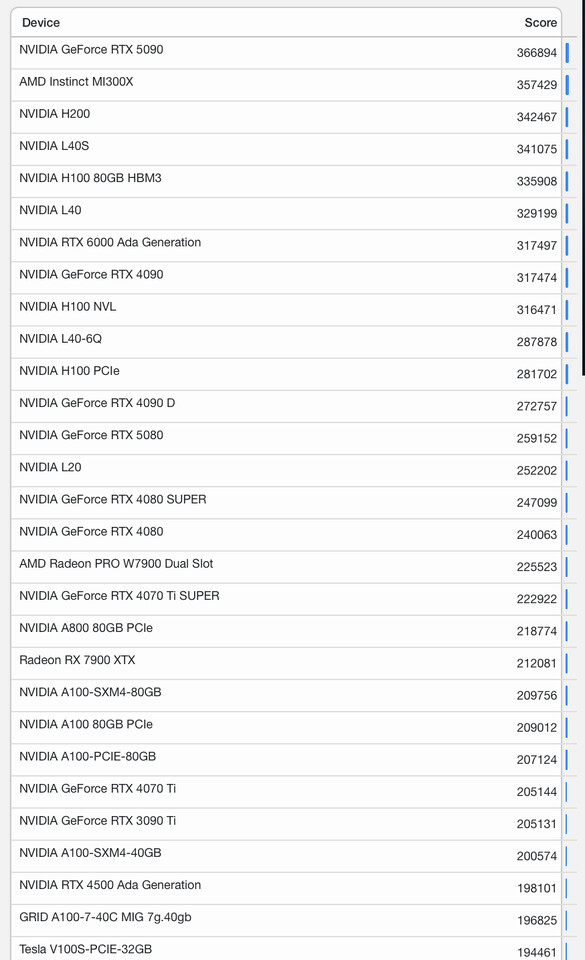
A recently surfaced Geekbench OpenCL listing has revealed the performance improvements that the GeForce RTX 5070 Ti is likely to bring to the table, and the numbers sure look promising - that is, coming from the disappointment of the GeForce RTX 5080, which manages roughly 260,000 points in the benchmark, portraying a paltry 8% improvement over its predecessor. The GeForce RTX 5070 Ti, however, managed an impressive 248,000 points, putting it a substantial 20% ahead of the GeForce RTX 4070 Ti. Hilariously enough, the RTX 5080 is merely 4% ahead, making the situation even worse for the somewhat contentious GPU. NVIDIA has claimed similar performance improvements in its marketing material, which does seem quiet plausible.

Of course, an OpenCL benchmark is hardly representative of real-world gaming performance. That being said, there is no denying that raw benchmarks will certainly help buyers temper expectations and make decisions. Previous leaks and speculations have hinted at a roughly 10% improvement over its predecessor in raster performance and up to 15% improvements in ray tracing performance, although the OpenCL listing does indicate the RTX 5070 ti might be capable of a larger generational jump, neck-and-neck with NVIDIA's claims. For those in need of a refresher, the RTX 5070 Ti boasts 8960 CUDA cores paired with 16 GB of GDDR7 memory on a 256-bit bus. Like its siblings, the RTX 5070 is also rumored to face "extremely limited" supply at launch. With its official launch less than a week away, we won't have much waiting to do to find out for ourselves.

Intel Reportedly Considering Resurrection of "Arrow Lake Refresh" Processor Family

Intel is reported to be eyeing a revival of its "Arrow Lake Refresh" desktop processor design—Golden Pig Upgrade disclosed this "strange" revelation via an updated Weibo blog post. Back in 2023, the Chinese hardware reviewer and leaker extraordinaire theorized that Team Blue's much-rumored shelving of "ARL-S/HX Refresh" came down to cost/benefit considerations relating to accommodating an upgraded NPU in the chip's tile-based design. Last September, reports suggested that Intel had put the final kibosh on a 14th Gen Core Ultra 8P+32E "Arrow Lake Refresh" processor series—leaked roadmaps had a launch window marked down for late 2025, going into 2026. Industry watchdogs have picked up on Golden Pig Upgrade's latest forecast—prompting further theorizing.

Intel has its mobile segment's future covered with Panther Lake (later in 2025) and Nova Lake (2026), but a notable gap exists in their desktop world. Nova Lake's desktop S-series is slated for launch at some point in 2026, so this year could be prime territory for a mild refresh of existing Arrow Lake-S processors—on the LGA1851 socket. Golden Pig Upgrade reckons that refreshes of ARL-S (desktop) and ARL-HX (high-end laptop) are back on Team Blue's upcoming product roadmap. Industry moles reckon that an updated NPU design—potentially similar to the one housed in Lunar Lake mobile chips—will be the only major upgrade lined up for the so-called "Core Ultra 300" processor series. Intel's current-gen flagship model—Core Ultra 9 285K—has NPU performance topping off at 13 TOPS. Refreshed Arrow Lake SKUs could be deployed with an improved NPU aspect, perhaps capable of hitting 48 TOPS.

Apple's Custom "Hidra" SoC Reportedly Exclusive to Next-gen Mac Pro

Apple's top-end M4 Ultra desktop-class chipset is allegedly going to feature on upcoming Mac Pro and Mac Studio refreshes—new product unveilings could be on the company's schedule (WWDC 2025). Bloomberg's Mark Gurman has divulged intriguing M4-series information within his latest newsletter. The M4 Ultra SoC—codenamed "Hidra"—was previously believed to be the most powerful processor option available on both next-gen Mac Pro and Mac Studio platforms. Now, Gurman believes that Apple engineers have created a distinct custom chipset design—exclusively designed for the Mac Pro workstation product stack—that sits above their M4 Ultra SoC.

Somewhat confusingly he suggests that "Hidra" is the codename for this top-of-the-line processor. Rumors swirled last month about the cancellation of an alleged "Extreme" model, so there is a degree of uncertainty surrounding unannounced M4 SKUs. Potential customers could choose Apple's (potentially) more powerful "Hidra-equipped" Mac Pro workstation over the highest-end M4 Ultra-based Mac Studio model. Industry experts propose that "Hidra" will arrive with an increased number of CPU and GPU cores—exceeding the M4 Ultra's speculated makeup of a 32-core CPU and an 80-core GPU.

Lenovo Unveils New 27- and 32-inch ThinkVision Monitors at CES 2025

CES 2025 is in full swing, with almost every technology company on the face of the planet unveiling fresh new products. Lenovo's ThinkVision lineup has witnessed two new entrants - the P32UD-40, and the P27QD-40. The former is a 31.5-inch 4K IPS monitor with a peak refresh rate of 120 Hz, that can also drop to 24 Hz. The latter is a 27-inch IPS unit with QHD resolution, also with a variable refresh rate that can vary between 24 and 120 Hz. Both the monitors, as the branding suggests, are aimed squarely at the professional crowd, boasting 98% coverage of the DCI-P3 color gamut, along with a peak dynamic contrast ratio of 3,000,000:1.

Unsurprisingly, the monitors are factory calibrated, ensuring great accuracy and commendably low Delta E values. The port selection is decent, with USB-C, HDMI 2.1, DP 1.4, along with a USB hub sporting Type-A and Type-B ports as well as a 2.5G Ethernet port. There is a built-in KVM switch as well, which is surely a welcome addition for those who can utilize it. The P27QD-40 will start shipping towards the middle of 2025, at a price of $559, whereas the larger P32UD-40 will start at $1,199 along with a similar launch timeframe.

8BitDo Launches Transparent Xbox Edition Retro Mechanical Keyboard and Retro R8 Gaming Mouse

8BitDo is known for making retro gaming-themed peripherals, and it's now expanded that line-up with two more products in a transparent green color way reminiscent of the original Microsoft Xbox gaming console. The 8BitDo Retro 87 Mechanical Keyboard has received a refresh in classic transparent Xbox colors, and 8BitDo has launched its first gaming mouse, the Retro R8 Mouse in the same color way. The new colorway incorporates the expected transparent green plastic enclosures for the mouse and keyboard and also features bright red, yellow, blue, and green accent colors that, following the traditional ABXY button colors. Both the new Retro 87 Mechanical Keyboard ($199.99) and Retro R8 Mouse ($59.99) are available for pre-order on Amazon, although it looks like the initial batches on the mouse have sold out for now.

While 8BitDo has opted for Kailh Jellyfish X switches, likely for their transparent appearance, the hardware changes to the Retro 87 Mechanical Keyboard are mostly limited to the transparent green case, keycaps, and extra macro buttons. The mouse, on the other hand, bears further inspection, since it's a new product category for 8BitDo. On a surface level, the 8BitDo Retro R8 Mouse looks like a typical ambidextrous gaming mouse, with a claimed eight programmable buttons, USB-C, 2.4 GHz, and Bluetooth LE connectivity, and up to 26,000 DPI resolution. While it's not advertised as a lightweight mouse, it's certainly not heavy for a wireless mouse, coming in at 77 g. The Retro R8 Mouse also comes with a matching charging dock, which 8BitDo says will charge the mouse to 100% in 2.5 hours and acts as a signal extender. 8BitDo claims that the mouse can achieve between 26 and 105 hours of use from its 450 mAh Li-ion battery in wireless mode, depending on the polling rate and connectivity mode.

Samsung Prepares World's First 27-Inch 500 Hz QD-OLED Gaming Display

Samsung Display has reportedly developed the world's first 27-inch OLED panel capable of a 500 Hz refresh rate at 2560x1440p resolution. The new panel utilizes Samsung's QD-OLED (Quantum Dot OLED) technology, which combines the color accuracy of Quantum Dots with the contrast and responsiveness of OLED displays. The panel is nearing the end of its development phase, and Samsung is reportedly in discussions with leading monitor manufacturers, aiming to introduce products featuring the panel to the market by mid-2025. This development adds to the growing competition in the gaming display market. For example, Chinese company Light Soul is preparing to release a 27-inch QD-OLED monitor with 4K resolution, a 240 Hz refresh rate, and a peak brightness of 1000 nits. Meanwhile, LG plans to launch a 45-inch monitor model featuring a 5120x2160 WOLED panel.

Across the industry, OLED is being transformed using various technologies, and every panel maker, including Samsung and LG, wants to stay ahead of the curve with high-refresh, high-color accuracy panels. The high-refresh-rate market is currently led by LG UltraGear 27GX790A-B and ASUS ROG Swift PG27AQDP 1440p monitors that max out at 480 Hz. While e-sports players might need the extra 20 Hz, regular users surely wouldn't notice the extra refresh. Nonetheless, it is interesting to see that OLED is getting lots of love in the coming year, and the constant development of it will not stop. We
Return to Keyword Browsing
Nov 11th, 2026 06:15 CST change timezone

New Forum Posts

Popular Reviews

TPU on YouTube

Controversial News Posts