Tuesday, September 8th 2026

Modders Rework DLSS 5's Rendering Pipeline For a Big Performance Boost

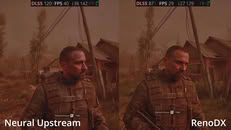
Modders have found a way to cut the huge performance cost of NVIDIA's DLSS 5 Neural Rendering. The fix involves reworking the DLSS 5 rendering order so that neural rendering runs before upscaling. The mod, called Neural Upstream and built by matiasLombo, now works through DLSS5-Autopilot, a community tool similar to DLSS 5 Swapper, that runs Neural Rendering in games NVIDIA never officially supported. A Redditor tested this fix on an RTX 4080 in Assassin's Creed Shadows at 4K with DLSS Performance. Switching from NVIDIA's standard pipeline to Neural Upstream reportedly pushed frame rates from 31 FPS up to around 50 FPS, compared to 63 FPS with the effect off entirely.

The trick comes down to where NVIDIA placed Neural Rendering in the pipeline. It normally runs last, on the fully upscaled 4K frame, which is why the cost balloons at higher resolutions. This is an issue the modders already ran into when they first got Neural Rendering working on RTX 40-series cards. Neural Upstream instead applies it to the lower-resolution frame before DLSS Super Resolution scales it up, similar to how Performance and Quality presets already work for regular upscaling. It looks like NVIDIA leaned toward image fidelity in the standard application, so the trade-off is a further hit to visual quality on top of DLSS 5's existing "uncanny valley" issues.
NVIDIA has said it's still tuning DLSS 5 for RTX 50-series cards before expanding support to older GPUs, so there's no word yet on whether Neural Upstream's approach could become an official preset. Given how hard the current implementation hits frame rates, I wouldn't bet against it. One thing is for certain: the modding community has done an incredible job with DLSS 5 ever since it got leaked, controversial as the feature may be.

Sources: Reddit, DuffB on YouTube, Neural Upstream (GitHub)
Add your own comment

18 Comments on Modders Rework DLSS 5's Rendering Pipeline For a Big Performance Boost

#1
zigzag
Nvidia should make two presets:
  1. Normal quality DLSS 5: NR before upscaling
  2. High quality DLSS 5: NR after upscaling
Posted on Reply
#2
agmarley
I'm not on either side of the DLSS 5 bandwagon but it burns me up when enthusiasts who only have their passion and time make things work and function better than the official developers. How far has the PC enthusiasts fallen from any type of consideration from these companies?
Posted on Reply
#3
Legacy-ZA
zigzagNvidia should make two presets:
  1. Normal quality DLSS 5: NR before upscaling
  2. High quality DLSS 5: NR after upscaling
But why should they? /smugface

nGreedia was so close to locking the "Before Upscaling NR" "Solution for their RTX6000 series under some new marketing BS. :roll:
Posted on Reply
#4
CyberPomPom
Don't DLSS uses dithering on the input side?
I might misremember but to me DLSS does a bit of dithering when sampling pixels before feeding it to it's model to improve the effective sampling rate using accumulated frames.

How would that work on a frame that was re-rendered using the DLSS5 AI imager? I would assume that the individual dithered pixels information are lost after the AI pass.
Some of the very low quality in movement in the demo video seems to show that it breaks apart as soon as DLSS upscale needs to refer to previous samples.

That would explain why NVidia decided to use DLSS5 on the output image rather than input. As one would assume they would to improve performance as much as possible.
Posted on Reply
#5
TheinsanegamerN
agmarleyI'm not on either side of the DLSS 5 bandwagon but it burns me up when enthusiasts who only have their passion and time make things work and function better than the official developers. How far has the PC enthusiasts fallen from any type of consideration from these companies?
Not far enough, considering they still make this tech available for you despite your whining. DLSS clearly shouldnt have been given away for free. Frankly neither nvidia or AMD should even sell dGPUs, they should only make APUs for the l337 gamurz, save the actual hardware for those of us that produce things instead of playing bing bing wahoo all night.
Posted on Reply
#6
john_
The whole community is working on unlocking/fixing half a dozen features that Nvidia restricts or implements in a way that warrants the need for a super fast GPU.
Posted on Reply
#7
Vraelon
john_The whole community is working on unlocking/fixing half a dozen features that Nvidia restricts or implements in a way that warrants the need for a super fast GPU.
I find it quite amusing even though I won't be using these features on my 4090. It reminds me of my Radeon experience relying on community mods/hacks. I can't really think of a reason why Nvidia would restrict DLSS5 other than artificial market segmentation given 40xx/50xx both support FP8.
Posted on Reply
#8
4KGAMINGFOREVER
I've just tried the app, dlss autopilot something. Not for me, I've tried it on some older games. It's nice to add dlss, but they don't need it hmm..
Posted on Reply
#9
zigzag
CyberPomPomDon't DLSS uses dithering on the input side?
I might misremember but to me DLSS does a bit of dithering when sampling pixels before feeding it to it's model to improve the effective sampling rate using accumulated frames.

How would that work on a frame that was re-rendered using the DLSS5 AI imager? I would assume that the individual dithered pixels information are lost after the AI pass.
Some of the very low quality in movement in the demo video seems to show that it breaks apart as soon as DLSS upscale needs to refer to previous samples.

That would explain why NVidia decided to use DLSS5 on the output image rather than input. As one would assume they would to improve performance as much as possible.
Isn't dithering noise? It probably shouldn't matter then. But are you sure you are not thinking of temporal data? For inferring information from temporal data it could probably still use source frames and then using that data on NR rendered image.
Posted on Reply
#10
phints
All the room temp iq/ arm chair computer engineers cluelessly complaining on this forum are just laughable. It’s ruining the best tech page around.
Posted on Reply
#11
Recus
phintsAll the room temp iq/ arm chair computer engineers cluelessly complaining on this forum are just laughable. It’s ruining the best tech page around.
Facebook added 2 hour limit so they migrated here.
Posted on Reply
#12
Tess
Caution: temp iq/ arm chair computer engineer comments:

Interesting, the difference in many of those examples almost look the same as proper HDR10 on/off.

Thanks @DrUsmanSaleem!
Posted on Reply
#13
AvrageGamr
agmarleyI'm not on either side of the DLSS 5 bandwagon but it burns me up when enthusiasts who only have their passion and time make things work and function better than the official developers. How far has the PC enthusiasts fallen from any type of consideration from these companies?
I wouldn't say modders are fixing it. It only supports one game currently. They are making it run better in unsupported games and exposing Nvidia's planned obsolescence BS with their software.
Posted on Reply
#14
Steevo
zigzagNvidia should make two presets:
  1. Normal quality DLSS 5: NR before upscaling
  2. High quality DLSS 5: NR after upscaling
Nvidia should just open source this since all their work is being done by modders just like all good software. But I have a hunch they will just sue the modders.
Posted on Reply
#15
wolf
Better Than Native
Man this is evolving quickly, pretty expected given the install base and how desirable it is.

modders don't have to follow any rules or anything, just 900% experimental fun. Good on them.
phintsAll the room temp iq/ arm chair computer engineers cluelessly complaining on this forum are just laughable. It’s ruining the best tech page around.
You never quite get used to it, but you're correct that most of it is funny :)
Posted on Reply
#17
CyberPomPom
zigzagIsn't dithering noise? It probably shouldn't matter then. But are you sure you are not thinking of temporal data? For inferring information from temporal data it could probably still use source frames and then using that data on NR rendered image.
In a way it is noise. And I used the wrong term even if the goals and mean are quite similar, most current implementations use jitter instead of dither.

Like SSAA and MSAA that uses several samples per pixel averaged from the current frame to provide the best color value by pixel ; TAA, DLSS and the like sample each frame a different part of the pixel and reuse previous samples with temporal and motion data to reconstruct each sample current position. And each sample position in the pixel is decided using either a dithering pattern or jitter.

That's what would be lost by passing the frame through DLSS5 as sub-pixel sample informations are very unlikely to be kept after the redraw.
Posted on Reply
#18
zigzag
CyberPomPomIn a way it is noise. And I used the wrong term even if the goals and mean are quite similar, most current implementations use jitter instead of dither.

Like SSAA and MSAA that uses several samples per pixel averaged from the current frame to provide the best color value by pixel ; TAA, DLSS and the like sample each frame a different part of the pixel and reuse previous samples with temporal and motion data to reconstruct each sample current position. And each sample position in the pixel is decided using either a dithering pattern or jitter.

That's what would be lost by passing the frame through DLSS5 as sub-pixel sample informations are very unlikely to be kept after the redraw.
AFAIK TAA, DLSS do not store multiple samples per pixel like MSAA, but one accumulated history value per pixel. Same jitter offset seems to be applied to whole frame by applying subpixel offset to a camera/projection. So NR re-renders that shifted image. Jitter offset value is passed independently from the image/buffers, so it's not getting lost. If DLSS NR is consistent enough it could preserve the subtle image differences caused by each sub-pixel jitter offset.

EDIT: I should have added to my last sentence: ...if not, then DLSS upscaling will be of lower quality, due to losing the higher resolution information normally gathered via that temporal jittering of the sub-pixel camera offset (like you've suspected).
Posted on Reply
Add your own comment
Nov 28th, 2026 13:28 CST change timezone

New Forum Posts

Popular Reviews

TPU on YouTube

Controversial News Posts