Wednesday, May 2nd 2018

AMD to Begin Sampling 7nm "Zen 2" Processors Within 2018 for a 2019 Launch
It looks like AMD's processor product launch cycle is on steroids, and keeping up (or even ahead) of Intel. After launching the first 12 nm processor architecture with "Zen+," the company is giving final touches to what it hopes to be the world's first 7 nanometer processor architecture, with "Zen 2." The company will reportedly begin sampling the chip within 2018, to enable volume production and market launch in 2019. Speaking at an investors conference call following the company's Q1-2018 Results release, AMD CEO Dr. Lisa Su confirmed the 7 nm roll-out strategy of her company.
"We have a 7nm GPU based on Vega that we'll sample later this year. We have a 7nm server CPU that we'll sample later this year. And then, obviously, we have a number of products that are planned for 2019 as well. So it's a very, very busy product season for us. But we're pleased with the sort of the execution on the product roadmap," Dr. Su said. Unlike Zen+, Zen 2 is a major update to the company's processor micro-architecture, and presents the company with opportunities to improve several silicon-level specifications, such as the number of cores per CCX, the IPC of each core, the core-count of the die, the cache hierarchy, and the overall energy-efficiency.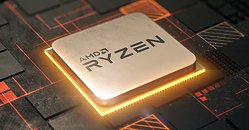
Source:
Seeking Alpha
"We have a 7nm GPU based on Vega that we'll sample later this year. We have a 7nm server CPU that we'll sample later this year. And then, obviously, we have a number of products that are planned for 2019 as well. So it's a very, very busy product season for us. But we're pleased with the sort of the execution on the product roadmap," Dr. Su said. Unlike Zen+, Zen 2 is a major update to the company's processor micro-architecture, and presents the company with opportunities to improve several silicon-level specifications, such as the number of cores per CCX, the IPC of each core, the core-count of the die, the cache hierarchy, and the overall energy-efficiency.

101 Comments on AMD to Begin Sampling 7nm "Zen 2" Processors Within 2018 for a 2019 Launch
Just in case it isn't clear to you: 4.8GHz < 5.0GHz "barrier" lol
EDIT: @Captain_Tom How and in what sentence did you see Intel here... I'm lost now. We're talking about Ryzen and how the overexaggeration of future releases has been painful for AMD in the past. If anyone's working against AMD its you right now. So again: LET IT GO. Your hole is only getting deeper.
(PS Agree that y'all disagree and leave it at that before modpolice are sent in)
Only AMD knows what is going on behind the scenes, same with intel, we are not microarchitecture engineers, we are forum members. The cpu makers have to develop cpus to cater primarily to system integrators/OEMs for different form factor sizes, if it gets too hot it could fail. 5.0 is possible but not likely, I forsee 4.5 being a possible target. I remember it was IPC during the Single Core Days that ruled the roost. Only time will tell. I'm glad AMD caught up and that helps prices be fair for everyone no matter if they use the Blue Oval or Mint Green Arrow.
- Based on the ample publicly available information citing higher clockspeeds on the coming 7nm process. 12nm already brought 4.3GHz chips, and the rumored 12nm Threadripper chips are said to likely have 4.4 - 4.5GHz clocks. If it's possible to go from 4.1 to 4.5 with 14nm->12nm, then it is easily possible to go from 4.5->4.8 with 7nm.
- With regards to IPC, there is still a lot of tweaking that can be done on the Zen design, and all claims up until now have been that this will be a decent architectural update. Frankly I am not sure why this is odd for some people: A 10-30% IPC Increase should be expected.
- Changing the way they organize the CCX's has been rumored for a while by multiple sources. It IS just rumors right now, but honestly why would AMD not iterate on there "glue architecture"? That would be ridiculous.
^ So really are any of those points crazy? They are all very grounded and semi-conservative possibilities (NOT guarantees). This fallacy that "AMD fanboys elevate expectations" is complete BS too lol. Ryzen over-delivered expectations kids, and who cares what fanboys talk about? If someone gets mislead by hype, it's their fault!From where I am sitting, it seems like there are still a lot of people around here who are simply so whipped by Intel that they cannot possibly bring themselves to believe that it's possible to have decent performance gains Year-Over-Year. Intel's complete lack of innovation over the past 5 years was their decision, it wasn't forced on them. It isn't the rule, and it's not insane for AMD to continue to make decent gains every generation.
Ryzen 1 brought a ~52% performance increase over AMD's previous gen. Ryzen 2 has brought another 10% gain with only a VERY slight node shrink and a couple modest tweaks. Ryzen 3 will be on a node that is superior to Intel's (not even real) 10nm, and AMD has stated that it will be more than a simple update - it will be a full architectural upgrade. Conclusion: As long as the 7nm node continues smoothly, Ryzen 3 will easily be a 20%+ improvement, and if it isn't - it IS a disappointment.
But now there really is nothing more for me to say if common sense continues to escape people. I will simply be taking screenshots of comments to rub in peoples' faces in under a year lol.haha I am done.
I seem to remembe a somewhat similiar situation before Ryzen 2 as well, where various "rumours", many of them posted through WFFCTECH (famously unreliable), showed 20-30% performance improvement. Because of these kinds of rumours, and many fanboys willingly spreading these rumours, quite a few users noted disappointment in Ryzen to giving "only" 10% performance improvement.
At the end of the day it doesn't matter. Your humongous claims of 20%+ IPC improvement + 20% clock speed + 50% more cores at the same time is in this thread, in black and white. As is the claim of a total performance improvement of around 15% by me, sergionography and Vayra86. I'm more than happy to wait until Ryzen 3, next year.
GloFo predictions are about as reliable as the stock market... and curiously connected too. For the rest, let's all hold on to those screenshots and slap each other with it in a year's time, yes let's do that ;)
Meanwhile
As for your logic of "if this, then that", it makes no sense at all. You can't just put two and two together. If that was the case, how come when Intel wen from 32nm on 2600K to 22nm on the 3700K, frequency improvement wasn't achievable? Not only was it not achievable, it was actually less. Same with 4790K at 22nm to 6700K at 14nm+. The latter had significantly better process node, but actually clocked lower. You want to know why? Because frequency doesn't always get higher with lower process node. Nor does frequency scale linearly with power usage (as Ryzen 2 at 4.2-4-3 GHz is a proof). Various architectures and nodes have specific limits and problems, before power delivery completely surges, and a limit can't be reached. That's why the 6700K could barily reach 4.6 GHz stable, when the older 2600K almost reached 5 GHz. Or how Intel went from 4.5 GHz on 6700K to almost 5GHz on the 7700K on the same node. The fact that you don't understand such basic understanding baffles me...
And again, as far as we know, Ryzen 2 on 12nm hasn't really achieved 4.3 GHz within the power limits that GloFo said they did (as TDP is way above 1700x/1800x). Also, nobody ever said 4.8 GHz wasn't achievable, or won't happen (I always professed 10% frequency increase, which is very close to 4.8 GHz)You are right, there is a lot of low-hanging fruits to pick, which is why we will yearly see higher performance improvements than we did during the Intel Core era. Ryzen 2's 10% total perf improvement is a a good example of this.
Why excactly should 30% IPC increase be expected? Can you give me examples of recent years where improvement of an already existing architecture gave 30% IPC increase? Or even 20%? If the IPC increases were this much, why would AMD not try to reflect it in their roadmap then? Their own claims (15% total perf improvement) isn't even near anything you seem to claim.Nobody has denied the possibility of this.Yes the points are absolutely crazy, and no, they most certainly are not conservative. They are the very opposite of conservative; these are radical claims.
The reason the points are crazy is because you are expecting a total performance improvement that is about the same as Ryzen itself as a whole new architecture brought from a 6 year old crappy architecture. In what reality is this even possible? And I really would like to know from which sources you are making these claims, because we already know AMD themselves are claiming numbers that are way, way below.It's actually completely well-grounded. Polaris got its expectations elevated to GTX 1080 and 1080 Ti killers. As did Vega. Now Navi is getting similiar predictions. Ryzen 2 was also supposed to give 20% performance improvement, according to many. I mean, this happens so often that "AMD hype train" has become a literal meme on the internet. Even on highly pro-AMD forums (like /r/AMD).Let's look at that, then. AMD actually put goal of achieving 40% performance improvement, but managed to churn a whole 52% in the end. You're absolutely right, AMD overachivied, but they also overachivied by a factor of 1.3x.
You, on the other hand, are claiming a performance improvement that is higher than what AMD have put on their own roadmap by a factor of 4x. That's an insane difference. Also, if you check the roadmap, the performance improvement of Zen 2 is actually closer to 12%. For the sake of a year of improvements, I decided to assume 15%, and even said this was "conservative. Either way, let's say the graph says 15%. Let's say AMD overachieves again, as they did with the initial launch of Ryzen. 15% x 1.3 =....drum roll....20%. Yes, 20%. Not the 50-60% total performance improvement (in SC, mind you; you seem to claim 50% more cores as well, so MT will, in your imagination, increase by 75%+).
So if AMD were to overachieve, the total performance improvement would be somewhere around 20%. NOT 60%+.Don't you ever stop with these childish remarks? Do I need to link you all of my posts, some of them almost 1000 words long, on various forums, where I heavily criticize Intel (and have been doing so for many year)? Do you want to see my receipt of the 2700X that I just recently bought (and guess what, I'm buying Zen 2 as well!) ? I don't understand why you keep making these immature accusations. Intel was never really an essential part of the discussion; it was about AMD and AMD alone. But somehow you manage to completely ruin the discussion with your childish fanboy delusions. Honestly, the only fanboy in here seems to be you.
As for us being so used to Intel's small incriments, that we can't fathom larger improvements. Yet again I refer to AMD's roadmap. There AMD themselves outline the typical 7% industry standard performance improvement from generation to generation, and how Zen is in comparison. AMD themselves outline what kind of year-on-year improvements we ought to see. And guess what? It's not 60%! Nowhere close!
Also, 10% that Ryzen 2 provided is actually better than what Intel does. As is the claim of 15% for Ryzen 2. So no, we're not influenced by years of stagnated Inte Core improvments...The tweaks were in no way modest, my friend; the cache latency was substantially reduced, XFR was improved and the new 12nm LP node supposedly allowed for a 10% frequency improvement on same power delivery. The latter is very important to remember: AMD achieved the 10% improvement overall by going beyond their TDP limits; a facts that you seem to ignore (or just don't understand).
Either way, I don't understand how you can use this as an argument for your 50% performance improvement claim. The disparity between 10% and 50% is huge.Whether it's superior to Intel's 10nm doesn't tell us anything, man. What matters is how the 7nm process node will be compared to the 12nm LP node on Ryzen 2. And we already have preliminary results to base ourselves off (read my earlier reference to GloFo's own site). We also know that power efficiency is not linear with frequency improvement, as Ryzen 2 using stupendous amounts of power with some overclocking has shown.For now, you are. I'll make sure to revive this thread in a year's time.
If it's possible to go from 4.1 to 4.5 with 14nm->12nm, then it is easily possible for the above unicorn to jump 50 feet longer, if that rainbow is made on a 7nm process. This is very grounded and semi-conservative (possibilities, NOT guaranteed -- that way, when it turns out I was wrong about the Unicorn jump length, in a year, I have an excuse to fall back on).
Personally, I'm interested in seeing what will happen in relation to cache size and latency more than anything else. We already saw with Ryzen 2 how crucial it is to gaming performance, and that Intel's superiority really stems from this, and not so much the higher clock speed + IPC. 3466 MHz with 15-15-15-35 timings improved 2700X's gaming perfomance by 10-14%, and brought the 2700X within 5% of the 8700K with the same memory setup, according to Computerbase. That's a huge difference.
So many people just keep forgetting that to make a product it needs a business case that is sound, and this one really isn't - look at AMD's HBM based GPUs for proof of that, we are suffering 1,5 Gen worth of stagnation because of that great decision. The complexity alone of all these creative designs simply doesn't fit a large portion of the marketplace, its the reason single-die GPUs are now the norm and exotic variations on it are extremely rare. Chip design needs to be scalable and universally applicable + suitable for each market segment and HBM does not fit that bill in any way. Its a trickle-down piece of technology in its purest form and as such it should be slowly implemented from top to bottom of the stack, you can bet this will take more than several generations.
www.globalfoundries.com/sites/default/files/product-briefs/7lp-product-brief.pdf
In terms of numbers, expect Zen2 (7nm) to have ~4 GHz base clocks (top variant) assuming the uarch isn't tweaked radically (impeding higher clocks) & the core count doesn't approach TR territory i.e. 16 cores.
Now you've got two options, stop hating on other users when actually they are more on the money than you with their predictions or actually look up the facts before presenting your argument because at the moment you just sound uninformed and it is making you look bad.
Good day