Monday, January 13th 2020

AMD Rolls Out Athlon 3000 Gold and Silver "Zen" 15W Mobile SoCs
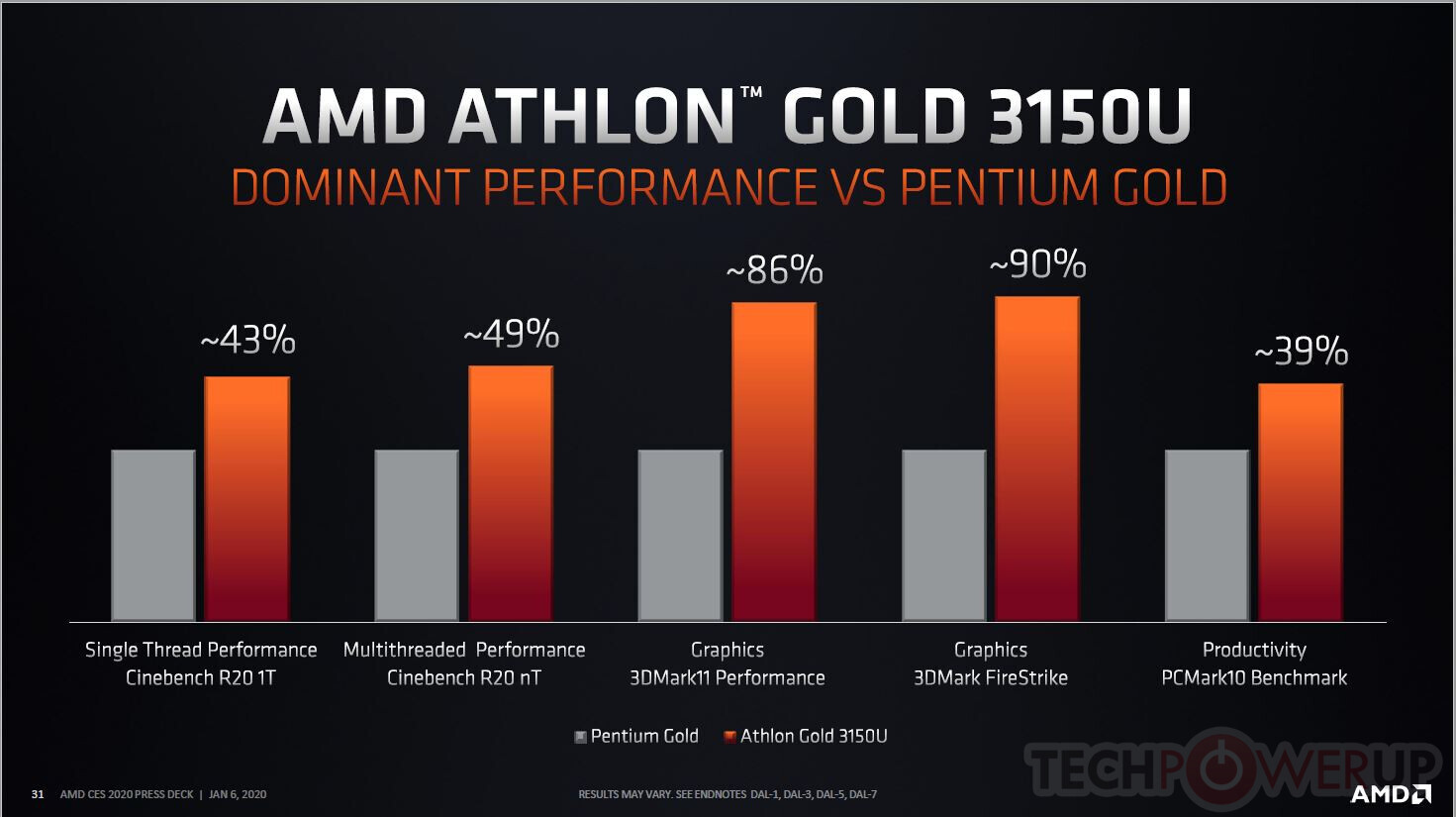
The "Zen 2" based Ryzen 4000-series mobile processors and Threadripper 3990X HEDT chip dominated headlines throughout AMD's CES 2020 event, but an important product announcement slipped past us: the mobile Athlon 3000 Gold and 3000 Silver families of entry-level mobile SoCs. These are 15-Watt SoCs targeting low-cost ultraportables, convertibles, and straight up Windows x64 tablets, competing against Intel's Pentium Gold 5000U "Whiskey Lake" and Pentium Silver "Gemini Lake Refresh" series. The family currently only consists of two SKUs, the Athlon Gold 3150U and Athlon Silver 3050U.
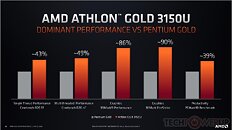
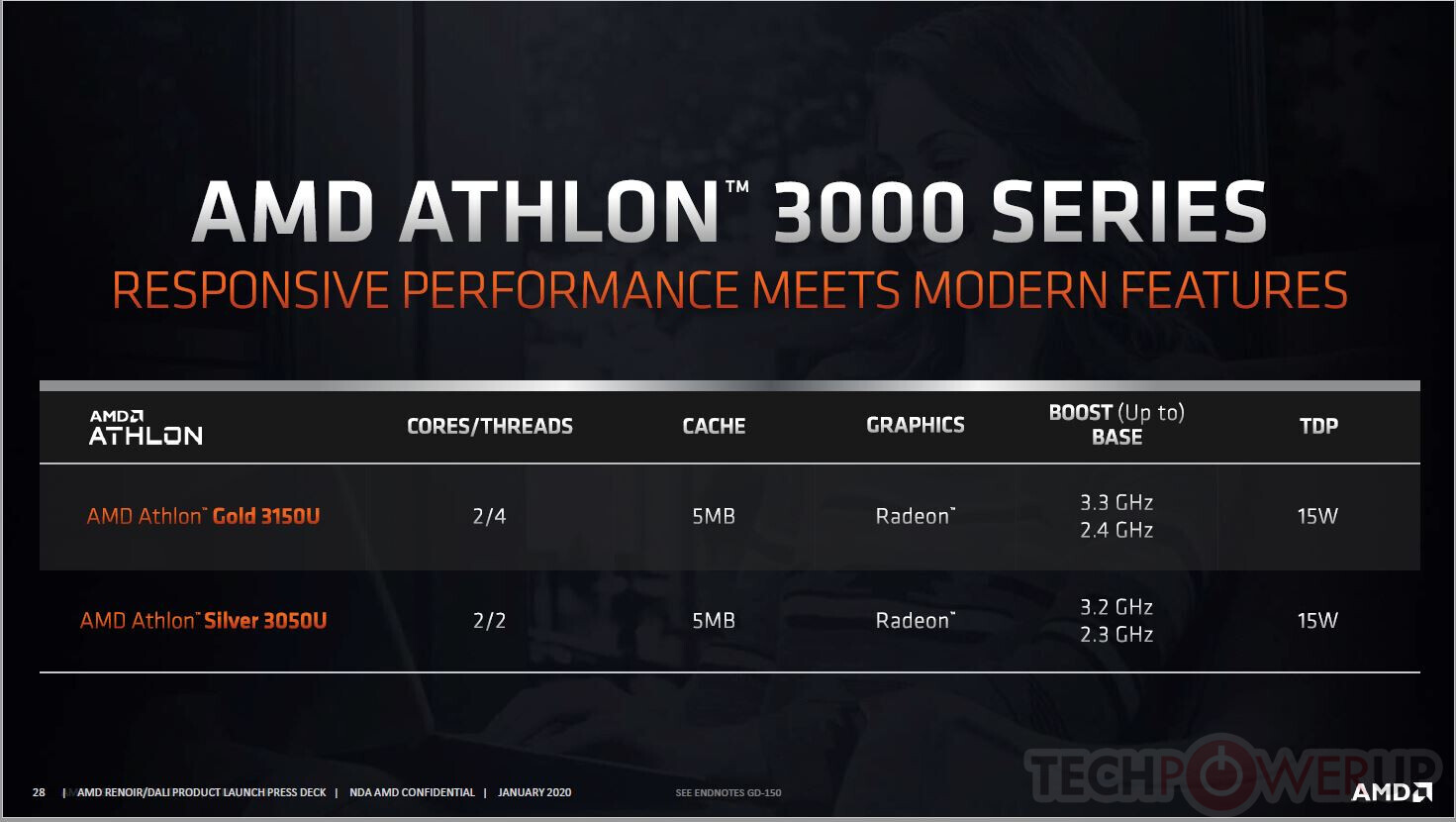
The two chips are based on the "Dali" silicon, and feature "Zen" CPU cores. The Athlon Gold 3150U features a 2-core/4-thread "Zen" CPU clocked at 2.40 GHz with 3.30 GHz boost. The Athlon Silver 3050U, on the other hand, is configured with a 2-core/2-thread CPU clocked at 2.30 GHz with 3.20 GHz boost. The CPUs on both models is configured with 4 MB of L3 cache, which takes their "total cache" (L2 + L3) figure up to 5 MB. The iGPU on the 3150U is a Radeon Vega 3 with 192 stream processors, clocked at 1.00 GHz. The one on the 3050U, is AMD's smallest, with just 2 compute units, working up to 128 stream processors, but the engine clock is set at 1.10 GHz.


The two chips are based on the "Dali" silicon, and feature "Zen" CPU cores. The Athlon Gold 3150U features a 2-core/4-thread "Zen" CPU clocked at 2.40 GHz with 3.30 GHz boost. The Athlon Silver 3050U, on the other hand, is configured with a 2-core/2-thread CPU clocked at 2.30 GHz with 3.20 GHz boost. The CPUs on both models is configured with 4 MB of L3 cache, which takes their "total cache" (L2 + L3) figure up to 5 MB. The iGPU on the 3150U is a Radeon Vega 3 with 192 stream processors, clocked at 1.00 GHz. The one on the 3050U, is AMD's smallest, with just 2 compute units, working up to 128 stream processors, but the engine clock is set at 1.10 GHz.


49 Comments on AMD Rolls Out Athlon 3000 Gold and Silver "Zen" 15W Mobile SoCs
Granted, I don't do rendering and such on it, but neither would anyone who I'd recommend a 2C to.
I'd recommend 4C to anyone now, as long as the two extra cores doesn't make it cost like 80 % more.
I've had mine for 4.5 years and I'll most likely use it for another six months or more, despite the fact that the hardware feels sluggish.
And before someone suggests getting an SSD or more RAM, it already has a 500GB SSD (had to swap out the Samsung OEM drive, as it slowed down the system even more) and 8GB of RAM with no spare slot.
I'm hesitant into buying hardware in general, as I've learned the hard way that I like hardware A LOT more than software,
so I can never justify most of my purchases as I won't be playing the latest demanding games or render for hours. :confused:
That's not a lot..
Grandma doesn't need a 4c/8t for paying bills and reading the news.
And yes, such comments are very common when GPU's are launched, it was just another example.
I'm sorry if you got offended, but what do you expect when you tell people what things "should" be? We should pat each on the back and agree on everything? It's just a forum full of people with different opinions, that's all..
It's just that I'm bored to hell with all these comments about what products SHOULD be, I mean what's the point.. it is what it is: A BUDGET CPU NOT WORTH ARGUING ABOUT.
Yeah you may call me or my words pathetic if that makes you feel better..
Cheers.
We still use dual core CPUs in multiple devices. And we still use chips few times weaker than these Athlons. We'll keep doing that for years to come.
There's just no reason to force an artificial limit and not make a CPU slower than you deem worthy. Performance is not everything. Some products don't need more. Live with it.
And it's a good business as well: dual core will always be cheaper than quad cores (or it'll utilize really bad dies).
So that argument is quite moot.
If this was for a media center type PC or a NAS or something else, then it would be fine. However, for a device that's being used on a daily basis, dual core CPUs are in general under powered and will give the user a bad experience.i5 to i5, so 2/4 to 4/8. The previous machine had an SSD as well and the same amount of RAM.
Afaik, there were no 2/2 i5's.
Most people would notice a difference, that doesn't mean they need it.
That's like saying you need that BMW, because you notice the difference compared to a Kia. Yeah, I made a car analogy.. :roll:No, the OP says Dali, but I haven't looked it up.
www.techpowerup.com/259264/amd-readies-the-low-power-dali-apu-for-thin-and-light-notebooks
There's a whole bunch of crap under $200 :laugh: although tbf there are some half decent ones to be had at the higher end of that when you take into account the cost /performance ratio
Dali is just Zen core on 14/12nm to fill GF wafer requirements, it seems.