Monday, February 10th 2020

Intel Xe Graphics to Feature MCM-like Configurations, up to 512 EU on 500 W TDP
A reportedly leaked Intel slide via DigitalTrends has given us a load of information on Intel's upcoming take on the high performance graphics accelerators market - whether in its server or consumer iterations. Intel's Xe has already been cause for much discussion in a market that has only really seen two real competitors for ages now - the coming of a third player with muscles and brawl such as Intel against the already-established players NVIDIA and AMD would surely spark competition in the segment - and competition is the lifeblood of advancement, as we've recently seen with AMD's Ryzen CPU line.
The leaked slide reveals that Intel will be looking to employ a Multi-Chip-Module (MCM) approach to its high performance "Arctic Sound" graphics architecture. The GPUs will be available in up to 4-tile configuration (the name Intel is giving each module), which will then be joined via Foveros 3D stacking (first employed in Intel Lakefield. This leaked slide shows Intel's approach starting with a 1-tile GPU (with only 96 of its 128 total EUs active) for the entry level market (at 75 W TDP) a-la DG1 SDV (Software Development Vehicle).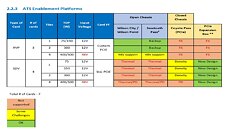
 Then we move towards the midrange market through a 1-tile 128 EU unit (150 W), a 2-tile 256 EU unit (300 W) for the enthusiasts, and finally, a 4-tile, up to 512 EU — a 400-500 W beast reserved only for the Data Center. This last one is known to be reserved for the Data Center since the leaked slide (assuming it's legitimate) points to a 48 V input voltage, which isn't available on consumer solutions. Intel's design means that each EU has access to (at least by design) the equivalent of eight graphics processing cores per EU. That's a lot of addressable hardware, but we'll see if both the performance and power efficiency are there in the final products - we hope they are.
Sources:
Digital Trends, via Videocardz
The leaked slide reveals that Intel will be looking to employ a Multi-Chip-Module (MCM) approach to its high performance "Arctic Sound" graphics architecture. The GPUs will be available in up to 4-tile configuration (the name Intel is giving each module), which will then be joined via Foveros 3D stacking (first employed in Intel Lakefield. This leaked slide shows Intel's approach starting with a 1-tile GPU (with only 96 of its 128 total EUs active) for the entry level market (at 75 W TDP) a-la DG1 SDV (Software Development Vehicle).


50 Comments on Intel Xe Graphics to Feature MCM-like Configurations, up to 512 EU on 500 W TDP
but on serious note,nvidia has been laughing how easy they've had it in the last couple of years.
even if intel is slower,merely producing new cards would invigorate the martket.
amd has no cards above tu106 equvalent rx5700xt.that's how sad it is.
this is going to need at least two respins before consumer time , see you in 2021 intel GPU, shame.
The last high end AMD that actually delivered was R9 290X. Let that sink in. R9 390x was a bloody rebadge and later R9 Fury and RX VII and Vega were late and duds.
hows about you comment on that, AMD and NVidia mean naught to my point so stick your point back up your nose and stop trying to start flame wars.
Where do you come up with the 500W card for Vega 64 performance?
As for the Intel GPUs, I fail to see any point in speculating based on unconfirmed snippet of information. On the one hand, Intel can throw money at the problem, while on the other, it's easy to ruin a perfectly good product with a small oversight.
@TheUn4seen I owned Fx8350 i owned vega neither use the wattage in use people percieved but they got slammed(rightly so on efficiency) and the vega 64 has done millions of folding @home Work units all day everyday since purchase @110-150watts , does 4k gaming on every game i have played at180-250 watts , if it works it works ,i bought and stuck a 1080ti gets 10-15% better Fps but would have cost me 10-15% more, im fine with my over hyped( true but mostly by other than AMD ) GPU
so then, why is intel different why shouldn't they get stick for raping wattage< answer that one question
I am certainly not hyping This , and I certainly don't want intel to fail, but my disappointment in what's been shown(Dg1 and this) is what it is, and as i said I now think Intels a non starter in the GPU space until 2021 at the earliest(i think im being optimistic here btw) unfortunately.
AND other than the foveros bit of this tech it sounds less interesting as a commercial purchase than any of its competition BY FAR.
AND EVERYONE keeps saying Intel has the money, true they certainly do - let's see what the shareholders have to say in 2021 shall we, they love throwing their dividend at the wall to hopefully stick? hence the massive re organization lately, it was all going to plan eh.
IT takes years to bring change into chip architecture not a year not two,,,, years, MANY years like 3-5, if they f up, like Larrabee,, they cant change tac that easy and despite all, will have to crack on, so by now positive news regarding their GPU's is what we need to be seeing not this.
AMD is trying (maybe was) to get 2 chips connected via IF. Is Intel trying to beat AMD to the punch?
Having multiple chips presented as one GPU has benefits for gaming and otherwise real-time rendering. For GPGPU/HPC/AI stuff it generally does not matter and presenting as they physically are is probably more beneficial for better control and efficiency.
If Intel has figured out how to efficiently combine multiple chips into one GPU they have pretty good jump on both AMD and Nvidia who have been trying to get there for at least over a decade.
AMD and Nvidia have put more time and effort into this than anyone and they do not have a viable solution to combining multiple dies to a single GPU. Even if the solution was something exotic and expensive, considering what workstation cards go for either one of them would have deployed it.
quoted from wccf
"
Here are the actual EU counts of Intel's various MCM-based Xe HP GPUs along with estimated core counts and TFLOPs:
- Intel Xe HP (12.5) 1-Tile GPU: 512 EU [Est: 4096 Cores, 12.2 TFLOPs assuming 1.5GHz, 150W]
- Intel Xe HP (12.5) 2-Tile GPU: 1024 EUs [Est: 8192 Cores, 20.48 assuming 1.25 GHz, TFLOPs, 300W]
- Intel Xe HP (12.5) 4-Tile GPU: 2048 EUs [Est: 16,384 Cores, 36 TFLOPs assuming 1.1 GHz, 400W/500W]"
I take back my mocking if this bit is true, they may have something in 2021 that Might compete, still needs some die shrinking and power optimization though but this sounds much more promising as a development step.There is no way in this world for a 96EU iGPU to fit into 15W TDP and a 512 EU to require 500W.
So now we suddenly think Intel can cram this into a 500W TDP? And how would this be positioned now?! 512 EU as entry level? 1024 EU midrange and 2048 EU... datacenter?! Where is enthusiast in this picture? So many questions.
Bags of salt required
500 watt TDP would be the 4 tile data center, the highes end consumer is 2 tiles 300 watt, I think ill pass personally but perhaps they might surprise us ,fingers crossed.