Thursday, February 18th 2021

NVIDIA Announces New CMP Series Specifically Designed for Cryptocurrency Mining; Caps Mining Performance on RTX 3060
This is a big one: NVIDIA has officially announced a new family of products specifically designed to satiate the demand coming from cryptocurrency mining workloads and farms. At the same time, the company has announced that the RTX 3060 launch driver will include software limitations for cryptocurrency mining workloads specifically correlated with Ethereum mining, essentially halving the maximum theoretical hashrate that could be achieved from a purely hardware perspective. The new family of products, termed CMP (Crypto Mining Processor) series, will see its products under the HX branding, and will be available in four different tiers: 30HX, 40HX, 50HX and 90HX. These products will not have any display outputs, and therefore are not applicable for gaming scenarios.
NVIDIA's stance here is that their new product will bring some justice in the overall distribution of its GeForce graphics cards, which are marketed and meant for gaming workloads. The new cryptocurrency-geared series will be distributed by NVIDIA authorized partners in the form of ASUS, Colorful, EVGA, Gigabyte, MSI, Palit, and PC Partner (more may be added down the line). There is currently no information on what silicon actually powers these graphics cards; and of course, the success of this enterprise depends on A) the driver restrictions not being limited to the RTX 3060 graphics card - it isn't clear from NVIDIA's press release if other RTX 30-series graphics cards will see the same performance cap. Even if NVIDIA did release those drivers, however, cryptocurrency miners would just opt to, well, not update them. So it is possible that NVIDIA will release a revision of the RTX 3090, RTX 3080, RTX 3070 and RTX 3060 Ti with silicon enhancements that will only work with the latest GeForce drivers - after allowing the channels to move all of their existing, cryptocurrency-enabled stock.
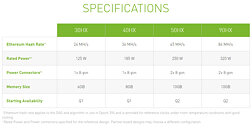 The other factor is, of course, pricing: miners will always look after the best price/performance ratio, even more so than gamers; and as such, the scenario can be imagined that were NVIDIA to add a tax to these products' based on their cryptocurrency mining nature, miners would still opt for GeForce products. The 30HX and 40HX will be made available in 1Q of this year, while the more powerful 50HX and 90HX will only hit retail come 2Q. NVIDIA finally did decide to take the matter into their own hands, in a move that not only accompanies their general "we're for the gamers" stance with more than words, while simultaneously insulating themselves from lawsuits targeting any possible inclusion of mining sales under their gaming division financials. I'll allow myself some emotion now: finally!
The NVIDIA Press Release follows:
Sources:
Thanks BTA for the inputs!, NVIDIA
NVIDIA's stance here is that their new product will bring some justice in the overall distribution of its GeForce graphics cards, which are marketed and meant for gaming workloads. The new cryptocurrency-geared series will be distributed by NVIDIA authorized partners in the form of ASUS, Colorful, EVGA, Gigabyte, MSI, Palit, and PC Partner (more may be added down the line). There is currently no information on what silicon actually powers these graphics cards; and of course, the success of this enterprise depends on A) the driver restrictions not being limited to the RTX 3060 graphics card - it isn't clear from NVIDIA's press release if other RTX 30-series graphics cards will see the same performance cap. Even if NVIDIA did release those drivers, however, cryptocurrency miners would just opt to, well, not update them. So it is possible that NVIDIA will release a revision of the RTX 3090, RTX 3080, RTX 3070 and RTX 3060 Ti with silicon enhancements that will only work with the latest GeForce drivers - after allowing the channels to move all of their existing, cryptocurrency-enabled stock.


The NVIDIA Press Release follows:
We are gamers, through and through. We obsess about new gaming features, new architectures, new games and tech. We designed GeForce GPUs for gamers, and gamers are clamoring for more.
Yet NVIDIA GPUs are programmable. And users are constantly discovering new applications for them, from weather simulation and gene sequencing to deep learning and robotics. Mining cryptocurrency is one of them.
With the launch of GeForce RTX 3060 on Feb. 25, we're taking an important step to help ensure GeForce GPUs end up in the hands of gamers.
Halving Hash Rate
RTX 3060 software drivers are designed to detect specific attributes of the Ethereum cryptocurrency mining algorithm, and limit the hash rate, or cryptocurrency mining efficiency, by around 50 percent.
That only makes sense. Our GeForce RTX GPUs introduce cutting-edge technologies — such as RTX real-time ray-tracing, DLSS AI-accelerated image upscaling technology, Reflex super-fast response rendering for the best system latency, and many more — tailored to meet the needs of gamers and those who create digital experiences.
To address the specific needs of Ethereum mining, we're announcing the NVIDIA CMP, or, Cryptocurrency Mining Processor, product line for professional mining.
CMP products — which don't do graphics — are sold through authorized partners and optimized for the best mining performance and efficiency. They don't meet the specifications required of a GeForce GPU and, thus, don't impact the availability of GeForce GPUs to gamers.
For instance, CMP lacks display outputs, enabling improved airflow while mining so they can be more densely packed. CMPs also have a lower peak core voltage and frequency, which improves mining power efficiency.
Creating tailored products for customers with specific needs delivers the best value for customers. With CMP, we can help miners build the most efficient data centers while preserving GeForce RTX GPUs for gamers.
120 Comments on NVIDIA Announces New CMP Series Specifically Designed for Cryptocurrency Mining; Caps Mining Performance on RTX 3060
They brought out mining cards previously such as the 1080 with none or at best one but apparently those ports were covered and didn't work with the specific Bios installed on the card.
I say make all mining cards headless and cheaper so miners snap those up instead.
Releasing mining specific cards in general is a good idea in the current situation, but will have to be priced very cheaply to make it attractive to miners, since the cards have no value afterwards for resale.
The best idea of all though, would be to have enough capacity to simply make enough cards for everybody and forget about cut down mining cards. Looks like realworld realities prevent this though. :ohwell:
That way, they can release a new product stack, perhaps the Super line?, and prevent this situation from ever happening again. I'm fine with that. Let GPU mining die already. It's been a pox upon the industry for way too long. Go build an ASIC and leave gamers in peace. And if you think it's illegal to differentiate your product stack arbitrarily, well, Intel's been doing it for years. Nvidia had Quadro or Tesla. It's not illegal in any way and it's the way out of this GPU mining mess.
And I can't wait till they lock people out. I wish they could do it right this second (or even at the 3000 series launch), but unfortunately that genie's already out of the bottle. Hopefully, next product stack they can get it fixed.
My 6800 16GB have used up to 15!!!GB playing Sotr at 4k ultra + rt ultra + msaa. Many other games here using above 10GB at 4k with everything set to ultra.
Buying a new expensive card and having to dial down pq so it doesn’t burst the 8/10GB limitation doesn’t make sense to me.
Now I'm pissed a bit I'm on old GPU still but calm down , unless you game 16hours a day is the butt hurt warrantied, if you are just pissed you don't have a new GPU for a few hours a night just to leave it sat switched off then chill ,some of us are trying to use our GPU for more.
This is a 100% Nvidia-benefitting move and hurts the consumers who, having been unable to buy gaming cards for six months, are then also deprived of the wave of cheap graphics cards that happens at the end of the bubble by these mining-only models. Adding display outputs costs very little, but definitively restricts what the card can be used for.
Cant wait to see the pricing and how fast supply will last, or could this be another paper launch date.
The only way we could check if SOTR really does use 15GB is to have two cards with identical performance, but with different equipped VRAM amounts (8GB/16GB, for example) and see if the game performs any worse when the VRAM is cut. Or perhaps there is a program to artifically store in VRAM without performance degradation, so you can effectively 'emulate' 12GB/8GB/4GB, etc. on a 16GB card? I'd be interested to see that comparison, as that's the only way to objectively measure it.
2. I was talking about 1440p, so a comparison to 4K is moot.
3. NVIDIA will use different compression algorithms so that 8GB will go further than previously. Also DirectStorage will alleviate a lot of VRAM usage as more data can be kept on SSDs instead of the VRAM.