Tuesday, September 27th 2022

Intel 13th Gen Core "Raptor Lake" Desktop Processors Launched: +15% ST, +41% MT Uplift
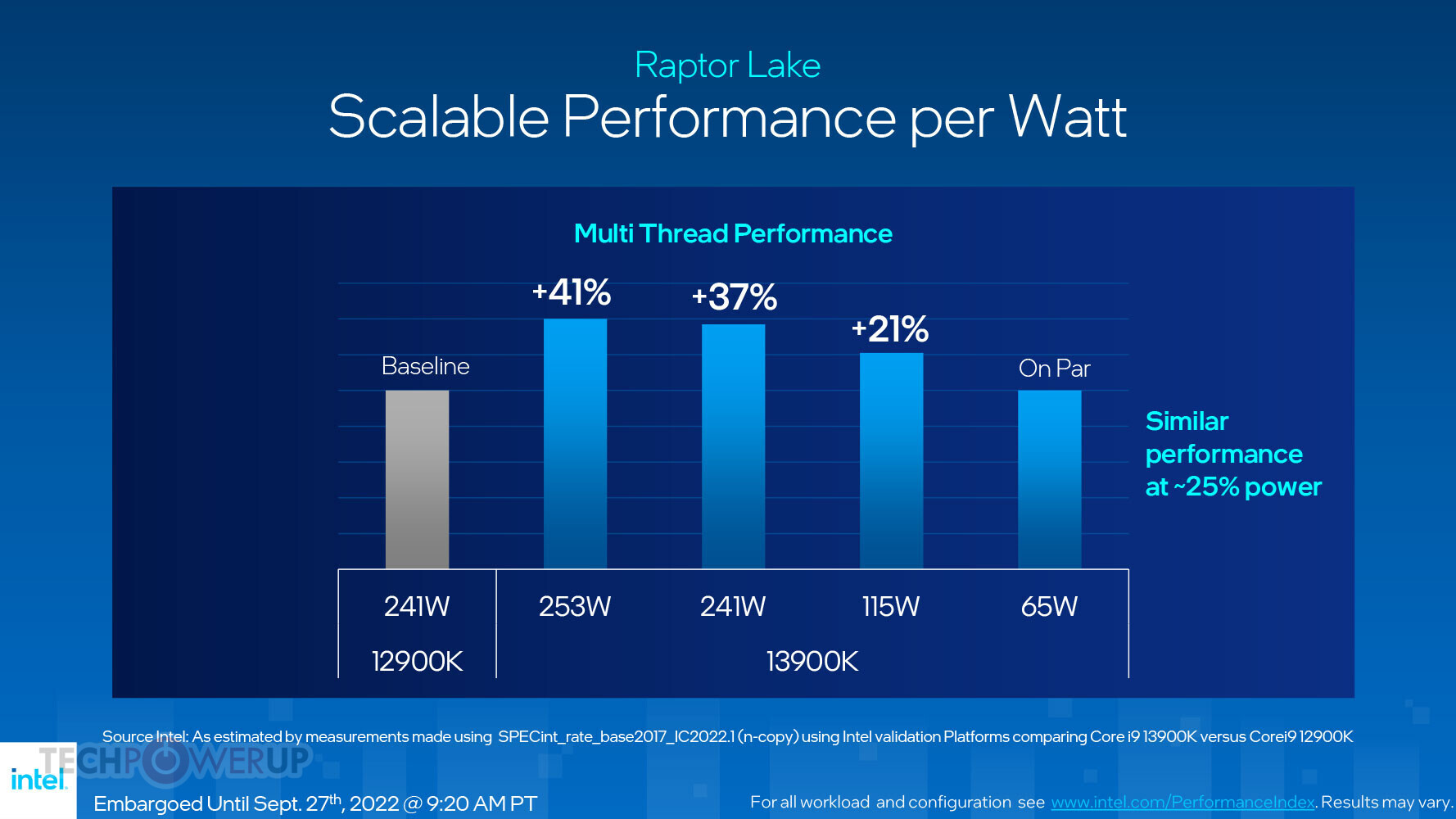
Intel today launched its 13th Gen Core "Raptor Lake" desktop processors, and companion 700-series motherboard chipset. These processors are built in the same LGA1700 package as the previous generation "Alder Lake," and are backwards-compatible with 600-series chipset motherboards through a BIOS update. Likewise, 700-series chipset motherboards support older "Alder Lake" processors. With the new 13th Gen Core, Intel is broadly promising an up to 15% uplift in single-threaded performance, which has a bigger bearing on gaming performance; and an up to 41% multi-threaded performance uplift; over the previous-generation, when comparing the top Core i9-13900K with its predecessor, the i9-12900K. Intel also claims to have outclassed the AMD Ryzen 9 5950X in multi-threaded performance, and the Ryzen 7 5800X3D in gaming performance.
Intel's performance claims are backed by some impressive hardware changes despite the company sticking with the same Intel 7 (10 nm Enhanced SuperFin) foundry node as "Alder Lake." To begin with, the single-thread performance uplift comes from the new "Raptor Cove" performance-core, which promises an IPC uplift over the previous-generation "Golden Cove," comes with more dedicated L2 cache of 2 MB per core (compared to 1.25 MB per core in the previous-generation); and significantly higher clock-speeds, going all the way up to 5.80 GHz. "Raptor Lake" has up to 8 P-cores, but the company has put in a lot of work in improving the contribution of E-cores to the processor's overall multi-threaded performance uplift. This is achieved by doubling the E-core count to 16. These are the same "Gracemont" E-cores as previous-generation, but Intel has doubled the L2 cache that's shared in a 4-core Gracemont cluster, from 2 MB per cluster to 4 MB. There are upgrades to even the hardware prefetchers of these cores.


 Intel didn't go into the nuts and bolts of what makes up the "Raptor Cove" P-core, but broadly explained that it comes with improved speed paths that enable an up to 600 MHz P-core boost frequency uplift at comparable power to the previous-gen "Golden Cove" while staying on the same process. The Intel 7 node also seems to have got some technological improvements, with the company referring to it as the "3rd generation" of this node (optical 10 nm). This mainly concerns better electrical characteristics from improved channel mobility. Cushioning the P-core with a larger 2 MB dedicated L2 cache also appears to be contributing to the iso-power uplift, as the core spends fewer cycles fetching data from the L3 cache. We will learn more about "Raptor Cove" in the coming days, and will hopefully have a more detailed look at the new core in our reviews of these processors.

 The E-core microarchitecture is the very same "Gracemont," but benefits from the node improvements to dial up E-core boost frequencies all the way up to 4.30 GHz. The cores also benefit from the larger 4 MB L2 cache that's shared among four E-cores in a "Gracemont" cluster. "Raptor Lake" has four such clusters, amounting to 16 on the silicon. The E-core clusters have access to the chip's L3 cache, just like the P-cores. As we mentioned earlier, the improved cache, and updated prefetcher algorithm should have an cumulative impact on E-core performance; and when you account for 16 of these, besides the improved 8 P-cores, you begin to see where Intel's 41% generational multi-threaded performance uplift claim is coming from.


 Intel also made updates to the processor's uncore components. The L3 cache that's shared among the processor's P-cores and E-core clusters, is now enlarged to 36 MB, from 30 MB in the previous generation. This cache is a continuously addressable block due to the Ringbus interconnect making ring-stops at various physical segments of the cache. Intel has improved the clock-speed of this fabric, which now boosts up to 5.00 GHz, or 900 MHz higher than the previous-gen.
The DDR5+DDR4 memory controllers also receive an update. The processor now natively supports up to DDR5-5600 JEDEC-standard memory speeds, when using 1 DIMM per 80-bit channel (which has two 40-bit sub-channels); or up to DDR5-4400 when using 2 DIMMs per channel (i.e. populating all four memory slots on your motherboard).
Intel also updated the Thread Director middleware that gives the software some degree of awareness of the Hybrid architecture, and attempts to ensure that the right kind of workload is allocated to the right kind of CPU core. Intel has given TD greater thread class awareness through machine-learning techniques (the processor learns over time what the nature of the workload could be). The processor also takes advantage of new scheduling features of Windows 11 22H2 Update, which introduce PID QoS for system background tasks and user-initiated background tasks.
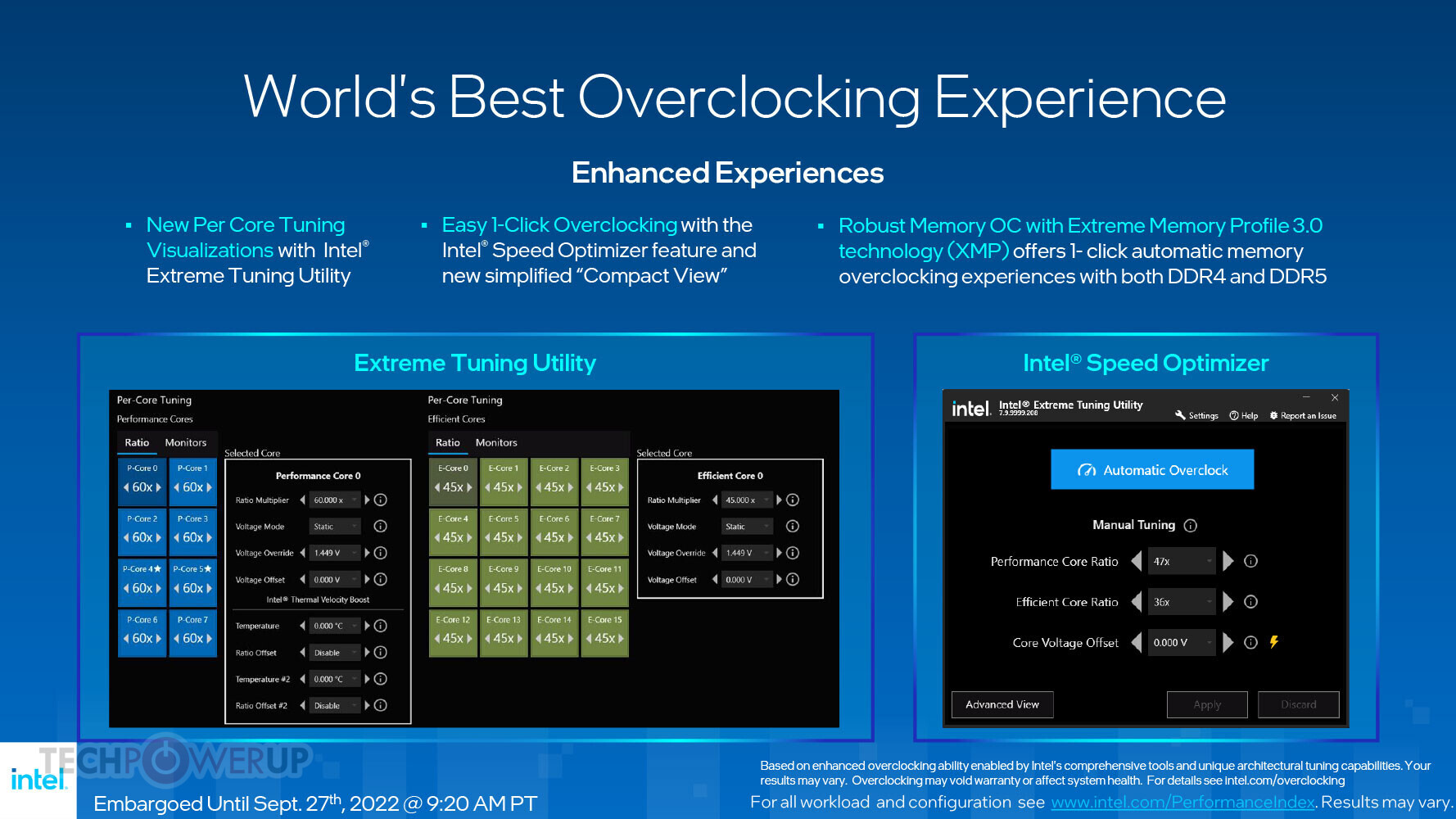
 Intel claims that "Raptor Lake" processors will be memory overclocking monsters, capable of speeds as high as DDR5-10000, when pushed to the limit with enthusiast-grade memory. For the P-cores, the company says that 8.00 GHz overclocks are now within reach for enthusiasts. The updated Intel Extreme Tuner Utility (XTU), allows you to set multipliers on a per-core basis, and tune your memory frequency on-the-fly (no reboots involved).
 Intel is launching the 13th Gen Core "Raptor Lake" desktop processor family with essentially three processor models—Core i9-13900K, Core i7-13700K, and Core i5-13600K; and their "KF" sub-variants that have disabled iGPUs, and are about $10-20 cheaper, depending on the model.
The Core i9-13900K is the flagship part, with 8 P-cores, and 16 E-cores (8P+16E), with the full 36 MB L3 cache available on the silicon. The P-cores have a base-frequency of 3.00 GHz, and boost up to 5.80 GHz; whereas the E-cores run at 2.20 GHz base, boosting up to 4.30 GHz. The processor base power is rated at 125 W, and the maximum turbo power at 253 W (up from 241 W for the i9-12900K). The i9-13900K comes with an MSRP of USD $589, while the i9-13900KF (which lacks the iGPU), is priced at $564.
The Core i7-13700K is an interesting SKU, as it has the same 8P+8E core-configuration as the previous-gen i9-12900K, but with all the new updates detailed above. Intel carved this SKU out by disabling two of the four E-core clusters on the "Raptor Lake" silicon, and reducing the L3 cache to 30 MB. The P-cores have a base frequency of 3.40 GHz, with a maximum boost frequency of 5.40 GHz; while the E-cores run at 2.50 GHz base, and 4.20 GHz maximum boost. These chips have the same 125 W PBP and 253 W MTP as the i9-13900K. The i7-13700K is priced at $409, and the i7-13700KF at $389.
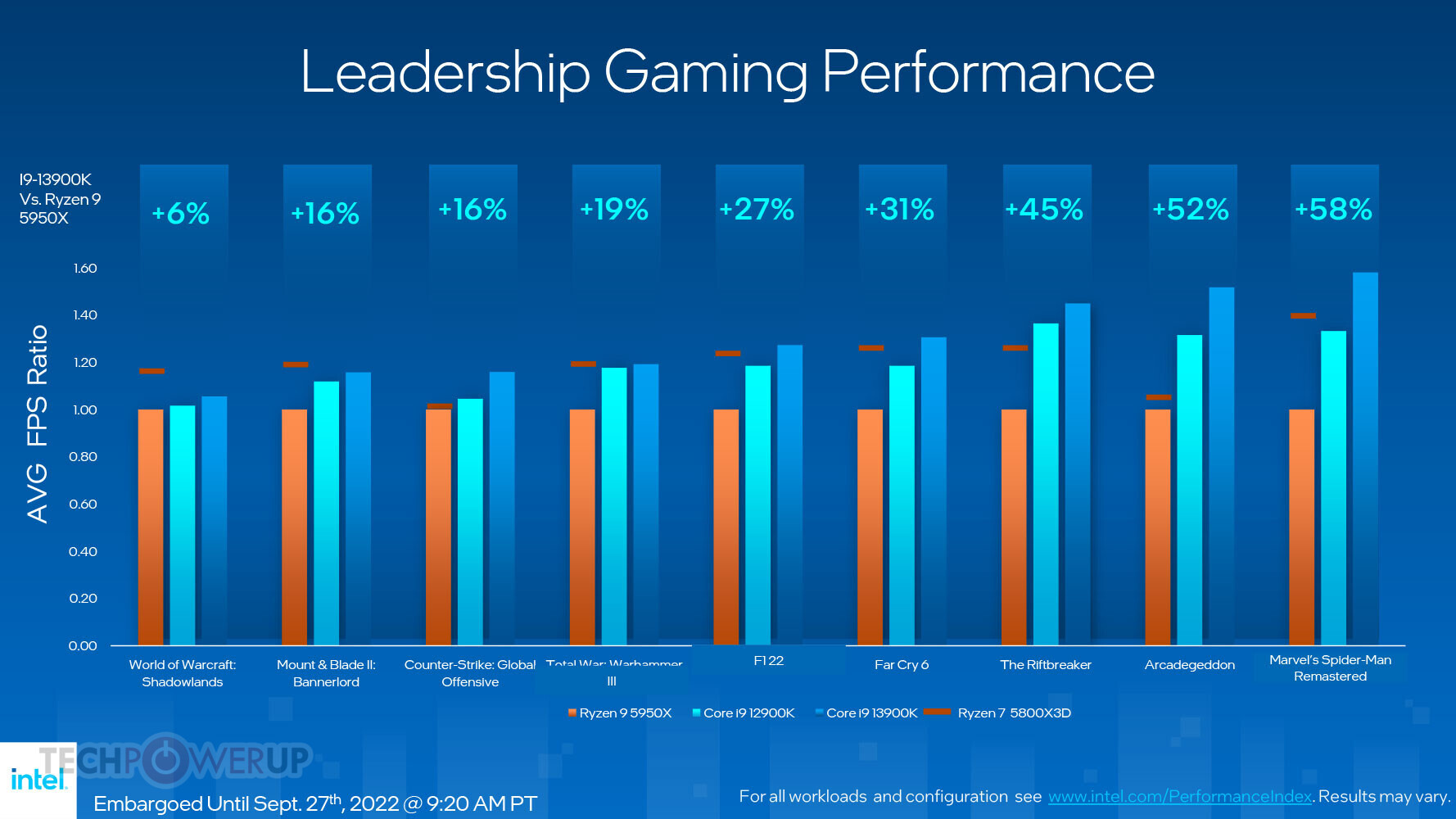
The Core i5-13600K is an equally interesting processor with which the company hopes to hold on to the mid-range. It now comes with a 6P+8E core-configuration, compared to 6P+4E of the i5-12600K. And of course, you get all the generational improvements detailed above. This SKU is carved out by disabling two P-cores, and two E-core clusters; while also cutting down the L3 cache to 24 MB (which is still higher than the 20 MB of the i5-12600K). The P-cores run at 3.50 GHz base with 5.10 GHz boost; while the E-cores do 2.60 GHz base, with 3.90 GHz boost. While the PBP value is the same 125 W as the higher SKUs, the MTP is reduced to 181 W. Intel is pricing the Core i5-13600K at $319, and the i5-13600KF at $294. Intel is claiming gaming performance uplifts of up to 18% when comparing the i9-13900K with the previous-gen i9-12900K, across a wide selection of games; while the comparison with the AMD Ryzen 9 5950X "Zen 3" sees gaming performance gains range between 6% to 58%. The gap only widens when you consider the 99th percentile low-water-mark analysis. Although mainly compared with the 5950X, Intel also threw in gaming performance values it tested on the Ryzen 7 5800X3D, which is shown matching the i9-13900K in games where it's beating the i9-12900K, or within 10% of it in games where the i9-13900K gets ahead. This is interesting, as Intel thinks the performance of "Zen 4" Ryzen 7000-series processors should roughly match that of the 5800X3D. In our performance reviews published on September 26, the 5800X3D is 4.5-5% behind the Ryzen 7 7700X, which means "Zen 4" should end up within 5% of the i9-13900K in gaming performance, should these numbers for the 5800X3D from Intel hold up.


 The platform I/O of these processors is identical to that of "Alder Lake." You get a 2-channel (4 sub-channel) DDR5 + 2-channel DDR4 memory interface. The processor puts out 28 PCI-Express lanes; 16 of these are Gen 5, and intended for the main x16 PEG slot; while the remaining are Gen 4. The main x4 NVMe interface of the processor is Gen 4, while the DMI chipset bus takes up the remaining 8 lanes (DMI 4.0 x8). You should still find motherboards with Gen 5 M.2 NVMe slots, but these would be eating into the x16 PEG bandwidth. Given that NVIDIA's latest GeForce Ada continues to be PCIe Gen 4, cutting into the bandwidth of the PEG slot to run Gen 5 M.2 SSDs could affect graphics performance (but we'll test this theory in upcoming PCIe-scaling articles with the RTX 4090).
The complete slide-deck for the processor launch event follows.


Intel's performance claims are backed by some impressive hardware changes despite the company sticking with the same Intel 7 (10 nm Enhanced SuperFin) foundry node as "Alder Lake." To begin with, the single-thread performance uplift comes from the new "Raptor Cove" performance-core, which promises an IPC uplift over the previous-generation "Golden Cove," comes with more dedicated L2 cache of 2 MB per core (compared to 1.25 MB per core in the previous-generation); and significantly higher clock-speeds, going all the way up to 5.80 GHz. "Raptor Lake" has up to 8 P-cores, but the company has put in a lot of work in improving the contribution of E-cores to the processor's overall multi-threaded performance uplift. This is achieved by doubling the E-core count to 16. These are the same "Gracemont" E-cores as previous-generation, but Intel has doubled the L2 cache that's shared in a 4-core Gracemont cluster, from 2 MB per cluster to 4 MB. There are upgrades to even the hardware prefetchers of these cores.


The DDR5+DDR4 memory controllers also receive an update. The processor now natively supports up to DDR5-5600 JEDEC-standard memory speeds, when using 1 DIMM per 80-bit channel (which has two 40-bit sub-channels); or up to DDR5-4400 when using 2 DIMMs per channel (i.e. populating all four memory slots on your motherboard).
Intel also updated the Thread Director middleware that gives the software some degree of awareness of the Hybrid architecture, and attempts to ensure that the right kind of workload is allocated to the right kind of CPU core. Intel has given TD greater thread class awareness through machine-learning techniques (the processor learns over time what the nature of the workload could be). The processor also takes advantage of new scheduling features of Windows 11 22H2 Update, which introduce PID QoS for system background tasks and user-initiated background tasks.


The Core i9-13900K is the flagship part, with 8 P-cores, and 16 E-cores (8P+16E), with the full 36 MB L3 cache available on the silicon. The P-cores have a base-frequency of 3.00 GHz, and boost up to 5.80 GHz; whereas the E-cores run at 2.20 GHz base, boosting up to 4.30 GHz. The processor base power is rated at 125 W, and the maximum turbo power at 253 W (up from 241 W for the i9-12900K). The i9-13900K comes with an MSRP of USD $589, while the i9-13900KF (which lacks the iGPU), is priced at $564.
The Core i7-13700K is an interesting SKU, as it has the same 8P+8E core-configuration as the previous-gen i9-12900K, but with all the new updates detailed above. Intel carved this SKU out by disabling two of the four E-core clusters on the "Raptor Lake" silicon, and reducing the L3 cache to 30 MB. The P-cores have a base frequency of 3.40 GHz, with a maximum boost frequency of 5.40 GHz; while the E-cores run at 2.50 GHz base, and 4.20 GHz maximum boost. These chips have the same 125 W PBP and 253 W MTP as the i9-13900K. The i7-13700K is priced at $409, and the i7-13700KF at $389.
The Core i5-13600K is an equally interesting processor with which the company hopes to hold on to the mid-range. It now comes with a 6P+8E core-configuration, compared to 6P+4E of the i5-12600K. And of course, you get all the generational improvements detailed above. This SKU is carved out by disabling two P-cores, and two E-core clusters; while also cutting down the L3 cache to 24 MB (which is still higher than the 20 MB of the i5-12600K). The P-cores run at 3.50 GHz base with 5.10 GHz boost; while the E-cores do 2.60 GHz base, with 3.90 GHz boost. While the PBP value is the same 125 W as the higher SKUs, the MTP is reduced to 181 W. Intel is pricing the Core i5-13600K at $319, and the i5-13600KF at $294.


The complete slide-deck for the processor launch event follows.






224 Comments on Intel 13th Gen Core "Raptor Lake" Desktop Processors Launched: +15% ST, +41% MT Uplift
another month like in zen4 case?
After currency conversion vs msrp
13900k is $690(590),
13700k is $492(410),
13600k is $380(320).
For amd, after currency conversion vs msrp,
7950x is $775(700),
7900x is $605(550),
7700x is $422(400),
7600x is $317(300)
Relative to amd's msrp, I don't know if it's intel being confident or they just want to make a fortune in my area
That being said, we get very powerful platforms this year from both companies, but also very expensive platforms from both companies.
With the exception of those who will pay anything to get the best and sell it when the next gen is released, people should consider buying the platform that will give them best value not just today, but for the next 2-4 years.
But in reality probably with these low 1K unit prices we may see higher mark-ups from partners since the competition doesn't offer competitive enough pricing!
If i remember Alder Lake's early street pricing vs 1K unit prices was a little better, but we'll see in 3 weeks the real deal anyway.
That being said, once someone reads something on the internet and has told themselves it's going to be a problem, they'll never be happy with said product.
Just buy a 5800x3d and be done with it. Tons of still (relatively) inexpensive B550 and X570s boards available, and 32GB of fast DDR4 can be had for less than top end DDR5.
The 5800x3d is still the one to beat for gaming - it's miles ahead of vanilla Ryzen 5000, and overall a tie with AL. AM4 and DDR4 are super mature so smooth sailing out of the box.
I may upgrade to i7 13700K in the near future, not disabling any e-cores though....Haha,,
Currently my i7 12700K does the job, waiting for reviews of the RL CPU's.
on game frame rate
5800x3d‹7600x‹7950x(≈13900k?)
7600x is very close to the 7950x ,and the 12700k is also very close to the 7600x, which means that the 13th generation intel products will basically not improve compared to the 12th generation?
If AMD really wanted they could price Intel out of the market completely, but just like Intel in the previous decade they won't do that. I'll let you guess why.
AT doesn't seem to have the latest chart, but they're only further down now ~
I guess it is common though so I don't need to worry about that.
I might do this.
In the end Intel's and AMD's profit margins the last quarter was about the same. AMD, gone up, Intel way down, but still about the same. So AMD is not really making a gazillion of profits and definitely Intel still enjoys good profits. Just not as high as needed to cover a much bigger number of wages, much more departments, much more R&D budgets, let's not forget manufacturing expansion with new fabs and of course a dividend that AMD is not paying.
Also something else that I added in my previous post, after your reply, so decided to move it here.
AMD doesn't have the needed capacity to "price Intel out of the market completely". They would had to secure a huge number of wafers from TSMC, probably even compete with Apple as the top TSMC customer to have the capacity to offer enough Ryzen CPUs to cover the huge demand that will be the result of selling Ryzen CPUs at really low prices.
Obvious:
Mathmatica
R
Less Obvious:
Waves Plug-ins.
but it may not be much of a hit.
All that stuff works on Apple.
As for your list of requested games, and if they were negatively affected by e-cores, here's a screenshot of task manager running Dragon Age: Origins. 1440p, Max quality, 120fps lock. E-cores are doing what they're supposed to do.