Tuesday, September 27th 2022

Intel 13th Gen Core "Raptor Lake" Desktop Processors Launched: +15% ST, +41% MT Uplift
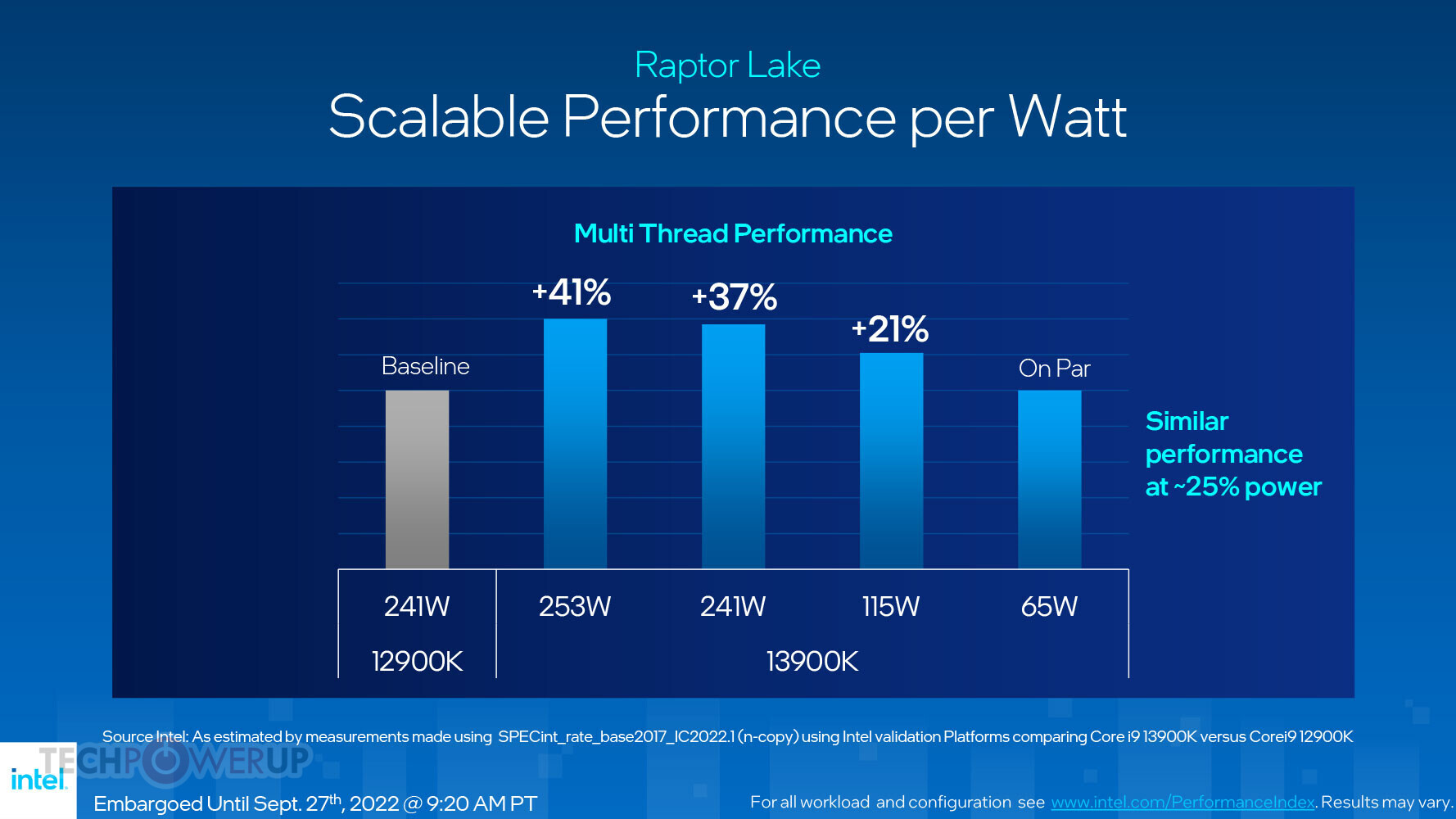
Intel today launched its 13th Gen Core "Raptor Lake" desktop processors, and companion 700-series motherboard chipset. These processors are built in the same LGA1700 package as the previous generation "Alder Lake," and are backwards-compatible with 600-series chipset motherboards through a BIOS update. Likewise, 700-series chipset motherboards support older "Alder Lake" processors. With the new 13th Gen Core, Intel is broadly promising an up to 15% uplift in single-threaded performance, which has a bigger bearing on gaming performance; and an up to 41% multi-threaded performance uplift; over the previous-generation, when comparing the top Core i9-13900K with its predecessor, the i9-12900K. Intel also claims to have outclassed the AMD Ryzen 9 5950X in multi-threaded performance, and the Ryzen 7 5800X3D in gaming performance.
Intel's performance claims are backed by some impressive hardware changes despite the company sticking with the same Intel 7 (10 nm Enhanced SuperFin) foundry node as "Alder Lake." To begin with, the single-thread performance uplift comes from the new "Raptor Cove" performance-core, which promises an IPC uplift over the previous-generation "Golden Cove," comes with more dedicated L2 cache of 2 MB per core (compared to 1.25 MB per core in the previous-generation); and significantly higher clock-speeds, going all the way up to 5.80 GHz. "Raptor Lake" has up to 8 P-cores, but the company has put in a lot of work in improving the contribution of E-cores to the processor's overall multi-threaded performance uplift. This is achieved by doubling the E-core count to 16. These are the same "Gracemont" E-cores as previous-generation, but Intel has doubled the L2 cache that's shared in a 4-core Gracemont cluster, from 2 MB per cluster to 4 MB. There are upgrades to even the hardware prefetchers of these cores.


 Intel didn't go into the nuts and bolts of what makes up the "Raptor Cove" P-core, but broadly explained that it comes with improved speed paths that enable an up to 600 MHz P-core boost frequency uplift at comparable power to the previous-gen "Golden Cove" while staying on the same process. The Intel 7 node also seems to have got some technological improvements, with the company referring to it as the "3rd generation" of this node (optical 10 nm). This mainly concerns better electrical characteristics from improved channel mobility. Cushioning the P-core with a larger 2 MB dedicated L2 cache also appears to be contributing to the iso-power uplift, as the core spends fewer cycles fetching data from the L3 cache. We will learn more about "Raptor Cove" in the coming days, and will hopefully have a more detailed look at the new core in our reviews of these processors.

 The E-core microarchitecture is the very same "Gracemont," but benefits from the node improvements to dial up E-core boost frequencies all the way up to 4.30 GHz. The cores also benefit from the larger 4 MB L2 cache that's shared among four E-cores in a "Gracemont" cluster. "Raptor Lake" has four such clusters, amounting to 16 on the silicon. The E-core clusters have access to the chip's L3 cache, just like the P-cores. As we mentioned earlier, the improved cache, and updated prefetcher algorithm should have an cumulative impact on E-core performance; and when you account for 16 of these, besides the improved 8 P-cores, you begin to see where Intel's 41% generational multi-threaded performance uplift claim is coming from.


 Intel also made updates to the processor's uncore components. The L3 cache that's shared among the processor's P-cores and E-core clusters, is now enlarged to 36 MB, from 30 MB in the previous generation. This cache is a continuously addressable block due to the Ringbus interconnect making ring-stops at various physical segments of the cache. Intel has improved the clock-speed of this fabric, which now boosts up to 5.00 GHz, or 900 MHz higher than the previous-gen.
The DDR5+DDR4 memory controllers also receive an update. The processor now natively supports up to DDR5-5600 JEDEC-standard memory speeds, when using 1 DIMM per 80-bit channel (which has two 40-bit sub-channels); or up to DDR5-4400 when using 2 DIMMs per channel (i.e. populating all four memory slots on your motherboard).
Intel also updated the Thread Director middleware that gives the software some degree of awareness of the Hybrid architecture, and attempts to ensure that the right kind of workload is allocated to the right kind of CPU core. Intel has given TD greater thread class awareness through machine-learning techniques (the processor learns over time what the nature of the workload could be). The processor also takes advantage of new scheduling features of Windows 11 22H2 Update, which introduce PID QoS for system background tasks and user-initiated background tasks.
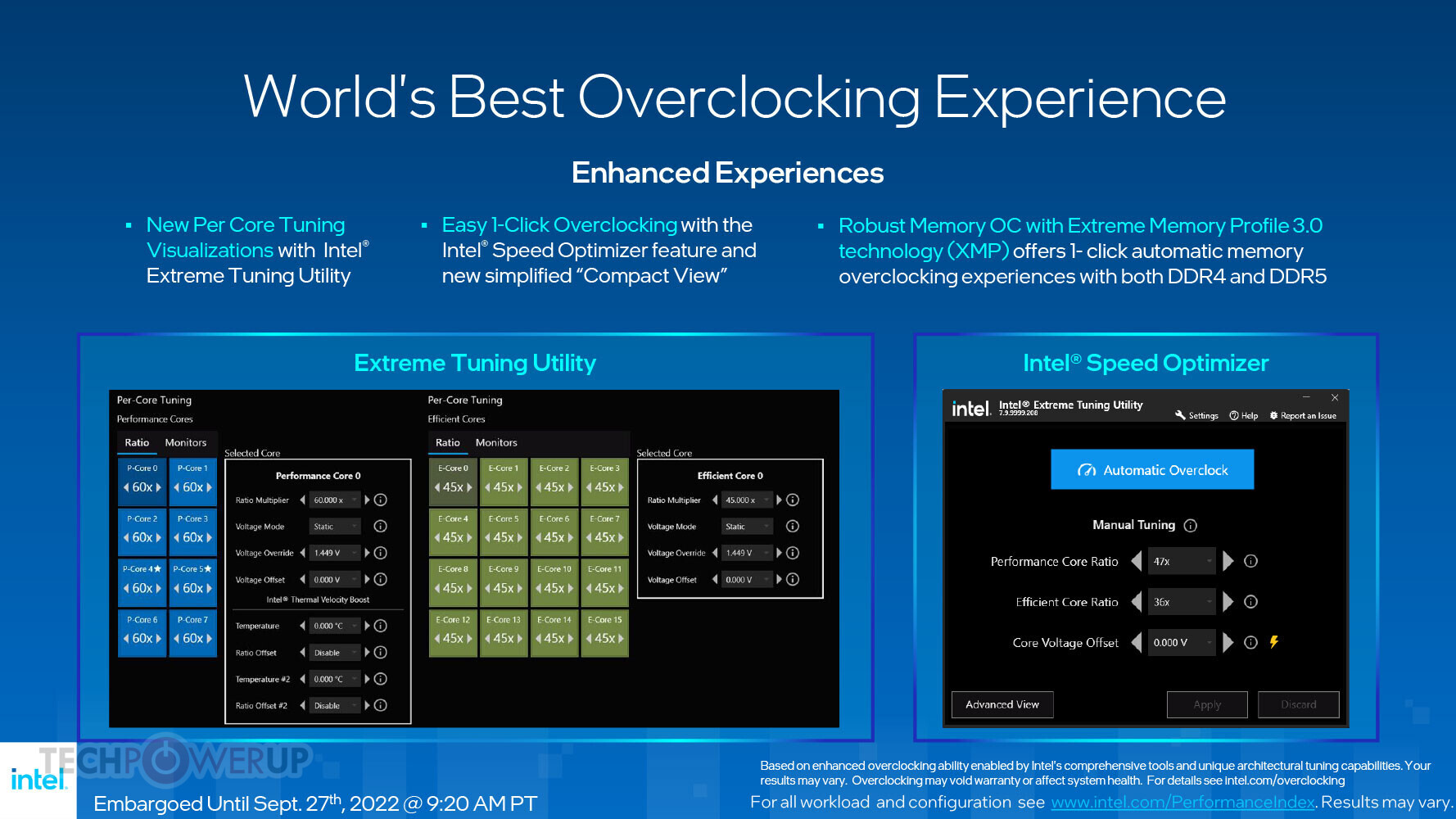
 Intel claims that "Raptor Lake" processors will be memory overclocking monsters, capable of speeds as high as DDR5-10000, when pushed to the limit with enthusiast-grade memory. For the P-cores, the company says that 8.00 GHz overclocks are now within reach for enthusiasts. The updated Intel Extreme Tuner Utility (XTU), allows you to set multipliers on a per-core basis, and tune your memory frequency on-the-fly (no reboots involved).
 Intel is launching the 13th Gen Core "Raptor Lake" desktop processor family with essentially three processor models—Core i9-13900K, Core i7-13700K, and Core i5-13600K; and their "KF" sub-variants that have disabled iGPUs, and are about $10-20 cheaper, depending on the model.
The Core i9-13900K is the flagship part, with 8 P-cores, and 16 E-cores (8P+16E), with the full 36 MB L3 cache available on the silicon. The P-cores have a base-frequency of 3.00 GHz, and boost up to 5.80 GHz; whereas the E-cores run at 2.20 GHz base, boosting up to 4.30 GHz. The processor base power is rated at 125 W, and the maximum turbo power at 253 W (up from 241 W for the i9-12900K). The i9-13900K comes with an MSRP of USD $589, while the i9-13900KF (which lacks the iGPU), is priced at $564.
The Core i7-13700K is an interesting SKU, as it has the same 8P+8E core-configuration as the previous-gen i9-12900K, but with all the new updates detailed above. Intel carved this SKU out by disabling two of the four E-core clusters on the "Raptor Lake" silicon, and reducing the L3 cache to 30 MB. The P-cores have a base frequency of 3.40 GHz, with a maximum boost frequency of 5.40 GHz; while the E-cores run at 2.50 GHz base, and 4.20 GHz maximum boost. These chips have the same 125 W PBP and 253 W MTP as the i9-13900K. The i7-13700K is priced at $409, and the i7-13700KF at $389.
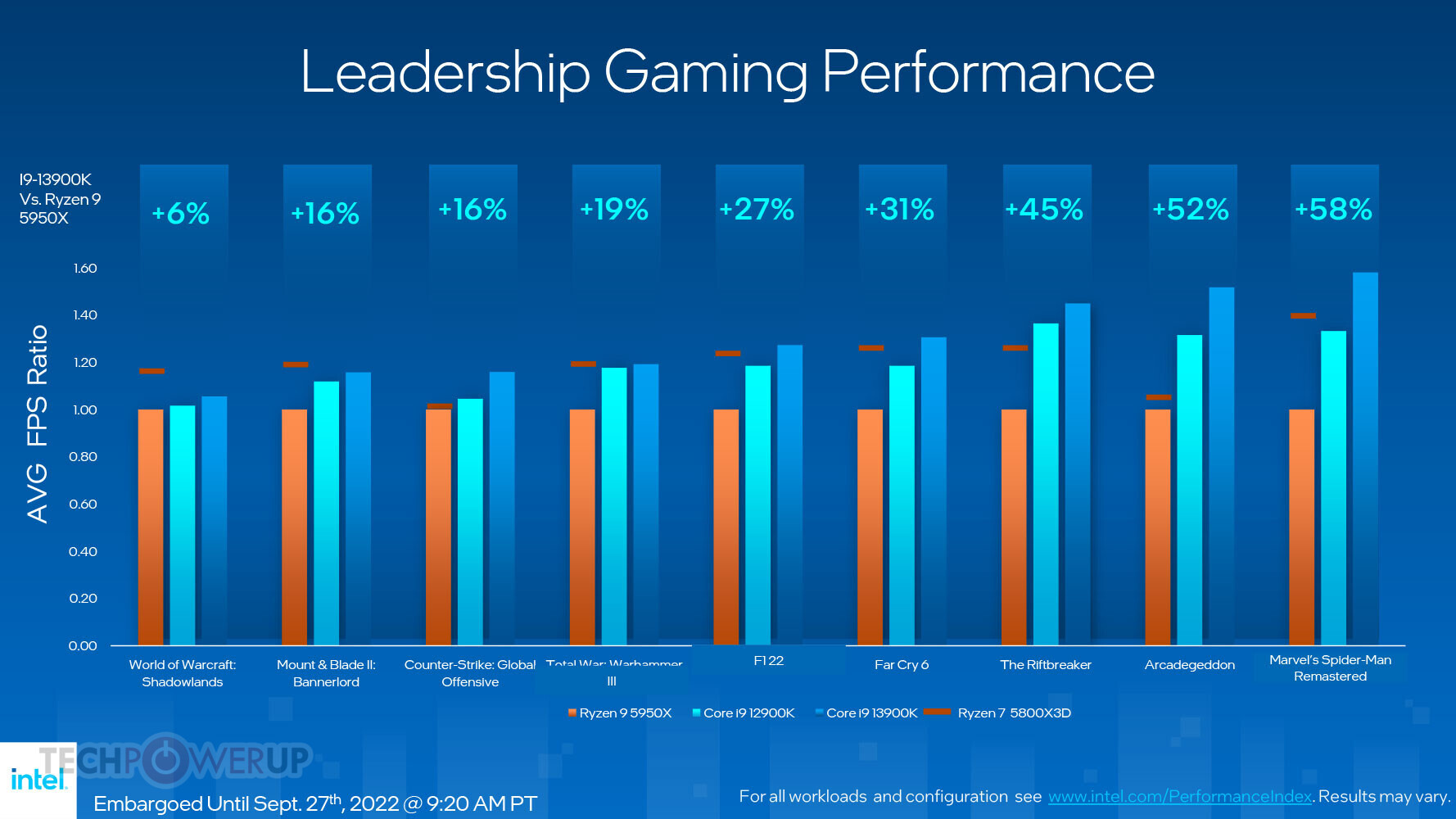
The Core i5-13600K is an equally interesting processor with which the company hopes to hold on to the mid-range. It now comes with a 6P+8E core-configuration, compared to 6P+4E of the i5-12600K. And of course, you get all the generational improvements detailed above. This SKU is carved out by disabling two P-cores, and two E-core clusters; while also cutting down the L3 cache to 24 MB (which is still higher than the 20 MB of the i5-12600K). The P-cores run at 3.50 GHz base with 5.10 GHz boost; while the E-cores do 2.60 GHz base, with 3.90 GHz boost. While the PBP value is the same 125 W as the higher SKUs, the MTP is reduced to 181 W. Intel is pricing the Core i5-13600K at $319, and the i5-13600KF at $294. Intel is claiming gaming performance uplifts of up to 18% when comparing the i9-13900K with the previous-gen i9-12900K, across a wide selection of games; while the comparison with the AMD Ryzen 9 5950X "Zen 3" sees gaming performance gains range between 6% to 58%. The gap only widens when you consider the 99th percentile low-water-mark analysis. Although mainly compared with the 5950X, Intel also threw in gaming performance values it tested on the Ryzen 7 5800X3D, which is shown matching the i9-13900K in games where it's beating the i9-12900K, or within 10% of it in games where the i9-13900K gets ahead. This is interesting, as Intel thinks the performance of "Zen 4" Ryzen 7000-series processors should roughly match that of the 5800X3D. In our performance reviews published on September 26, the 5800X3D is 4.5-5% behind the Ryzen 7 7700X, which means "Zen 4" should end up within 5% of the i9-13900K in gaming performance, should these numbers for the 5800X3D from Intel hold up.


 The platform I/O of these processors is identical to that of "Alder Lake." You get a 2-channel (4 sub-channel) DDR5 + 2-channel DDR4 memory interface. The processor puts out 28 PCI-Express lanes; 16 of these are Gen 5, and intended for the main x16 PEG slot; while the remaining are Gen 4. The main x4 NVMe interface of the processor is Gen 4, while the DMI chipset bus takes up the remaining 8 lanes (DMI 4.0 x8). You should still find motherboards with Gen 5 M.2 NVMe slots, but these would be eating into the x16 PEG bandwidth. Given that NVIDIA's latest GeForce Ada continues to be PCIe Gen 4, cutting into the bandwidth of the PEG slot to run Gen 5 M.2 SSDs could affect graphics performance (but we'll test this theory in upcoming PCIe-scaling articles with the RTX 4090).
The complete slide-deck for the processor launch event follows.


Intel's performance claims are backed by some impressive hardware changes despite the company sticking with the same Intel 7 (10 nm Enhanced SuperFin) foundry node as "Alder Lake." To begin with, the single-thread performance uplift comes from the new "Raptor Cove" performance-core, which promises an IPC uplift over the previous-generation "Golden Cove," comes with more dedicated L2 cache of 2 MB per core (compared to 1.25 MB per core in the previous-generation); and significantly higher clock-speeds, going all the way up to 5.80 GHz. "Raptor Lake" has up to 8 P-cores, but the company has put in a lot of work in improving the contribution of E-cores to the processor's overall multi-threaded performance uplift. This is achieved by doubling the E-core count to 16. These are the same "Gracemont" E-cores as previous-generation, but Intel has doubled the L2 cache that's shared in a 4-core Gracemont cluster, from 2 MB per cluster to 4 MB. There are upgrades to even the hardware prefetchers of these cores.


The DDR5+DDR4 memory controllers also receive an update. The processor now natively supports up to DDR5-5600 JEDEC-standard memory speeds, when using 1 DIMM per 80-bit channel (which has two 40-bit sub-channels); or up to DDR5-4400 when using 2 DIMMs per channel (i.e. populating all four memory slots on your motherboard).
Intel also updated the Thread Director middleware that gives the software some degree of awareness of the Hybrid architecture, and attempts to ensure that the right kind of workload is allocated to the right kind of CPU core. Intel has given TD greater thread class awareness through machine-learning techniques (the processor learns over time what the nature of the workload could be). The processor also takes advantage of new scheduling features of Windows 11 22H2 Update, which introduce PID QoS for system background tasks and user-initiated background tasks.


The Core i9-13900K is the flagship part, with 8 P-cores, and 16 E-cores (8P+16E), with the full 36 MB L3 cache available on the silicon. The P-cores have a base-frequency of 3.00 GHz, and boost up to 5.80 GHz; whereas the E-cores run at 2.20 GHz base, boosting up to 4.30 GHz. The processor base power is rated at 125 W, and the maximum turbo power at 253 W (up from 241 W for the i9-12900K). The i9-13900K comes with an MSRP of USD $589, while the i9-13900KF (which lacks the iGPU), is priced at $564.
The Core i7-13700K is an interesting SKU, as it has the same 8P+8E core-configuration as the previous-gen i9-12900K, but with all the new updates detailed above. Intel carved this SKU out by disabling two of the four E-core clusters on the "Raptor Lake" silicon, and reducing the L3 cache to 30 MB. The P-cores have a base frequency of 3.40 GHz, with a maximum boost frequency of 5.40 GHz; while the E-cores run at 2.50 GHz base, and 4.20 GHz maximum boost. These chips have the same 125 W PBP and 253 W MTP as the i9-13900K. The i7-13700K is priced at $409, and the i7-13700KF at $389.
The Core i5-13600K is an equally interesting processor with which the company hopes to hold on to the mid-range. It now comes with a 6P+8E core-configuration, compared to 6P+4E of the i5-12600K. And of course, you get all the generational improvements detailed above. This SKU is carved out by disabling two P-cores, and two E-core clusters; while also cutting down the L3 cache to 24 MB (which is still higher than the 20 MB of the i5-12600K). The P-cores run at 3.50 GHz base with 5.10 GHz boost; while the E-cores do 2.60 GHz base, with 3.90 GHz boost. While the PBP value is the same 125 W as the higher SKUs, the MTP is reduced to 181 W. Intel is pricing the Core i5-13600K at $319, and the i5-13600KF at $294.


The complete slide-deck for the processor launch event follows.






224 Comments on Intel 13th Gen Core "Raptor Lake" Desktop Processors Launched: +15% ST, +41% MT Uplift
Of course, if you're a reasonably average user, just set your CPU to Eco mode and you'll get much lower power draw (and heat, unless you also scale back cooling) for a minimal performance loss.We'll see. I don't think Intel's 15% ST gains will hold up in gaming, so the main question is whether it'll be noticeably faster or just another entry in the "yep, this is more than fast enough for anybody" club. And it'll be interesting to see how AMD responds to Intel's 13th gen pricing, of course.
I mean, I've actually seen pictures of motherboards where the thermal pads on the VRMs melted, stuff like that. But then, in the real world, most people's PCs are idle 90%++ of the time so they are not really in danger of that. Extreme performance users, might want to pick their motherboard carefully. Overall, I doubt this will be an issue. I could be wrong, again it's more a question of the motherboard makers testing their wares.
VRM cooling will be more important with this generation, but that's due to higher power draws and more load on VRMs, not due to 95-degree CPUs. A 170W CPU dumps more heat into the socket and motherboard than a 105W CPU, yes, but it does so pretty much regardless if it's running at 95, 60 or 35. It's the amount of thermal energy released that matters, not the absolute temperature of the CPU core, which is a product of heat output and the specific thermal transfer characteristics of surrounding materials.
I would like if this would force (incentivize) AMD to lower their prices, since I kind of like the new CPUs but they, as well as the whole platform are REALLY expensive, based on the first 2 days of it's release.
I've just checked Geizhals (gh.de) and price of 7950x dropped about 40 - 45 euros, so not too shabby. Still expensive though.
On the other hand, I have checked the AM5 boards, and the cheapest one grew 50 or so euros from yesterday. :laugh:
I think we are too early to tell and that it would be wise to wait for at least a month after Raptor Lake is released before making any purchases.
I would like a new platform after all, but I don't have the itch.
If I must use a good AIO at least (that`s basicly AMD recomandation) and that AIO will be 100% fan for every >5sec load than we have a problem, espacialy when intel top cpus can still stay under 95 (or 195..) with proper fan cooling and with a lowere overal noise for the same or higher wattage consumption\workload.
So if I must use a louder and more expensive cooler for the same level of performance than AMD`s "95 is the new 65" design choice is a design flaw.
Same deal with motherboards. Also as you say, very expensive, the *least* expensive AM5 is $260 - and that is an ASRock PG Lightning 14 phase VRM board. Move up just a tad to the Steel Legend, which has an "ok" reputation, and it's $299. The Z690 version of that board is $209. Maybe ASRock did better this time, but their low and midrange board VRM designs were total garbage on Alder Lake. The board next up is $470.
I think this might be more of a macro-economic thing than having anything to do with performance. If there is still a bunch of supply after this weekend, the whole PC / electronics space might be in trouble. I still don't know a single person who bought an iPhone 14, for example.
AMD users - esp those who would buy an 'X' performance chip -haven't had a new chip in 2 years. There are a ton of people here still on Zen 2, Gen 9 and earlier, and like me Gen 10. These type of users tend to upgrade frequently. I do about every 2-3 years.
I think a lot of this has to do with high inflation, and currency exchange rates. High GPU prices may also be affecting these decisions, after all for a gamer what good does it do to say upgrade from a 3900X or 9900K when you've got a 2070 Super. Quick calculation shows that's probably a $1500++ upgrade to see a difference. $400 7700X + $300 (questionable ASRock) motherboard + $250 RAM + $700 GPU? That's $1650 + Tax, in the US.
Intel had release a note previously - then they went on fixing those issues one by one.
I agree its a bad time to buy PC considering inflation,delivery issues and some manufacturers still try to ride mining time prices and now it looks like we are heading into recession plus current energy prices may lead to less people willing to pay such high prices so i belive that after few months manufacturers gonna fix prices in order to sell enough products
Unfortunately people are still buying even when more expensive...
www.pcgamer.com/intels-core-i5-13400-is-shaping-up-to-be-a-killer-budget-gaming-chip/
Don't know about everyone else.... i'm still excited how things shape up towards the end of the year. The Intel/AMD price war will be interesting
Edit: I'm wrong, it's 34 Raptor Cove cores.
Like @Valantar said though, there isn't really a market there.
Or perhaps I should say it's there but not what most people think it is.
Intel makes Xeon's (Ice Lake-SP and Cascade Lake based) in workstation guise for those who need massive IO. You can build your own too, see socket 4189 CPUs and motherboards from newegg for the latest and greatest. And ofc AMD does threadripper. Compute is not the big thing in that space though, it's all about the IO.
The cause for these temps is because AMD, much like what happens on all mobile SOCs, decided to boost the frequency (power and temperature) all the way to 95 degrees to achieve higher frequencies, so better cooling like an AIO don't decrease temps much, but instead produce higher clocks. This is the case since Ryzen 5000.
It is automated overclocking. It will use more power, generating more heat, in order to reach higher clocks, like your iPhone or Galaxy phones do.
There are a multitude of ways of limiting or disabling that. Some people just decrease PPT and other metrics in the BIOS, decreasing heat and power usage by like 40% while losing ~5% in performance. Or you can just disable boosting.
Again, these chips come literarily overclocked and not efficiently tuned, like most recent nVidia GPUs. You also don't need to have your fans at 100% at 95 degrees, since apart from CineBench, you'll never see these temps constantly during gaming, the most you'll see is 85 degree peaks and 70-75 on average.
Here I had a D15 and now an Arctic 280mm, and in both cases I set 80% fans at 95 degrees and a very slow ramp up of 6% per second (using Fan Control), resulting in a very quiet system that does not have constant ramp ups and downs. Still managed to achieve 16k on Cinebench on my 5.05 GHz 5800X.